The Top 10 Growing Domestic Brands in China: Chart

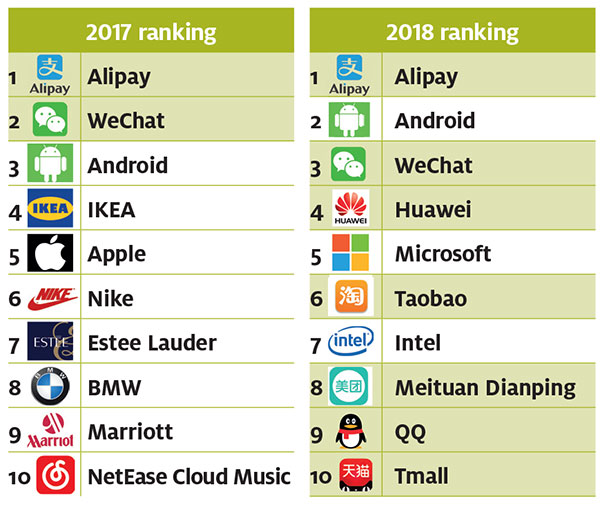
The economy of China is increasingly becoming a domestic consumption oriented economy form an export-driven economy. As a result, consumption is booming and Chinese firms are focusing more on the local market than the overseas markets. By producing goods that most people can afford they are also taking market share from foreign multi-national firms. Hence Western companies are losing their market share and are no longer the preferred brand of Chinese consumers.

The following chart shows the change in the top 10 brands in China in 2018 relative to 2017:

Click to enlarge
Source: China’s dominance is about more than demographics, Money Observer

The implication of this shift among Chinese consumers is huge for foreign firms with substantial investments in the country. They can longer take Chinese consumers fro granted and have to work harder to compete and gain their businesses.
How Much Dividends Contribute to S&P 500’s Total Return

The importance of dividends to a well-diversified portfolio cannot be understated. In fact, dividends account for a significant portion of the overall total return of the S&P over the long term. Though the current yield on the S&P is around 2%, the power of compounding and divided growth over time leads to a higher contribution to the total return.

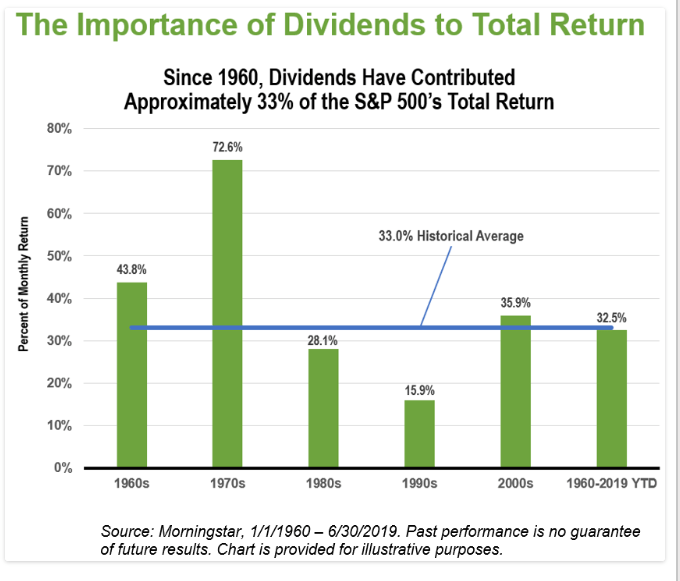
According to an article at S&P by Kieran Kirwan dividends accounted for 33% of the total return of S&P 500 since 1960 as shown in the chart below:

Click to enlarge

Source: The Rising Importance of Dividends When Earnings Slow, S&P

The contribution of dividends to total return varies over different periods. For instance, during the 1970s dividends amounted to nearly 73% of the total return but during the dot com era of the 1990s it declined to 16%.

Key Takeaway:

Investors should not ignore dividends even if they are low such as the current 2% or so. Unlike price appreciation, dividends are usually stable and predictable for well established firms and many of them also increase dividend payments year after year. So investors can identify and own some of these dividend paying and dividend growing leaders.

You may also like:

Related ETF:

  • SPDR S&P 500 ETF Trust (SPY)
  •  iShares Select Dividend ETF (DVY)
  • Vanguard High Dividend Yield ETF (VYM)
  • Vanguard Dividend Appreciation ETF (VIG)

Disclosure: No Positions

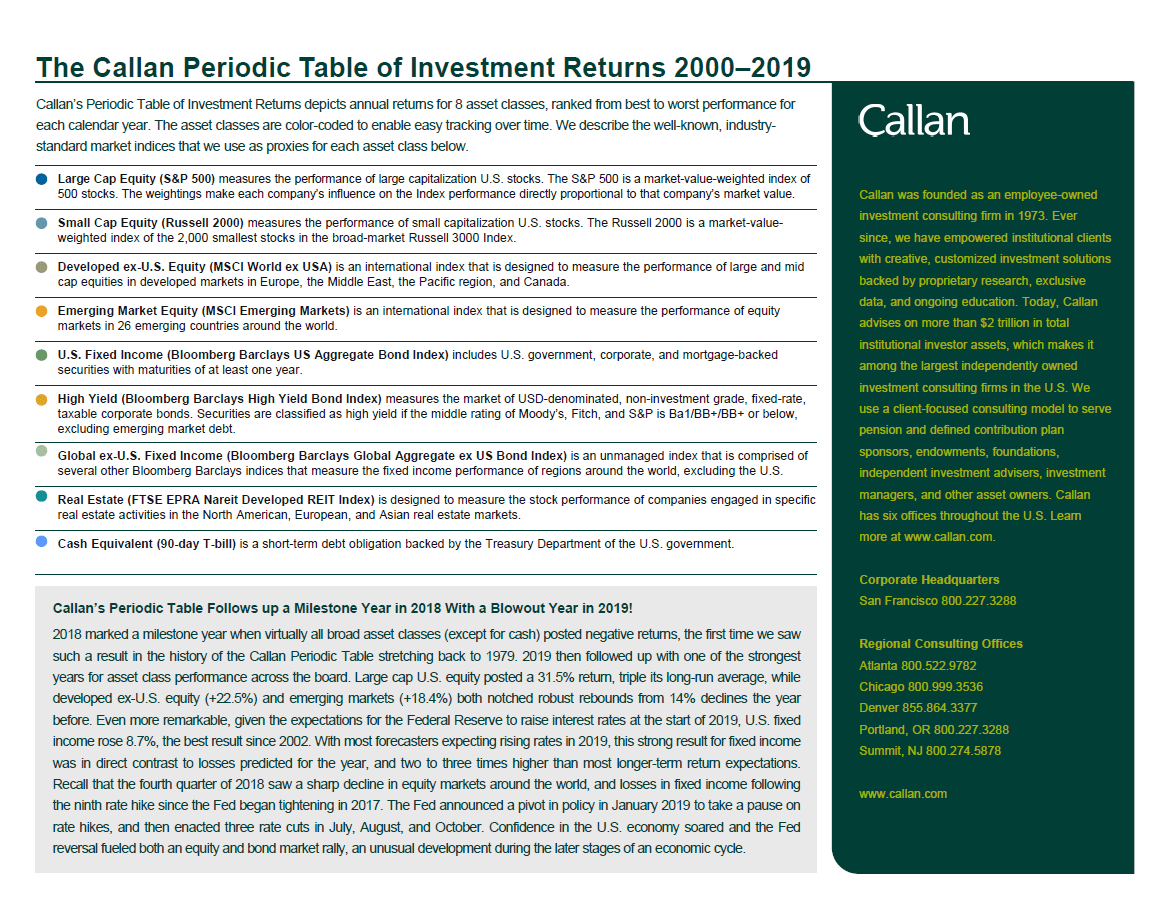
The Callan Periodic Table of Investment Returns From 2000 to 2019: Chart

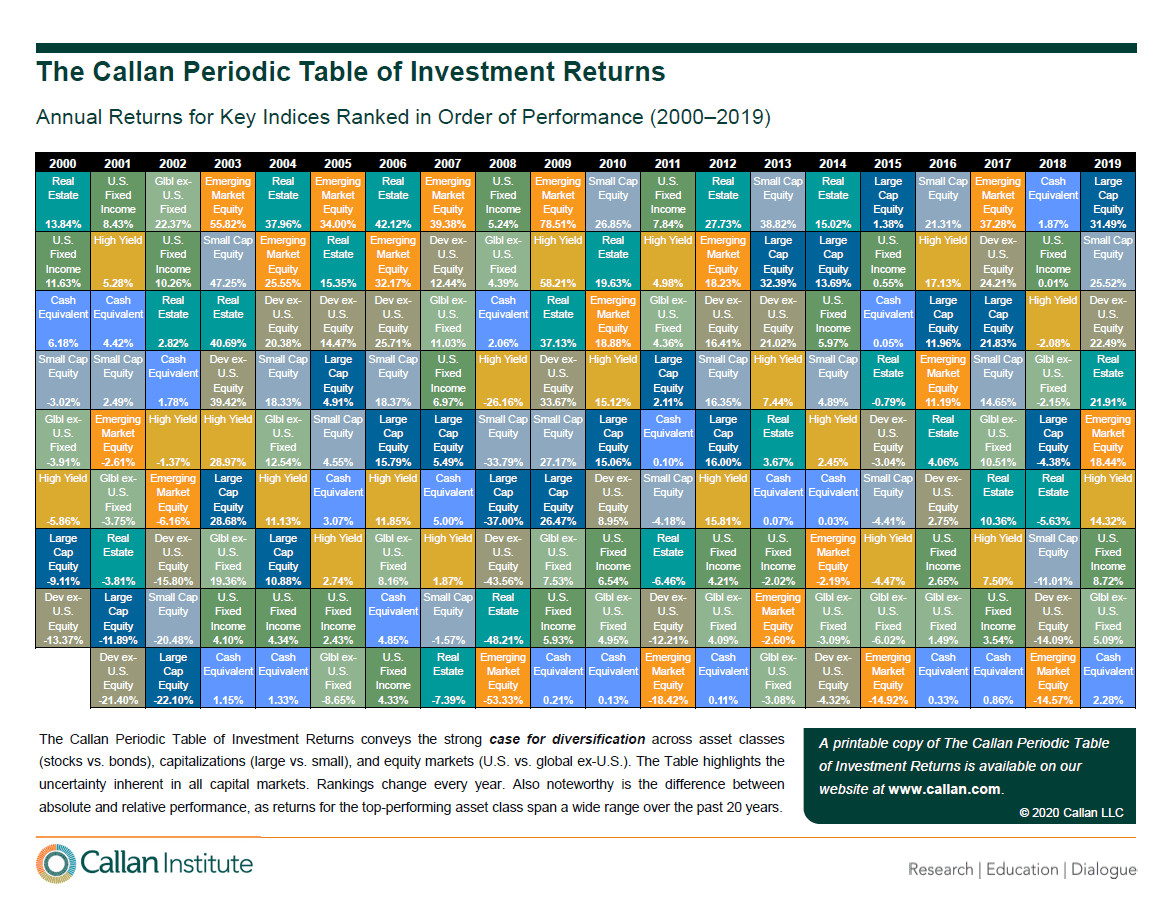
Callan has updated their popular “The Periodic Table of Investment Returns” with 2019 data. This chart shows the importance for diversification. For instance, U.S. large caps were the top performers in 2019 with a return of over 31%. Emerging markets which used to be hot a few years ago did not have such a great year. Emerging market equities earned just over 18% relative to the spectacular performance of American stocks. It should be noted however Russia was one of the top markets last year. However overall as a group emerging markets simply well underperformed US markets.

Other developed markets also earned lower returns than the US with the Developed excluding the US growing over 22%.

The Callan Periodic Table of Investment Returns From 2000 to 2019:

Click to enlarge

Source:  Callan LLC

Download:

Key Takeaway:

The importance and benefits of diversification cannot be understated. As the chart above shows, an investor overweight in emerging equities would have missed the substantial growth of US equities. Since it is impossible to predict which market and sector will outperform in any given year, the wise move is to allocate one’s assets across a wide range of sectors, countries and asset classes.

Past Callan Charts:

Related ETFs:

  • iShares Dow Jones Select Dividend ETF (DVY)
  • SPDR S&P Dividend ETF (SDY)
  • Vanguard Dividend Appreciation ETF (VIG)
  • SPDR S&P 400 Mid Cap Growth ETF (MDYG)
  • iShares Russell Midcap Index Fund (IWR)
  • iShares MSCI Emerging Markets Indx (EEM)
  • SPDR S&P 500 ETF (SPY)
  • Vanguard MSCI Emerging Markets ETF (VWO)
  • SPDR S&P 500 ETF (SPY)
  • SPDR KBW Bank ETF (KBE)
  • SPDR KBW Regional Banking ETF (KRE)
  • SPDR S&P 500 ETF (SPY)
  • Vanguard Dividend Appreciation ETF (VIG)
  • SPDR S&P Dividend ETF (SDY)
  • SPDR STOXX Europe 50 ETF (FEU)

Disclosure: No Positions

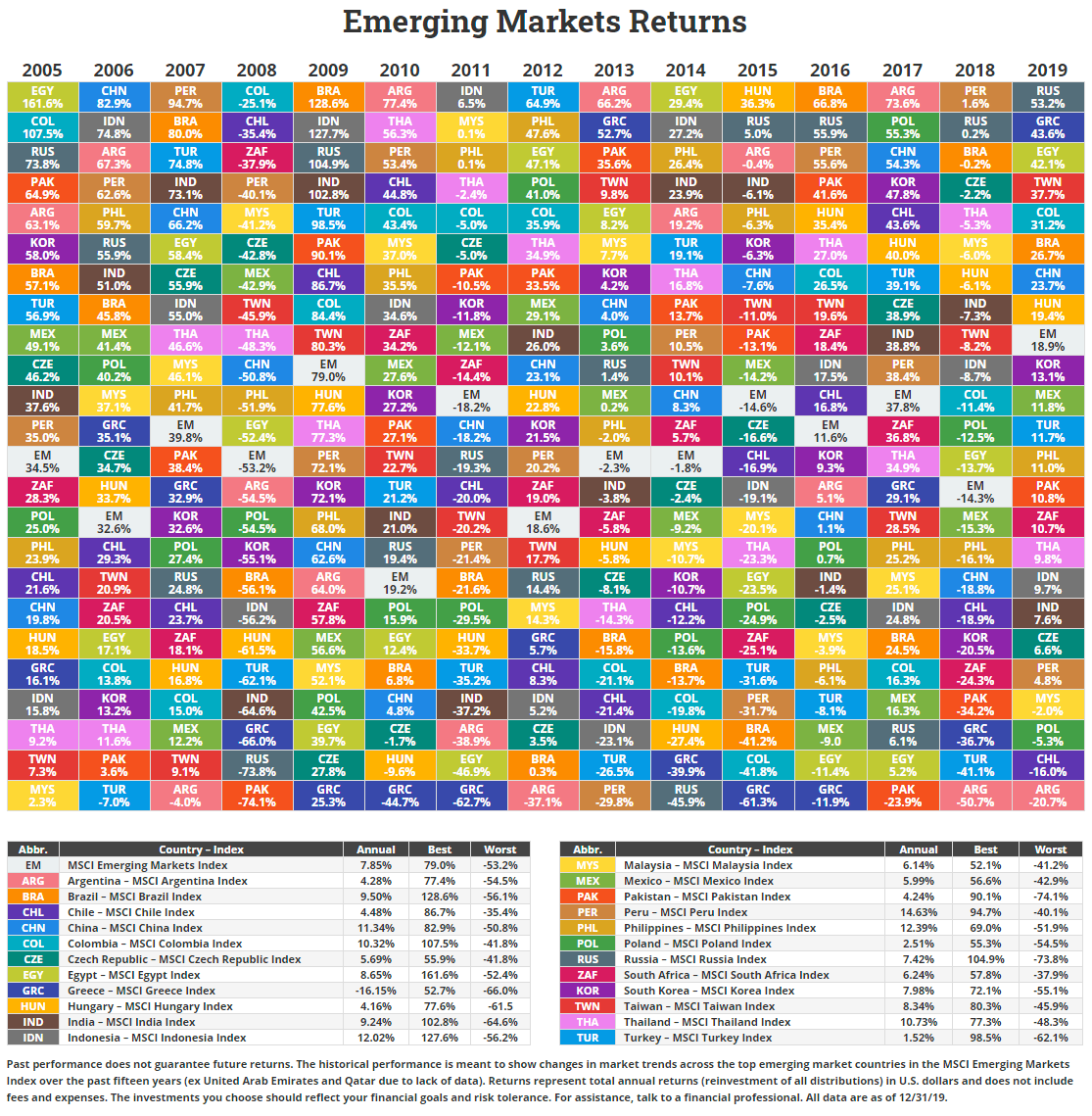
Emerging Markets Returns 2005 Thru 2019: Chart

Emerging market equity returns vary wildly from one country to another. In addition, similar to developed markets, no country is the top performer in consecutive years. One year’s best performer can turn into next year’s worst performer. Novel Investor recently updated his returns chart for emerging markets. The following chart shows the equity returns of single country MSCI indices for emerging markets from 2005 thru 2019:

Click to enlarge

Credit: Novel Investor

Russia was the best performing market in 2019. In 2008, during the global financial crisis it was most negative return at nearly 74%. Last year the situation was reversed with Russia gaining over 53%. While Greece went into tailspin a few years ago in 2019 it was the second highest returning emerging market.

The colorful above chart also shows the importance of diversification. Within emerging markets, it is always wiser to distribute one’s assets across countries to reduce risk and increase potential gains.

Related ETFs:

  • Market Vectors Russia ETF (RSX)
  • iShares MSCI Mexico Capped Investable Market (EWW)
  • iShares FTSE/Xinhua China 25 Index (FXI)
  • The iShares MSCI India ETF  (INDA)
  • iShares MSCI Brazil Index (EWZ)
  • iShares MSCI All Peru Capped Index (EPU)
  • Global X FTSE Colombia 20 ETF (GXG)

Disclosure: No Positions

Latest Dividend Yields by Country: Chart

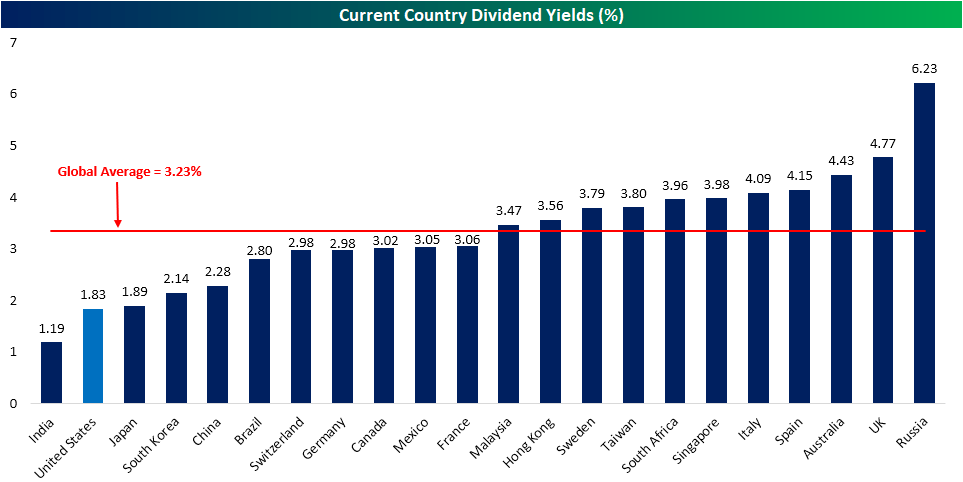
Dividend yields of equity markets vary across countries significantly. The following chart shows the latest dividend yields for select countries as of December, 2019.

Russia has the highest dividend yield in the world at 6.23% while India has the lowest rate at just 1.19%. Many of key companies in Russia such as those in oil and gas, banking industries are owned by the state and the state encourages them to payout a high portion of their profits as dividends, India is traditionally not known for its dividend culture. Global investors primarily invest there for growth. Among emerging countries, Brazil is also not a big dividend payer. Countries such as Malaysia, Colombia and Chile offer much higher yields than India and others. So those countries are better for income investors.

Among the developed countries, the US has the lowest yield at 1.83%. The yield on the S&P 500 has stayed under 2% for many years if not decades. This is because US firms invest most of their retained earnings in R&D, capital expenditures and others that are geared towards growing the company. Very few firms are interested in sharing most of the profits with shareholders in the form of dividends. Even if they want to payout more than the average yields they prefer stock buybacks as opposed to cash dividends. This is due to a major quirk in the Federal tax  code in that taxes on dividends are charged at the ordinary income tax rates which is high while the tax on capital gains is low. So some if not all investors also are content with this strategy followed by American companies.

Australia is known as one of the top countries for dividends. Dividends are high there due to the concept of franking. Moreover Aussie firms do not have much opportunity for growth and historically have preferred to share the wealth with equity holders in cash dividends.

Click to enlarge

Source: Bespoke

Below are few examples showing the big difference in dividend yields between firms in different countries:

1) US & UK – Utility Sector:
Company: National Grid PLC (NGG)
Current Dividend Yield: 4.97%
Country: UK

Company: Consolidated Edison Inc. (ED)
Current Dividend Yield: 3.34%
Country: US

2)US & Australia – Banking:
Company: Wells Fargo & Company (WFC)
Current Dividend Yield: 2.68%
Country: US

Company: Westpac Banking Corp (WBK)
Current Dividend Yield: 7.11%
Country: Australia

3)India & Chile – Banking:
Company: HDFC Bank Ltd (HDB)
Current Dividend Yield: 0.70%
Country: India

Company: Banco Santander-Chile (BSAC)
Current Dividend Yield: 4.82%
Country: Chile

Note: Dividend yields noted above are as of Jan 3, 2020. Data is known to be accurate from sources used.Please use your own due diligence before making any investment decisions.

Key Takeaway: Country selection is key when looking to invest in foreign countries for income. This is especially important in emerging countries. Non-US developed countries are better for income investors although the net yields received could be lower due to dividend withholding taxes, foreign exchange rate fluctuations and other factors.

Disclosure: Long WBK