Review: Canadian Banks and Select ETFs Performance using Charts

In this post lets take to a look at the performance of the five large Canadian bank stocks and a select few ETFs using charts. This does not involve a deep technical analysis but just a simple review of these charts and making some observations.

1.Performance of five Canadian banks over the past 2 years:
TD Bank(TD) and Royal Bank(RY) have been much better performers than the other three banks. Royal Bank is the most profitable bank in Canada.Hence it is not surprising to see Royal Bank leading the pack together with TD. Though TD has exposure to the US markets thru a Bank North acquisition and the brokerage operation TD Ameritrade, still TD Bank has weathered the current storm better than others.CIBC (CM) reported a huge loss last year due to their exposure to sub-prime assets. Hence CM is lagging the pack.

Related Article:

“NEW YORK — Royal Bank of Canada is seeking to cash in south of the border on Canada’s new cachet as the soundest financial system in the world.

The bank, which has about 450 RBC Bank branches in the southern United States as well as wealth management and investment banking services, launched an advertising campaign a few weeks ago that, for the first time, clearly plays up its Canadian ties.” Canadian banks cash in on new cachet

2. Comparison of iShares MSCI Canada ETF Vs. iShares MSCI Australia ETF:
The Canadian ETF (EWC) is well ahead of the Australian ETF(EWA). This comparison is interesting since these two countries share similar features such as developed western-style democracy, commodity-based economy, blessed with plenty of natural resources, etc. However from the performance above, one can infer that Australian banks and commodity producers were hurt much more than their Canadian peers since Australia is much closer to many Asian emerging markets like China,India, Malaysia, etc. and those countries have been hurt much more than the trading partners of Canada. It must be noted here that the largest trading partner of Canada is the US.

3. Comparison of iShares MSCI Malaysia ETF Vs. iShares MSCI Singapore ETF:
The ishares ETF for Malaysia (EWM) is doing better than the ETF for Singapore(EWS). This could be due to the fact that Singapore’s economy is affected more adversely by the global economy than the Malaysian economy. Besides cargo shipping has fallen heavily since the recession.This has been a major drag for the Singapore economy since the port is a major hub between Asia and the developed world.

4. Comparison of iShares MSCI Chile ETF Vs. iShares MSCI Brazil ETF:
The ETF for Chile is performing better than the ETF for Brazil.The Chilean economy was more resilient to the global economic events than the Brazilian economy.

5. Comparison of iShares S&P; Global Utilities ETF (JXI) Vs. iShares S&P; Global Financials (IXG) ETF:
The above chart shows the difference in the performance of global financials and utilities. While the financial ETF fell as much as 80%, utilities held up relatively well.Hence slow growing but high yielding utilities must be an integral part of a diversified portfolio.


Knowledge is Power: Bill Gross Investment Outlook Edition

1.Job seekers are flocking to the once have-not province, now enjoying its bright time in the sun.Ontarians head west to ‘Saskaboom’

2. Monitor of bailout plan wants executives from Citigroup and AIG to be axed in damning report.American watchdog calls for sacking of financial bosses

3.The G-20 has agreed on plans to fight the global downturn. But its approach will only lay the foundation for the next, bigger crisis. Instead of “stability, growth, jobs,” the summit’s real slogan should have been “debt, unemployment, inflation.”The West’s Fatal Overdose

4. If you got stoned, you may have missed it, along with some of the best investment opportunities seen in the past 60 years.What’s happened to “Great Depression II?”

5.Leonard Melman, a leading authority in the metals and mining arenas, sees opportunity for some “really good moves” and “fabulous returns” on the horizon, and considers the price of the base metals as a real key to the future of the economy. On the other hand, he shares some serious concerns about the economy. Interview with The Gold Report.Gold behaving beautifully” and good reason for optimism in base metals – Leonard Melman

6. Record numbers of individuals and companies are predicted to go bankrupt this year.Bankrupt Britain: 340 people bust every day

7.The title of this Outlook, “The Future of Investing,” is a theme that will take the evolving years to resolve, let alone the next few days. Still, PIMCO is an organization that loves a challenge. All of us here today would agree that the answer to both questions will be highly dependent on the evolution of the global economy, and when it comes to those questions PIMCO has excelled because of its long-term secular outlook. It has paid dividends for our clients for over 30 years and it should do so now as well. The Future of Investing: Evolution or Revolution?

Photo: Smuggler’s Cove Tortola, British Virgin Islands

Smugglers Cove

International Capital Gains Tax Rate Comparison: Where Does The US Stand?

The Capital Gains Tax Rate in USA is unfavorable for economic growth when compared with other major economies in the world, as per a report published by the American Council for Capital Formation (ACCF), based in Washington,DC. More specifically the study was based on the long-term capital gains tax rates for individuals. More than half of the countries in the study have lower capital gains tax rates lower than that of the United States.

Chart – International Individual Long-Term(LT) Capital Gains Tax Rate Comparison


US Capital Gains Tax Rate

Update 4/24/11: The German rate is 25% and not 0% as shown in the chart above. There is also no difference between short-term and long-term capital gains according to a reader.

The above chart shows that the LT capital tax rate is 0% in many developing countries such as India, Indonesia, Thailand and Malaysia. This is understandable since many of these emerging countries want to encourage capital investment by individuals for growth.Besides these Asian countries have historically been a country of high savers relative to the developed world.This is another reason why the LT individual capital gains tax is kept at 0%.

However what is fascinating is that some developed countries such as Belgium, Germany,  Singapore, The Netherlands, Hong Kong and Taiwan also have 0% tax rates. One would think that the socialist European countries of Germany, The Netherlands and Belgium would have high capital tax rates even for individuals.It is unclear if countries such as Singapore, Hong Kong and Taiwan have 0% tax rates since they are export-driven economies and also they are all Asian countries where historically consumers saved more than invest in capital gain producing assets.

Japan, Canada and Italy are marginally better in terms of LT individual tax rates. The US rate at 15% is higher than the emerging markets mentioned above and also slightly above Canada which is again a highly socialist country. The US rate is equivalent to the Brazil tax rate. Brazil has a different approach to the capital tax structure than other emerging countries. The UK, with one of the high tax rate system in the world, has a LT individual capital gains tax of just 18% which is 3% higher than the US rate.

According to the ACCF report, the last time major reduction was made in this tax was in 1978 initiated by the late Congressman Bill Steige. Many folks today believe that” the 78 cut in capital gains tax rates not only helped make Silicon Valley the center of technological breakthroughs but has also had a strong, positive, and lasting impact on overall investment, economic growth and job creation in the U.S.” The cuts in capital tax rates in 2003 under President George Bush also helped the US economy maintain strong growth up until the credit crunch began early 2008.

President Obama’s has proposed some positive changes to the current capital gains tax structure. His Comprehensive Tax Plan states:

Eliminating Capital Gains Taxes for Entrepreneurs and Investors in Small Business. Barack Obama understands that small businesses are the engines of our economy, and he will eliminate all capital gains taxes on investments in small and start up firms.

Capital Gains: Families with incomes below $250,000 will continue to pay the capital gains rates that they pay today. For those in the top two income tax brackets’ likewise adjusted to affect only families over $250,000 Obama will create a new top capital gains rate of 20 percent. Obama’s 20% rate is equal is the lowest rate that existed in the 1990s and the rate that President Bush proposed in 2001. It is almost a third lower than the rate that President Reagan signed into law in 1986.

Dividends: The top dividends rate for people making over $250,000 would be set at 20 percent.Dividends will not return to being taxed at ordinary income tax rates. Obama’s 20 percent rate on dividends will be 39 percent lower than the rate President Bush proposed in 2001, and would be lower than all but 5 of the last 92 years we have been taxing dividends.  (emphasis added)

Source: http://www.barackobama.com

While the Obama Plan encourages entrepreneurship by eliminating the capital gains tax, raising the tax rate to 20% for high income earners over $250K may not be conducive for the economy. In fact, the ACCF calls for the continuation of the current 15% to maintain the competitive edge of our economy over other countries countries. In my view, since the current administration is doling out billions to failed financial institutions to keep them alive, it will be a low-cost, simple but effective strategy to not increase the current capital gain tax rates.

Countries such as Sweden and Denmark have very high tax rates at 30% and 45% since the Scandinavian countries are the most socialist countries in the world and follow a unique form of political system. The Scandinavian countries tax their citizens such high rates in order to provide liberal social benefits such as unemployment, medical, maternity leave, pension benefits etc. They also aim for full employment with the government being the employer of last resort.

To download the full ACCF report, click here.

Update:

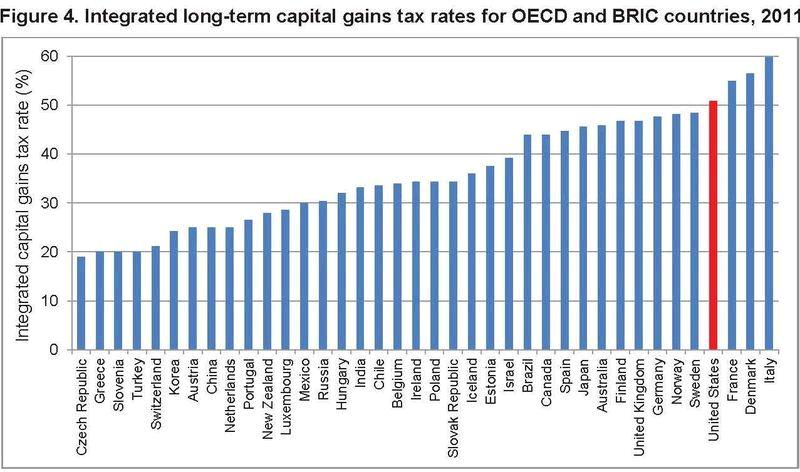
Click to enlarge

International Capital Gains Tax Rate Comparison 2011

Via The Overwhelming Case against Capital Gains Taxation, Dan Mitchell

Also checkout:

Related Links:

  1. Withholding Taxes for Foreign Stock Dividend Payments
  2. Is the U.S. Corporate Tax System A Major Barrier to Economic Growth
  3. Withholding Tax Rates by Country for Foreign Stock Dividends
  4. Impact of Tax Rate Changes on Capital Gains Realizations
  5. Chart: Capital Gains Tax Rate Since 1929 (TFS)
  6. Dividend Tax Rate and Long-Term Capital Gains Tax Rate: U.S vs.Other Countries (TFS)
  7. U.S. Dividends and Capital Gains Tax Rate Since 1961 (TFS)
  8. Impact of Tax Rate Changes on Capital Gains Realizations (TFS)

Top Internet Banks of the World in 2008

The following are the Top Internet Banks for 2008 as announced by the Global Finance magazine.

ASIA – Best Internet Banks 2008  for Consumers:
Australia – HSBC
Brunei – HSBC
China – ICBC
Hong Kong – HSBC
India – ICICI Bank
Indonesia – Citi
Japan – HSBC
Kyrgyz Republic – AsiaUniversalBank
Malaysia – Citi
Pakistan – Citi
Philippines – Citi
Singapore – DBS Bank
South Korea – Citi
Sri Lanka – HSBC
Taiwan – Chinatrust Commercial Bank
Thailand – Citi

LATIN AMERICA – Best Internet Banks in 2008  for Consumers:
Argentina – Santander Rio
Brazil – HSBC
Chile – Banco Santander
Colombia – Bancolombia
Mexico – Banamex
Peru – BBVA Banco Continental
Puerto Rico – Banco Popular de Puerto Rico
Venezuela – Banco Mercantil

MIDDLE EAST and AFRICA – Best Internet Banks in 2008  for Consumers:
Bahrain – Citi
Egypt – HSBC
Lebanon – Blom Bank
Qatar – Qatar National Bank
Saudi Arabia – Samba Financial Group
United Arab Emirates – HSBC

NORTH AMERICA – Best Internet Banks in 2008  for Consumers:
Canada – CIBC
United States – Bank of America

Source: Global Finance

First Quarter Markets Performance Review of Individual Countries

Emerging markets are the top performers in the first quarter this year. The five best performing five indices are:

1.China – Shanghai A Shares Index Up 32.85%

2.Peru – INDICE SELECTIVO PERU-15 Up 32.79%

3.Venezuela – Caracas General Index Up 25.23%

4.Pakistan- KSE 100 Index Up 24.99%

5.Taiwan – TSEC Taiwan 50 Index Up 17.06%

One common feature among the five countries above is that except Taiwan all others are emerging countries.Emerging markets are expectd to have a positive GDP growth this year and global capital is flowing to some of the beaten down emerging markets.However countries such as Pakistan and Venezuela carry huge political risks. Since the majority of industries in Taiwan are export-based and also many of them are contract electronics makers it is suprising to see Taiwan’s index up so much this year.

Brazil’s Bovespa Index was up 16.47% which is very good in current market conditions. The ishares MSCI Brazil ETF (EWZ) is showing strong performance since the beginning of the year. The Santiago IPSA Index in Chile returned 6.67% last quarter tracking the overall upturn in the commodity prices.

Other than Taiwan, three other developed countries were in the positive territory for the quarter as well. Canada’s S&P;/TSX Composite Index was up just under1%, Norway at 8.29% and Ireland at 0.89%.

Large European markets like the FTSE 100, CAC 40 and the DAX were all down in the 7 to 9% range. The US Dow Jones Index was also off 9.10%.

On the worst performing countries list, Latvia and Ukraine are both down around 22%. The Nigeria NSE All-Share Index was down 36.79%.