Performance Comparison: Peru and Colombia Top Brazil

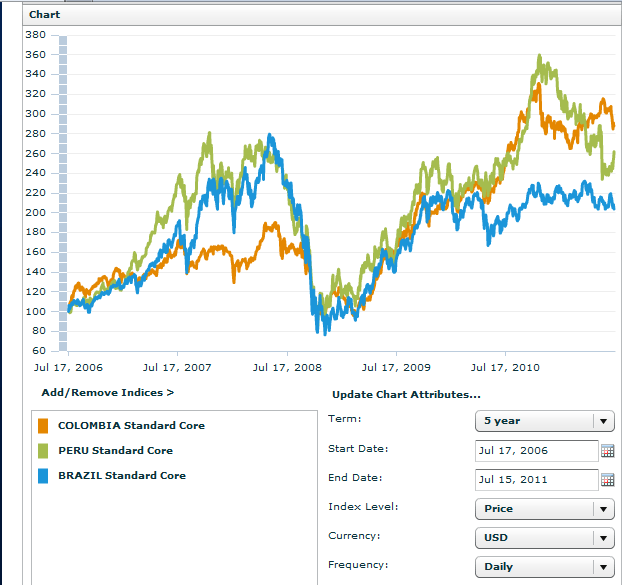
Brazil is one of the perennial favorite emerging market destination for many investors. However in terms of equity market performance, the smaller Latin American economies of Peru and Colombia beat Brazil over the 5-year term.

In a recent Trustnet (UK) article Fidelity manager Alex Duffy noted:

“Despite the fact that Brazil is the largest economy in LatAm, it has actually only been the best performing market twice in the past 10 years,” the manager explained.

“Colombia and Peru have delivered consistent returns at far lower volatility than Brazil.”

The following chart shows the 5-year performance of MSCI indices for Peru, Colombia and Brazil:
 

Source: MSCI

The MSCI indices for Colombia and Peru has clearly outperformed Brazil in five years in US dollar terms. Though Brazil is home to some of the top companies in Latin America, better performing companies exist in other countries such as Chile, Colombia, Peru, etc. Two such companies are Peru’s Compania de Minas Buenaventura (BVN) and Colombia’s Ecopetrol (EC).

The key takeaway from this post is that it is always not a good idea to follow where the hot money is flowing into. This is especially true with respect to selecting and investing in emerging markets.

Related ETFs:

iShares MSCI Brazil Index (EWZ)
iShares MSCI All Peru Capped Index (EPU)
Global X FTSE Colombia 20 ETF (GXG)
Market Vectors Colombia ETF (COLX)

Disclosure: No Positions
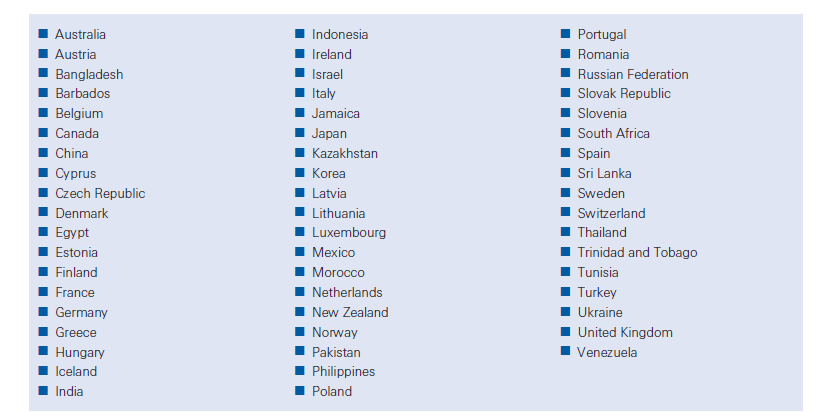
List of Countries With Which the US Has Tax Treaties

When investing in foreign stocks one of the factors that investors should take into consideration is the tax treatment of dividends earned. To that end, earlier this year I wrote an article on Withholding Tax Rates by Country for Foreign Stock Dividends.

Similar to other countries, the U.S. also has income tax treaties with many countries to avoid double taxation of dividends and other income earned by US citizens. In addition these treaties also offer other favorable tax treatments to investors in order to stimulate investment between each countries and allow free flow of capital. In general, it is a wise idea to invest in countries with which the U.S. has tax treaties.

From the IRS site:

The United States has tax treaties with a number of foreign countries. Under these treaties, residents (not necessarily citizens) of foreign countries are taxed at a reduced rate, or are exempt from U.S. taxes on certain items of income they receive from sources within the United States. These reduced rates and exemptions vary among countries and specific items of income. Under these same treaties, residents or citizens of the United States are taxed at a reduced rate, or are exempt from foreign taxes, on certain items of income they receive from sources within foreign countries. Most income tax treaties contain what is known as a “saving clause” which prevents a citizen or resident of the United States from using the provisions of a tax treaty in order to avoid taxation of U.S. source income.

If the treaty does not cover a particular kind of income, or if there is no treaty between your country and the United States, you must pay tax on the income in the same way and at the same rates shown in the instructions for the applicable U.S. tax return.

The graphic below lists countries with which the US has income tax agreements:

Note: Data shown is accurate as of 2009.

Source: US Tax Liability on 2009 Dividends, Deutsche Bank Trust Company Americas

For additional information on tax treaties between particular countries and U.S., please refer to the IRS website here.

Publication 901 (04/2011), U.S. Tax Treaties also provides the additional details.

Canadian Investors: The list of countries with which Canada has tax treaties can be found here.

Australian Investors: The list of countries with which Australia has tax treaties can be found here.

First Tibetan Company Hong Kong IPO

Tibet 5100 Water Resources Holdings(1115.HK) recently raised HK$1.38 billion ($177 million) from its initial public offering and will become the first Tibetan company to list in Hong Kong.

Tibet 5100 sells most of the water it produces to corporate clients like railway operators, airlines, banks and hotels as well as government organisations through long-term contracts. Its most important customer is China Railway Express, which is the procurement agency for the Ministry of Railways and accounted for close to 90% of its total sales volume in 2010.


However, it is also developing its retail distribution channels in China and its water is now available at supermarket chains such as Walmart, Carrefour, Metro and Auchan, and high-end hotels such as Shangri-la Hotels, and convenience store chains such as Lawson and Watsons.

According to Euromonitor, Tibet 5100 is the largest producer of premium bottled mineral water in China.

Tibet 5100 markets its water under the brand “5100 Tibet Glacier Spring Water”, emphasize that it comes from a glacial spring located 5,100 metres above sea level in the Nianqing Donggula Mountains in Tibet.

Source: Finance Asia

Tibet 5100 Water Resources Holdings(1115.HK) closed at 4.12 HK$ today and the company has a market cap of 10.58 billion.

Disclosure: No positions


The Top Companies in the U.S.Tire Market

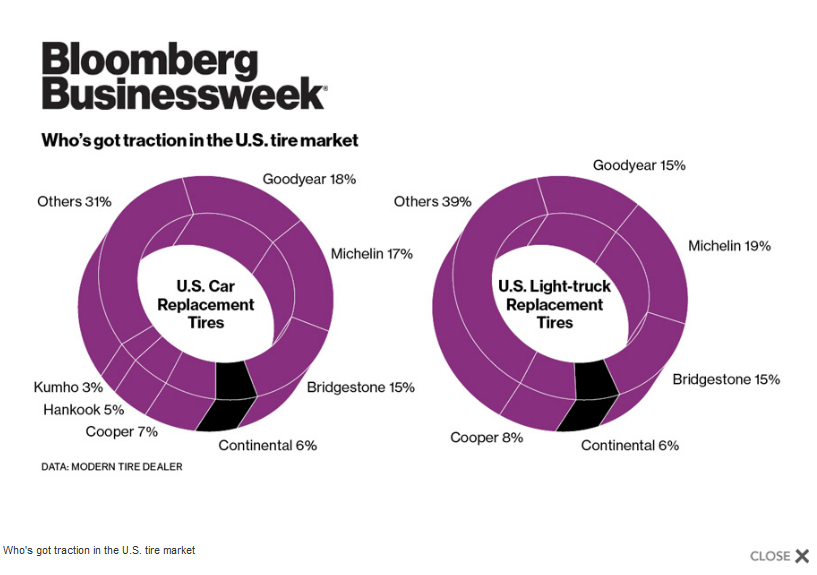
The graphic below shows the top companies in the U.S. tire market:

Click to enlarge

Source: Continental Sells to Tire Salesmen in the U.S., Bloomberg BusinessWeek

Goodyear, Michelin and Bridgestone sell about half of the replacement tires for U.S. passenger cars. Akron, Ohio-based The Goodyear Tire & Rubber Co (GT) is the largest U.S. manufacturer of tires and had sales of about $20.0 billion last year. Japan-based Bridgestone trades as an unsponsored ADR on the OTC market under the ticker BRDCY. The stock is up about 23% YTD.

Cie Generale Des Ets Michelin SCA (MGDDY) is a tire maker based in France. Michelin ADR is also up about 24% YTD. Germany-based Continental AG (CTTAY) is one of the largest tire makers in the world. Continental generates 13% of its revenue from the U.S.

Although much smaller than Goodyear, Cooper Tire & Rubber Company(CTB) had sales of $3.5 billion last year and has a higher profit margin. Since its humble beginnings in 1960, South Korea-based Kumho Tires has grown tremendously over the years to become the 9th largest tire manufacturer in the world. Hankook is also a South Korean firm and is the seventh largest tire manufacturer in the world.

Disclosure: No positions

Healthcare Expenditure as a Share of GDP Among OECD Countries 2009

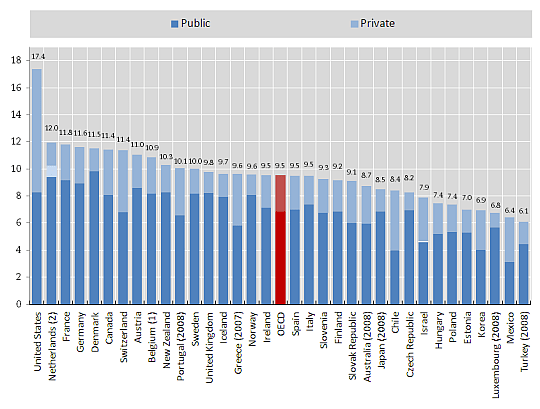
According to the OECD recently released its OECD Health Data 2011 report, healthcare spending continues to rise faster than economic growth in most OECD countries. Healthcare spending reached 9.5% of GDP on average in 2009, up from 8.8% in 2008.

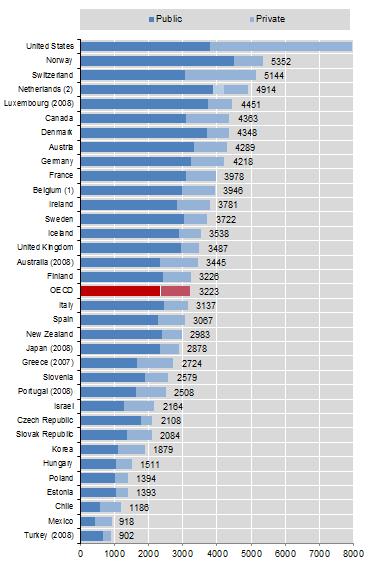
As expected the U.S. continues to spend the most on healthcare. The following chart shows the wide margin between the U.S. and other developed countries:

Health expenditure per capita in US$ Purchasing Power Parity (PPPs) 2009, OECD countries

Source: OECD

Due to the lack of a decent national healthcare system for all citizens the U.S. is the only developed country where private health spending accounts is in addition to and higher than public spending as clearly shown in the chart above.

From the report:

In 2009, there were large variations in how much OECD countries spent on health and the health spending share of GDP. The United States continued to outspend all other OECD countries by a wide margin, with spending on health per capita of $7960. This was two-and-a-half times more than the OECD average of $3223.

As a share of GDP, the United States spent 17.4% on health in 2009, 5 percentage points more than in the next two countries, the Netherlands and France (which allocated 12.0% and 11.8% of their GDP on health). Norway and Switzerland were the next biggest spenders on health per capita, with spending of more than $5000 per capita in 2009.