Five European Bank Stocks To Buy Now

Some investors are staying clear of European bank stocks as fresh fears of debt crisis haven re-surfaced especially with Greece in recent weeks. Greece will be bailed out for the second time and is on track to implement austerity measures that will fix some of the country’s awful fiscal woes.

In general, Greece has always been the poorest country in Western Europe plagued by corruption, tax evasion and other social ills usually seen in third-world countries. So in some sense the country should not have been invited to become part of the European Union(EU) in the first place. However after joining the EU, despite sucking billions in aid from the EU in the years since, the cradle of democracy continues to remain a problem child and gains the attention of the global media for all the wrong reasons. Rightly so, hard-working Germany and other nations are getting tired of coming to the rescue of the lazy and irresponsible Greece over and over.

It must noted that some European banks have high exposure to Greece. The fear of a Greek default and to some lesser extent fiscal issues in Portugal and Italy is keeping bank stocks depressed. However when looked from another perspective, some of these banks are cheap at current valuations and look attractive now. In my view, fears of debt crisis are way overblown and stronger banks are also badly hurt by the overall sentiment towards this sector. Investors with a long-term horizon of five years or more can consider adding some of the strong European banks.

Five European bank stocks that look attractive now are listed below with some reasons for investing in them:

1.Bank: Nordea Bank AB (NRBAY)
Current Dividend Yield: 3.84%
Country: Sweden
Investment Rationale: One of the largest banks in the Nordic region with a significant presence in the Baltic countries.Nordea’s Core Tier 1 Capital Ratio is high at 10.7%.The divided payout ratio is now higher than the pre-crisis level. The Swedish government plans to reduce its current ownership of around 13.4% from mid-August.

2.Bank: ING Groep NV (ING)
Current Dividend Yield: N/A
Country: The Netherlands
Investment Rationale: ING is one of the top European financials with a global footprint.Though the group has suspended dividends it is taking steps in the right direction for boosting its capital base and increase asset growth. For example, in June ING sold its popular ING Direct unit in the U.S. to the subprime lender Capital One(COF) for $9.0 billion.

3.Bank: Societe Generale (SCGLY)
Current Dividend Yield: 4.59%
Country: France
Investment Rationale:Societe Generale is one of the largest banking groups in France with operations in 85 countries. SocGen is slowly recovering after getting hit hard in the credit crisis and a huge fraud committed by a rogue trader. This year SocGen increased its dvidend payment significantly from 2010. The bank is well capitalized with a Tier 1 Ratio of 10.8% in the first quarter.

4.Bank: HSBC Holdings PLC (HBC)
Current Dividend Yield: 3.61%
Country: UK
Investment Rationale:Though based in UK, “The World’s Local Bank” has operations in 87 countries
serving some 95 million customers. HSBC has a strong presence especially in fast-growing Asia. In the U.S., HSBC took prudent measures and limited losses in its Household International subprime unit that it bought a few years ago. The bank has the highest market capitalization among the major British and top 20 European financials and stands to gain from growth in emerging markets.

5.Bank: Erste Group Bank AG (EBKDY)
Current Dividend Yield: 1.97%
Country: Austria
Investment Rationale: Erste bank has a strong presence in Central and Eastern Europe where the Czech economy is faring well and the Romanian economy has stabilized. Erste is looking for expansion in Poland which has become highly successful among the former Eastern bloc countries. Erste Bank has recovered well from the depth of the credit crisis since the government’s bailout did not dilute existing shareholders and came with extremely favorable conditions.

Note: Dividend yields noted are as of July 8, 2011

Disclosure: Long ING, EBKDY, SCGLY

U.S. Utility Stock Investors May Want to Switch to Foreign Utilities

Investors looking for yields and stable growth have traditionally preferred utility stocks. The majority of the utilities in the U.S. are regulated and tend to have near monopoly in the operating areas offer stable growth. However in recent years U.S. utilities are facing many headwinds and their stocks have not performed as they have in the past.

From Fear and Loathing for Utilities by Liam Denning in The Wall Street Journal:

Widows and orphans have reason to be pessimistic. That, along with their love of big dividends and regulated cash flows, is why they traditionally value utility stocks. Utility-dividend yields historically have tended to move with Treasury yields. As the latter fall—usually when fear reigns—utility yields fall.


That has been the case since mid-April. Utility stocks have rallied strongly, sending their yields down, as the 10-year Treasury yield has dropped from about 3.6% to a recent low of less than 2.9%. It stands now at about 3.2%.

If the economic recovery falters in the second half of 2011, renewed demand for Treasurys could, in theory, boost utility stocks further. But don’t bank on it.

The sector’s current dividend yield of 4.2% is 1.05 percentage points higher than that offered by Treasurys, compared with a monthly average of 0.13% since 1970. Utility dividend yields have often been below Treasury yields. Indeed, across that entire period, there have been only three episodes where utility dividend yields stayed above Treasury yields for longer than 12 months. The current one, which began in mid-2007 and really took off after the financial crisis, is the longest since 1980.

The author further notes in the article that 42% of S&P 500 utilities missed their earnings estimates in the first quarter and earnings are expected to drop this year.

Compared to their U.S. peers, many foreign utilities offer better growth potential. This is true especially for large diversified utilities and those operating in emerging markets. As the demand for electricity continues to grow in emerging markets such as China, India, Brazil, etc. utilities are bound to experience higher growth. In addition, many foreign utilities offer higher dividend yields than U.S. utilities. Hence investors in U.S. utilities may want to consider switching to some of the foreign utilities at current levels. The potential for earning higher returns is higher with these utilities despite factors such as foreign tax withholdings on dividends, currency fluctuations, etc.

The following 10 foreign utilities have dividend yields of more than 4.2% paid by U.S. utilities:

1.Company:EON AG (EONGY)
Current Dividend Yield: 7.82%
Country:Germany

2.Company:Companhia Energetica De Minas Gerais Cemig (CIG)
Current Dividend Yield: 4.97%
Country: Brazil

3.Company:National Grid PLC (NGG)
Current Dividend Yield: 5.90%
Country: UK

4.Company:Veolia Environnement Ve SA (VE)
Current Dividend Yield: 6.48%
Country: France

5.Company:Huaneng Power International Inc (HNP)
Current Dividend Yield: 5.7%
Country: China

6.Company:Cpfl Energia SA (CPL)
Current Dividend Yield: 5.40%
Country: Brazil

7.Company:Enel SpA (ENLAY)
Current Dividend Yield: 6.31%
Country: Italy

8.Company:EDP Energias de Portugal SA (EDPFY)
Current Dividend Yield: 6.95%
Country: Portugal

9.Company:Gdf Suez SA (GDFZY)
Current Dividend Yield: 5.93%
Country: France

10.Company:Aes Tiete SA (AESAY)
Current Dividend Yield: 8.50%
Country: Brazil

Note: Dividend yields noted are of July 8, 2011

Disclosure: Long VE, EONGY

Site Fixed !!

Hello Readers

We have fixed our site. Regular posting will start tonight.

Over the past few days postings have been thin due to site issues. In the future we will make sure such issues are kept to a minimum.

Thanks for your patience !!

-David

IMF: Bank Capital Adequacy Ratios Improves Worldwide

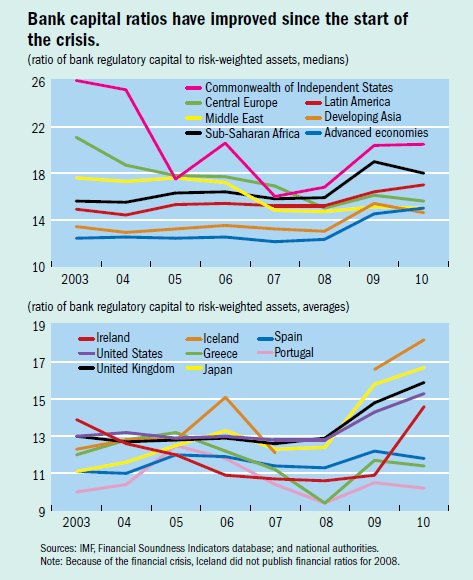
The health of the banking industry as measured by the Capital Adequacy Ratios (CARs) has improved in all regions of the world since the start of the credit crisis in 2008 according to a report by José M. Cartas and Ricardo Cervantes of the IMF.

Definition of Capital Adequacy Ratio:

Capital requirements are designed to ensure that banks hold enough resources to absorb shocks to their balance sheets. A standard measure of the health of individual banks is their capital adequacy ratio (CAR). Introduced in 1988 with the Basel I Accord, the CAR is calculated as the total regulatory capital of a bank divided by its risk-weighted assets. The Basel II revision refined the calculation of risk weights and incorporated three major components of risk: credit, operational, and market risk.

The Basel Accords set the minimum CAR at 8 percent. Conservatively-run banks tend to have high CARs to cushion against higher losses.

The graphic below shows the improvement in capital ratios of all regions and select developed countries:

Source: Finance & Development, June 2011, IMF

In developed countries, banks lent money liberally before the credit crisis. Whether it was the now failed Northern Rock in the UK or Washington Mutual in the U.S. banks juiced up their earnings by lending heavily to the subprime mortgage sector. In addition, commercial real estate loans, home equity loans, credit credit loans and other types of lending boomed. After the credit crisis, banks in the developed countries have strengthened their CARs by limiting lending to their customers and shifting their portfolios to low-risk assets such as government securities.

The graph also shows the deterioration of the banking sector in Greece, Spain and Portugal.The CAR for Iceland hovered slightly above 12 percent until 2007 and jumped to more than 18 percent in 2010 after the painful restructuring of the country’s banking system.