Reverse Stock Splits Never Work Especially When A Company Is Losing Money

Listed companies can implement reverse stock splits for many reasons. For example, they can consolidate the number of stocks outstanding in order to bring the stock price above a certain point like $1 after the price falls below that level. This is necessary for liquidity, preventing de-listing by exchanges, etc. Investors should be very careful of firms that do reverse stock splits especially if a the firm is losing money. Another factor that investors must be wary of is multiple reverse stock splits.

A recent article by Peter Hodson, CFA, is CEO of 5i Research Inc. in Financial Post discussed some of the lessons to learn from five losing stocks. One of them is the effect of stock consolidations. From the article:

DryShips (DRYS on NASDAQ)

First, the stunning fact. When adjusted for share consolidations over the years, shares of DryShips have gone from $1.515 million per share to $1.17 per share in 10 years. That is not a typo. That is a decline of 99.9999992 per cent. This year alone, the stock has declined 94.2 per cent. Of bizarre note, the company recently declared a dividend, after omitting them in 2008. The company operates dry bulk shipping carriers. In 2016, it lost $464.76 per share on $51.9 million in revenue. Market cap is $177 million and it still brings in buyers, with trading usually more than 30 million shares a day.

Lesson to be learned: Investors can’t stand share consolidations, and losing money is not great for share prices (split-adjusted, DRYS lost $10,023 per share in 2015!).

Source: Five stocks that have burned investors, and the lessons we all can learn from them, Financial Post

DryShips(DRYS) did reverse stock splits 4 times in just two years (2016 and 2017). The splits were as follows:

Date Ratio
03/11/2016 1 for 25
08/15/2016 1 for 4
11/01/2016 1 for 15
01/23/2017 1 for 8


The impact of these splits with the firm losing money was disastrous to investors. A $10,000 investment in March, 2007 in DRYS would have turned to just $0.05 on 3/22/17 with dividend reinvested.  So Total Return  equals to -100.00% according to split history website. This is indeed shocking.

Click to enlarge
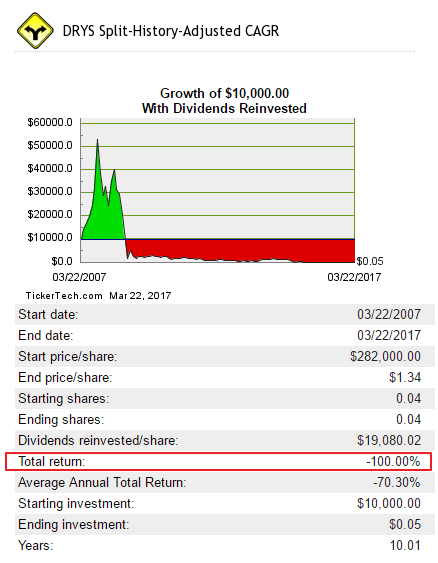
Source: Split History

DRYS closed at $1.34 yesterday.

Disclosure: No Positions

Update(April 7, 2017): 

DryShips announced yet another reverse split in the ratio of 1:4 today with an effective date of April 11. This is incredible. From a journal story:

DryShips, a Greek owner of dry bulk carriers and tankers, announced late Thursday that it will execute a reverse stock split effective April 11. Every four shares outstanding will be combined into one share of common stock.

DryShips stock plunged more than 25% Friday morning, possibly because its maneuver should sound familiar. This will mark the second reverse split of the year and the fifth time since February 2016.  Meanwhile, the latest reverse split comes less than a month after completing a $200 million share offering, in which the company raised net proceeds of $198 million.

DryShips shares have experienced extraordinary volatility, including a more than 1500% rise immediately after the election. But the company is worth a small fraction of its value from several years ago.
Source: WSJ

Apple’s Supply Chain: An Example Of Challenges Of Bringing Manufacturing Jobs Back To The U.S

I came across the following cool infographic showing the difficulty of manufacturing jobs back to the US. From the AB article:

In this infographic, we show how a sample of nine companies from Apple’s supply chain represent $122 billion in assets and 525,000 employees, all of which would need to be relocated to bring iPhone manufacturing back to the US. And the chain gets even more complex the further down it you go. Below these nine are even more layers of component and subcomponent suppliers outside the US, which could triple the costs and further complicate the logistical challenges of relocation.

Click to enlarge


Source: Homeward Bound? A Challenging Journey for US Manufacturing, Alliance Bernstein, Mar 14, 2017

Update:

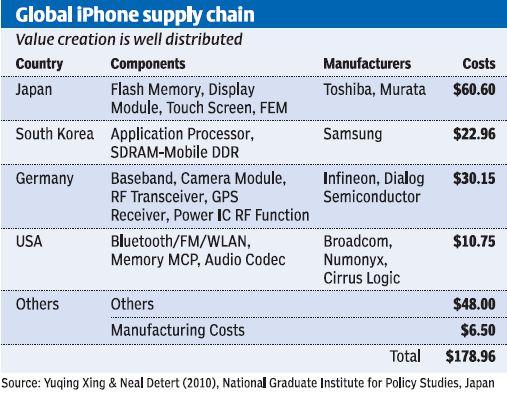
Global iPhone Supply Chain

Source: The Hindu BusinessLine

Also see:

Breakdown of Apple iPhone 7 Retail Price, TFS

Breakdown of an Apple iPhone 5 Component Costs, TFS

Apple Inc. (AAPL) is the world’s most valuable company with market cap exceeding $742.0 billion.

Disclosure: No Positions

Ten Latin American Stocks To Consider

Emerging markets are back in vogue this year, As commodity prices are increasing, investors are turning their attention to countries dependent on commodity exports.Among the many emerging market regions Latin America offers plenty of opportunities for investors looking for growth. Following are ten stocks from Latin American countries that investors can consider for further research:

1.Company: Ultrapar Participacoes SA (UGP)
Current Dividend Yield: 2.34%
Sector: Oil, Gas & Consumable Fuels
Country: Brazil

2.Company: Banco Bradesco SA (BBD)
Current Dividend Yield: 4.11%
Sector: Banking
Country: Brazil

3.Company:Banco Santander- Chile (BSAC)
Current Dividend Yield: 4.46%
Sector: Banking
Country: Chile

4.Company: Banco de Chile (BCH)
Current Dividend Yield: 3.62%
Sector:Banking
Country: Chile

5.Company:Empresa Nacional de Electricidad SA (EOC)
Current Dividend Yield: 3.79%
Sector:Electric Utilities
Country: Chile

6.Company: Braskem SA (BAK)
Current Dividend Yield: 7.71%
Sector: Chemicals
Country: Brazil

7.Company: Bancolombia (CIB)
Current Dividend Yield: 3.10%
Sector: Banking
Country: Brazil

8.Company: Credicorp (BAP)
Current Dividend Yield: 2.31%
Sector: Banking
Country: Peru (but based in Bermuda)

9.Company:Vina Concha y Toro SA (VCO)
Current Dividend Yield: 2.60%
Sector:Beverages
Country: Chile

10.Company: Embraer SA (ERJ)
Current Dividend Yield: 0.71%
Sector: Aerospace & Defense
Country: Brazil

Note: Dividend yields noted above are as of Mar 17, 2017. Data is known to be accurate from sources used.Please use your own due diligence before making any investment decisions.

Disclosure: Long CIB, BCH, BBD

Dividend Withholding Tax Rates By Country 2017

Update – For the latest rates go to: Dividend Withholding Tax Rates by Country for 2018

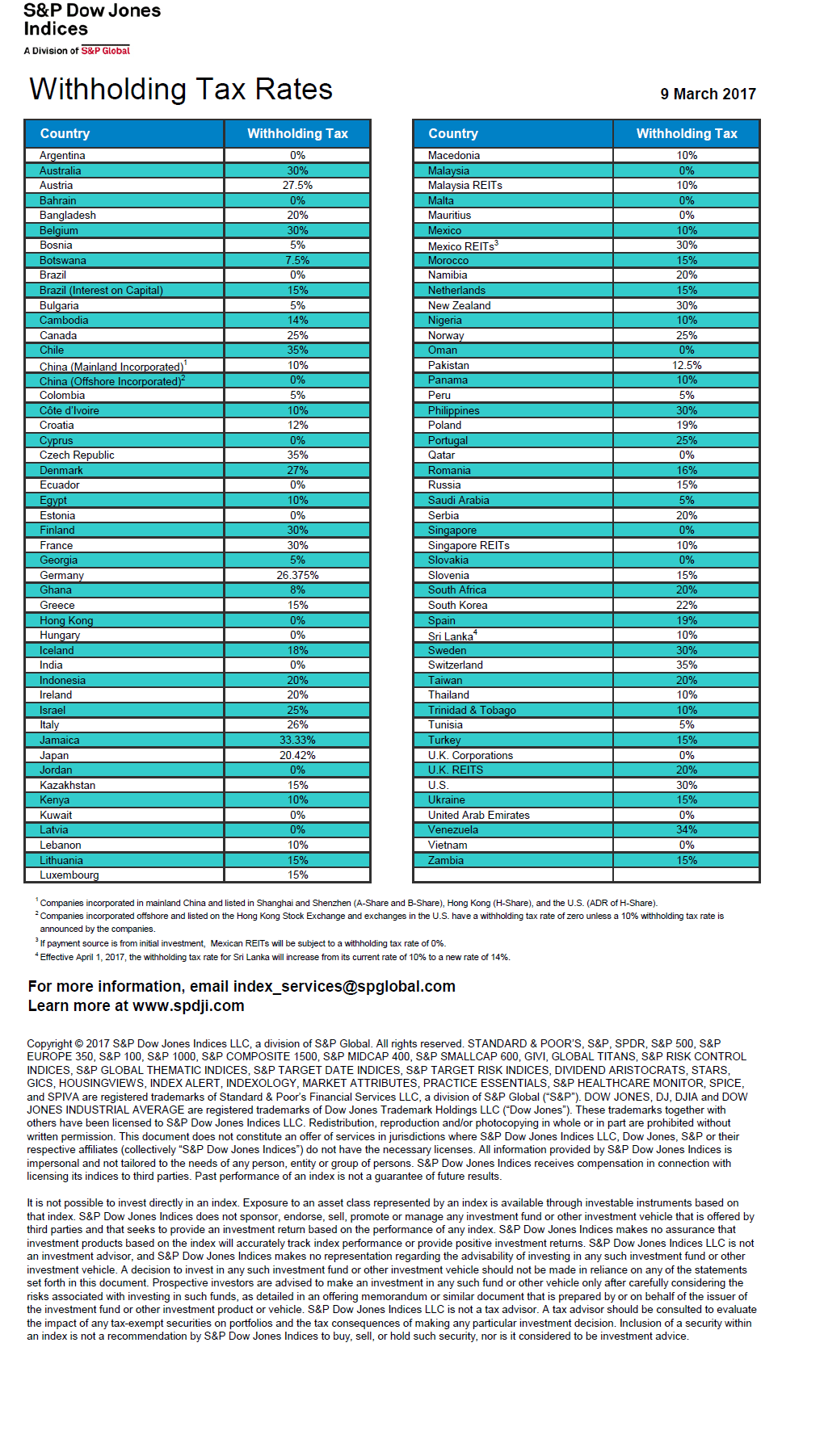
The Withholding Tax Rates for Foreign Stock Dividends for 2017 are shown in the table below. As some countries change the withholding tax rate every year this list can be a valuable tool for investors holding or planning to invest in foreign stocks. Since this tax can take a huge chunk of dividends sometimes it is important to review the tax impacts before going abroad. For example, among developed countries Switzerland charges one of the highest dividend withholding taxes for non-residents. Others such as Canada give favorable treatment to Americans by waving the tax if the investments (excluding REITs) are held in qualified retirement accounts such as 401Ks.

The Dividend Withholding Tax Rates by Country for 2017 :

Click to enlarge

Source: Deloitte

Download: Dividend Withholding Tax Rates By Country 2017 (in pdf format)

Related: