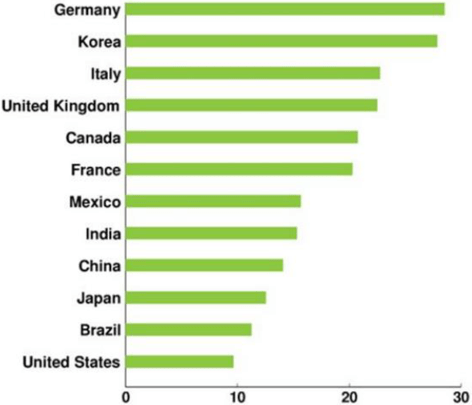
Percentage Share of Total Employment That Depend on Exports for Select Countries: Chart

The economies of some countries are heavily dependent on exports while others do not. A higher percentage of jobs in export-driven countries depend on exports. For example, Germany is a classic export-based economy unlike the US which is a consumption-based economy. So 30% of total employment is attributed to exports. In the US, the figure is only 10%. Other countries like Korea, Mexico, Canada also have high number of jobs dependent on exports.

It is surprising that a lower percentage of jobs are dependent on exports in China than other countries like Mexico, Canada, India, UK, etc.


Click to enlarge
 

Source: The truth about Brexit, April 2017, The Absolute Return Letter, Absolute Return Partners
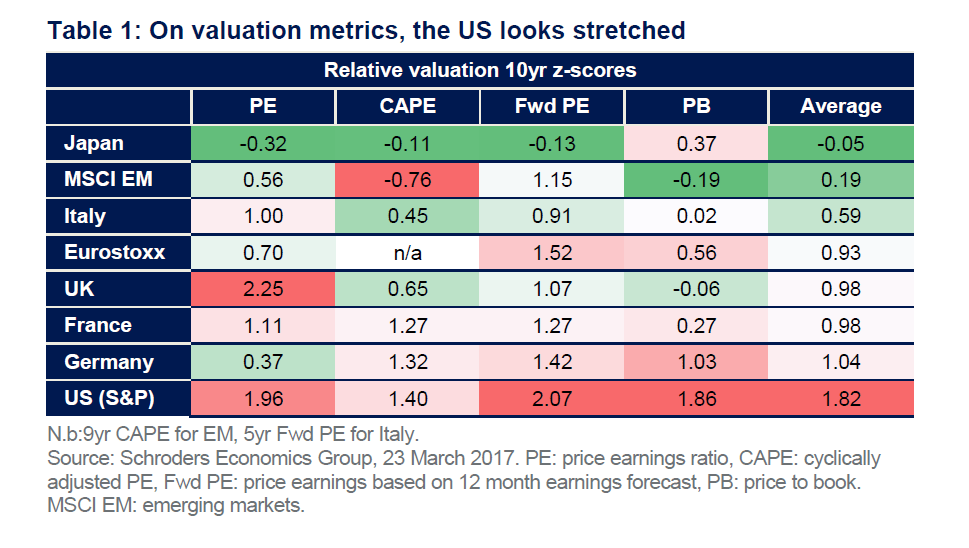
Valuation Metrics: U.S. vs. Foreign Stocks

The U.S. equity market has performed well in recent months especially since the election in November. The S&P 500 is up by over 5.50% year-to-date on price only basis. The solid performance of US stocks has pushed valuations to high levels. When compared to other markets, US valuations look stretched according to a report by Schroders. From the report:

Markets are clearly putting a lot of faith in President Trump’s ability to deliver on his promises. Although valuation is not a good guide to near term performance, it does become a factor on longer time horizons. From our analysis, the US is trading well above normalised valuations for Price Earnings (historic, expected and cyclically adjusted PE) and on price-to-book. Easy money and low bond yields play a significant role in sustaining these valuations, so higher inflation which threatens to change Fed policy will be critical to the market outlook.

Source: Schroders Economic and Strategy Viewpoint, April 2017, Schroders

The key takeaway is that investors must not be complacent when markets continue to rise. U.S. stocks  could lag foreign stocks this year. Many of the developed European markets are ahead of US markets so far this year. So investors may want to consider diversifying their portfolio across markets and asset classes.

Knowledge is Power: Oil Opportunities, Emerging Markets and American Democracy Edition

Sunset over the Pacific Ocean in Mazatlan, Mexico

Small Caps Are Attractive Relative To Large Caps

Global small cap stocks are attractive now compared to large caps based on valuation, according to an article by David Brett at Schroders.

Small caps as measured by the MSCI Small Cap Index has returned three times as much as large caps since March 2001. Small caps returned 317%  including dividends compared with 107% for the MSCI Global Large Cap Index.

From the article:

Do small caps remain good value?

On average small-cap valuations have so far remained relatively attractive, despite their rapid rise.

One way to value individual shares or the stockmarket as a whole is to compare share prices and earnings in a price-to-earnings ratio (P/E). A lower P/E ratio suggests better value.

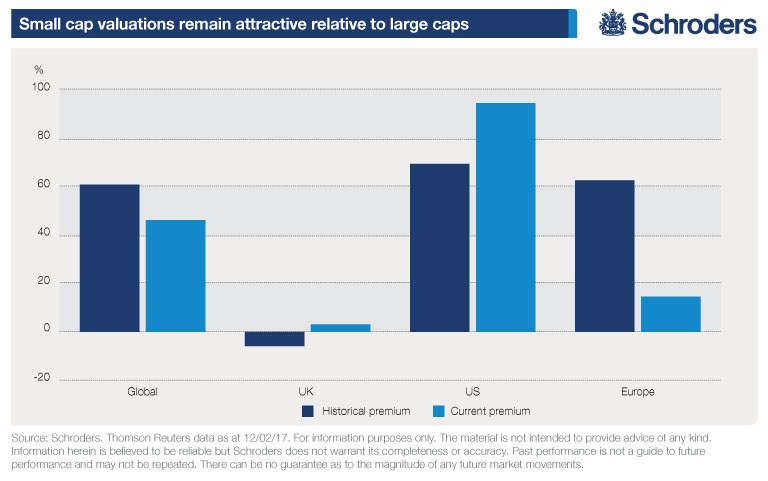
Global small caps’ 10-year median P/E is 25.8, compared with large caps’ P/E of 16. So on average global small caps have traded on a 61% premium to large caps since 2007.

The premium is currently 46%. Small cap P/Es have risen to 30.8 from 27.5 in 2007, while large cap P/Es have climbed to 21 from 16.3.

Regional bias

Global and European small caps trade below their historical (10 years from Q4 2006 to Q4 2016) median premiums, compared with large caps, according to MSCI data. The US and the UK appear more expensive.

Source: Small cap vs large cap: how valuations compare, Schroders

Generally investing in small companies involves more risk than larger companies.Since higher risk means the possibility of higher reward they tend to perform better than large caps. Though definitions of a small cap can vary, usually companies with market caps of less than $1.0 billion can be considered small companies. Researching and identifying individual small companies to invest in is more time-consuming than large ones since the universe of available firms is huge. So it may be easier for most retail investors to go with small cap ETFs.

Related ETFs:

  • iShares MSCI EAFE Small-Cap ETF (SCZ)
  • Vanguard FTSE All-World ex-US Small-Cap ETF (VSSS)
  • SPDR S&P International SmallCap ETF (GWX)

Disclosure: No Positions

Emerging Markets: Companies Showing Signs Of Recovery ?

Emerging markets are performing well so far this year. But until last year they were depressed as investors avoided them for a variety of reasons including the plunge in commodity prices. According to an article at Franklin Templeton, these markets are showing signs of recovery ass earnings, exports and commodity prices are on the upswing.

Click to enlarge

Source: Why Things Aren’t What They Used to Be in Emerging Markets, Franklin Templeton Investments, Mar 23, 2017

Related ETFs:

  • iShares MSCI Emerging Markets ETF (EEM)
  • Vanguard MSCI Emerging Markets ETF (VWO)

Disclosure: No Positions