Social Security Payments Across OECD Countries: Chart

Most retired Americans depend on social security payments for their survival in retirement, In fact, according to a report by Center on Budget and Policy Priorities for about half of retired seniors it provides at least 50 percent of the income and for 1 in 4 it provides 90 percent of the income. This is surprising given that so much attention and focus is devoted to savings and investments through 401K and other retirement programs.

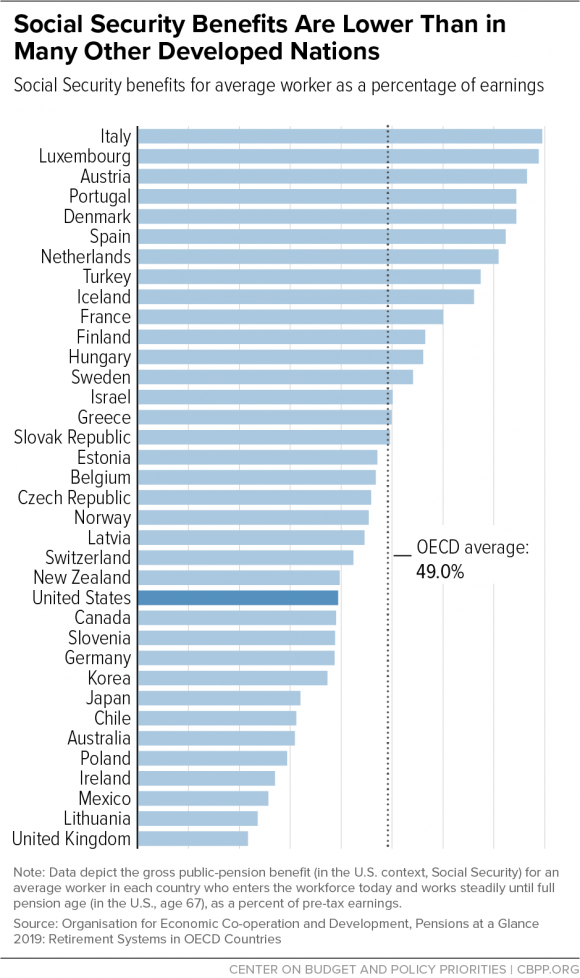
With that said, the following chart shows social security benefit payments across OECD countries in 2019:

Click to enlarge
Source: Social Security Benefits Are Modest, CBPP

The US has lower social security payments than most developed countries.
Required Minimum Distributions (RMDs) Can Be Skipped in 2020

Required Minimum Distributions (RMDs) usually have to be taken each year from certain accounts such as IRAs, 401Ks, and other qualified retirement accounts by owners over age 70 1/2. Similarly RMDs have to be taken by account owners of inherited IRAs. Since RMDs have to be completed before of the year, some owners of these accounts may be wondering if they have to take it out before Dec 31st. Due to the pandemic, RMDs can be skipped this year. This relief was part of the The Coronavirus Aid, Relief, and Economic Security (CARES) Act passed earlier this year.

Note: This post applies to US investors only

Below is an excerpt from an article at Schwab:

Hayden Adams, CPA, CFP®, and director of tax planning at SCFR, offers answers to some common questions retirees are asking about RMDs in light of the CARES Act:

1. Do retirees have to take RMDs from retirement accounts in 2020?

“No, all RMDs have been suspended for 2020,” says Hayden. This waiver includes any retirement account subject to RMDs, such as IRAs, 401(k)s, Roth 401(k)s and inherited accounts.

2. What age do I have to be in order to qualify for the waiver?

If you are subject to RMDs, the waiver applies to you regardless of age. It includes original account owners over age 70½ (or 72, under the SECURE Act), original account owners who turned 70½ in 2019 but have not taken their distribution yet, and inherited-IRA beneficiaries of any age (see number 3, below).

3. Does the waiver apply to inherited IRAs?

Yes. The waiver extends to inherited IRAs (including stretch IRAs), as Schwab interprets the law. Even inherited IRAs with non-spousal beneficiaries, which would normally need to be liquidated within 5 years of the original account-holder’s death, are not required to take a distribution in 2020. You should consult with your tax advisor, but Schwab’s interpretation is that beneficiaries have an extra year to fulfill the 5-year requirement, since RMDs can be skipped in 2020.

Source: Can You Forgo Taking RMDs in 2020?, Schwab

Related articles:

Price Changes of Consumer Goods and Services in the US from 1998 To 2019

Prices of basic needs for living have soared in the US in the past few years while discretionary items have become cheaper. For example, housing prices are unaffordable in many parts of the country. Though shelter is the most basic need of any human being it is very expensive and housing costs continue to rise due to a variety of factors including inflation and policies. Similarly Education has become expensive especially at the college level where a third-rate school can cost five figures in tuition alone for a 4-year degree. Of all the basic human needs, healthcare is the most important and unfortunately the most expensive. Healthcare costs have in fact increased more than college tuition since 1998. It should be noted that most of the money spent on healthcare does not actually go towards the treatment of the patient but rather towards administration and paperwork operations run by insurance companies and to some extent the providers.

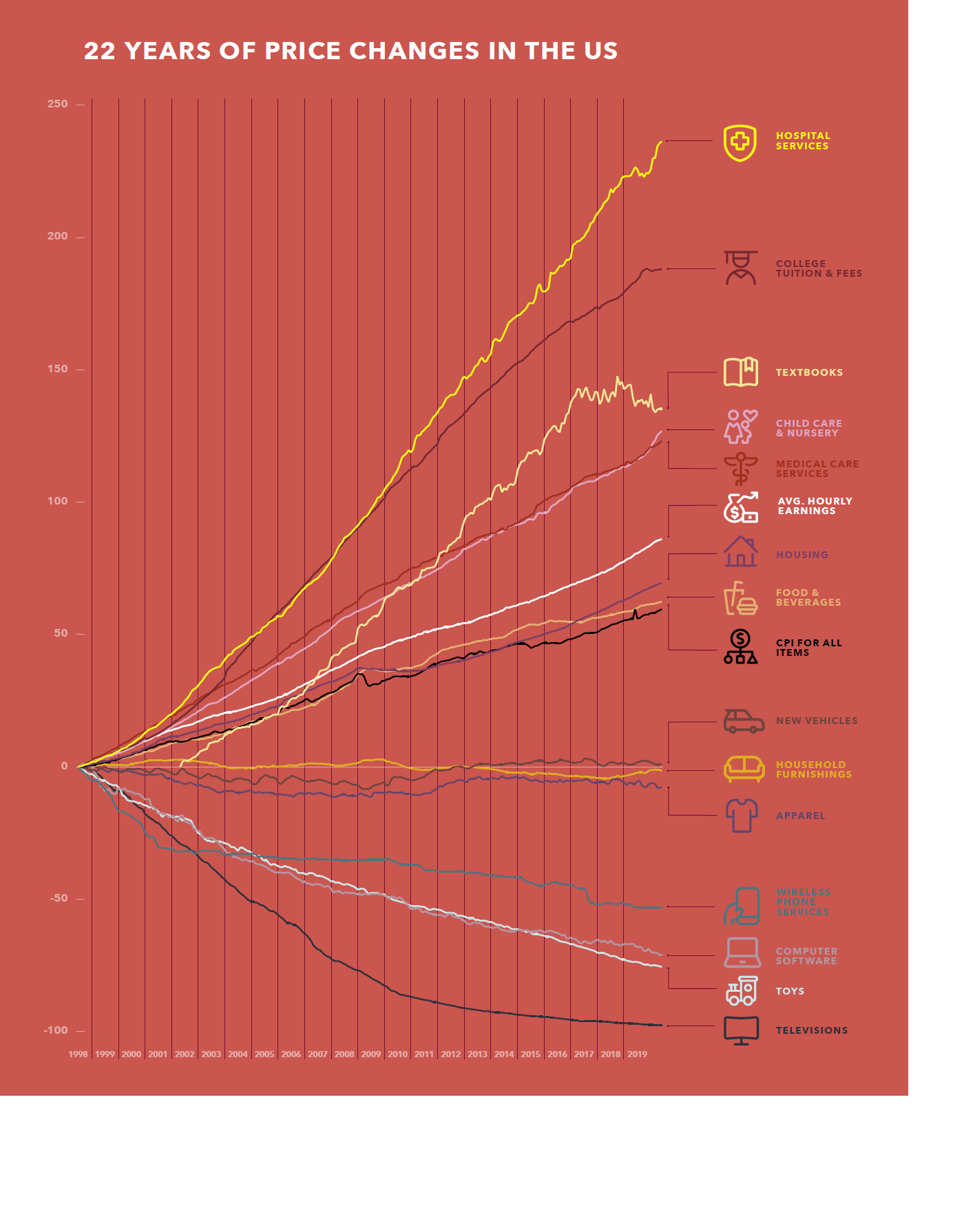
The following chart shows the price changes of select consumer goods and services since 1998:

Click to enlarge

Source: The Ruffer Review 2020, Ruffer LLC, UK

Below is a brief excerpt from the above report:

THIS SNAPSHOT OF THE US ECONOMY SHOWS THE DIVERGENCE in the price of selected consumer goods and services.

Mass consumer products such as TVs, toys and mobile phone services have become both cheaper and of much higher quality, thanks to improvements in technology. Cars have also improved vastly, without becoming less affordable.

By contrast, things that contribute to long-term quality of life – such as healthcare and education – have become significantly more expensive. Here, the rate of increase in prices has far surpassed the wage growth of the average American consumer. Healthcare costs have risen by more than 236% while a college education costs 187% more than it
did in 1998.

The key takeaway is that in the current structure of the economy, necessary items are expensive while useless items are cheap. The million dollar question is what will it take to fix this fundamental flaw in the system.

Earlier:

The Complete List of Italian ADRs Subject to Financial Transactional Tax

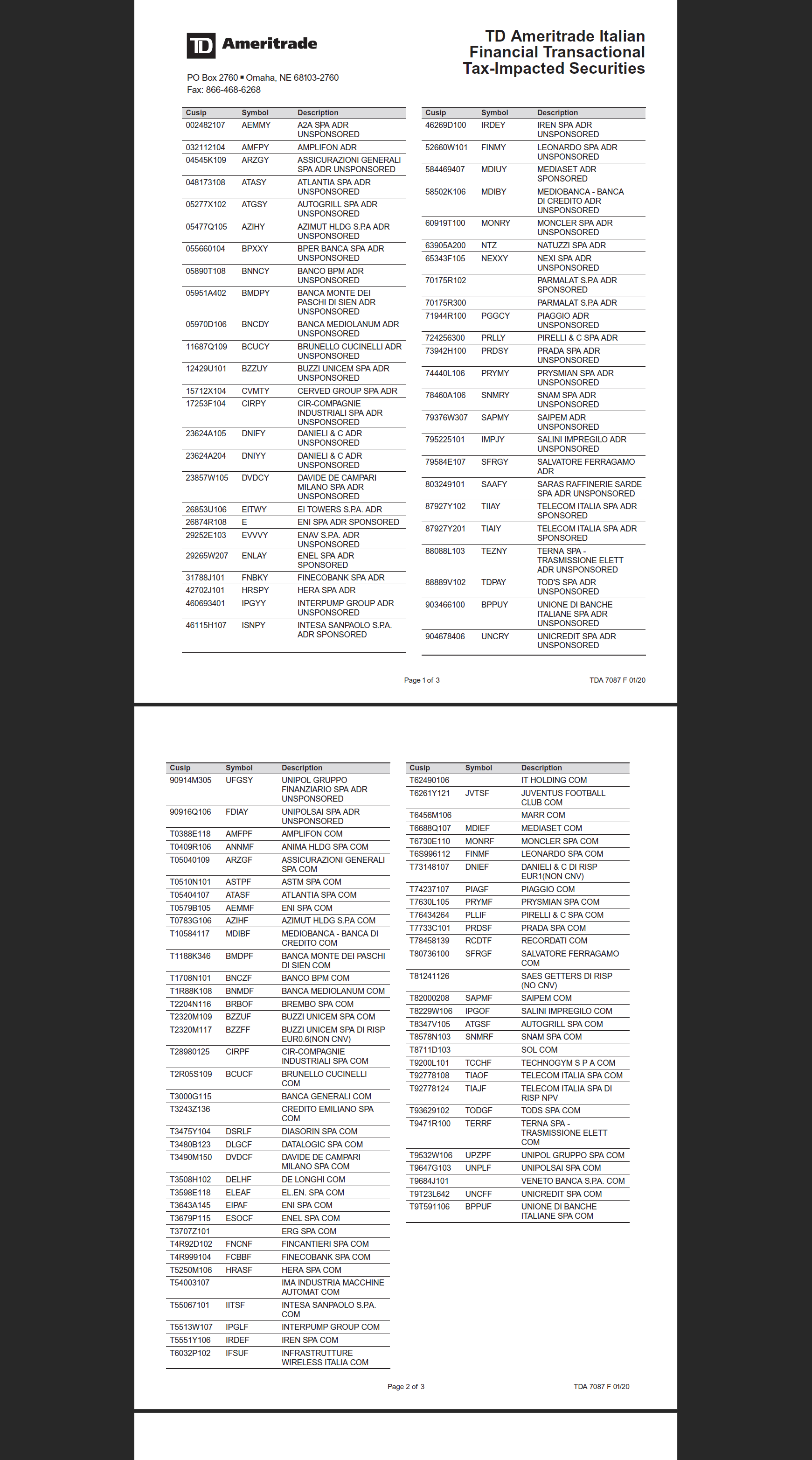
Italy is one of the few countries that imposes a transaction tax for all financial transactions (FTT). This includes Italian ADRs trading on the US markets. The current FTT rate is 0.20% with a lower rate for certain transactions. This 20% rate will impact the overall return an investor earns on Italian ADRs. This tax is on top of the dividend withholding tax rate which is 26% for US investors. So investors need to consider these factors before buying Italian ADRs.

Which Italian ADRs are subject to Financial Transactional Tax?

The following table shows an updated list of Italian ADRs subject to Financial Transaction Tax:

Click to enlarge

Source: TD Ameritrade

Download List:

Earlier:

Australian Bull and Bear Markets Since 1970: Chart

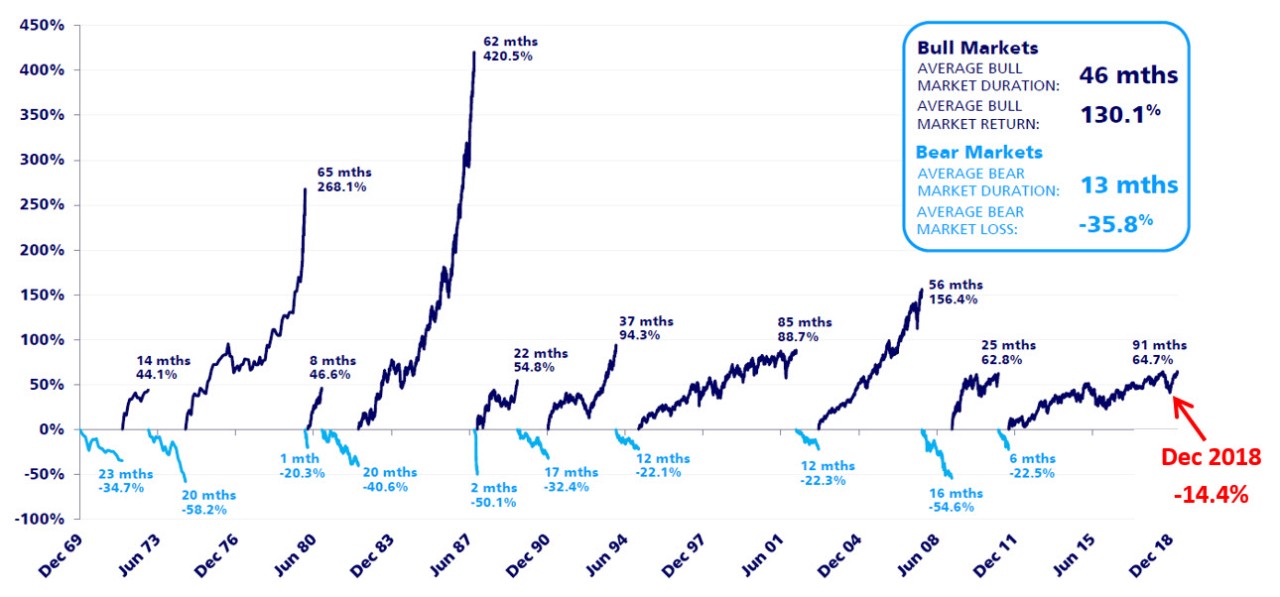
Stocks tend to earn higher returns relative to other assets over the long-term. This is because despite corrections and bear markets that can occur on a regular basis, over many years stocks go up more than they go down. To put it another way bull market returns are higher than bear market declines most times. So the key point to remember is not to panic and sell out during bear markets or corrections. We have reviewed the bull and bear markets in the US, Canada and India before. In this post let’s take a look at the Bull and Bear markets in Australia as represented by the ASX All Ordinaries Price Index:

Click to enlarge

Source: Bull vs Bear, Zurich Australia

From 1970 thru 2019, there have been 10 bear markets in Australia. The duration of each bear market was 13 months and the average loss was 35%. On the other hand, the average bull market lasted 46 months with an average bull market return of 130%.

The chart also shows that while the bear market declines (light blue color) were sharp, the bull market rises were sharper.

Related ETF:

  • iShares MSCI Australia ETF (EWA)

Disclosure: No positions