Poland: Europe’s Exciting Investment Destination

Poland is one of the top performing markets among the emerging markets in Europe. Since the March-lows of 2009, the WIG index, the main index on the Warsaw Stock Exchange, has soared to close at 46,874 on Friday. The all-time high is about 67,500 which was reached in mid 2007.

Poland has a highly-skilled and educated workforce. The country is host to some of the major German and other European manufacturing firms. In fact, European powerhouse Germany is the largest trading partner of Poland. In addition to the manufacturing sector,  Poland has a competitive edge in the service sector too. Proximity to the EU, a strong domestic consumer market, cheap labor are some of the major attractions for foreign firms investing in the country. In some sectors, Poland is a better alternative to India and China.

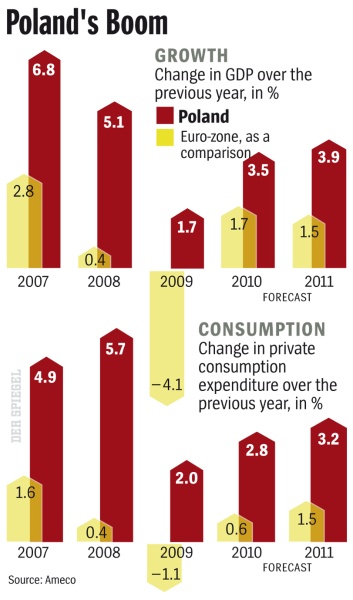
The Polish economy is projected to grow by more than double that of the estimated forecast GDP for Euro-zone this year according to a recent report in the Der Speigel. From the article:
poland-economy.jpg

The country has benefited from its accession to the European Union and globalization more than almost any other. Twenty years ago, the deeply Catholic country was largely agricultural and considered backward and provincial, a millstone around Europe’s neck. Since then, however, Poland has experienced an almost nonstop boom.

Even when the rest of Europe was suffering through a recession in 2009, Poland’s economy grew by 1.7 percent. Thanks to its accession to the EU in 2004, unemployment fell from more than 20 percent to about 8 percent today.

The boom has been most evident in the cities. Warsaw and Poznan, for example, have full employment. According to surveys, Poles are among Europe’s most optimistic people. They have never had it as good as they do today.

Warsaw is also at peace with itself politically. Prime Minister Donald Tusk runs the government with a stabile majority, while nationalist extremists on the left and right are no longer represented in Poland’s parliament, the Sejm. Poland is now on excellent terms with Berlin and has toned down its rhetoric toward Moscow; the country is also no longer seen as an unpredictable obstructionist in Brussels. Almost a quarter century after the collapse of the Soviet bloc, the country of 38 million has become a respected regional power.

How to invest in Poland?

None of the Polish firms are listed on the organized exchanges in the U.S. The majority of the Polish ADRs that trade on the OTC markets are unsponsored. Hence a simple way to gain exposure to the Poland for US-based investors is via the Market Vectors Poland ETF (PLND). This ETF has a small asset base of about $64.0 million. More than half of the fund’s assets are in the top 10 holdings. Financials account for 40% of the portfolio.
Libya and Oil

Crude oil prices rallied today reaching $100 a barrel in New York before settling the day for April delivery at $98.10. Oil prices have steadily increased since the political turmoil in the Middle East started a few weeks ago. “Oil prices may surge to $220 a barrel if political unrest in North Africa halts exports from Libya and Algeria.” according to Nomura Holdings quoted by Bloomberg. As Libya’s regime fights to quash the rebellion, oil prices may continue to rise further.Though media reports talk of oil exports disruption in Algeria, it seems unlikely. The Algerian government has not only banned protests but has also reduced the prices of essential food items.

The following are some interesting facts about the oil industry of Libya:

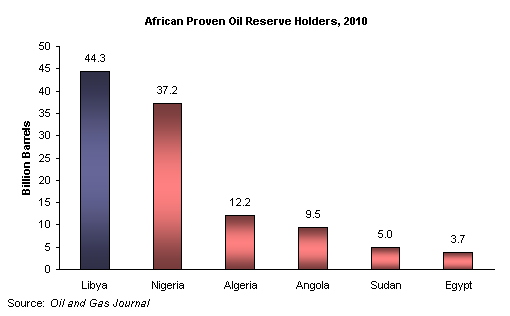
  • Libya has the largest proven oil reserves in Africa followed by Nigeria and Algeria.

2010-african-oil-reserves.gif

  • Despite the huge reserves Libya oil production has been on the decline since the 1960s.
  • In 2009, crude oil production was 1.65 million barrels per day.
  • Libya is a net exporter of oil with the vast majority of exports going to Italy, Germany, France and Spain.
  • Some of the major foreign oil firms involved in the Libyan oil industry are: Eni (E), StatoilHydro (STO), Occidental (OXY), OMV (OMVKY), Repsol (REP), Wintershall, ConocoPhillips (COP), Hess (HES), Marathon (MRO), Shell (RDS.A, RDS.B), BP (BP) and ExxonMobil (XOM).

Source: U.S. EIA , FT

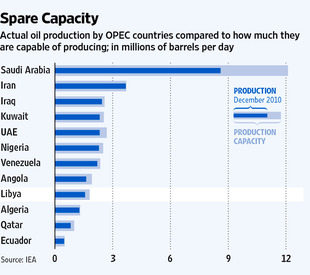
Comparison of production capacity to actual daily oil production by OPEC countries:

opec-spare-capacity.jpg

Source: The Wall Street Journal

Update: Why the Disruption of Libyan Oil Has Led to a Price Spike

Libya produces less than 2 percent of the world’s oil and exports little to the United States. But the quality of its reserves magnifies its importance, causing a spike in both American and European oil price benchmarks despite assurances from Saudi Arabia that it was ready to pump more oil to calm markets.

In New York West Texas Intermediate Benchmark crude for April delivery briefly touched $100 on Tuesday for the first time in more than two years, before easing moderately. In London, Brent crude for April delivery rose $5.47 to $111.25 a barrel.

Libya’s sweet crude cannot be easily replaced for the production of gasoline, diesel and jet fuel, particularly by the many European and Asian refineries that are not equipped to refine heavier grades of oil. Saudi Arabia may have more than 4 million barrels of spare capacity, but it includes heavier grades of crude that are higher in sulfur content and more expensive to refine.

“Quality matters more than quantity,” Larry Goldstein, a director of the Energy Policy Research Foundation, an organization partly financed by the oil industry.

Source: The New York Times

A Review of Investing in Foreign Stocks Via ADRs

One simple and easy way for U.S.-based investors to gain exposure to foreign equities is investing via American Depository Receipts (ADRs). The number of overseas companies listing on the U.S. markets continues to increase each year. Currently about 1,194 companies can be accessed with the sponsored DR programs and another 1,064 trade as unsponsored ADRs (Source: Bank of New York Mellon ADR site). Among the organized exchanges, 300 firms are listed on the NYSE and 104 on the NASDAQ. The rest of them trade on the Amex and OTC markets.

The major depository banks in the U.S. are: JPMorgan, Citi, BNY Mellon and Deutsche Bank. 81 new unsponsored programs were created in the first 11 months of 2010. Due to rising listing fees and regulatory requirements 11 foreign companies delisted from the organized U.S. exchanges and moved to the OTC last year.

The 10 most traded ADRs on the organized exchanges:

[TABLE=879]

The 10 most traded stocks on the OTCQX market:

[TABLE=880]

Note: The OTCQX market is the top tier of the OTC market where companies meeting the highest financial standards are listed.

Brazilian oil giant Petrobras (PBR) raised about $10 billion in a follow-on offering thru DR program in 2010 making it the largest-ever DR offering in history.

The top 20 global DR programs by value:

top-20-dr-programs-by-value.png

The above chart includes DR programs listed on the London Stock Exchange (LSE).

Source: Depository Receipts – Year in Review 2010, JP Morgan

Are Emerging Market Stocks Cheap Now?

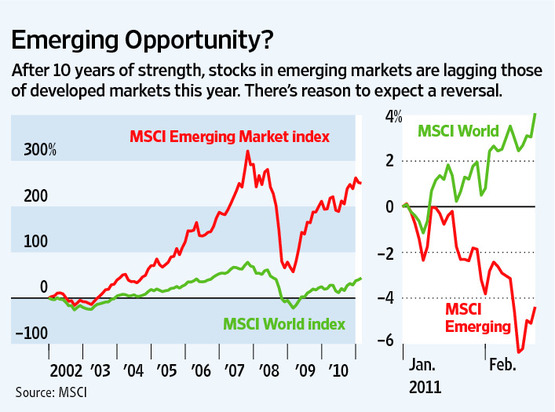
Emerging markets are lagging developed markets this year. The S&P 500 is up 6.8% YTD. The YTD returns of the major indices of some of the other developed markets are noted below:

Canada – 5.1%
Germany – 7.4%
Italy – 14.3%
Switzerland – 4.4%
Australia – 4.0%

On the other hand, the majority of the emerging markets have performed poorly this year after strong runs in the previous years. The YTD returns of the major indices of some of the emerging markets are shown below:

India – (11.2%)
China – 3.3%
Chile – (9.8%)
Brazil – (1.8%)
Mexico – (2.7%)

India is the worst performer among emerging markets with double digit losses.One of the reasons for the fall of emerging markets is the soaring inflation in those countries.

An article in The Wall Street Journal notes that emerging markets are getting cheap after the recent selloff. Some of the reasons attributed for this include the projected high GDP growth rates in these countries relative to the developed world and valuation. Since the financial crisis, the P/E ratios of emerging markets are on an average 16% lower than that of developed markets. Hence investors may want to consider adding high-quality EM stocks to their portfolios at current levels.

dev-em-markets.jpg

Source: The Wall Street Journal

Ten emerging market equities to consider for further analysis are listed below:

1.Company: HDFC Bank (HDB)
Sector: Banking
YTD Change: (8.26%)
Country: India

2.Company: Cemex (CX)
Sector: Cement Manufacturing
YTD Change: (9.52%)
Country: Mexico

3.Company: Braskem (BAK)
Sector: Chemicals
YTD Change: (4.06%)
Country: Brazil

4.Company: Vivo (VIV)
Sector: Mobile Telecom
YTD Change: 3.10%
Country: Brazil

5.Company: Banco Santander Chile (SAN)
Sector: Banking
YTD Change: (9.80%)
Country: Chile

6.Company: Taiwan Semiconductor Manufacturing (TSM)
Sector: Semiconductors
YTD Change: 2.15%
Country: Taiwan

7.Company: China Petroleum & Chemical (SNP)
Sector: Oil
YTD Change: 14.32%
Country: China

8.Company: CPFL Energia (CPL)
Sector: Electric Utility
YTD Change: (1.25%)
Country: Brazil

9.Company: Wimm-Bill-Dann Foods (WBD)
Sector: Food Producers
YTD Change: (1.61%)
Country: Russia

10.Company: China Eastern Airlines (CEA)
Sector: Airlines
YTD Change: (7.67%)
Country: China

Note: The YTD return is as of Feb 18, 2011

Related ETFs:

iShares MSCI Emerging Markets Index Fund (EEM)
Vanguard Emerging Markets ETF (VWO)

Disclosure: No Positions

Is the current U.S. Income Tax System Fair and Sustainable?

The official unemployment rate in January was 9% and the total number of unemployed persons were at 13.9 million according to BLS data. As of Feb 17th, 2011 the total U.S. debt held by the public is 9,490,705,812,100.38.  Foreigners held about $4.4 Trillion of U.S. treasury securities at the end of 2010. The U.S. spends billions of dollars in interest payments to service all this debt.

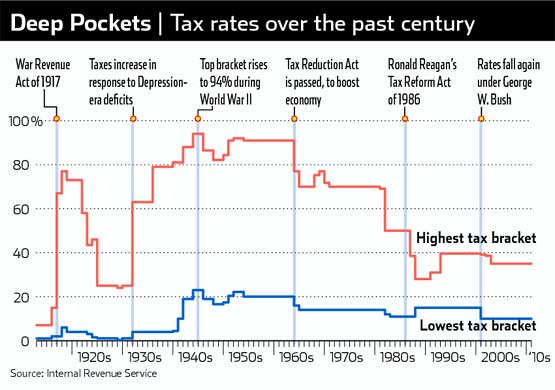
Despite the rise in prices of assets like equities in recent months, the U.S. economy continues to be in doldrums. The employment rare continues to remain stubbornly high in spite of record profits earned by corporations.In this context it a good idea to take a look at the current U.S. income tax system. The chart below shows the U.S. tax rate changes over the past century:

US-Historical-Tax-Rates

Source: The Wall Street Journal

The chart above shows that the tax rates for high earners in this country has been steadily declining since 1960s.During the Second World War the top tax bracket rose to 94%.But this rate stands at just 35% now for earned income over $379,150. The Federal lowest tax bracket stands at 10%.

Republicans would argue for further reduction of taxes saying that lower rates help stimulate the economy. Some democrats would argue for increasing taxes on the higher earners. The fact is that despite the fall in tax rates under the previous President George W.Bush the economy has not improved and the promised investments and job growth has not happened here. Instead companies have been creating jobs abroad and high earners have been reaping the rewards in terms of low taxes on capital gains, earned income and dividends. President Obama, a democrat, in another policy failure extended the Bush tax cuts again favoring the wealthy.

In general, the current U.S. tax regime is unfair, unsustainable and needs a complete overhaul. With the country involved in two wars, sky-high deficits and government spending poised to soar due to healthcare reforms, entitlement programs like social security, medicare, etc. it is time to raise the rates on the top tax bracket.The argument that lower tax rates for the wealthy stimulates economic growth no longer holds true.The current low tax rates and inflation in asset prices suits the wealthy perfectly well since they are able to multiply their wealth while the middle-class and the poor are forced to deal with rising gas, food, healthcare costs, etc. on top of the horrendous job market and collapse of the housing market. In addition, many states are cutting social services across the board as they are also suffering from budget issues due in part to reckless spending during the good times.