Why Invest In Singapore Stocks

singapore-merlionThe city state of Singapore is one of the developed markets in Asia. Unlike its neighboring country of Malaysia, Singapore had a strong political system since its independence that helped transform its economy into a highly industrialized economy on par with the developed world. As a major trading hub of global trade with a top banking sector global investors cannot afford to ignore Singapore.

From an investment standpoint, Singapore has many advantages over the U.S. and other developed markets. For example, while the dividend yield on the S&P 500 is 2.3% Singapore has a country yield of 2.9% as of Jan 2, 2014 according to FT market data. In order to identify potential investment options in Singapore I referred to the Singapore Dividend Equity Fund run by Nikko Asset Management Asia Limited.

According to Nikko, Singapore has a resilient economy and the four Cs which are discussed below:

  • Strong Confidence – The stability and security offered by the political system offers businesses a higher degree predictability.This in turn gives investors confidence in the Singapore market.
  • Strong Dividend Paying Culture – Singapore has a strong dividend culture and equities have one of the highest dividend yields in the Asia Pacific region.
  • Strong Corporate Governance – The high disclosure standards and transparency emphasized in the country leads to good corporate governance.
  • Strong and Stable Currency – Singapore enjoys a “AAA” credit rating and the Singapore Dollar remains strong due to the resilient economy.

The top 10 holdings of the fund as of 3Q, 2013 are listed below with the ADR ticker if available and the current dividend yield:

1.Company: DBS Group Holdings Ltd (DBSDY)
Current Dividend Yield: 5.01%
Sector: Banking

2.Company: Singapore Telecom (SGAPY)
Current Dividend Yield: 4.69%
Sector: Telecom

3.Company: Overseas-Chinese Banking Corp
Current Dividend Yield: N/A
Sector: Banking

4.Company: United Overseas Bank Ltd (UOVEY)
Current Dividend Yield: 3.35%
Sector: Banking

5.Company: Keppel Corp (KPELY)
Current Dividend Yield: 3.43%
Sector: Industrial Conglomerate

6.Company:Hong Kong Land Holdings Ltd
Current Dividend Yield: N/A
Sector: Real Estate

7.Company: Jardine Matheson Holdings Ltd (JMHLY)
Current Dividend Yield: 2.57%
Sector: Industrial Conglomerate

8.Company: Sembcorp Marine (SMBMY)
Current Dividend Yield: 2.99%
Sector: Marine Engineering and Services

9.Company: Thai Beverage PCL (TBVPY)
Current Dividend Yield: N/A
Sector: Beverages

10.Company: CapitaLand Ltd (CLLDY)
Current Dividend Yield: 2.37%
Sector: Real Estate

Since most of the Singapore companies do not trade on the organized exchanges, another simple and easy way to invest in Singapore equities is via the iShares MSCI Singapore ETF (EWS). The fund has over $1.1 billion in assets and a 12-month yield of 4.30%. The ETF is highly concentrated with financials accounting for over 52% of the portfolio. Most of the ten firms listed above are in the funds’ holdings. Hence this ETF offers direct exposure to those ten stocks.

Note: Dividend yields noted above are as of Jan 3, 2014. Data is known to be accurate from sources used.Please use your own due diligence before making any investment decisions.

Disclosure: No Positions
Is the US Manufacturing Industry Really Undergoing a ‘Renaissance’?

I wrote an article titled  Can the U.S. Become the Mecca of Manufacturing Again? back in May 2012. In the article noted why Caterpillar (CAT) shut down its plant in London, Ontario and moved it to Muncie, Indiana and that places like Greenville/Spartanburg corridor in South Carolina are emerging as the Mecca of manufacturing in the U.S quoting a Journal piece on the manufacturing industry.

Greg Meier, a strategist at Allianz  Global Investors published an excellent research report on this topic late last year. His main conclusion is “the concept of a manufacturing ‘renaissance’ is yet to be proven”. Before we get to his report, let me quote some recent media articles on the state of manufacturing industry in the U.S.

From U.S. Manufacturing Looks Set to Grow Bolder in The Wall Street Journal , Jan 4, 2014:

Some major investments are being made, particularly in the South. Airbus last April began building a passenger- jet factory in Mobile, Ala. In Louisiana, petrochemical plants are mushrooming. Keer Group, a Chinese textile firm, is spending $218 million to build a yarn-spinning factory near Charlotte, N.C.

Even so, the U.S. still relies heavily on products made overseas. The deficit on manufacturing trade totaled $568 billion in the first 10 months of 2013, narrowed only slightly from $574 billion a year earlier, Mr. Meckstroth calculates. U.S. manufacturers also face big challenges, including skill shortages, deteriorating highways and bridges, and higher taxes than most major foreign rivals.

Employment in U.S. manufacturing has grown about 5%, to 12 million jobs, since bottoming out in early 2010. But it is still 13% below the prerecession level of late 2007.

U.S. manufacturers have several trends running in their favor: Wages are flat, while those in China are soaring. U.S. energy costs have fallen. And many U.S. companies want to stop relying so heavily on foreign plants, where quality and delivery times are hard to control.

(Mr. Daniel Meckstroth is the chief economist at the Manufacturers Alliance for Productivity and Innovation, a research organization in Arlington, Va).

Here is Gary Shilling writing in a Bloomberg article on Nov, 2013:

Even with the recent strength in the U.S. manufacturing sector, labor-intensive industries won’t return to the U.S. as long as the huge labor compensation gaps persist with Asian and other developing countries. Sure, there will be niches created when quick delivery, changes in fashion and other developments require production to be close by.

The majority of what could be rapid growth in U.S. manufacturing will probably come from capital-intensive, robotics-intensive production that doesn’t require many people. Those employed in this area will need considerable skills. Furthermore, these are the industries that show rapid productivity growth as new technologies are introduced. But when productivity growth is robust, output will rise substantially without much increase in employment.

Source: U.S. Manufacturing Only Has Jobs for the Skilled Few, Bloomberg

From a September, 2013 article in The Washington Post’s Wonkblog:

The United States lost 6 million manufacturing jobs between 2000 and 2009. At least, that’s the official count from the Bureau of Labor Statistics. But could the official count be missing something?

In a new paper, two economists point out that nowadays there are lots of companies in the United States that aren’t counted as manufacturing by the government but are still heavily involved in the manufacturing of goods.

The prevalence of these “factory-less goods producers” — Apple, Inc. is a prime example — suggests that the country might have more manufacturing capabilities than official statistics suggest.

Some interesting facts from the industry’s trade association website:

In 2012, manufacturers contributed $1.87 trillion to the economy, up from $1.73 trillion in 2011. This was 11.9 percent of GDP. For every $1.00 spent in manufacturing, another $1.48 is added to the economy, the highest multiplier effect of any economic sector. 1

Manufacturing supports an estimated 17.2 million jobs in the United States—about one in six private-sector jobs. Nearly 12 million Americans (or 9 percent of the workforce) are employed directly in manufacturing.2

In 2011, the average manufacturing worker in the United States earned $77,060 annually, including pay and benefits. The average worker in all industries earned $60,168.3

Manufacturers in the United States are the most productive in the world, far surpassing the worker productivity of any other major manufacturing economy, leading to higher wages and living standards.4

Manufacturers in the United States perform two-thirds of all private-sector R&D in the nation, driving more innovation than any other sector.5

Taken alone, manufacturing in the United States would be the 10th largest economy in the world.6

1 Bureau of Economic Analysis, Industry Economic Accounts (2011).
2 Bureau of Labor Statistics (2012), with estimate of total employment supported by manufacturing calculated by NAM using data from the Bureau of Economic Analysis (2011).
3 Bureau of Economic Analysis (2011).
4 NAM calculations based on data from the United NationsBureau of Labor Statistics, and the International Labour Organization.
5 National Science Foundation (2008).
6 Bureau of Economic Analysis, Industry Economic Accounts (2011) and International Monetary Fund (2011).

Source: National Association of Manufacturers

The summary of five main points discussed by Greg Meier of Allianz Global Investors in his report are listed below:

Factor 1: The US macroeconomic backdrop
The U.S. economy is in recovery mode and the housing market is growing again. Hence U.S. consumers are planning to upgrade their cars and appliances, buy homes,etc.Producing products locally helps companies reduce the risk of supply disruption and save time and cost.

Factor 2: Relative labor costs
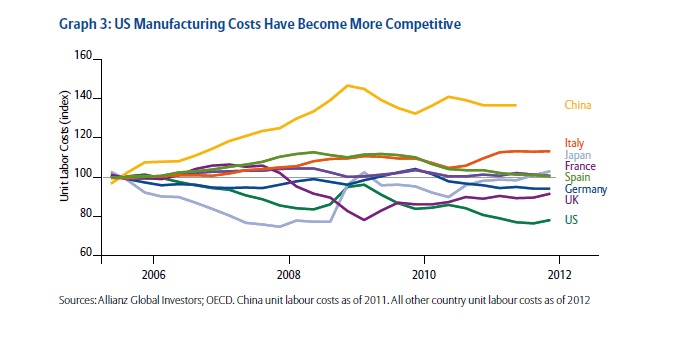
Labor costs are cheaper in the U.S. American manufacturing unit costs fell 20% from 2005 to 2012 according to the OECD. This compares to a 36% rise in Chinese labor costs from 2005 to 2011 as shown in the chart below:

Click to enlarge

Labor-Costs-Across-Countries

Factor 3: The shale energy revolution
The explosive growth of the shale oil industry has led to cheaper oil and natural gas prices in the U.S. helping energy-intensive industries such as paper and chemicals.

Factor 4: The value of the dollar
Since 2002 the US dollar has fallen about a third in value against six commonly-traded currencies of the world.This has dual benefit for U.S. manufacturers since it makes U.S. imports of foreign goods expensive and US goods cheaper to foreign buyers.

Factor 5: Tax and monetary policy
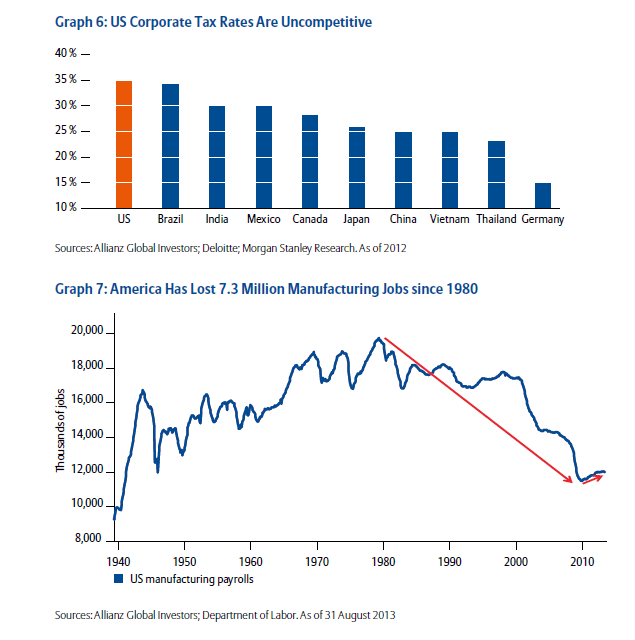
The biggest challenge to US manufacturing renaissance is the tax and monetary policy. The 35% statutory US corporate tax rate is uncompetitive relative to other developed economies.

Click to enlarge


US-Corporate-Tax-Rate-manufacturing-Job-Loss

US-Economy-Composition
The Federal Reserve will eventually reduce its stimulus program. This may strengthen the US dollar and is a risk to rate sensitive industries.

Here is Greg’s conclusion:

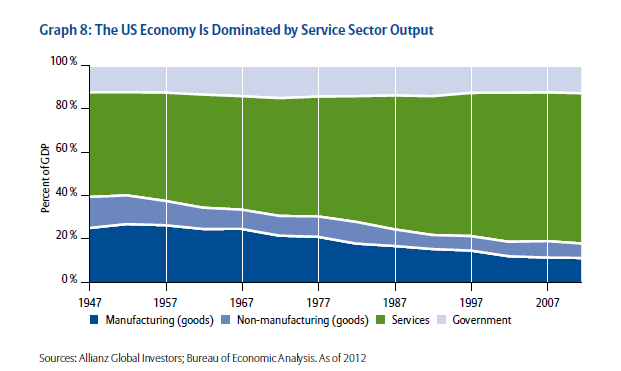
US manufacturers are supported by comparatively robust domestic demand and relatively cheap labour and energy costs. However, tax policy changes – the largest swing factor that could boost US manufacturing – look unlikely. Even then, a return to the glory days when manufacturing accounted for more than 25 % of US GDP and more than 30% of nonfarm payrolls would be difficult to achieve (see Graph 8). While the US offshoring trend of the last 50 years has likely peaked, the concept of a manufacturing ‘renaissance’ is yet to be proven.

Source: 

US Manufacturing: Prospects, Threats and Misperceptions – Is the US going through a manufacturing ‘renaissance’?, Allianz Global Investors

Related:

Spotted Again in America: Textile Jobs (WSJ)

BASF Steps Up Investment in U.S (WSJ)

Asset Class Returns From 2004 To 2013

J.P. Morgan Asset Management publishes the Guide to the Markets report each quarter. The latest report for Q1, 2014 is out and investors can find useful information in this 71-page report which is full of interesting charts and tables.

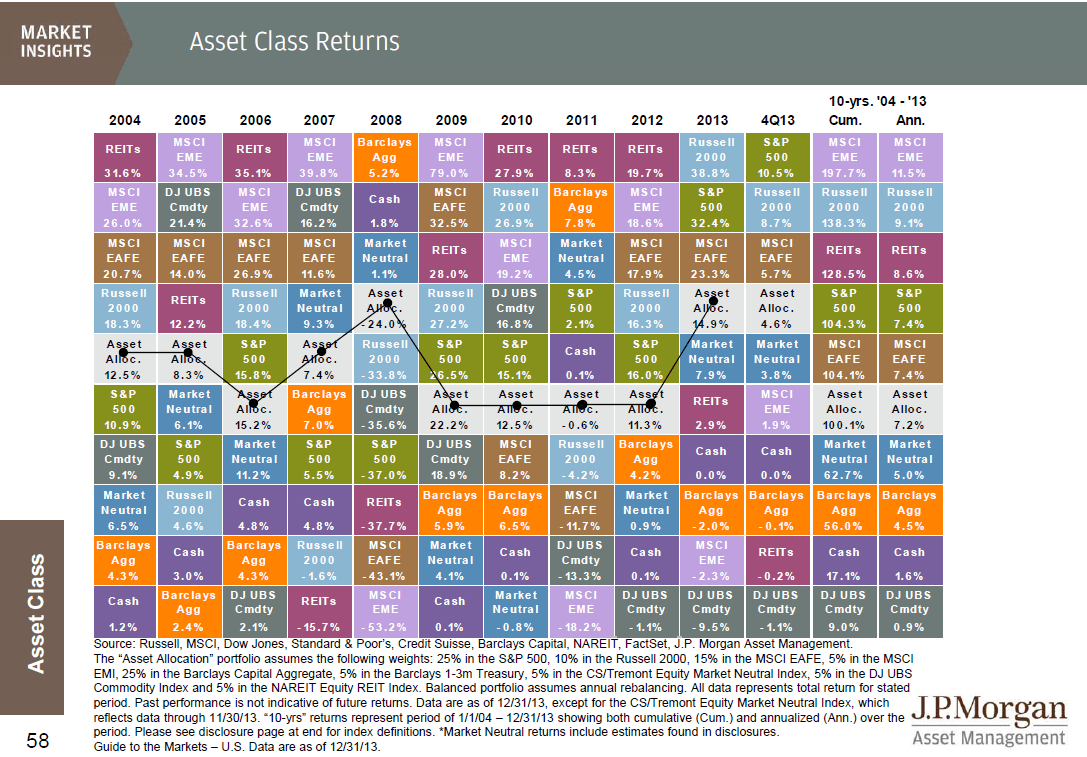
The Asset Class Returns chart for the period 2004 to 2013 is shown below:

Click to enlarge

Asset Class Returns 2004 to 2013

Source:  Guide to the Markets, J.P. Morgan Asset Management

This color-coded chart is modeled similar to the popular The Callan Periodic Table of Investment Returns. The chart above clearly shows the importance for diversification since the performance of asset classes vary every year.

Here are a few observations on the Asset Class Returns chart:

  1. The S&P 500 had a total return of 32.4% in 2013 which includes price appreciation and dividends. Excluding dividends the return amounted to about 30%.
  2. Commodities were poor performers last year with the Dow Jones Commodity Index falling 9.5%.
  3. The MSCI EAFE Index representing developed markets outside of the U.S. fared lower than the S&P 500 with a return of 23.3%.
  4. The cumulative return for the S&P 500 over 10 years was 104.3%. But emerging markets performed much better with a return of about 198%.Much of the gains came from the years before global financial crisis when commodity prices soared boosting many emerging markets.
  5. It is interesting that the U.S. and other developed markets had almost the same exact returns over the past 10 years.
  6. While REITs were the top performers in 2010, 2011 and 2012, last year they had a low return of 2.9%.

Related ETFs:

  • iShares MSCI Emerging Markets ETF (EEM)
  • Vanguard Emerging Markets ETF (VWO)
  • SPDR S&P 500 ETF (SPY)
  • SPDR STOXX Europe 50 ETF (FEU)
  • SPDR DJ Euro STOXX 50 ETF (FEZ)
  • iShares Barclays US Aggregate Bond Fund(AGG)

Disclosure: No Positions

Which ADRs Are The Most Widely Held?

Stocks of hundreds of foreign companies trade on the U.S. markets. For example, about 387 foreign companies (excluding Canada)are listed on the organized exchanges according to BNY Mellon. In addition, over 2300 companies trade on the OTC and OTCQX markets. However only some of these stocks are highly liquid and have a large following in the U.S. while others simply trade under the radar with a few hundred or thousand shares exchanging hands every day. There are also some companies which are rarely traded. This is especially true with companies trading on the OTC markets.

With so many choices available to invest  it can be a daunting task to figure out which companies to invest in for an investor looking to add foreign stocks.One way to pick stocks is to identify the ones that are widely held by other investors and then evaluate those stocks for potential addition to a portfolio.

The table below lists the ten most widely ADRs at end of 2013:

S.No.Company NameTickerShares HeldOwnership Value ($)Dividend Yield as of Dec 31, 2013
1BAIDU INCBIDU230.8M38.4BN/A
2DAIMLER AGDDAIY408M33.9B3.30%
3VODAFONE GROUPVOD670.5M24.9B4.13%
4UBS AGUBS1.1B21.8B0.83%
5BP PLCBP421.3M19.8B4.51%
6NOVARTIS AGNVS244.2M19.3B3.02%
7TAIWAN SEMICONDUCTOR MANUFACTURING CO LTDTSM1.1B19.3B2.87%
8TEVA PHARMACEUTICAL INDUSTRIES LTDTEVA452.5M18.4B2.73%
9ROYAL DUTCH SHELL PLCRDS.A263M17.5B5.05%
10GLAXOSMITHKLINE PLCGSK270M14.3B4.51%


Source: ADR.com

Each one of the ADRs has some unique characteristics. Baidu(BIDU) is the largest online search engine in based in China. Royal Dutch Shell, one of the world’s largest oil majors, has two types of shares listed on the NYSE – the A and B shares.However US investors  can avoid the withholding taxes on dividends completely if they held the A shares which is the UK version. The B shares are subject to Dutch dividend withholding taxes. Hence the most held Royal Dutch Shell share type by US investors is the A version as shown in the table above. Israel-based Teva Pharmaceutical Industries (TEVA) is one of the most widely ADRs because Teva is the largest generic drug maker in the world and is also one of the world’s large drug companies. So the company has excellent growth potential considering the demand for cheaper generics is rising in most countries.

Disclosure: No Positions

Gold: Bear Markets Since 1972

Gold is traditionally considered as a safe heaven asset and a hedge against inflation. Investors piled into Gold during times of economic uncertainty such as the period after the recent global financial crisis. In addition, gold is one of the preferred asset class for investors who lack faith in the current fiat currency system which allows countries to countries spend like drunken sailors without suffering the consequences at least in the short-term. This scenario is especially true in most of the the developed world where continuous economic growth is encouraged even if it means piling onto more debt.

Gold prices fell 28% in 2013 and closed at $1,202.30 an ounce in New York. According to a Bloomberg article, this is the first loss since 2000 and the biggest since 1981. From the article:

12-Year Rally

Gold surged more than 500 percent in the 12 straight years of gains through 2012 as the dollar weakened. The rally accelerated from December 2008 to June 2011 as the Fed expanded its balance sheet through debt purchases and held borrowing costs at a record low in a bid to revive growth amid a U.S. recession. Bullion reached a record $1,923.70 in September 2011.

“While there are no immediate worries about inflation, it can’t be ruled out in the future with economic growth accelerating in some parts of the world,” said Jeff Sica, who helps oversee more than $1 billion of assets as president of Sica Wealth Management in Morristown, New Jersey. “Gold will find support at lower prices with interest rates hovering near zero.”

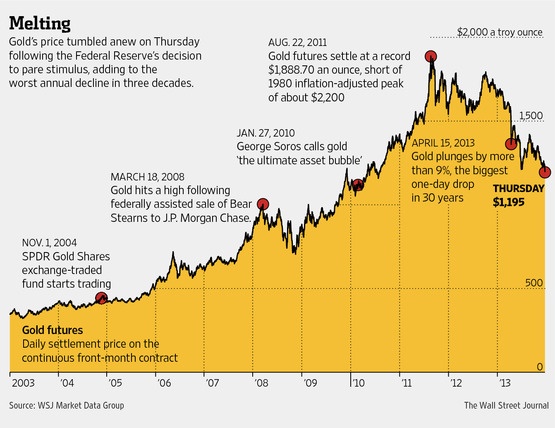
The  following chart from a December 20, 2013 article in The Wall Street Journal shows the dramatic rise in gold prices since 2003 and the following decline:

Click to enlarge

Gold-Prices-Since-2003

Source: Gold Is Testing ‘Last Ditch Support’ Before It Falls Further Into the Abyss, The Wall Street Journal

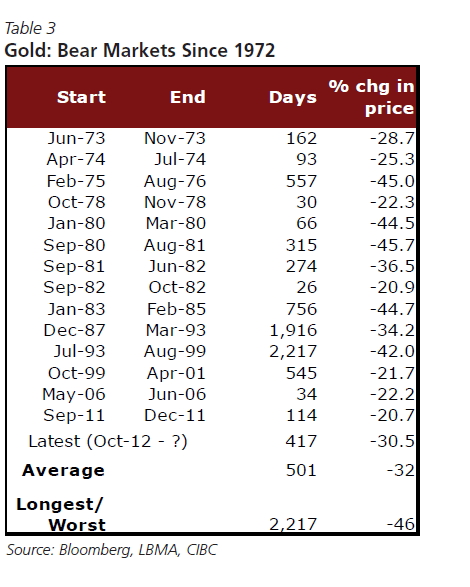
Since 1972 Gold has had at least 14 bear markets – defined as a fall of 20% or more as the table shows below:

Gold-Bear-Markets-1973

Source: A Look to the Future – 2014 Edition, CIBC World Markets

During bear markets lasting more than 500 days gold prices fell over one-third with exception of Oct-99 to Apr-01 period when it fell only about 22%.

CIBC World Markets projects gold has further to fall this year. They have a 2014-end a target of $1,000 an ounce. That would imply a decline of more than 15% from the current level.

Related ETF:

  • SPDR Gold Trust ETF (GLD)

Disclosure: No Positions