CIBC: Asian Stocks Are Well Positioned For 2014

Asian stocks have not significantly outperformed other major global indices during the past three to four years. The MSCI Asia ex-Japan index has mostly went sideways during the period.

Click to enlarge
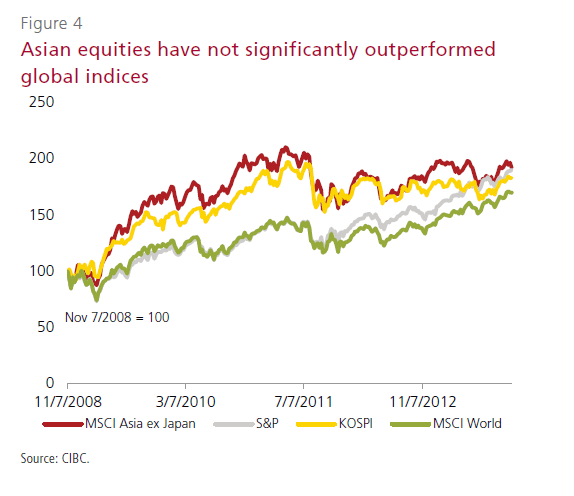
Asian-Stock-Returns-vs-Global-Indices


According to a report by CIBC World Markets, Asian equities are well positioned to post solid returns in 2014. Some of the reasons CIBC offers in support of this prediction are:

  • Asian markets have generally positive fundamentals.
  • The asset markets in Asia have not been excessively inflated by global easing.
  • The Fed tapering may not affect these markets.
  • Inter-regional trade is growing strongly in Asia with countries in the region trading more with one another than with developed countries. This has helped reduce the adverse effect of soft demand from the developed world. For example, China is the largest trade partner of both South Korea and Taiwan.
  • Asia’s current account surplus has stabilized this year as shown in the chart below:

Click to enlarge

Asia Current Account Surplus

Some of the other factors noted by CIBC in favor of Asian economies include:

Solid economic fundamentals in the fashion of moderate growth, (mostly) low inflation, currencies that are by and large on the cheap side of fair value, and policymakers willing and ready to respond to.

Source: A Look to the Future – 2014 Edition, CIBC World Markets

In general, consumption of goods and services in many Asian countries is increasing faster as wages rise. For example, wages in China have increased so much in the past few years that some manufacturers are shifting their operations to cheaper countries such as Vietnam or Cambodia. Other than the developed Asian countries, poor infrastructure is a major impediment to growth in emerging Asian countries. So growing investments in infrastructure development should help drive economic growth in addition to rising private consumption.

Ten stocks from ten Asian economies trading on the US markets are listed below for consideration:

1.Company: China National Offshore Oil-CNOOC (CEO)
Current Dividend Yield: 3.60%
Sector:Oil & Gas Producers
Country: China

2.Company: Chunghwa Telecom (CHT)
Current Dividend Yield: 4.93%
Sector: Telecom
Country: Taiwan

3.Company: HDFC Bank (HDB)
Current Dividend Yield: 0.75%
Sector: Banking
Country: India

4.Company: Posco (PKX)
Current Dividend Yield: 1.89%
Sector: Metals & Mining
Country: South Korea

5.Company: Telekomunikasi Indonesia (TLK)
Current Dividend Yield: 3.47%
Sector: Telecom
Country: Indonesia

6.Company: Philippine Long Distance Telephone (PHI)
Current Dividend Yield: 4.81%
Sector: Telecom
Country: Philippines

7.Company:United Overseas Bank(UOVEY)
Current Dividend Yield: 3.31%
Sector: Banking
Country: Singapore

8.Company: Malayan Banking Berhad(MLYBY)
Current Dividend Yield: 5.78%
Sector: Banking
Country: Malaysia

9.Company:PTT Exploration & Production (PEXNY)
Current Dividend Yield: 3.81%
Sector: Oil & Gas Producers
Country: Thailand

10.Company:Hang Seng Bank (HSNGY)
Current Dividend Yield: 4.19%
Sector: Banking
Country: Hong Kong

Note: Dividend yields noted above are as of Dec 27, 2013. Data is known to be accurate from sources used.Please use your own due diligence before making any investment decisions.

Disclosure: No Positions

Knowledge is Power: Food Stamps, Lessons Learned, Contrarian Bet Edition

UK Europe’s ‘largest’ economy by 2030 (BBC)

The companies Canadians love most (Canadian Business)

Demand for food stamps soars in US (The Guardian)

Long term investing – the best gift to give your children (New.com.au)

Europe: cheap shares continue to lure investors (CityWire)

Why I’m loading up on shares for 2014 (MoneyWeek)

Lessons Learned in 2013 (Alliance Bernstein blog)

Innovation in Latin America (OECD Observer)

Why emerging markets are a contrarian’s best bet for 2014 (FE Trustnet)

Singapore-Cable-Car

 Singapore Cable Car

Dividend Payout Ratio: U.S. vs. Asia-Pacific(ex Japan) Region

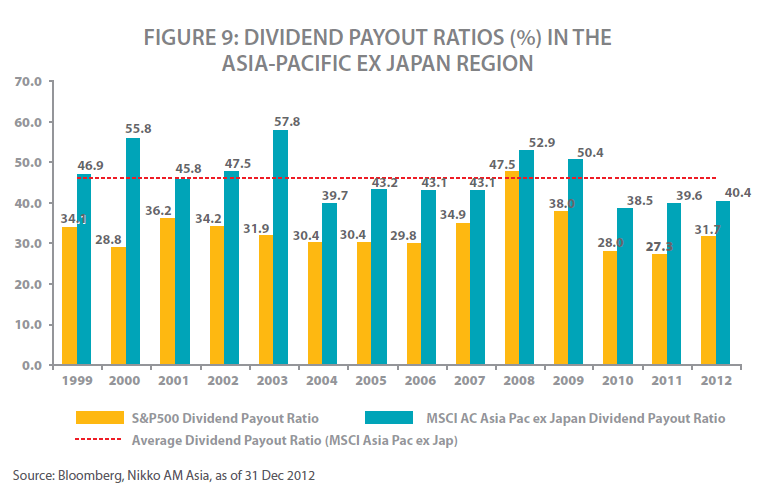
Dividend payout ratios are higher in the Asia-Pacific(excluding Japan) region than in the U.S. Historically Asian firms have paid out more in dividends than their U.S. peers.

The graph below shows the dividend payout ratio in the Asia Pacific region and the S&P 500 by year:

Click to enlarge

Dividend Payout Ratios for US vs. Asia Pacific

Source: High Dividend Investing – East Side Story, Nikko Asset Management, Singapore

Every year since 1999 the dividend ratio in the Asia-Pacific region is higher than in the U.S. In addition, the dividend per share (DPS) has been growing at an annualized rate of 8% in the Asia-pacific region compared to 5% for the S&P 500 firms.

Related ETFs:

  • SPDR S&P Dividend ETF (SDY)
  • SPDR S&P 500 ETF (SPY)
  • iShares Asia/Pacific Dividend (DVYA)

Disclosure: No Positions

Why Invest In Asia-Pacific Dividend Stocks

The current dividend yield on the S&P is 2.30% as of Dec 20, 2013. Compared to this low yield, some markets in the Asia Pacific region have higher yields while others have similar low yields. The dividend yields of select Asian countries according to data from Financial Times are listed below:

Australia – 4.1%
China – 4.5%
Hong Kong – 2.9%
Indonesia – 2.7%
India – 1.7%
Philippines – 1.9%
South Korea – 1.1%
Taiwan – 2.7%
Thailand – 3.3%

Investors generally invest in Asian stocks mainly for price appreciation and not for dividend returns. This is particularly true for investments made in emerging Asian countries. However this need not be the case. Instead of simply focusing on price appreciation, investors must consider total returns which includes both price appreciation and dividend returns.

Asian dividend stocks should be part of well-diversified portfolio. Some of the reasons for holding dividend stocks from the Asia Pacific markets include:

  • Dividends boost the total return even when the yields are low such as the Korea market with its 1.1% yield.
  • They help reduce volatility in a portfolio. Unlike developed markets, Asian emerging markets are highly volatile. It is not uncommon for stable large-cap stocks such as those in consumer staples, banking, utility sector to swing 5% to 10% from one day to another.
  • Dividends can account for a large portion of total returns in the long-term.
  • Many emerging Asian companies are embracing the dividend culture and are increasingly paying out a larger portion of profits to shareholders.
  • In some countries, the government is the majority shareholder in publicly-traded companies which were formerly state-owned monopolies. These companies regularly pay out big dividends in order to please the government.

According to a research report by Nikko Asset Management annualized volatility for Asia-Pacific equity markets since 1988 was 21.8% which is much higher than the US rate of 14.8%.

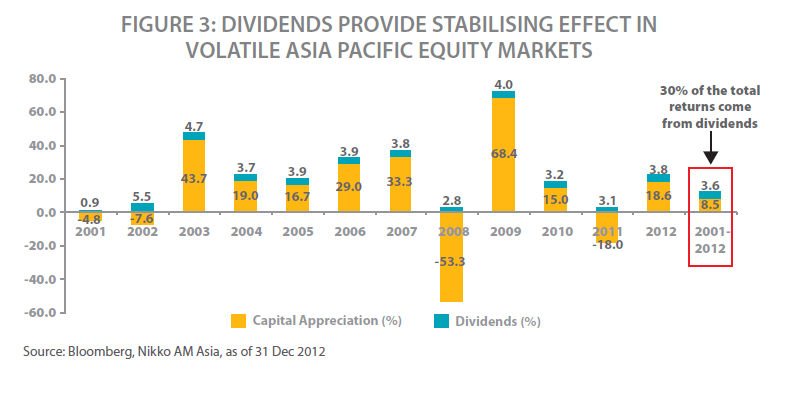
The following chart shows the importance of dividends in Asian equity returns over the long-term:

Click to enlarge

Asia-pacific-Dividend-Price-Return-by-Year


On a yearly basis dividend returns are small compared to price appreciation. However for the period from 2001 to 2012 dividends accounted for an astonishing 30% of the total returns.

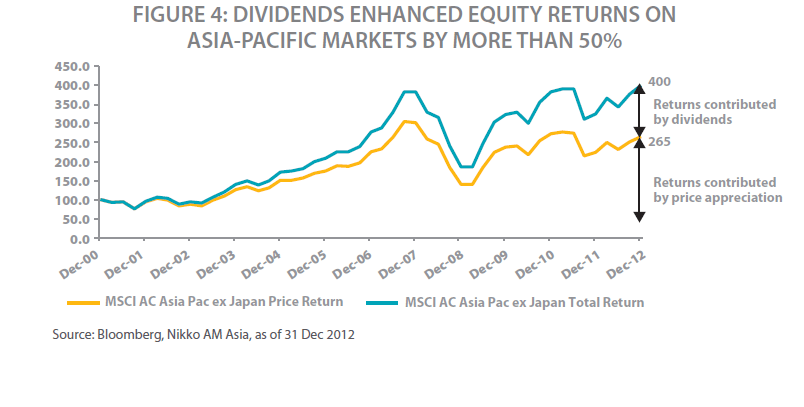
The chart below shows how reinvestment of dividends boosted total returns by more than 50% during the same time period:

Asia-pacific-Dividend-Returns-Contribution-to-Total-Return

Source: High Dividend Investing – East Side Story, Nikko Asset Management, Singapore

Ten Asia-Pacific dividend stocks are listed below for further research:

1.Company: Taiwan Semiconductor Manufacturing Co Ltd (TSM)
Current Dividend Yield: 3.15%
Sector: Semiconductors
Country: Taiwan

2.Company: PetroChina Co Ltd (PTR)
Current Dividend Yield: 3.68%
Sector: Oil & Gas Operations
Country: China

3.Company: Philippine Long Distance Telephone Co (PHI)
Current Dividend Yield: 4.14%
Sector:Communications Services
Country:Philippines

4.Company: China Petroleum & Chemical Corp (SNP)
Current Dividend Yield: 4.40%
Sector: Oil & Gas Operations
Country: China

5.Company: Chunghwa Telecom Co Ltd (CHT)
Current Dividend Yield: 5.81%
Sector: Telecom
Country: Taiwan

6.Company: PT Telekomunikasi Indonesia (TLK)
Current Dividend Yield: 3.37%
Sector: Telecom
Country: Indonesia

7.Company: Westpac Banking Corp (WBK)
Current Dividend Yield: 5.92%
Sector: Banking
Country: Australia

8.Company: Australia and New Zealand Banking Group Ltd (ANZBY)
Current Dividend Yield: 5.13%
Sector: Banking
Country: Australia

9.Company: Telstra Corporation Ltd (TLSYY)
Current Dividend Yield: 5.92%
Sector:Telecom
Country: Australia

10.Company: DBS Group Holdings Ltd (DBSDY)
Current Dividend Yield: 5.04%
Sector: Banking
Country: Singapore

Note: Dividend yields noted above are as of Dec 24, 2013. Data is known to be accurate from sources used.Please use your own due diligence before making any investment decisions.

Disclosure: No Positions
Why Dividends Matter During Any Market Condition

Some investors tend to invest in equities primarily for price appreciation. They ignore dividends or consider dividends to be of low to no significance. However the strategy of ignoring dividends and concentrating purely on share price growth may not work all the time. This is especially true during times of economic uncertainty or recessions.

Dividends matter during both bull and bear markets. During bull markets dividends an extra kick to the total return while during bear markets they offer a cushion effect to a portfolio and provide at least some returns as opposed to no returns at all.

Dividends are a significant part of the total returns especially for high-quality stocks held for the long-term such as 5 years or more. The following chart shows the contribution of price appreciation and dividends to the total return of the S&P 500 since 1930 by decade:

Click to enlargeTotal Return of SP500 from 1930 to 2012

Source: High Dividend Investing – East Side StoryNikko Asset Management, Singapore

Dividends contributed more to total returns than capital appreciation during the following four decades: 1930-1939, 1940-1949, 1970-1979 and 2000-2009.  These four decades were periods of low or uncertain economic growth in the U.S.  The 1930s and 40s saw The Great Depression and World War II. The Oil Crisis of the 1970s adversely affected economic growth and more recently the crash of the dot-com bubble in the last decade killed stock prices and the negative effects lingered for many years that followed.

Even when we consider the bull markets of the 50s, 80s and 90s dividends were a significant portion of the total returns of the S&P 500. For example, in the period 1950-1959 dividends accounted for about 28% of total returns. During the 1990s when the dot-com stocks were all the rage, dividends contributed 15% of the total return of 18%.

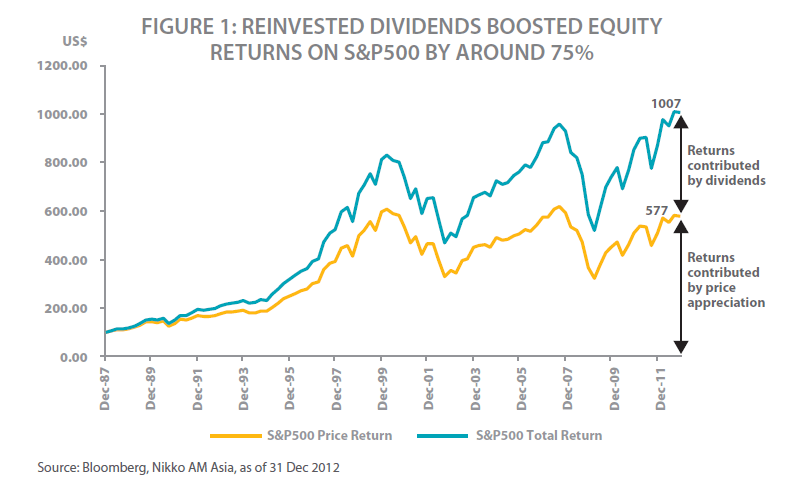
Reinvestment of dividends can boost total returns significantly over the long-term due to the effect of dividend growth and compounding. The chart below shows the growth of $100 invested in an S&P 500 index tracker fund from Dec 31, 1987 to Dec 31, 2012 by price appreciation and reinvestment of dividends:

Reinvestment-of-Dividends-Strategy-2

Based on purely price appreciation the $100 investment would have grown to $577 by the end of 2012. However it would grown to $1,007 had the dividends received over the years were reinvested. Hence the reinvested dividends boosted an investor’s return by 75%. This shows the importance of dividends and dividend reinvestment when evaluating the total return of an equity investment.

A few of the high-quality S&P 500 stocks that investors can consider holding for both share price growth and dividends are  Johnson & Johnson (JNJ), Colgate-Palmolive Co(CL), General Mills Inc (GIS), Northrop Grumman Corp (NOC) and FedEx Corp (FDX).

Related ETF:

  • SPDR S&P Dividend ETF (SDY)

Disclosure: Long GIS