Average Stock Dividend Yields By Country

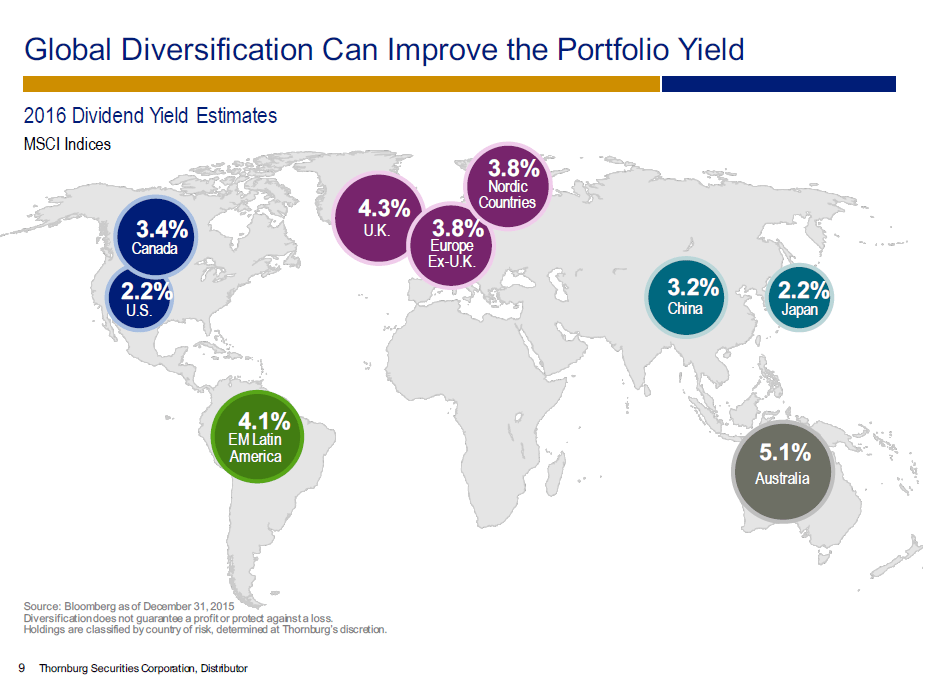
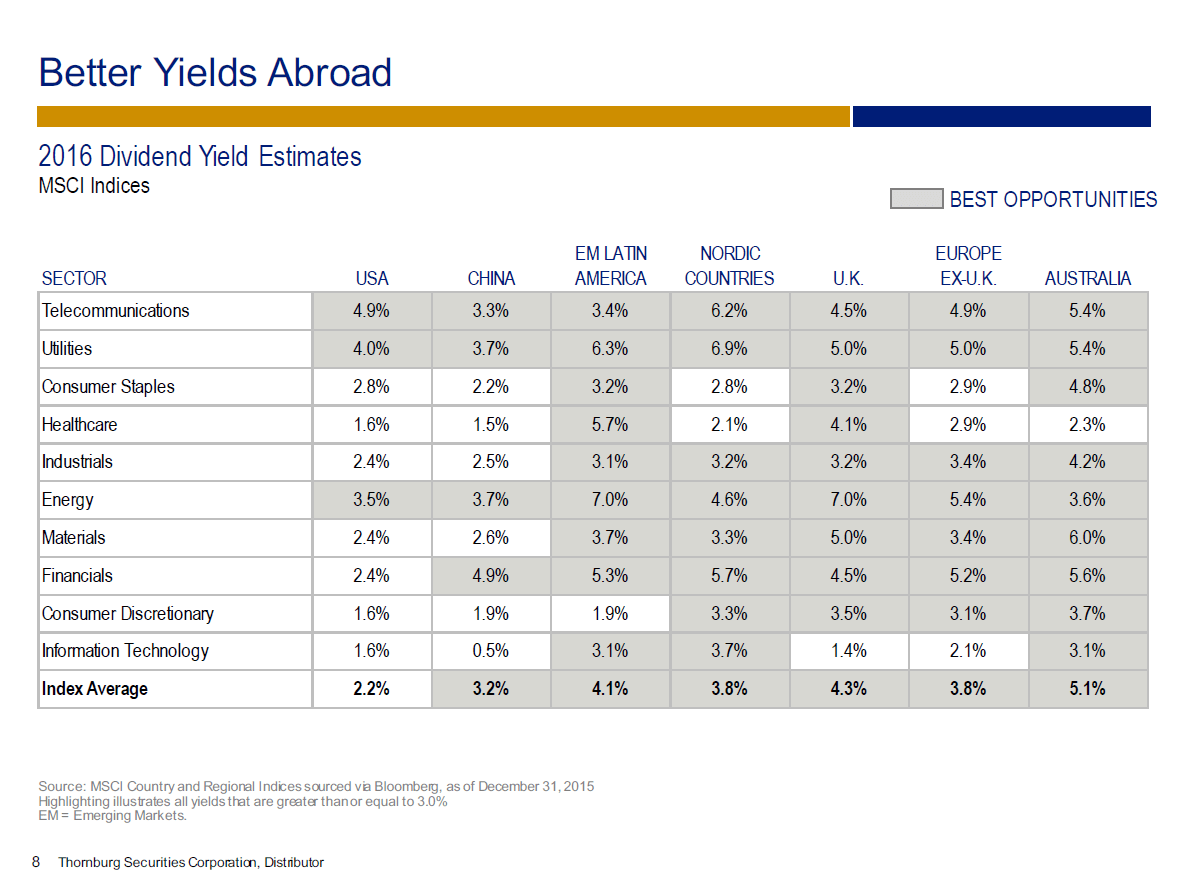
Dividend yields are generally higher overseas relative to the U.S. market. In the U.S. investors and management tend to prefer high share prices while in other developed economies investors prefer both moderate price appreciation and high dividend payments.

The following chart shows the Average Stock Dividend Yields in G-20 countries:

Click to enlarge

Dividend Yields by Country Jan 2016

Source: The Dividend Signal Uncovering Global Growth Opportunities, Salient Partners

Here a few points to remember when investing in foreign stocks for dividends:

  • Other developed countries such as France, Germany, UK, etc. have higher average dividend yields than the U.S.
  • Even just venturing Canada one can earn more than 3% dividends compared to the average of around 2% to US stocks.
  • South Korea, India and Japan are low dividend countries and hence income investors can avoid dividend stocks in those countries.
  • Investing in foreign stocks for dividend involves dividend withholding taxes.So investors should be mindful of the effects of this tax and try to avoid it if possible.

Credit Suisse Global Investment Returns Yearbook 2016

Credit Suisse published the popular Global Investment Returns Yearbook for 2016 last month. The report contains a wealth of data especially from a long-term and country-specific perspective.

The following is a sample chart from the report. It shows the relative shows of the equity markets by country at the end of 1899 and 2015:

Click to enlarge

Credit Suisse Global Investment Returns Yearbook 2016 World Equity Market Sizes 1899 and 2015

The US equity market capitalization of the end of 1899 was just one-fourth of the world markets capitalization. Today it accounts for over 52%. UK on the other hand fell from over 25% of the world market size to just about 6% now.

Credit Suisse Global Investment yearbook 2016

Download the full Credit Suisse Global Investment Returns Yearbook for 2016  report (in pdf) by clicking on the above image.

Source: Credit Suisse

Related: Download: Credit Suisse Global Investment Returns Yearbook 2015

Majority Of American Workers Do Not Have A College Degree

Higher education is a big business in the U.S. Every year millions of students graduate from schools across the country with billions of dollars in student loan debt. Tuition at both public and private universities and colleges have increased year after year with demand for getting a degree going only higher.

In an article a few years ago I wrote about some of the reasons for the ever increasing college tuition in the U.S. One of the main reason for the craze to get a degree is that employers are increasingly demanding a degree even for a job that requires just English reading and writing skills. The most basic of a job function such as secretary for the front office requires a college as if a degree is needed to take phone calls, take notes, making hotel reservations, decorate office buildings with balloons for a party, etc.

Though a college degree has become mandatory to get any decent job, that rule seems to apply only to new workers joining the workforce in the past couple of decades. Many of the workers that already in the work force do not have a degree. In fact, according to a study by EPI more than two-thirds of American workers do not have a college degree.

Click to enlarge

US Workers College Degree By State

From the EPI report:

Almost two-thirds of people in the labor force (65.1 percent) do not have a college degree. In fact, people without a college degree (which includes those without a high school degree, with a high school degree, some college education, and an associates’ degrees) make up the majority of the labor force in every state but the District of Columbia. Mississippi has the highest share of non-college educated workers (75.7 percent) while Massachusetts and the District of Columbia have the lowest shares (51 percent and 33.7 percent, respectively).

While this two-thirds figure looks surprising college degree was not needed to get a job many decades ago. In fact, going to college was a privilege and not a right and few bothered to get a degree as it was demanded by companies. Millions of workers led a comfortable middle-class life working in auto factories, appliance factories, etc. without needing a degree. Many of those older workers are still in the labor today waiting to retire. In the future, getting a degree would be the equivalent of getting a high school diploma.

Source: Almost two-thirds of people in the labor force do not have a college degree, EPI, Mar 30, 2016

Does Market Timing Work In Emerging Markets?

One of the equity strategy topics that I discuss here often is the concept of ‘Market Timing’. This involves simply buying stocks when the market is down and then selling them when the market is at the top. Sounds simple. But if it were that easy then everyone would be a millionaire. In reality, timing the market does not work for almost all investors. Even professional fund managers who manage other people’s money for a living with teams of experts, sophisticated computer models and other better information fail miserably trying to time the market. So for retail investors it goes without saying that they should not time the market. In fact, the time in the market is more important than timing the market,

For example, investors who panicked and sold out at the trough of the global financial crisis of 2008-09 ended up with losses.On the other hand, those who stayed put and did not take a single portfolio action (i.e. either buying or selling) are now sitting on nice gains as the S&P 500 has more than doubled since then. Using the concept of market timing, early 2009 would have been an excellent time to buy stocks at dirt cheap prices. However majority of the investors including myself did not have the guts to invest any new money in the market. I remember reading about one French fund manager who was vacationing somewhere in Thailand in early 2009 and had watched the market crashing to new lows. He had the instinct to immediately plough millions of dollars of his firm’s assets into top-quality stocks at low prices. Many years later he recalled how his fund holdings had soared in value as markets recovered all those losses and then moved even higher. However managers such as this one are very very rare indeed.

Going to market timing, the easiest thing for most retail investors to build a diversified portfolio and hold it for the long-term. In fact, market panics like earlier this year’s collapse are a great time to pick up additional stocks if one has the funds to invest and has identified stocks to buy. Some of my earlier articles on market timing can be found here and here and here and here and here.

Timing the market does not work in any market. Emerging markets are no exception. In fact, emerging markets by definition are more volatile and it is foolish to time the markets in emerging equities. It is not uncommon for individual stocks in emerging countries to soar or decline by 10% or more in a single day. Similarly markets as a whole tend to fall fast and soar high almost overnight.

I came across an fascinating article that shows how market timing does not work in emerging markets also.

Click to enlarge

Market Timing in Emerging Markets

From the article:

‘Time In’ the markets. Missing just a few of the best performing trading days can be significantly detrimental to returns. Total returns for the MSCI EM Index since 1/3/2000 until 10/30/2015 has been 151%, but this number falls sharply if the best daily returns are excluded. As the chart shows, if the 16 best trading days out of 4,131 total days were missed, the total return of the MSCI EM Index drops to below zero. Missing the best 25 days brings investors significantly below zero. We believe that investors should consider that ‘timing’ the markets is not as important as ‘time in’ the markets.

Source: Market Timing vs. Time in the Market, Emerging Global Advisors, LLC

Related ETFs:

  • iShares MSCI Emerging Markets ETF (EEM)
  • Vanguard MSCI Emerging Markets ETF (VWO)

Disclosure: No Positions

The World’s Best Developed Markets Banks 2016

Every year Global Finance magazine publishes the list of world’s best banks. This years ranking was published recently. The full list of banks and additional details will be released in May. From the press release:

Global Finance, founded in 1987, has a circulation of 50,050 and readers in 180 countries. Global Finance’s audience includes senior corporate and financial officers responsible for making investment and strategic decisions at multinational companies and financial institutions. Global Finance also targets the 8,000 international portfolio investors responsible for more than 80% of all global assets under professional management.

Its website — GFMag.com — offers analysis and articles that are the heritage of 29 years of experience in international financial markets. Global Finance is headquartered in New York, with offices around the world. Global Finance regularly selects the top performers among banks and other providers of financial services. These awards have become a trusted standard of excellence for the global financial community.

The following are the World’s Best Developed Markets Banks 2016:

S.No.CountryWinner
1AustriaErste Bank
2BelgiumKBC
3CyprusHellenic Bank
4DenmarkDanske Bank
5FinlandPohjola Bank
6FranceCredit Mutuel
7GermanyCommerzbank
8AndorràCrèdit Andorrà
9GreeceEurobank Ergasias
10IcelandLandsbankinn
11IrelandBank of Ireland
12ItalyIntesa Sanpaolo
13LuxembourgBanque et Caisse d’Epargne de l’Etat
14MaltaBank of Valletta
15NorwayNordea
16PortugalBanco Santander Totta
17SpainCaixaBank
18SwedenSEB
19SwitzerlandZürcher Kantonalbank
20The NetherlandsING
21UKSantander
22CanadaRoyal Bank of Canada
23USWells Fargo
24BermudaButterfield Bank
25AustraliaWestpac
26Hong KongBank East Asia
27New ZealandWestpac New Zealand
28SingaporeOversea-Chinese Banking Corp
29IsraelBank Hapoalim

Download: The World’s Best Developed Markets Banks 2016 (in Excel)

Source: Global Finance Names The World’s Best Banks 2016, Global Finance

This year’s list includes a few surprises. One of the four super-banks, US-based Wells Fargo(WFC) is the best bank in the US. This is not surprising since the bank has been a consistent performer and is well known for strong customer relationships with many customer’s having multiple products with the bank. Royal Bank of Canada(RY) is the best bank north of the border.Royal Bank is the most profitable bank in Canada and has an excellent track record in terms of shareholder returns.

In developed Europe, ING Groep (ING) is the top bank in Holland. After the financial crisis, ING has made many smart moves including divesting units such as ING Direct and is now on a recovery mode. In Germany, Deutsche Bank is in chaos and has suspended its dividends. So competitor Commerzbank (CRZBY) is the best bank according to Global Finance. Commerzbank’s share collapsed during the financial crisis due to its high exposure to the shipping industry and is now slowly recovering. It is interesting that Spain-based Santander (SAN) is the best bank in the UK. All the British banks are still suffering and most investors are avoiding them at all costs. It may take many decades for British banks to regain their former glory.

Australia’s Westpac(WBK) is the top bank in both the domestic market and New Zealand.

Also see: Bloomberg: The World’s Strongest Banks 2015, Aug 1, 2015 TFS

Disclosure: Long WBK, RY, ING, SAN