The STOXX Europe 600 Index Companies’ Sales by Country/Region

We have looked at S&P 500 companies’ sales by region/country before. In this post let us review the revenue composition of European companies by region/country using the The STOXX Europe 600 Index.

The STOXX Europe 600 Index is represents 600 large, mid and small capitalization companies across 17 countries of the European region: Austria, Belgium, Czech Republic, Denmark, Finland, France, Germany, Ireland, Italy, Luxembourg, the Netherlands, Norway, Portugal, Spain, Sweden, Switzerland and the United Kingdom. So this index is an ideal choice to evaluate sales since it gives a broad exposure not only countries but also includes companies of all sizes.

According to the authors of the above article a rising Euro and declining dollar has relatively low impact on the earnings of European firms since they have low exposure to the US market. From the piece:

Downside to the U.S. dollar’s decline?
As noted, the weaker U.S. dollar has aided U.S. companies which have international operations. However, there are two sides to a trade—a winner and “loser.” The sharp and ongoing rise in the euro versus the dollar has turned the 5% gain this year for the Europe STOXX 600 index into an 18% gain when measured in dollars, nearly doubling the 10% rise in the S&P 500. While this outperformance has been welcomed by investors in international stocks, the downside of a stronger currency for European companies is that it could mean weaker reported earnings growth as sales in foreign currency translate into fewer euros. For example, $100 of sales at the beginning of this year was worth 96.1 euros, but as of the end of July it was worth only 83.4 euros—a 13% decline for the same dollar amount of sales.

Fortunately, the stronger euro doesn’t seem to be weighing on profit growth for companies in the region. Profits are rising thanks to sales to the United States making up only 16% of the total for the companies in the MSCI Euro Index; and most sales coming from within Europe where economic growth has been solid, as you can see in the chart below.

Source: Schwab Market Perspective: Things are Looking Good … But are They Too Good?, Schwab

More than half of sales for the companies in the index comes from Europe and the UK. It is interesting to note that the US accounts for a large share of their revenues than Asia Pacific where two of the largest emerging countries are located. While some large-cap European multinationals have large exposure to emerging markets, on an aggregate most European firms depend on Europe. So when Euro strengthens and European economies are growing these companies prosper.

The chart below shows the long-term return of the index in Euro terms:

Click to enlarge
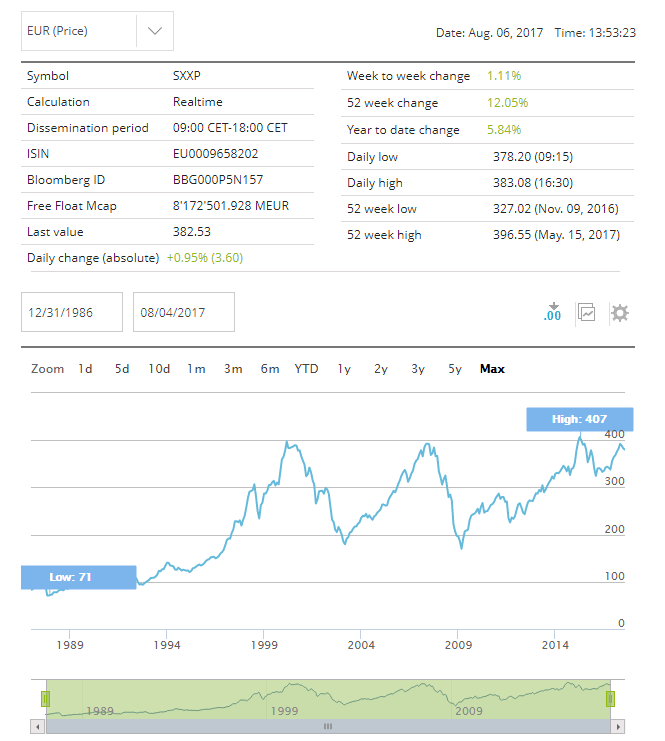
Source: STOXX

Ten components from the above index are listed below with their current dividend yield on the US market for further research:

1.Company: Nestle SA (NSRGY)
Current Dividend Yield: 2.68%
Sector: Food Products
Country: Switzerland

2.Company: Novartis AG (NVS)
Current Dividend Yield: 3.20%
Sector: Pharmaceuticals
Country: Switzerland

3.Company: Roche Holding AG (RHHBY)
Current Dividend Yield: 3.22%
Sector: Pharmaceuticals
Country: Switzerland

4.Company: Total SA (TOT)
Current Dividend Yield: 5.12%
Sector: Oil, Gas & Consumable Fuels
Country: France

5.Company: British American Tobacco PLC (BTI)
Current Dividend Yield: 3.43%
Sector:Tobacco
Country: UK

6.Company: Royal Dutch Shell PLC (RDS.A)
Current Dividend Yield: 6.56%
Sector: Oil, Gas & Consumable Fuels
Country: UK

7.Company: BP PLC (BP
Current Dividend Yield: 6.61%
Sector: Oil, Gas & Consumable Fuels
Country: UK

8.Company: Siemens AG (SIEGY)
Current Dividend Yield: 2.94%
Sector:Industrial Conglomerates
Country: Germany

9.Company: Sanofi (SNY)
Current Dividend Yield: 3.41%
Sector: Pharmaceuticals
Country: France

10.Company: BASF SE (BASFY)
Current Dividend Yield: 3.46%
Sector:Chemicals
Country: Germany

Note: Dividend yields noted above are as of Aug 4, 2017. Data is known to be accurate from sources used.Please use your own due diligence before making any investment decisions.

Disclosure: No Positions
Can a Stock Price Decline from $1.483 BILLION per Share To just $1.40 per Share?

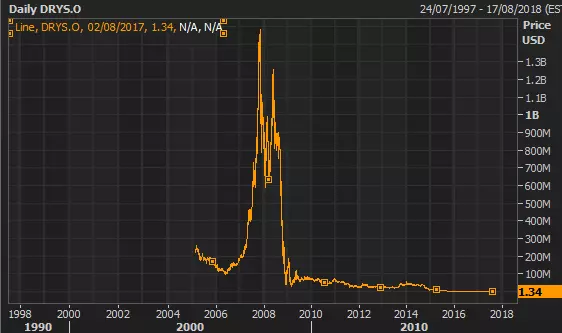
Investing in the equity markets is not for the faint-hearted. Many questionable companies’ stocks trade everyday on markets worldwide. One example of the extreme case of public company is NASDAQ-listed Greek shipping company DryShips Inc (DRYS). According to a post in FT Alphaville recently, the share price of DRYS has plunged from from $1.483 BILLION per Share from peak to just $1.40 per Share on Thursday. The figures are not a typo.

DRYS long-term chart:


Source: Who buys DRYS? by Paul Murphy, FT Alphaville

In addition to the collapse in share prices, the company implemented multiple reverse stocks splits in recent years. The FT article notes that in the past four months reverse splits were done every month to get the stock price above $1.

Another example of a Greek shipping stock that has become practically worthless is Diana Containerships Inc. (DCIX).

Key Takeaways from this post:

  • Investors have to be really careful in choosing their stocks for their portfolios.
  • Despite regulations, some companies will find loopholes to defraud unsuspecting investors.
  • Scary stocks do not trade not just on emerging and frontier markets. Many trade on the developed markets as well.

Also see: Reverse Stock Splits Never Work Especially When A Company Is Losing Money, TFS

Disclosure: No Positions

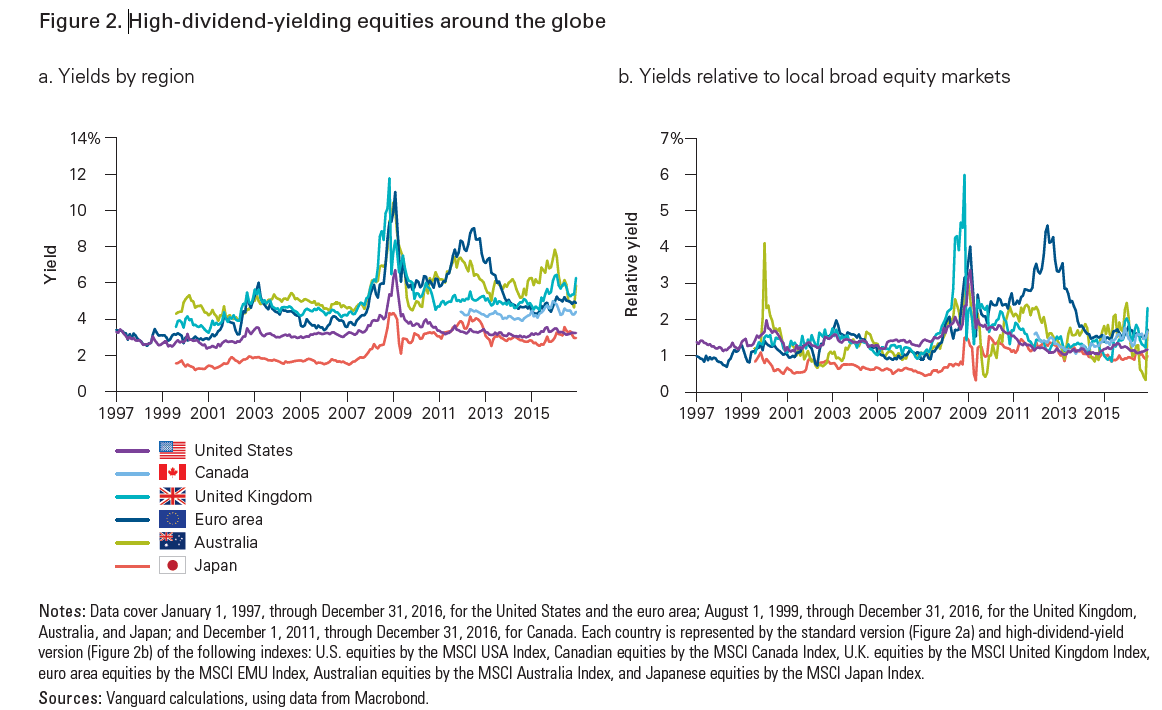
Comparing Dividend Yields Across Global Developed Regions Since 1997

Dividend yields across regions vary widely. For example, a 2% yield is considered high for Japanese equities whereas that would be low for Australian stocks as the Aussie equity market is one of the top markets for high dividend payers. According to a research report by Vanguard, a 2% yield on a Japanese stocks may seem low when compared to other regions but is about 50% more than those available at the broader local market.

The chart below shows the dividend yields by region and also relative to the broad local markets:

Click to enlarge

Source: An analysis of dividend-oriented equity strategies by Todd Schlanger, CFA; Savas Kesidis, May 2017, Vanguard

Japanese equities have the lowest dividend yields in the world. The US has the next lowest yields. Australia and the UK have the highest dividend yields. So those markets are excellent hunting grounds for income seeking investors.

The Best Banks in Latin America 2017

The Global Finance magazine published their 24th annual ranking of the World’s Best Banks by region and country back in May. The criteria for selecting these banks were many ranging from asset growth to customer service. From the news article announcing the winners:

In this, our 24th annual survey, Global Finance has identified the best banks in more than 150 countries and eight regions. The winners are not necessarily the biggest banks, but rather, the best—those with the qualities that corporations should look for when choosing a bank. They are banks that attended carefully to their customers’ needs in difficult markets and accomplished better results while laying the foundations for future success.

All selections were made by the editors of Global Finance after extensive consultations with corporate financial executives, bankers and banking consultants, and analysts throughout the world. Banks were invited to submit entries supporting their selection. Our selection criteria include growth in assets, profitability, strategic relationships, customer service, competitive pricing, and innovative products. In addition, editors conducted a poll of Global Finance’s corporate readership to increase the accuracy and reliability of the results.

In this post, let us take a quick look at The Best Banks in Latin America 2017 by country:

S.No.CountryWinner
1ArgentinaBanco Macro
2BahamasScotiabank Bahamas
3BarbadosScotiabank Barbados
4BelizeBelize Bank
5BoliviaBanco Mercantil Santa Cruz
6BrazilBanco do Brazil
7ChileBanco de Chile
8ColombiaBanco de Bogota
9Costa RicaScotiabank Costa Rica
10Dominican RepublicBanco Popular Dominicano
11EcuadorProdubanco
12El SalvadorBanco Agricola
13GuatemalaBanco Agromercantil
14HondurasBanco Ficohsa
15JamaicaNational Commercial Bank of Jamaica
16MexicoBanorte
17NicaraguaBanco Lafise Bancentro
18PanamaBanistmo
19ParaguayBBVA Paraguay
20PeruBanco de Credito del Peru
21Puerto RicoBanco Popular de Puerto Rico
22Trinidad & TobagoRepublic Bank
23Turks & CaicosScotiabank Turks & Caicos
24UruguayBanco Santander Uruguay
25US Virgin IslandsScotiabank US Virgin Islands
26VenezuelaBBVA Provincial

Source: The World’s Best Banks 2017, Global Finance

Banco de Chile(BCH) is an excellent bank with solid dividend yield and stable growth. Canadian banking giant Scotiabank (BNS) is the best bank in Bahamas, Bermuda, Costa Rica and US Virgin Islands. The bank has a larger presence in Caribbean countries than any other Canadian bank. Argentina’s Banco Macro(BMA) has soared in recent years to reach over $90 per share. The stock used to trade in the $12 range in July, 2012. BMA is now richly valued and recently announced a secondary offering.

For the rest of the world’s best banks in 2017 for other regions and countries please visit the article at GF mag here.

Disclosure: Long BCH and BNS