Australian Stocks’ Growth and Major Events Since 1900

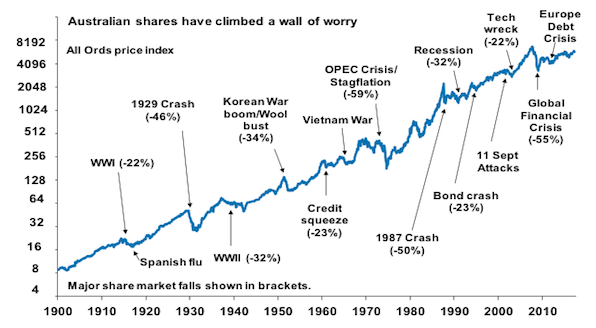
In an article yesterday we looked at how Australian stocks beat cash and bond since 1900. During this period there we many major political and economic events that shook Australia and the world. In general, investors have always something to worry about. For example, today it is North Korea. Just a while ago it was the US election drama.Before that many years of European debt crisis drama and so forth.

Despite multiple major events since 1900 Australian stocks continued to move upward as shown in the All Ordinaries share price index  below:

Click to enlarge
Source: Five great charts on investing, AMP Capital

For investors, there is always something to worry about. In the past stocks have overcome the wall of worry to earn higher returns than cash and bonds.

The key takeaway is that investors cannot wait for an ideal environment for investing in the equity market. There will always be some negative events happening – whether it is fluctuating oil prices, wars or simply threat of wars, recessions, etc. Instead of worrying too much about events that are beyond their control investors should focus on the long-term goal and accumulate assets at cheaper prices when the opportunity presents itself.
The Power of Compounding: An Australian Example

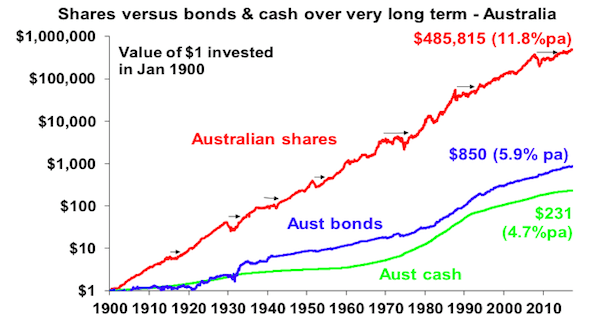
Albert Einstein said “Compound interest is the eighth wonder of the world”. Compounding of interest over many years will lead to multiplication of the original principal or capital many times. The following example shows the power of compounding for various Australian asset classes:

Click to enlarge


Source: Five great charts on investing, AMP Capital

From the above article:

The chart shows the value of $1 invested in various Australian assets in 1900 allowing for the reinvestment of dividends and interest along the way. That $1 would have grown to $231 if invested in cash, to $850 if invested in bonds and to $485,815 if invested in shares. While the average return since 1900 is only double that in shares relative to bonds, the huge difference between the two at the end owes to the impact of compounding or earning returns on top of returns. So any interest or return earned in one period is added to the original investment so that it all earns a return in the next period. And so on.

Similar to most other developed markets, stocks beat cash and bonds in Australia also from a return perspective. It is unlikely that one would stocks for such a long period of time such as over 100 years though. Most people invest or save for a particular goal such as retirement or children’s education. Despite this point, the above chart clearly shows that investing in stocks yields a better return than cash or bonds.

The Top German Companies By Revenue 2016

Germany is the economic powerhouse of Europe. Unlike the consumption-driven economy of many countries such as the US, the Germany economy is export-driven. Some of the world’s largest companies are based in Germany. One way to identify the largest German companies in terms of revenue is to review the Fortune Global 500 list. The latest list for this year was published by Fortune last month. The table below shows the German companies that made it to the prestigious Fortune Global 500 list:

Global RankCompany Name2016 Revenue (in millions)
6Volkswagen$240,264
16Daimler$169,483
34Allianz$122,196
52BMW Group$104,130
66Siemens$88,419
76Robert Bosch$80,869
77Deutsche Telekom$80,832
91Uniper$74,407
109Munch Re Group$68,700
117Deutsche Post DHL Group$65,787
123Metro$64,853
126BASF$63,641
174Bayer$52,569
189Deustche Bank$48,876
195RWE$48,204
212Deutsche Bahn$44,850
213Continental$44,842
224ThyssenKrupp$43,589
231E.ON$42,213
263ZF Friedrichshafen$38,888
302Talannz$35,101
303Lufthansa Group$35,011
309Edeka Zentrale$34,193
327DZ Bank$32,636
335Fresenius$32,161
403Phoenix Pharmahandel$26,976
443SAP$24,397
457Heraeus Holding$23,793
499TUI$21,655

Source: Fortune

Download: The largest German companies based on revenue in 2016 (in Excel)

A few observations:

  • A total of 29 German firms are in this years Fortune Global 500 list.
  • The highest ranked company is the auto-maker Volkwage(VLKAY) with a revenue of over $240 billion in 2016. To put this in perspective, the world’s largest company by sales Walmart(WMT) had a revenue of over $485 billion.
  • Other major auto-makers BMW Group(BMWYY) and Daimler are also on this list.
  • E.ON(EONGY) and RWE(RWEOY) are two of the largest utilities. However their stocks have collapsed in the past few years but are slowly recovering.
  • TUI is one of the world’s largest travel company.
  • Some of the companies from that above table that trade on the US markets are chemical giant BASF(BASFY), automation leader Siemens(SIEGY), tire market Continental(CTTAY), SAP(SAP) and Fresenius (FMS).

Disclosure: Long CTTAY, EONGY, RWEOY

Earlier: The 32 Largest German Companies By Revenue 2012 (TFS)

What Do US Corporations Really Pay in Taxes?

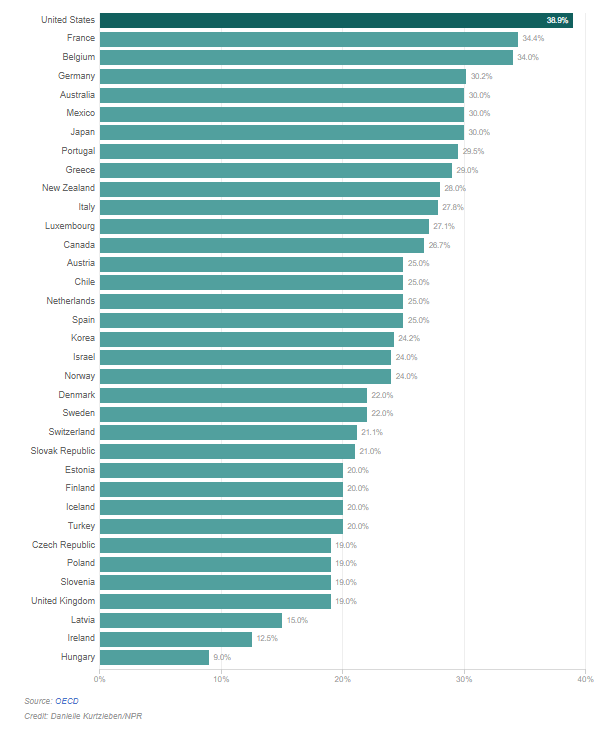
The US has the highest corporate taxes in the world. The current official rate of 35% is higher than even other developed socialist countries such as Scandinavian countries and France. The chart below shows the official corporate taxes by country according to OECD data:

Click to enlarge

Source: FACT CHECK: Does The U.S. Have The Highest Corporate Tax Rate In The World?, NPR

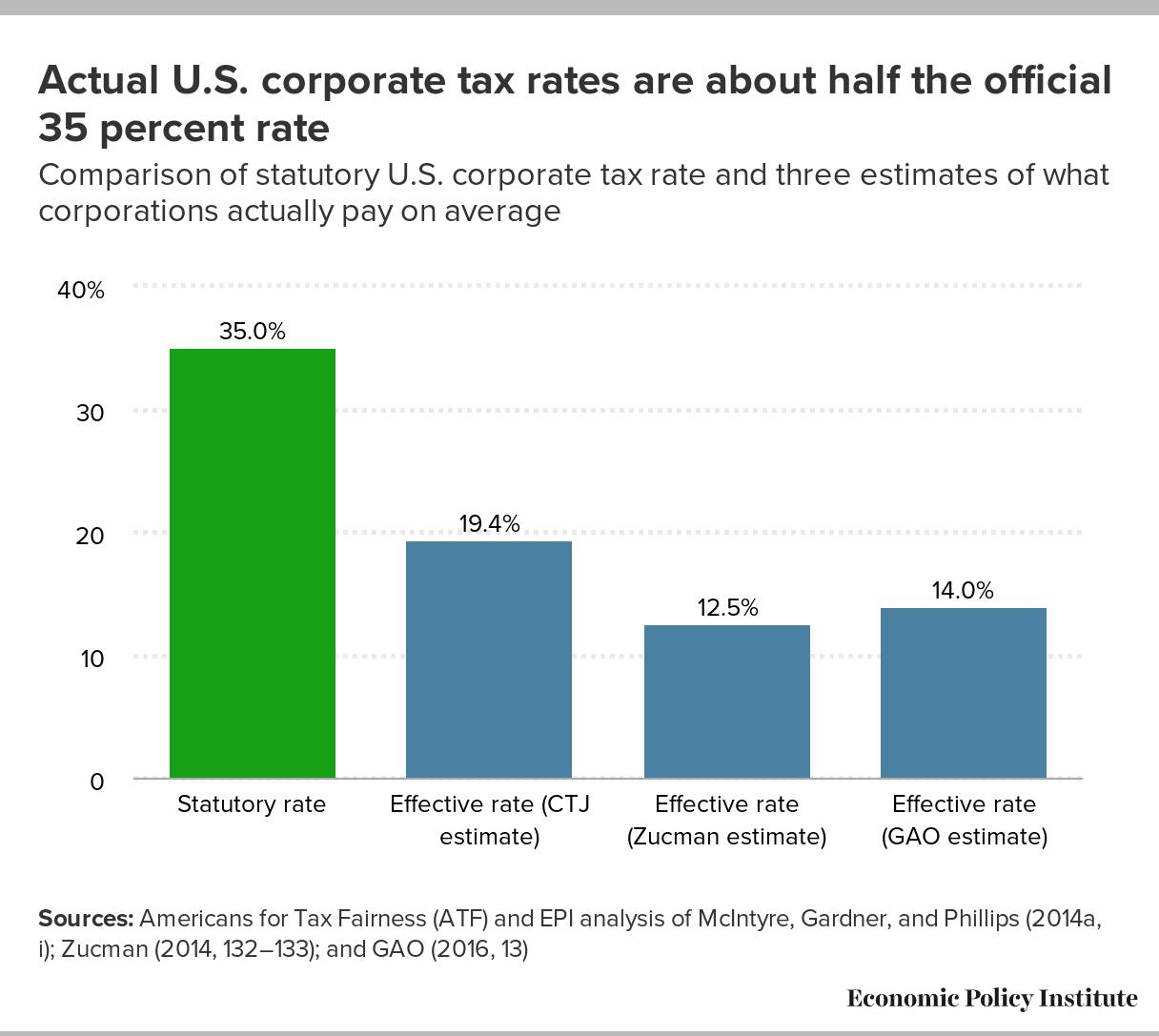
However the real tax rate that US companies pay is much lower based on analysis by various institutions. This is because corporations have a multitude of legal loopholes to avoid paying taxes. One such loophole is that profits earned overseas by US multinationals are not taxable as long as they are stashed overseas. So billions of dollars hoarded by multinationals abroad magically become non-taxable.

A report by EPI notes that the real US corporate tax rate that firms actually pay is somewhere between 13% and 19%.


Source: Corporations pay between 13 and 19 percent in federal taxes—far less than the 35 percent statutory tax rate, EPI