Why Foreign Stocks Could Beat U.S. Stocks Over The Next Few Years

I have written many times before that no country is the consistent winner in equity market returns every year. The winner in one year could be the loser in next and vice versa. Though US stocks have performed very well for over a decade now, their leadership could be overtaken by their foreign peers. According to an article by Jeffrey Kleintop of Charles Schwab now may be the time to invest in foreign equities. From the article:

Change in leadership

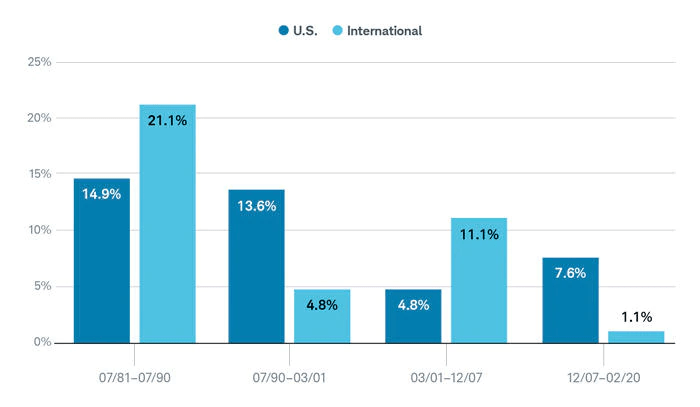
Market leadership usually switches between U.S. and international stocks at the start of a new economic cycle:

  • In the 1980s, international stocks—led by Japan—outperformed the United States for most of the decade.
  • In the 1990s, the dot-com economy paved the way for U.S. stock market leadership.
  • In the 2000s, international markets again took the lead—until the 2008–2009 global financial crisis restored the reign of U.S. stocks (see “And the winner is …,” below).

And the winner is …

U.S. and international stocks keep trading the title of greatest annualized total returns.

Source: Charles Schwab and Bloomberg, as of 10/27/2020. Annualized total return between cycle peaks measured by MSCI USA Index and MSCI EAFE Index. Past performance is no guarantee of future results.

These changes in leadership typically are triggered by a breakdown in fundamentals, such as unsustainably high stock valuations and dwindling earnings expectations. We’re currently seeing signs of fundamental deterioration in U.S. stocks—and as a result, international stocks may again take the lead.
Source: Is It Time to Increase Your International Exposure, Schwab

Related ETFs:

  • iShares Dow Jones Select Dividend ETF (DVY)
  • SPDR S&P Dividend ETF (SDY)
  • Vanguard Dividend Appreciation ETF (VIG)
  • Vanguard High Dividend Yield ETF (VYM)
  • SPDR Dow Jones Industrial Average ETF (DIA)
  • Vanguard MSCI Emerging Markets ETF (VWO)
  • iShares MSCI Emerging Markets ETF (EEM)
  • Vanguard Developed Markets Index Fund ETF (VEA)

Disclosure: No Positions

Related article with an opposite view:

Dividends Can Help Beat The Scourge of Inflation

There are many reasons to invest in dividend-paying stocks. One of the reason for example is to earn income. Another critical factor to invest in these equities is to keep pace with or exceed the rate of inflation. Inflation is the mysterious force that stealthily decreases the purchases power of the dollar. So for example, the value of 1 dollar may be worth only 97 cents in April next year, 95 cents in April 2023, etc. This erosion in the value of the dollar can be called the scourge of inflation.

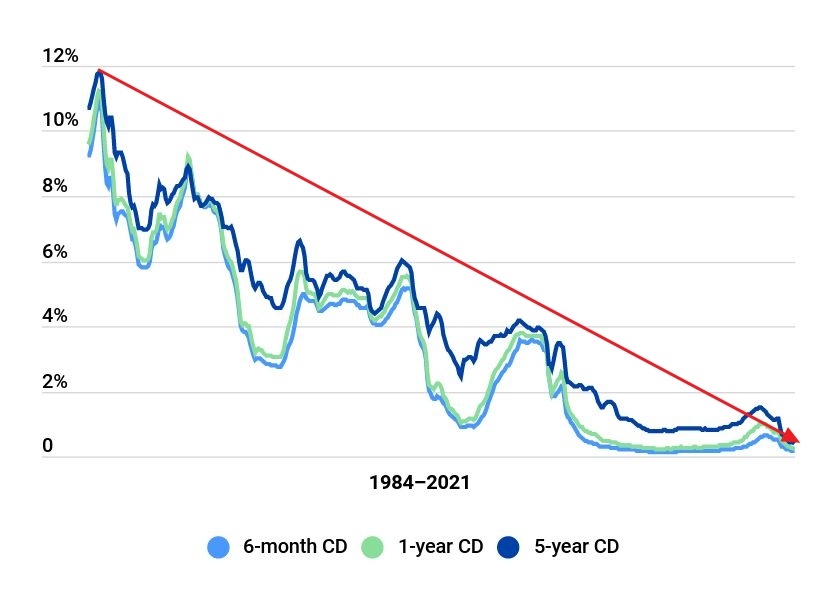
These days the Effective Fed Funds Rate is ultra-low at just 0.07 percent. The Fed has stated its intention to keep interest rates ultra-low for the foreseeable future. With interest rates so low, savers can only get only under 1.00% in interest rate for a 1-year CD.  Earning this rate is less than the rate of inflation. Though keep cash in banks is safe and secure, savers will lose money by investing in CDs. CD rates in the past used to be decent. However for many years now CD rates for different time periods have declined as shown in the chart below:

Click to enlarge

Source: Historical CD interest rates: 1984-2021, Bankrate

With CD interest rates so low, savers are better off investing in high-quality dividend payers. In a recent articleSteven P. Greiner, Ph.D. of Schwab noted that dividends can help preserve purchasing power. From the article:

For retirees, on the other hand, the regular payouts from dividend-producing stocks have the potential to provide a steady stream of income. And whereas dividend yields from companies in the S&P 500 may have declined over time, it’s important to consider them in the context of inflation.

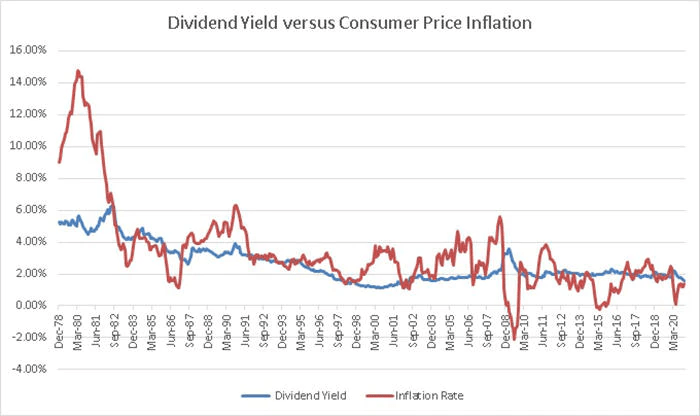
When inflation is high, it erodes your purchasing power, meaning your dividends must be greater to keep pace with rising prices. The opposite is also true: A low-inflation environment, like the current one, puts less pressure on income. Consequently, you want your dividends to regularly exceed, or at least keep pace with, the rate of inflation—something companies in the S&P 500 has been doing for the better part of five years (see “Preserving purchasing power,” below).

Preserving purchasing power

Dividends from companies in the S&P 500 may have declined, but they have surpassed inflation since 2012.

Source: Robert Shiller and the U.S. Bureau of Labor Statistics. Data are from 01/01/1979 through 12/31/2020. Past performance is no guarantee of future results.

Source: Why and How to Invest in Dividend-Paying Stocks, Schwab

Below are 10 S&P 500 constituents that pay dividends:

  1. Abbott Laboratories(ABT)
  2. Pfizer Inc (PFE)
  3. Walmart Stores(WMT)
  4. NextEra Energy Inc (NEE)
  5. Union Pacific Corp (UNP)
  6. FedEx(FDX)
  7. Emerson Electric Co (EMR)
  8. PPG Industries Inc (PPG)
  9. The Clorox Co (CLX)
  10. Kansas City Southern (KSU)

Disclosure: Long NEE, UNP

Time in the Market is More Important Than Timing the Market

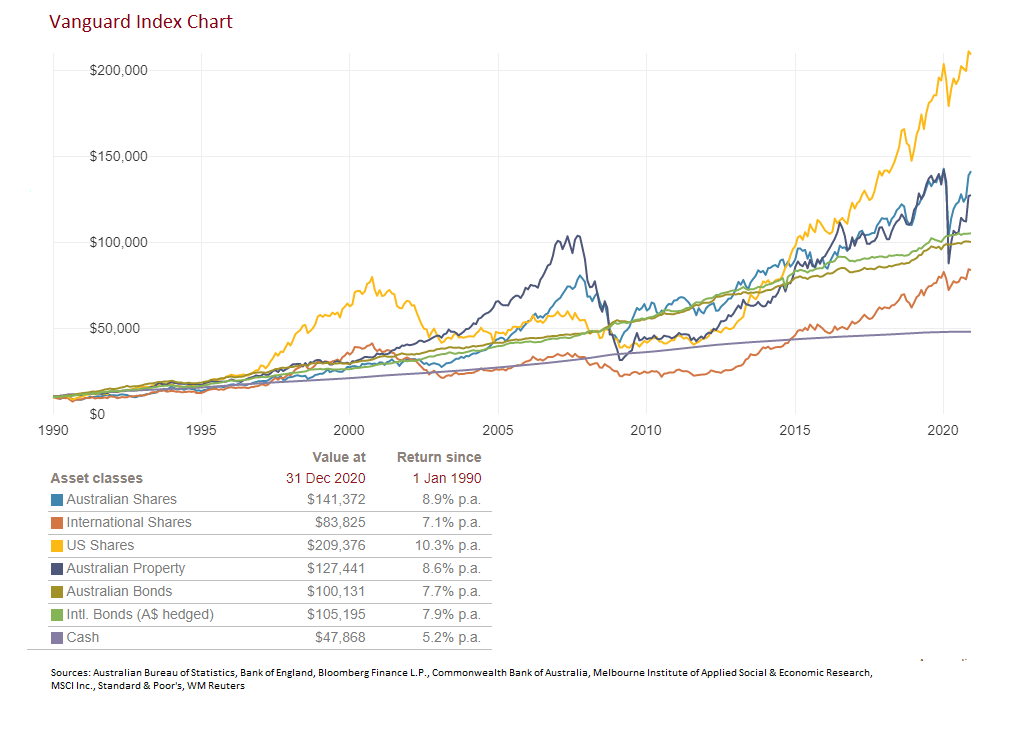
In order to be successful with investing in equities it is important to note that time in the market is more important than simply timing the market. Despite many ups and downs staying invested during all times is the wise strategy. Any investor that tries to get in and out of the market at opportune times is not wise. With that brief intro, the following chart from Vanguard Australia shows the need to be in the market:

Click to enlarge

Source: COVID crash: one year on, Vanguard Australia

An excerpt from the above article:

Looking back over the past 30 years, it also shows that all asset classes have provided consistent growth over time, and some much more than others.

Taking the Australian share market, for example, up until the end of December it had delivered an average return of 8.9 per cent per annum over three decades, assuming all distributions had been fully reinvested.

Using a base amount of $10,000 invested back in 1990, a person holding Australian shares through an ETF or managed fund tracking the whole Australian market would have turned their initial holding into more than $141,000. That’s a total return of well over 1,000 per cent, excluding any fees, expenses and taxes.

A $10,000 investment into U.S. shares over the same time frame would have returned 10.3 per cent per annum and be worth more than $200,000 using the same assumptions as above.

Even cash, the lowest-returning asset, would have delivered a total return of 5.2 per cent per annum and turned $10,000 into almost $50,000 with the benefit of compounding returns.

That’s the ultimate power of being focused on time in the markets, instead of trying to time markets.

More recently the dramatic decline in market in March last year and the following spectacular recovery is another classic example of why staying in the market is better strategy.

Related ETFs:

  • iShares MSCI Australia Index Fund (EWA)
  • SPDR S&P 500 ETF (SPY)

Disclosure: No Positions

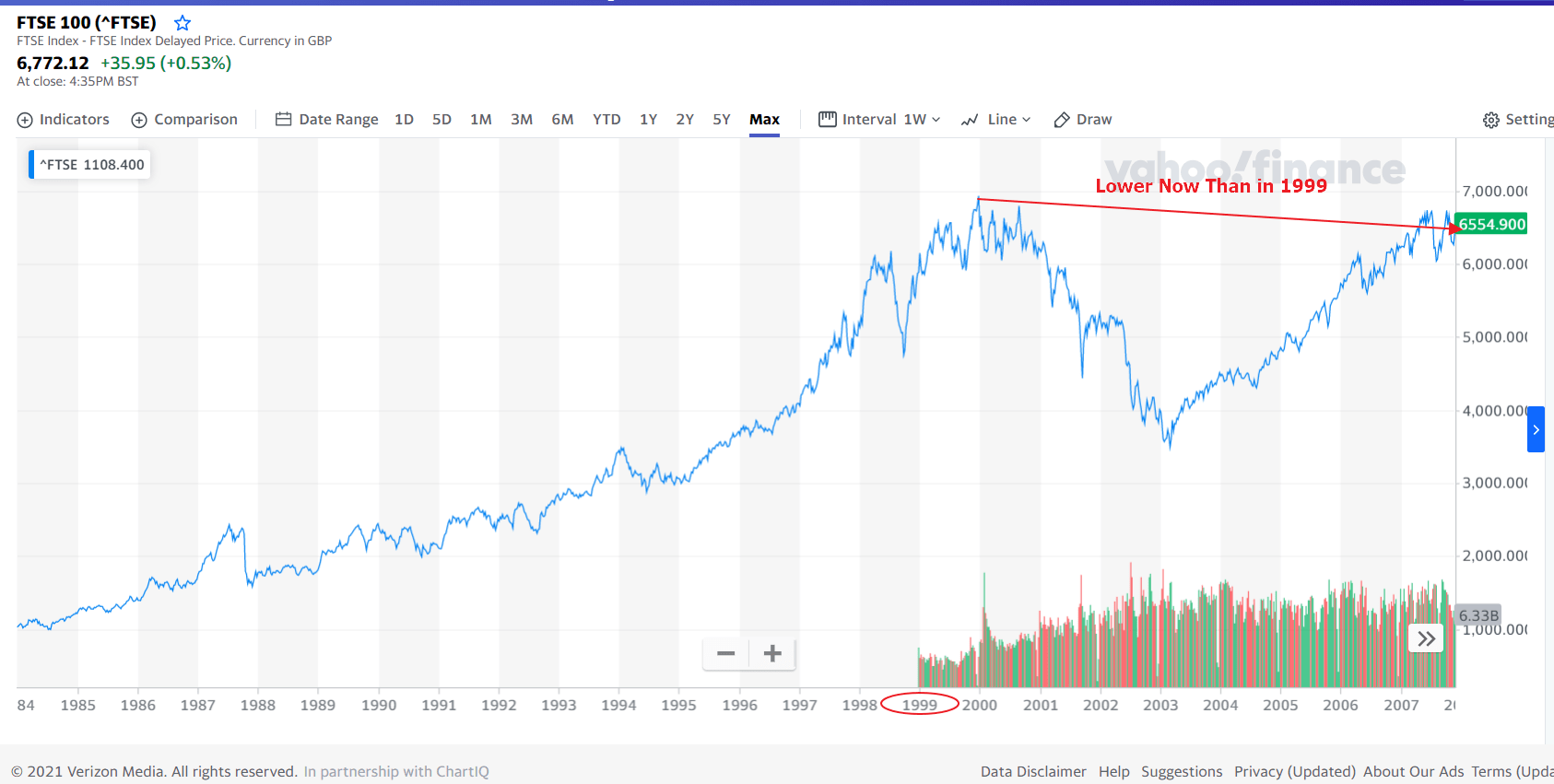
The FTSE 100 Is Trading At Lower Levels Now Than in 1999

The FTSE-100 Index of the UK is still trading at levels below where it was in 1999 ! Indeed the index has gone nowhere on a price only basis all the way from 1999 when the dot com mania was in full swing. The index reached 6,930 in December, 1999. Yesterday it closed at 6,772. In the more than two decades since 1999, we have gone through many crises including the dot com crash, the Global Financial Crisis(GFC), the many phases of European sovereign debt crisis and of course the great British Brexit saga. The performance of index since 1999 feels like the UK has been literally frozen in time for more than 20 years. Curious minds are wondering how the UK that used to be called as the empire where the sun never sets has ended up in this situation.

One main reason why the FTSE-100 has been a disaster is that the index is dominated by “old world” companies and not technology leaders like the US index. The benchmark index is mostly concentrated in banking, oil & gas, consumer staples, mining and drug companies.

Click to enlarge

Source: Yahoo Finance

Related ETF:

  • iShares MSCI United Kingdom ETF (EWU)

Many of the constituents of the FTSE-100 and other British companies trading as ADRs on the US market can be found here.

Disclosure: No Positions