Ten Fascinating Facts About Wind Energy

Renewable energy is the future of energy as the world increasingly moves towards replacing fossil fuels which are dirty and cause pollution. Among the sources of renewable energy, the adoption of wind energy is growing rapidly. In the US, the Biden Administration announced major policy changes today to jumpstart offshore energy projects to further champion green energy initiatives and also boost the creation of thousands of jobs in the sector. Overseas, some countries in Europe such as Denmark and the UK are already ahead of the US in the use of wind energy. With that brief overview, let’s take a look at xx fascinating facts about wind energy below:

1.The height of wind turbines have been growing over the years. The next generation wind turbines due online in 2025 are projected to be 300 m (or 984 feet) tall. This is astonishing indeed ! These will be built by Siemens(SIEGY) of Germany and Vestas Wind Systems(VWDRY) of Denmark.

2.The evolution of wind turbine height and capacity is shown below:

Click to enlarge
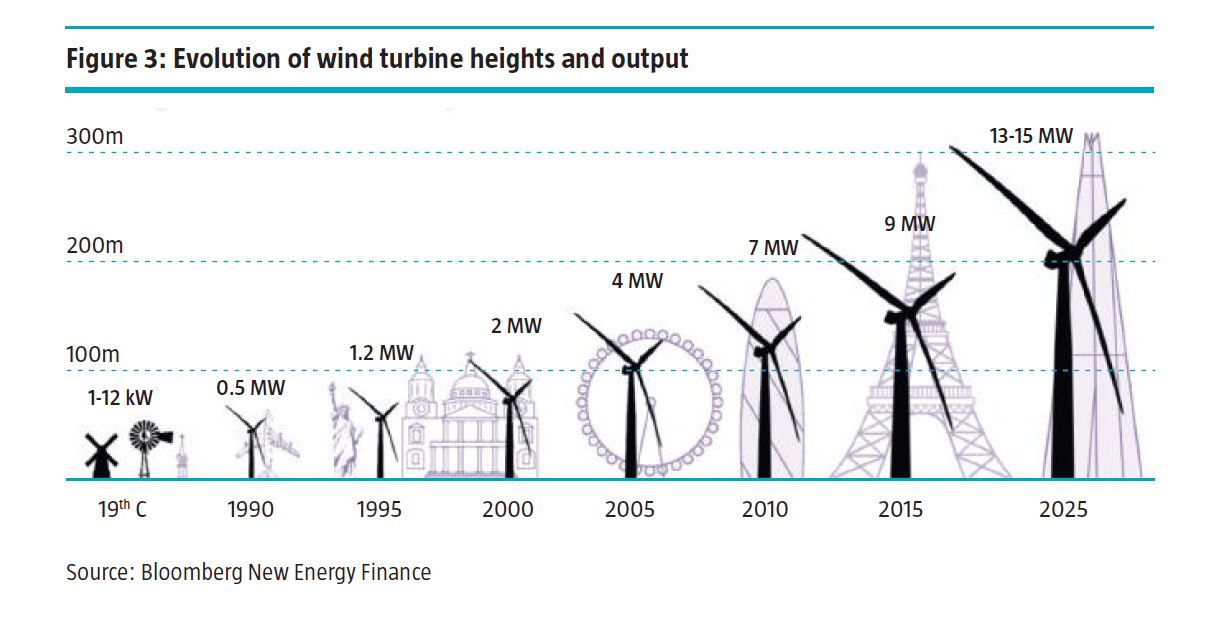
3.The blades of the next generation wind turbines will be longer the wingspan of Airbus 380. And they will generate 13-15 MW of electricity.

4.To put the height in perspective, the world’s largest windmill is only 33 meters tall. It stands in Schiedam in the Netherlands and was built in 1803 for the gin industry.

5.Texas is the fifth largest producer of wind power in the world after India.

6.We can boldly say Texas has “Gone with the Wind” since wind energy accounted for 22% of the total energy production in 2019 in the state.

7. Wind energy accounts for more than 30% of total electricity production in Kansas, Iowa, and Oklahoma.

8. In 2019, wind was the largest renewable energy source in the US.

9.A typical wind turbine has more than 8,000 components.

10.Higher wind speeds mean more electricity. Hence wind turbines are getting taller and taller in height where its more windier than the ground level.

Sources:

The stunning statistics of sustainable investing, Robeco

Top 10 Things You Didn’t Know About Wind Power, EIA

Disclosure: No positions

Utility Stocks Look Attractive For Current Market Conditions

The Utility sector under-performed the market last year when growth-oriented stocks were in vogue. This year utility stocks could perform better for a variety of reasons including the projected economic recovery, investors’ interest towards value stocks, etc. Utilities are generally preferred by income-oriented investors since they offer stable growth and high dividend yields. In the they current market conditions, they are even more attractive as they are cheap and can offer shelter from a potential downturn in overall markets. Continued move towards green energy and also upcoming infrastructure investment announcements from the Biden administration could also aid the sector.

A recent Reuters article discussed about utility sectors. From the article:

While utilities still sharply lag gains for the year compared with many cyclical sectors, including energy, they are also considered inexpensive at this point by some investors.

After a weak performance in 2020, utilities “are just really, really cheap at the moment,” Hurst said. “And that is an attractive place to be when you’re in a market that’s very much earnings driven.”

The utilities sector is trading at 18.3 times forward earnings compared with a price-to-earnings ratio of 22.1 for the S&P 500 index and 26 for technology, according to Refinitiv’s data.

David Bianco, Americas chief investment officer for DWS, which has an overweight rating on utilities, said interest rates are still low, but utilities offer inflation protection because they would be able to raise their prices.

As of Friday, the S&P 500 utilities sector had a dividend yield of 3.3%, the second-highest among S&P sectors after consumer staples, and well above the 1.5% yield for the S&P 500, according to data from S&P Dow Jones Indices.

Benchmark 10-year note yields were at 1.660% on Friday after reaching a one-year high of 1.754% the week before.

“Utilities is our most preferred bond substitute,” said Bianco.

Source: Wall Street Week Ahead: Investors look to utilities to weather any market rout, Reuters

The following are ten utility stocks with their current dividend yields. Investors looking to gain exposure to this sector can consider these stocks for further research and analysis:

1.Company: Duke Energy Corporation (DUK)
Current Dividend Yield: 4.03%

2.Company: NextEra Energy Inc (NEE)
Current Dividend Yield: 2.08%

3.Company: Dominion Resources, Inc. (D)
Current Dividend Yield: 3.33%

4.Company: Southern Company (SO)
Current Dividend Yield: 4.15%

5.Company: Exelon Corporation (EXC)
Current Dividend Yield: 3.51%

6.Company: American Electric Power Co. (AEP)
Current Dividend Yield: 3.48%

7.Company: Consolidated Edison (ED)
Current Dividend Yield: 4.16%

8.Company: PPL Corporation (PPL)
Current Dividend Yield: 5.67%

9.Company: Public Service Enterprise Group Inc. (PEG)
Current Dividend Yield: 3.44%

10.Company: Edison International (EIX)
Current Dividend Yield: 4.37%

Disclosure: Long NEE

How Did Past Research Help Covid-19 Vaccine Development: Chart

Its been more than a year since the Covid-19 pandemic started ravaging the developed world. As of yesterday, over 30 million Americans are infected and the death toll exceeded 547,000 according to NY Times data. Globally more than  2.7 million have died with some countries such as Brazil suffering from surge in cases. On the positive side, vaccines for treating the diseases were discovered in a very short time of under one year. The development of vaccine was helped in part by past research on vaccine development for other diseases. The following chart shows some additional fascinating insights on this topic:

Click to enlarge

Source: Compound Chem

Companies Referenced :

Related:

Disclosure: No positions

Industry Weightings in the US and UK Stock Markets in 1900 vs. 2021

In 1900, the US and UK equity markets looked a lot different than today. The US was an emerging market in the beginning of the 20th century while the UK was colonial super power. Now the UK is just another developed country but no longer a power. Unlike other emerging countries, the US economy grew dramatically in the past century or so and remains the dominant economy in the world.

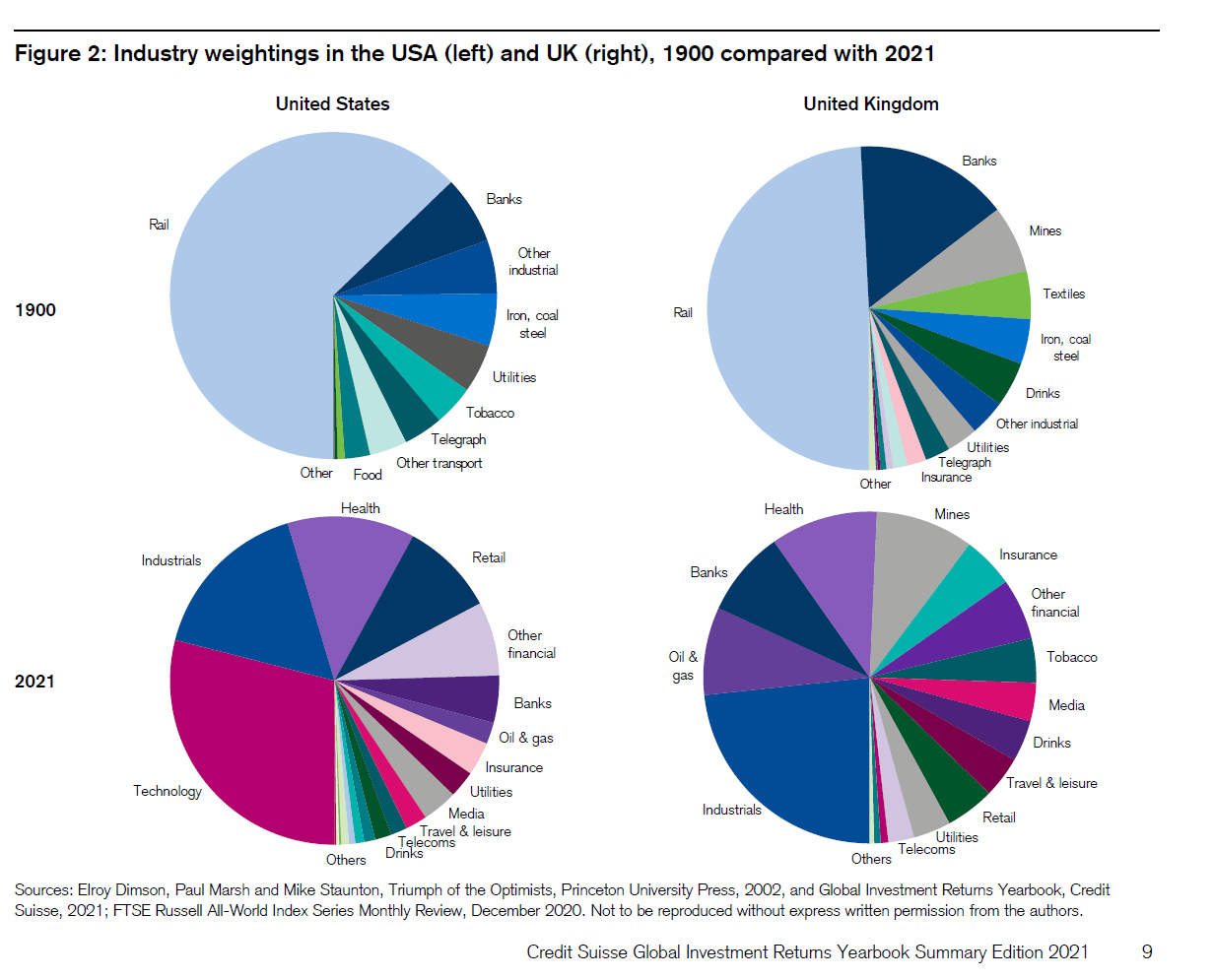
With that said, the recently published Credit Suisse Global Investment Returns Yearbook 2021 contains many fascinating facts. One chart that caught my attention is the below chart comparing the industry weightings of US and UK equity markets in 1900 and now:

Click to enlarge

Source: Credit Suisse Global Investment Returns Yearbook 2021, Credit Suisse

An excerpt from the report:

At the start of 1900 – the start date of our global returns database – virtually no one had driven a car, made a phone call, used an electric light, heard recorded music, or seen a movie; no one had flown in an aircraft, listened to the radio, watched TV, used a computer, sent an e-mail, or used a smartphone. There were no x-rays, body scans, DNA tests, or transplants, and no one had taken an antibiotic; as a result, many would die young.

Mankind has enjoyed a wave of transformative innovation dating from the Industrial Revolution, continuing through the Golden Age of Invention in the late 19th century, and extending into today’s information revolution. This has given rise to entire new industries: electricity and power generation, automobiles, aerospace, airlines, telecommunications, oil and gas, pharmaceuticals and biotechnology, computers, information technology, and media and entertainment.

Meanwhile, makers of horse-drawn carriages and wagons, canal boats, steam locomotives, candles, and matches have seen their industries decline. There have been profound changes in what is produced, how it is made, and the way in which people live and work.

A few observations:

  • At the start of 1900, railroads dominated the US and UK stock markets with a weightage of 63% and 50% respectively of market values.
  • Industries such as iron ore mining, steel, coal and textiles have declines since 1900 to become a small part of equity markets now.
  • Telegraph was the technology of the time back then. Now telegraph is extinct but we have smartphones and other hi-tech devices.
  • Despite many ups and downs, railroad stocks have beaten airline and trucking stocks in the past 121 years.
  • The railroad industry has become almost non-existent in the UK equity market.

Select related stocks:

  • Kansas City Southern (KSU)
  • CSX Corp (CSX)
  • Union Pacific(UNP)
  • Norfolk Southern Corp(NSC)
  • Schneider National, Inc.(SNDR)
  • J.B. Hunt Transport Services Inc. (JBHT)

Disclosure: Long CSX, UNP, NSC