Is Gold the Best Asset Class for All Economic Conditions?

gold-bars2.jpgIn the past few years Gold has become a much-talked about and safe-haven asset class. Investors have been piling into gold due to the credit crisis, collapse of equity markets, Greek debt crisis, continued devaluation of paper currencies and more recently the newly announced QE2 which will depreciate the value of the dollar further. As an example,the SPDR Gold Shares ETF(GLD) has an asset base of about $55 billion.

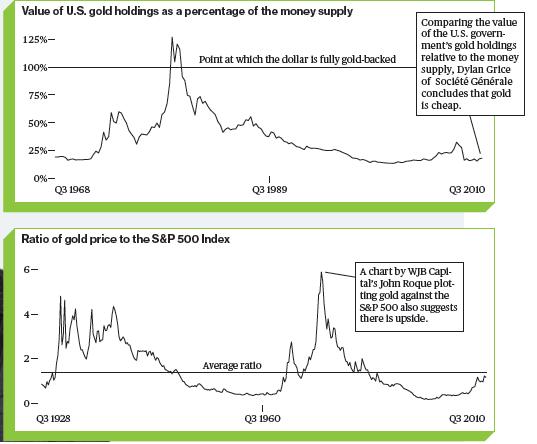
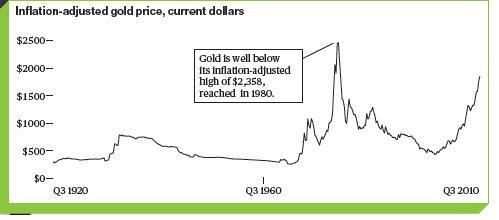
As of last week Gold has gained 28% this year and touched a record $1,398.70 an ounce. Barry Ritholtz, chief executive officer of FusionIQ  and the author of the popular “The Big Picture” blog, made the following comment in a recent Bloomberg BusinessWeek article. Barry considers three ways of valuing gold, shown below. “All three of the metrics suggest [gold] has not yet reached its highest potential price,” Ritholtz says. “Slapping a $2,000 target is not unreasonable, and breaching its inflation-adjusted target of $2,358 is also possible.” He adds an important caution: “Gold fever has risen to the point of excess, and gold shouldn’t account for more than 5 percent of your portfolio.”

gold-metrics-2.jpg

gold-metric-4.jpg

In a report, William Martin, Senior Vice President, Senior Portfolio Manager of American Century Investments says that unlike stocks and bonds whose returns are dependent on business conditions, gold actually tends to perform better during periods of economic and political uncertainty. He mentions a number of factors supporting investment demand for gold over the next decade.

From the report:

“To see how its unique supply and demand dynamics affect gold in different economic and market environments, we look at the performance of gold relative to U.S. stocks, bonds, and cash under three different historical periods: 1) hyperinflation, 2) low inflation, and 3) financial system crisis. We have intentionally chosen favorable comparisons for gold to illustrate our point that gold has the potential to outperform mainstream assets across diverse environments. ”

a) Gold performance during hyperinflation

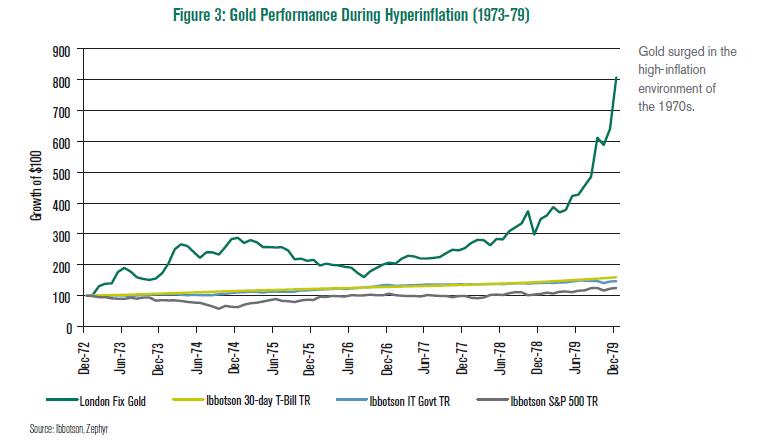
The graphic below shows the performance of gold against other asset classes during the hyper-inflationary period of the 1970s. The data used started from December 1972, since before that time the price of gold was pegged to the dollar at $35 an ounce.

Click to enlarge

Gold-during-hyperinflation

During inflationary periods such as the one shown above, as prices of goods and services rise, the value of paper currencies decline in purchasing  power since their values are not tied to a tangible asset. The value of the dollar has declined sharply since the 1970s relative to gold. Gold, on the other hand, offers some certainty during inflationary periods when paper currencies decline in value. Hence Gold can be used effectively as an inflation-hedging vehicle.

b) Gold performance during low-inflation

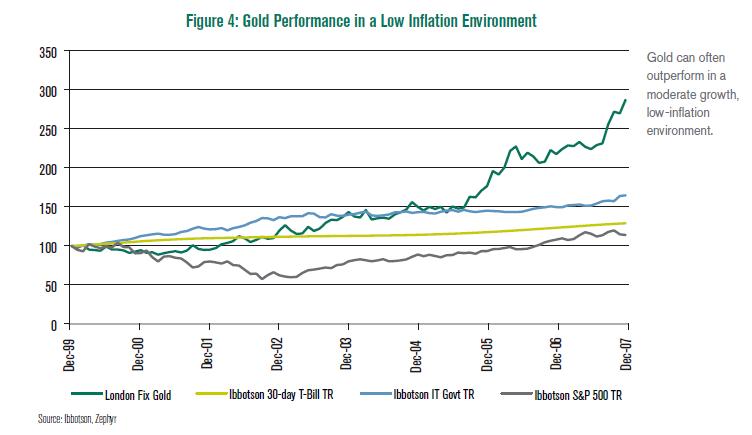
During periods of low-inflation gold can also outperform other assets. For example, during the moderate economic growth and low inflation period in the 2000s before the financial crisis, gold performed very well compared to other asset types as shown in the graphic below.:

Gold-during-low-inflation

One of the main factors that contributed to the positive performance of gold in the decade mentioned, is the rise of emerging markets where citizens invested their savings in gold due to cultural and other factors. Many political and economic crises during this time also forced investors to seek the safe-haven of gold.

c) Gold performance during crisis

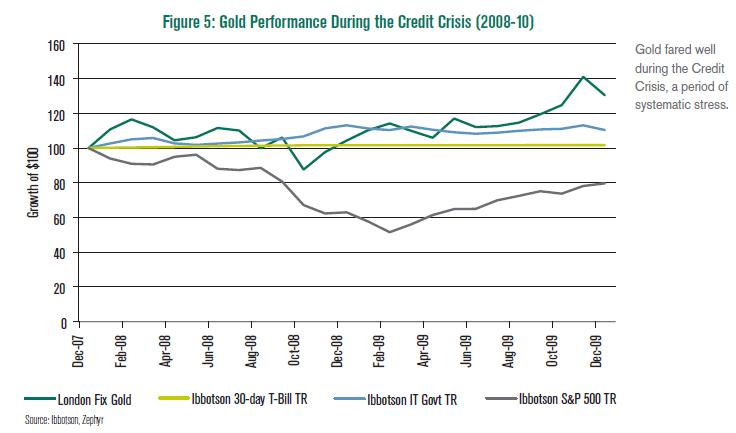
Gold has performed well during periods of stress in the political and financial systems. As shown by the chart below, gold outperformed other asset classes during the credit crisis in 2008 and the European sovereign debt crisis earlier this year. Investors are attracted to gold due to fear of sovereign credit defaults and deflation.

gold-during-credit-crisis.jpg

Overall gold is an excellent way to diversify your portfolio due to some of the reasons discussed above. Gold has low and in some cases negative correlations with other financial asset types. Hence allocating a small portion of assets to gold in a well diversified portfolio is a prudent strategy. However, it is not clear if gold is the perfect class for all economic cycles since the above analysis looked at a limited time-series of data. But the study shows that gold is a dependable asset class especially during periods when main-stream assets such as stocks and bonds decline sharply.

Source: Gold and the Decade to Come, William Martin, American Century Investments

Disclosure: No positions

Small-Caps may offer better Investment Opportunities for an Economic Recovery

Generally small caps yield higher returns over large caps over long periods. In the last decade small cap stocks easily beat large cap stocks in terms of returns. From an article I wrote in May:

  • The S&P 600 Index, a small-stock index, gained nearly 100% in the decade that began Jan 1, 2000  , producing an annualized return of 7.1%. In the same period, S&P 500 has lost almost 2% per year for a total loss of about 18%.
  • Small caps benefit more quickly when the economy recovers.

The current recession started in December 2007 and ended in June 2009 according to by the National Bureau of Economic Research (NBER).

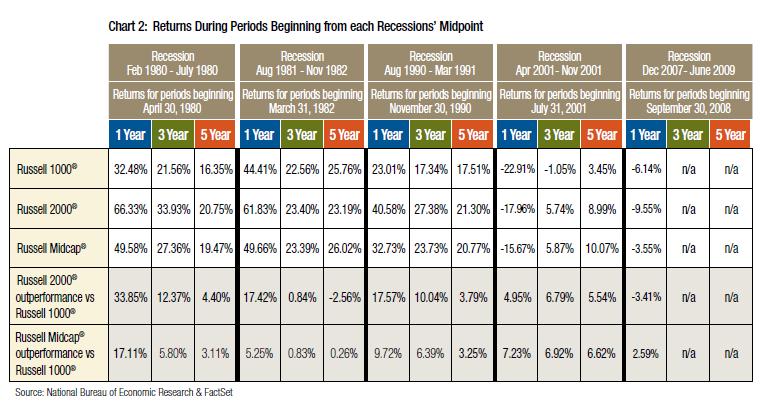
The chart below shows the one,three and five-returns of small, mid and large-caps beginning from the mid-point of each recession:

Click to enlarge

Small-Large-Mid-Cap-Return-Comparison

Source: Smaller-Cap Equity Performance Coming Out of a Recession by Michael Weiss and Yuliya Tarasava,  Managers Investment Group

Small-caps as noted by The Russell 2000 Index have outperformed large-cap stocks following all of the recessions except the 5-year period associated with the 1981-82 recession and the 1-year period associated with the 2008-09 recession. However, mid-cap stocks outperformed large-cap stocks following all of the recessions.

The authors note that ” it is important to note that the smaller-cap stock underperformance exception that occurred after the 1981/1982 recession came after a long period of small-cap stock dominance over large-cap stocks. According to Morningstar/Ibbotson Associates’ 2008 SBBI Yearbook, from 1971 through 1980,small-cap stocks returned 17.53%, substantially outperforming large-cap stocks, which returned 8.44%.

Similarly,relative asset class performance during the downturn period for the 2008/2009 recession might explain the one-year performance exception.”

Why do smaller-cap stocks perform better than large-cap stocks coming out of recessions?

Michael and Yuliya mention the following key arguments to support the theory for the relative outperformance of smaller-caps:

“First, in order to adjust to an environment moving from contraction to expansion, a company needs to be nimble. To that end, small- and midsized companies are generally better able to quickly add to their work forces and ramp up production in anticipation of an improvement in the economy.

Second, small caps generally experience steeper declines early in a recession due to a flight to safety that naturally occurs, resulting in oversold conditions and undervalued small- and mid-cap stocks.

Third, smaller companies tend to get a performance boost when merger and acquisition activity increases, which is common toward the end of a recession when valuations become more attractive and larger companies look for ways to grow their businesses.”

It must be noted that small-cap stocks are extremely risky and can be highly volatile. Hence an investor can allocate a small portion of their portfolio to small caps and use a mutual fund or an ETF instead of picking individual stocks.

Related ETFs:
U.S. Small Cap ETFs
iShares S&P SmallCap 600 Index Fund (IJR)
iShares Russell 2000 Index Fund (IWM)
SPDR DJ Wilshire Small Cap ETF (DSC)
Vanguard Small-Cap ETF (VB)

International Small-Cap ETFs
iShares MSCI EAFE Small-Cap Index Fund (SCZ)
International Small-Cap Fund (GWX)
Vanguard FTSE All-World ex-U.S. Small Cap ETF (VSS)
SPDR S&P Emerging Markets Small Cap (EWX)

Disclosure: Long GWX

Emerging Markets: Correlation Between Economic Growth and Stock Market Returns

The MSCI Emerging Market(EM) Index has posted an annualized return of 10.2% over the past 10 years thru the end of 2009. Due to this solid performance and other factors investors are increasingly attracted to EM equities. However many studies have proven that economic growth does not automatically translate into higher stock market returns.

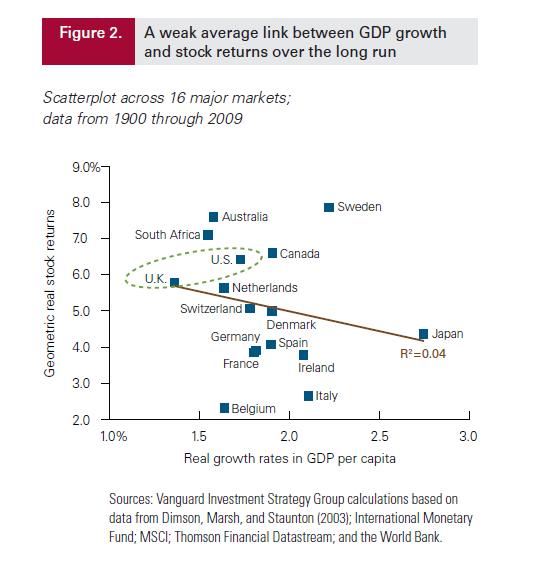
In a study of 16 major markets by the Vanguard group, the correlation  between economic growth as measured by GDP per capita and long run stock returns since the 1900 was effectively zero. In the last decade, EM stocks performed well not because of economic growth per se but because of low valuations in early 2000s.  Globalization also plays an important factor impacting the relationship between economic growth rates and market returns. For example, U.S. corporate profits from direct investments abroad jumped from 20% in 1999 to 40% in 2008. Hence multinational firms contribute to the economic growth of emerging markets.

From the Vanguard research paper:

devloped-mkts-gdp-stock-returns.jpg

“Since 1900, the correlation between long-run economic growth (as measured by real GDP growth per capita, a standard proxy for a country’s productivity growth) and long-run stock returns across 16 major markets has been effectively zero.The slope of the line in Figure 2 is actually slightly negative.”  The study observed a similar relationship for emerging markets as well.

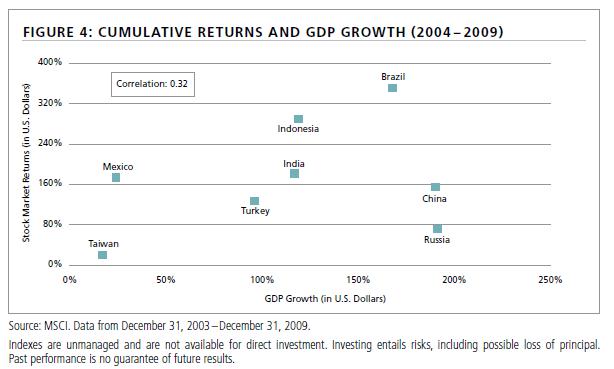
Another study by Neuberger Berman confirms that GDP growth does not necessarily translate to high equity returns. The chart below shows “the disparity between GDP growth rates and five-year cumulative returns for select emerging market countries.

em-gdp-markt-returns-select-countries.jpg

In U.S. dollar terms, the highest nominal GDP growth countries, China and Russia, did not produce the best stock market returns. Mexico, however, outperformed both countries with only about a sixth of their GDP growth. ”

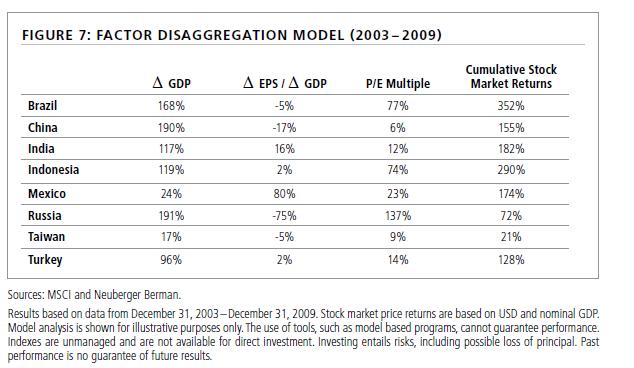
The study further analyzed the MSCI Emerging Markets Index data over a six-year time period from 2003 thru 2009 which coincided with one of the biggest bull markets in emerging markets history. This showed that “the impact of EPS growth (earnings to shareholders) and re-valuation (the price investors are willing to pay) had much larger impact on stock market returns than GDP growth”.

em-mkt-retunrs-analysis.jpg

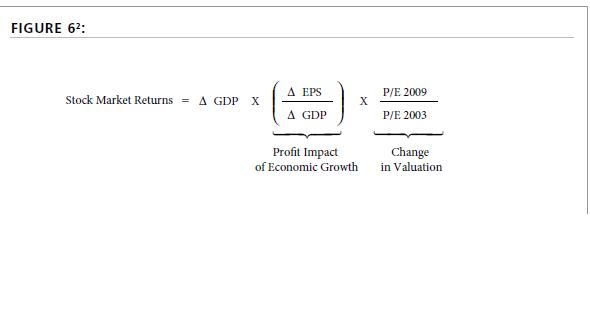
In the above chart, stock market returns was calculated by using the following formula:

em-forumal.jpg

Brazil and Indonesia were the best performing markets in the period studied. They achieved this growth by greater P/E expansion than their peers.Part of this P/E expansion can be attributed to the great run experienced by commodities.

China enjoyed a strong GDP growth but the stock market returns were mediocre.On the other hand Mexico had a much lesser economic growth but the stock return was higher. Similarly Russia had a strong GDP growth and P/E expansion but stock returns suffered due to the increased state ownership component within the benchmark. Despite strong economic growth in terms of market returns Russia was an underperformer.

Hence investors must focus on fundamentals of individual firms, profitability, valuation, etc. and follow a bottom-up strategy when investing in emerging markets as opposed to just looking at economic growth.

Related ETFs:
iShares Emerging Markets ETF (EEM)
iShares Brazil ETF (EWZ)
Market Vectors Russia ETF (RSX)
iShares Mexico ETF (EWW)

Sources:
Investing in emerging markets: Evaluating the allure of rapid economic growth, The Vanguard Group
Does Economic Growth in Emerging Markets Drive Equity Returns? , Neuberger Berman

Disclosure: No positions

Which is the World’s Best Stock?

The world’s best stock in terms of returns is not a U.S.-based company stock. Many people assume that Warren Buffet’s Berskhire Hathaway is the world’s best stock. However that is not true.

kornhamn_372_hogre.gifAccording to the Swedish business daily Dagens Industri’s stock market expert  and author Björn Wilke, Sweden’s Handelsbanken is the best stock in the world. The company first listed on the Stockholm Stock Exchange in 1873. Since 1900 the stock has gained unimaginable 1.9 million percent thru September last year. That amounts to 10 percent a year not including dividends. A $10 investment made in the stock in 1900 would be worth about  20 million dollars as of September 2009.

Compared to the performance of  Handelsbanken, Warren Buffett’s Berkshire Hathaway(BRK.A, BRK.B) has gained just 362,300% since Buffett’s takeover in 1964. And General Electric (GE) stock has grown 843,000% from 1900 to the peak of 2007. These findings were confirmed by researchers at the London Business School.

While past performance is not a predictor of future performance, it gives us an opportunity to analyze why and how some companies thrive against all odds while others perform poorly or yield mediocre returns.

Source: The Swedish Wire

A brief note on Handelsbanken:

The bank was founded in the spring of 1871 when a number of prominent companies and individuals in Stockholm’s business world founded “Stockholms Handelsbank”. At the outset, the bank proclaimed that it would pursue “true banking activities” with deposits and loans and that it would focus on the domestic banking market. Today the bank aims to be a universal bank with 460 branches in Sweden and operations in other Nordic countries and the U.K. Over the years Handelsbanken has followed a very conservative banking model which has led to its success.

Despite the recent financial crisis, the company has paid dividends to shareholders without a break in the past four years. Handelsbanken’s dividend policy is that the dividend should be competitive relative to other listed Nordic banks.  The bank’s ADR (SVNLY) is very thinly traded. Currently the stock pays a 3.11% dividend. The iShares Sweden ETF (EWD) provides exposure to this bank with an allocation of about 5% total assets.

Disclosure: No positions

Update: