Dividends are an Important Part of Total Returns

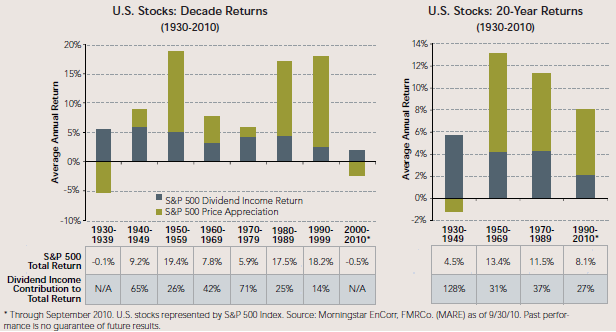
Dividends are an important component of total returns of equity investments. After going out of favor during the booming 90s dividend stocks are back in fashion now. Currently the S&P has a dividend yield of about 2%. The chart below shows the return on the S&P 500 by decades:

Click to enlarge
US-Stocks-SP500-Dividend-Total-Return-Splits

In the 1970s U.S. companies used to have higher dividend payouts. Hence during that time dividends accounted for 75% of the total return of the S&P 500. Since that time dividend payouts have fallen and during the 90s bull market, dividends contributed just 14% of the total return. However with stock prices remaining flat to slightly higher in the last decade the contribution of dividends to total return may be higher in this decade.

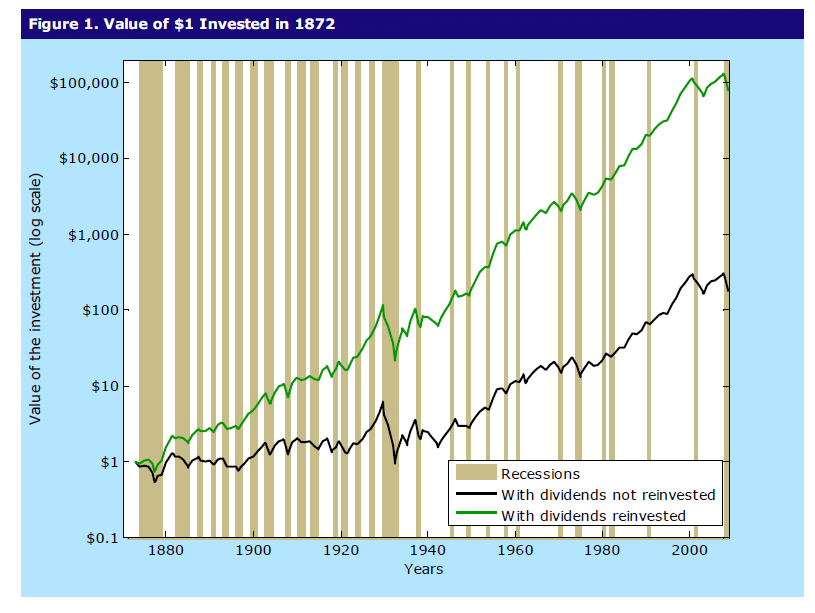
Using historical data, Yale university professor Robert Shiller has constructed a stock market index for larges companies. The index begins in December 1872 and ends in December 2008. This is an extension of the S&P 500 index.

The graph below shows the growth of $1 over time with dividends reinvested and not reinvested:
One-Dollar-Growth

Source: Valuescope

The black line shows the growth of $1 that one invested in December 1872 and updated the portfolio regularly to reflect the composition of the S&P 500 with all dividends taken out during the 136-year period. The value in December 2008 would have been just $173.  On the other hand, if one had reinvested all the dividends received each year during that long period, the $1 would have grown to an impressive $79,962 by December 2008 as shown by the green line.

Investors looking for long-term investment opportunities can explore some of the dividend aristocrats. A few of the large-cap, high-quality dividend stocks are shown below with their current yields:

1. 3M Co (MMM)
Country: USA
Current Dividend Yield: 2.42%

2. Johnson & Johnson (JNJ)
Country: USA
Current Dividend Yield: 3.45%

3. Kimberly Clark (KMB)
Country : USA
Current Dividend Yield: 4.26%

4. Abbot Laboratories (ABT)
Country: USA
Current Dividend Yield: 3.72%

5. ExxonMobil (XOM)
Country: USA
Current Dividend Yield: 2.47%

6. Unilever (UN)
Country: The Netherlands
Current Dividend Yield: 3.89%

7. Unilever plc (UL)
Country: UK
Current Dividend Yield: 3.97%

8. British American Tobacco (BTI)
Country: UK
Current Dividend Yield: 2.81%

9. Nestle (NSRGY)
Country: Switzerland
Current Dividend Yield: 2.43%

Among the Canadian stocks, Royal Bank of Canada (RY) is a consistent dividend payer and has also increased dividends over time. The current dividend yield for Royal Bank is 3.67%.

Disclosure: Long RY
The Top 10 Global Retailers

The Top 10 Global Retailers based on revenues in 2008 are listed below:

[TABLE=756]

Source: Emerging from the Downturn – Global Powers of Retailing 2010, Deloitte

US-based Wal-Mart (WMT) is the largest retailer in the world followed by Carrefour of France. Recently Wal-Mart has offered $2.32 billion to acquire Mossmart Holdings of South Africa. This is Wal-Mart’s first entry into the African continent.Wal-Mart operates 4,40o stores in the U.S. Internationally the company has 1,578 stores in Mexico, 452 in Brazil, 298 in China, 414 in Japan, 379 in U.K. and 321 in Canada, in addition to stores in other countries.In the U.K. Wal-Mart runs its stores under the Asda brand name.

In Brazil, French-retailer Carrefour leads Wal-Mart in market share. Half-of the top 10 global retailers are based in the U.S. Grocery-chain Kroger(KR) and Target(TGT) do not have stores outside of USA. UK-based Tesco (TSCDY) has a strong presence in other European nations.Tesco currently operates around 850 stores in the Czech Republic, Hungary, Poland, Slovakia and Turkey. Outside of its home market, Tesco’s biggest market is South Korea.

Disclosure: No positions

Summary Post:Ireland, Portugal, Spain, Belgium ADRs, Indices & ETFs

Here are some links related to Ireland, Portugal, Spain and Belgium ADRs, Indices and ETFs.

1. Ireland
The Largest 10 Irish Companies

Irish ADRs performance YTD

List of Irish ADRs

European Banks Have Large Exposures To Ireland

The components of the ISEQ-20 Index

Related ETF:
iShares MSCI Ireland ETF (EIRL)

Closed-End Fund:
The New Ireland Fund, Inc. (IRL)

2.Spain
List of Spanish ADR Stocks

Spanish Bank Stocks

The 10 Most Profitable Spanish Companies

Top 25 Spanish Dividend Stocks

The components of the IBEX-35 Index

Related ETF:
iShares MSCI Spain Index (EWP)

3.Portugal
How do you invest in Portugal?

List of Portugal ADRs

The components of the PSI-20 Index

4.Belgium
The List of Belgium ADRs

Components of the BEL20 Index

The Top 10 Belgian Companies by Sales

Related ETF:
iShares MSCI Belgium Index Fund (EWK)

Disclosure: No Positions

The Five Best and Worst Performing Brazilian Stocks YTD

The five best performing Brazilian exchange-listed ADRs at the end of November 2010 are listed below:

1.Ambev (ABV)
Change YTD: 34.34%

2. Embraer (ERJ)
Change YTD: 31.71%

3.Braskem (BAK)
Change YTD: 30.83%

4. Ultapar (UGP)
Change YTD: 26.14%

5. Comp. Paranaense de Energia (ELP)
Change YTD: 16.14%

The five worst performing Brazilian exchange-listed ADRs at the end of November 2010 are listed below:

1. Petroleo Brasileiro (PBR)
Change YTD: -31.96%

2. Fibria Celulose S.A. (FBR)
Change YTD: -33.10%

3. Tele Norte Leste (TNE)
Change YTD: -34.22%

4. Centrais Eletricas Brasileiras-Eletrobras (EBR)
Change YTD: -36.56%

5. Brasil Telecom (BTM)
Change YTD: -48.53%

Disclosure: Long PBR

Dividend Stocks Outperform Even in High Tax Environments

In an earlier article on why U.S. companies should raise their dividend payments now I mentioned that even if higher taxes are levied on dividends next year it is beneficial for investors to earn higher dividends if companies are unable to use their excess cash productively.

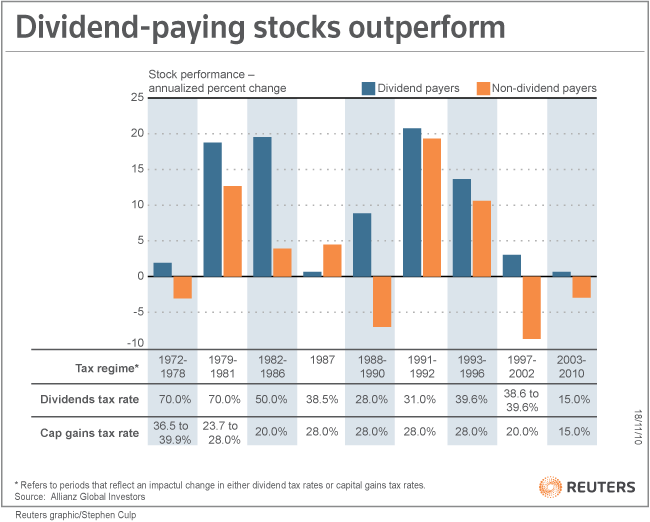
A study by Allianz Global Investors confirms that dividend stocks outperform non-dividend payers in all tax environments:

Click to enlarge

US-Dividend-Payers-Tax-Environments

From a recent Reuters report:

“Research from Allianz Global Investors shows it may not matter if dividend taxes return to a pre-Bush era marginal rate of up to 39.6 percent, rise to 20 percent as outlined in President Barack Obama’s 2011 budget or somewhere in between.“So, worst case scenario they expire… historically where you have had tax regimes where the highest rate was 50 percent or 70 percent, in those periods, dividend-paying stocks (still) outperformed,” said Kristina Hooper, head of portfolio strategies at Allianz in New York.

Allianz reviewed tax rates from 1972 to the present, identified nine distinct time ‘regimes’ and found dividend-paying stocks outperformed nondividend-paying stocks in all but one period.

Prior to present tax levels, in the 1997-2002 period, when dividend taxes topped out at 39.6 percent, dividend-paying shares gained 3.03 percent on an annualized basis versus a drop of 8.73 percent for nondividend-paying stocks.”

Since U.S. companies hold nearly a Trillion dollars in cash and cash equivalents, they should increase their dividend payments now despite any changes in the tax regime next year for the reason discussed above. Hence instead of worrying about tax rates for 2011 investors may be better off picking up dividend-paying stocks at decent prices.