A Review of Investing in Foreign Stocks Via ADRs

One simple and easy way for U.S.-based investors to gain exposure to foreign equities is investing via American Depository Receipts (ADRs). The number of overseas companies listing on the U.S. markets continues to increase each year. Currently about 1,194 companies can be accessed with the sponsored DR programs and another 1,064 trade as unsponsored ADRs (Source: Bank of New York Mellon ADR site). Among the organized exchanges, 300 firms are listed on the NYSE and 104 on the NASDAQ. The rest of them trade on the Amex and OTC markets.

The major depository banks in the U.S. are: JPMorgan, Citi, BNY Mellon and Deutsche Bank. 81 new unsponsored programs were created in the first 11 months of 2010. Due to rising listing fees and regulatory requirements 11 foreign companies delisted from the organized U.S. exchanges and moved to the OTC last year.

The 10 most traded ADRs on the organized exchanges:

[TABLE=879]

The 10 most traded stocks on the OTCQX market:

[TABLE=880]

Note: The OTCQX market is the top tier of the OTC market where companies meeting the highest financial standards are listed.

Brazilian oil giant Petrobras (PBR) raised about $10 billion in a follow-on offering thru DR program in 2010 making it the largest-ever DR offering in history.

The top 20 global DR programs by value:

top-20-dr-programs-by-value.png

The above chart includes DR programs listed on the London Stock Exchange (LSE).

Source: Depository Receipts – Year in Review 2010, JP Morgan
Are Emerging Market Stocks Cheap Now?

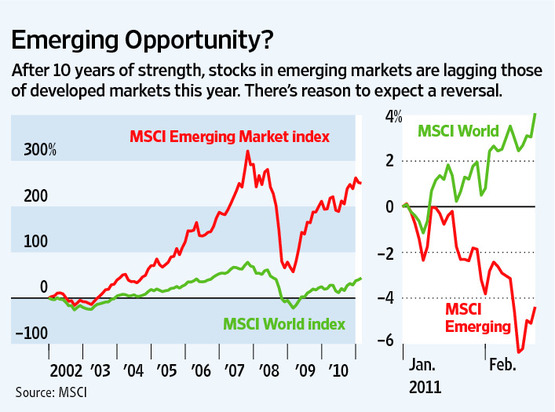
Emerging markets are lagging developed markets this year. The S&P 500 is up 6.8% YTD. The YTD returns of the major indices of some of the other developed markets are noted below:

Canada – 5.1%
Germany – 7.4%
Italy – 14.3%
Switzerland – 4.4%
Australia – 4.0%

On the other hand, the majority of the emerging markets have performed poorly this year after strong runs in the previous years. The YTD returns of the major indices of some of the emerging markets are shown below:

India – (11.2%)
China – 3.3%
Chile – (9.8%)
Brazil – (1.8%)
Mexico – (2.7%)

India is the worst performer among emerging markets with double digit losses.One of the reasons for the fall of emerging markets is the soaring inflation in those countries.

An article in The Wall Street Journal notes that emerging markets are getting cheap after the recent selloff. Some of the reasons attributed for this include the projected high GDP growth rates in these countries relative to the developed world and valuation. Since the financial crisis, the P/E ratios of emerging markets are on an average 16% lower than that of developed markets. Hence investors may want to consider adding high-quality EM stocks to their portfolios at current levels.

dev-em-markets.jpg

Source: The Wall Street Journal

Ten emerging market equities to consider for further analysis are listed below:

1.Company: HDFC Bank (HDB)
Sector: Banking
YTD Change: (8.26%)
Country: India

2.Company: Cemex (CX)
Sector: Cement Manufacturing
YTD Change: (9.52%)
Country: Mexico

3.Company: Braskem (BAK)
Sector: Chemicals
YTD Change: (4.06%)
Country: Brazil

4.Company: Vivo (VIV)
Sector: Mobile Telecom
YTD Change: 3.10%
Country: Brazil

5.Company: Banco Santander Chile (SAN)
Sector: Banking
YTD Change: (9.80%)
Country: Chile

6.Company: Taiwan Semiconductor Manufacturing (TSM)
Sector: Semiconductors
YTD Change: 2.15%
Country: Taiwan

7.Company: China Petroleum & Chemical (SNP)
Sector: Oil
YTD Change: 14.32%
Country: China

8.Company: CPFL Energia (CPL)
Sector: Electric Utility
YTD Change: (1.25%)
Country: Brazil

9.Company: Wimm-Bill-Dann Foods (WBD)
Sector: Food Producers
YTD Change: (1.61%)
Country: Russia

10.Company: China Eastern Airlines (CEA)
Sector: Airlines
YTD Change: (7.67%)
Country: China

Note: The YTD return is as of Feb 18, 2011

Related ETFs:

iShares MSCI Emerging Markets Index Fund (EEM)
Vanguard Emerging Markets ETF (VWO)

Disclosure: No Positions

Is the current U.S. Income Tax System Fair and Sustainable?

The official unemployment rate in January was 9% and the total number of unemployed persons were at 13.9 million according to BLS data. As of Feb 17th, 2011 the total U.S. debt held by the public is 9,490,705,812,100.38.  Foreigners held about $4.4 Trillion of U.S. treasury securities at the end of 2010. The U.S. spends billions of dollars in interest payments to service all this debt.

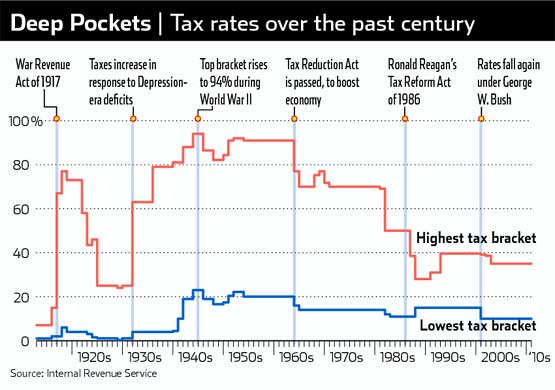
Despite the rise in prices of assets like equities in recent months, the U.S. economy continues to be in doldrums. The employment rare continues to remain stubbornly high in spite of record profits earned by corporations.In this context it a good idea to take a look at the current U.S. income tax system. The chart below shows the U.S. tax rate changes over the past century:

US-Historical-Tax-Rates

Source: The Wall Street Journal

The chart above shows that the tax rates for high earners in this country has been steadily declining since 1960s.During the Second World War the top tax bracket rose to 94%.But this rate stands at just 35% now for earned income over $379,150. The Federal lowest tax bracket stands at 10%.

Republicans would argue for further reduction of taxes saying that lower rates help stimulate the economy. Some democrats would argue for increasing taxes on the higher earners. The fact is that despite the fall in tax rates under the previous President George W.Bush the economy has not improved and the promised investments and job growth has not happened here. Instead companies have been creating jobs abroad and high earners have been reaping the rewards in terms of low taxes on capital gains, earned income and dividends. President Obama, a democrat, in another policy failure extended the Bush tax cuts again favoring the wealthy.

In general, the current U.S. tax regime is unfair, unsustainable and needs a complete overhaul. With the country involved in two wars, sky-high deficits and government spending poised to soar due to healthcare reforms, entitlement programs like social security, medicare, etc. it is time to raise the rates on the top tax bracket.The argument that lower tax rates for the wealthy stimulates economic growth no longer holds true.The current low tax rates and inflation in asset prices suits the wealthy perfectly well since they are able to multiply their wealth while the middle-class and the poor are forced to deal with rising gas, food, healthcare costs, etc. on top of the horrendous job market and collapse of the housing market. In addition, many states are cutting social services across the board as they are also suffering from budget issues due in part to reckless spending during the good times.

The Evolution of the British Stock Market

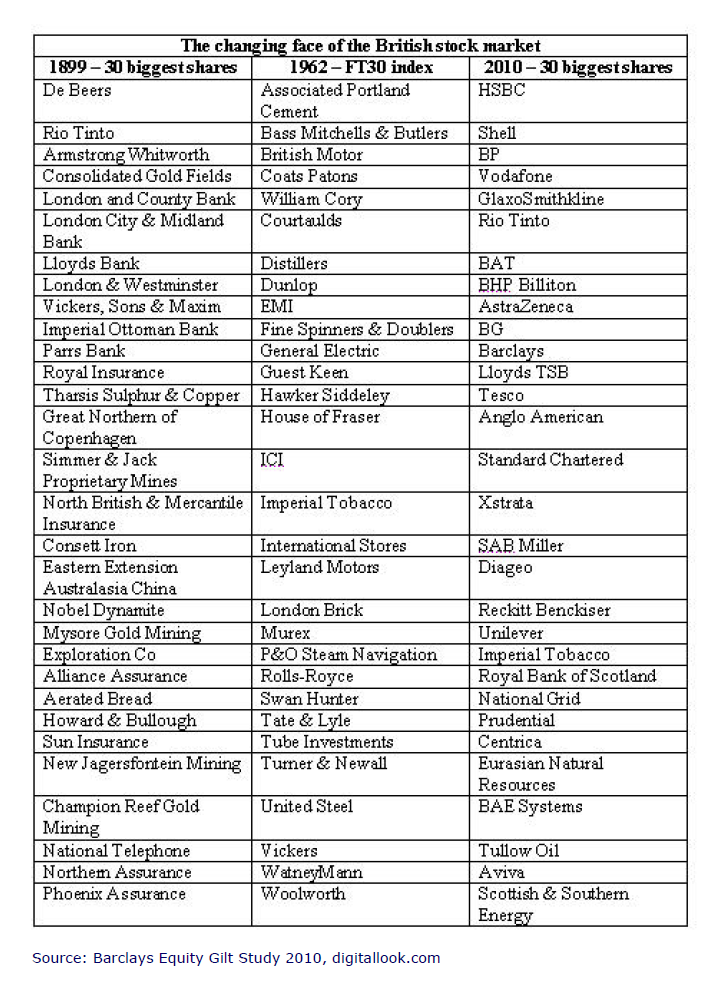
In an earlier post, we looked at the Historical Components of Dow Jones Industrial Average since 1896. The chart below shows the evolution of the British stock market since 1899:

Click to enlarge

british-stock-market-evolution.png

Source: The Barclays Capital Equity Gilt Study

Reinvestment of dividends is an important tool to increase the total returns earned on an equity investment. The Barclays study confirms this theory again.

“With 110 years in its database now, Barclays calculates that £100 invested in the UK stock market in 1899 would have grown to £11,407 by the end of 2009 in terms of capital appreciation alone. If dividends from the shares had been reinvested, however, the same £100 would have grown to a scarcely believable £1.49m. ”

Companies from just four sectors that dominate the British equity market today. These sectors are mining, financials, oil and pharmaceuticals. Similarly in the early 1900s, the market had concentration in the finance and mining industries. In the first column of the above chart we see companies like Lloyds Bank(LYG), Royal Insurance, Northern assurance, etc. in the financial sector and many mining companies in that sector.

Disclosure: Long LYG

The Top 15 Global Oilfield & Drilling Service Companies

This week oil driller Ensco plc(ESV) announced the acquisition of competitor Pride International (PDE) in a cash and stock deal valued at $7.3 billion. According to the deal, shareholders of Pride will receive a 0.4778 Ensco share and $15.60 in cash for each Pride share they own. This offer represents a 21% premium to Pride’s stock price as of Feb 4th.

From a Bloomberg article suggesting that this deal may spur more mergers in the industry:

Rowan Cos., a Houston-based operator of shallow-water rigs, and DryShips Inc.’s Ocean Rig UDW unit may be the next targets for drillers eager to expand fleets as the search for offshore oil and natural-gas fields intensifies, said Brian Uhlmer, an analyst at Global Hunter Securities LLC in Houston.

Buying competitors is an alternative path to growth amid a building boom for deep-water rigs that Barclays Plc analyst James West said is reducing shipyard space from South Korea to Finland.

“This industry is fairly scattered and consolidating this and moving forward on a basis of strength rather than speculation is always a good thing,” said Esa Ikäheimonen, chief financial officer of Seadrill Ltd. today in a telephone interview. Seadrill, based in Bermuda, hasn’t decided yet whether to shed its 9.4 percent stake in Pride and use the cash to pursue other targets, said Ikäheimonen.

Companies in this industry offer their highly-specialized technical expertise to the major oil firms. The success of the oil giants depends on smaller companies like the oil-drillers and other service providers. So investors looking to research into companies in the oil drilling industry may want to start with the world’s top companies noted below:

[TABLE=878]

Source: PFC Energy

Disclosure: No Positions