Six Reasons to Invest in German Chemical Stocks

The German chemical industry is the fourth largest in the world and number one in Europe. Traditionally Germany has maintained leadership position in this industry beating other countries due to innovative policies encouraging investment, highly specialized educational programs fostering the advancement of chemical science, world-class infrastructure, sustainable development with public and private sector partnership, substantial development, high investment in R&D, etc. As chemicals are an ingredient in most of the products we consume, this sector offers attractive opportunities for long-term investment. German companies are especially well-positioned to profit from growth in the developed world and in the emerging countries.

The following are some of the reasons to invest in German chemical stocks:

  • Germany is Europe’s preferred location for chemical investment.
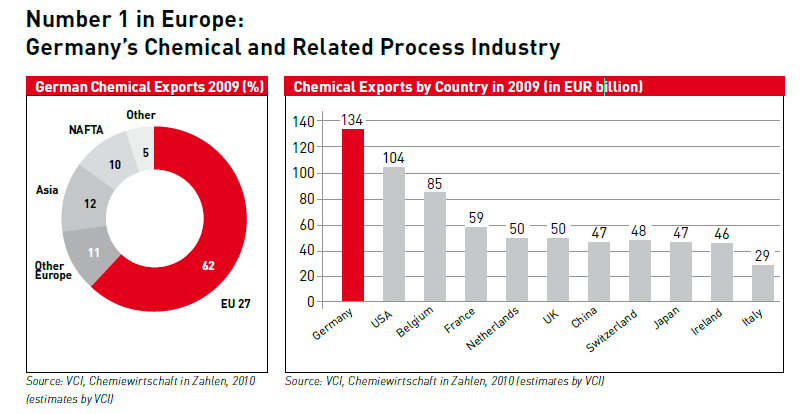
  • Germany is the world’s largest exporter of chemicals.

Click to enlarge
german-chemcial-industry.png

  • German chemical firms set the benchmarks for advancement of various state-of-the-art technologies in other sectors.
  • Located in heart of Europe, chemical firms supply their products to other industries in Europe with easy access to a market of more than 450 million customers.
  • The country is home to 40 large-scale chemical parks that offer excellent infrastructure including their own power plant.
  • Global chemical firms such as Dow Chemical, Ineos and Sabic have a significant presence in Germany.

Source: Germany Trade and Invest

The four German chemical companies available for US-investors as sponsored ADRs  on the the OTC market are listed below:

1. BASF AG (BASFY)
Current Share Price: $84.48
Current Dividend Yield: 2.63%
Total Revenue: $89.3B

2. Bayer (BAYRY)
Current Share Price: $79.10
Current Dividend Yield: 2.33%

3. K+S  AG(KPLUY)
Current Share Price: $39.26
Current Dividend Yield: 0.32%

4. Linde AG (LNEGY)
Current Share Price: $15.76
Current Dividend Yield: 1.46%

Note: Stock prices and dividend yields noted are as of market close Mar 4, 2011

Disclosure: No Positions
Factors Affecting Global Food Prices

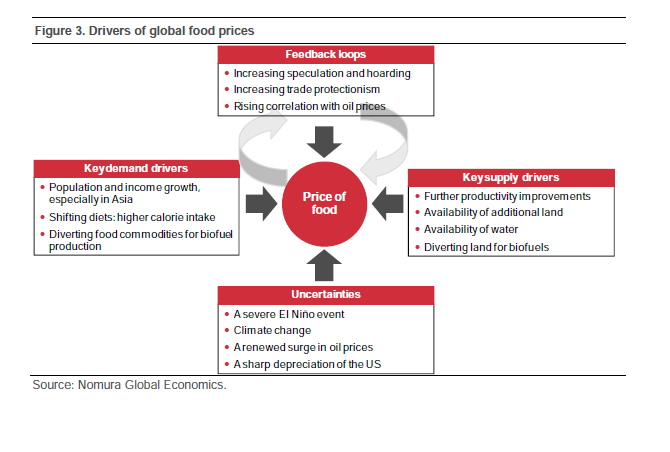
Crude oil is the most traded commodity in the world. However other than just supply and demand, a multitude of factors impact oil prices on a daily basis. Similar to the crude oil example, the prices of food are affected by a variety of complex factors. While in the past, food prices were determined just by the variables of supply and demand, today many factors come into play. The following graphic shows some of the factors and their impact on global food prices:

Factors-affecting-global-food-prices

Source: Nomura Global Economics

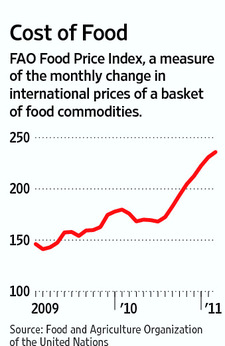
One of the main factors that affect food prices is the price of oil. As the price of oil has shot up in recent months food prices have also followed suit. The following chart from a Journal article confirms this trend:

food-chart.jpg

From the article:

The Food and Agriculture Organization price index rose by 2.2%—the eighth consecutive rise since June—to an average of 236 points last month, the highest record in real and nominal terms since the agency started monitoring prices in 1990.

Global cereal supplies are also expected to tighten sharply this year due low stock levels, the FAO said. The body raised its estimate for world cereal production in 2010 by eight million metric tons from its December estimate to 2.2 billion tons but said it expects that to be outpaced by an 18 million-ton increase in world consumption.

But while the world isn’t yet facing a food crisis, the secretary of the FAO’s Intergovernmental Group on Grains, Abdolreza Abbassian, said the recent rise in Brent oil prices to above $120 a barrel could create the same potent mix of factors that pushed grain prices to record highs three years ago.

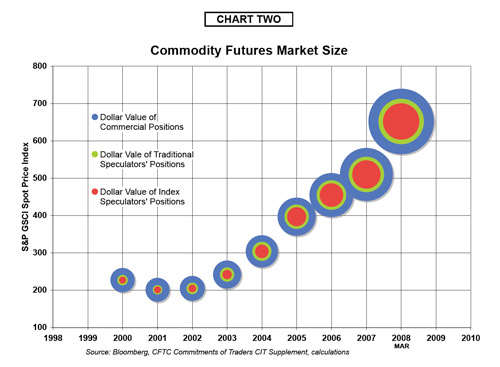
Another factor affecting global food prices is the rise in speculation in food commodities. From a CFR 2009 article on food prices:

food-specualtion.jpg

Source: CFR

Rising food prices may also affect the fragile economic recovery. As struggling consumers battle on two fronts – one with soaring fuel prices and the other with food costs – they may cut down on spending on other goods and services. A recent article in This is Money website of UK noted this point:

“Economists also fear that food price hikes will reduce economic activity and squeeze household spending as families desperately cut back elsewhere.

A UN report yesterday revealed that rises in bread, pasta, breakfast cereal, dairy and meat prices are on the horizon – irrespective of future oil price hikes.

The commodity price of key foods rose again in February, making it the eighth successive month of increases, according to the UN Food & Agriculture Organisation. It pointed out the export prices of wheat, corn and rice are up by a staggering 70% in one year.”

Overall if oil prices do not fall there is a serious risk for the global economy to enter into a recession again.

Why Soaring Energy and Food Prices Have Low Impact on CPI

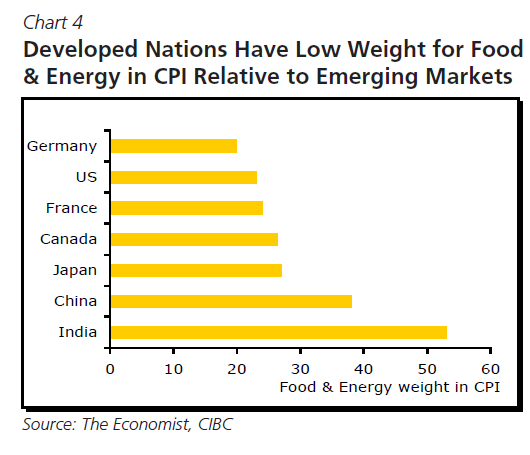
Soaring energy and food prices have low impact on Consumer Price Indices (CPI) in developed countries than in emerging countries. This is because unlike in the emerging markets, food and energy make up a lower share in the more service-oriented CPI baskets of developed countries. Emerging markets such as India, China, Brazil are experiencing high inflation rates now since energy and food prices have a higher allocation in their CPI calculations.

cpi-dev-em-markets.png

Source: US Treasuries and the Three Bears, CIBC World Markets

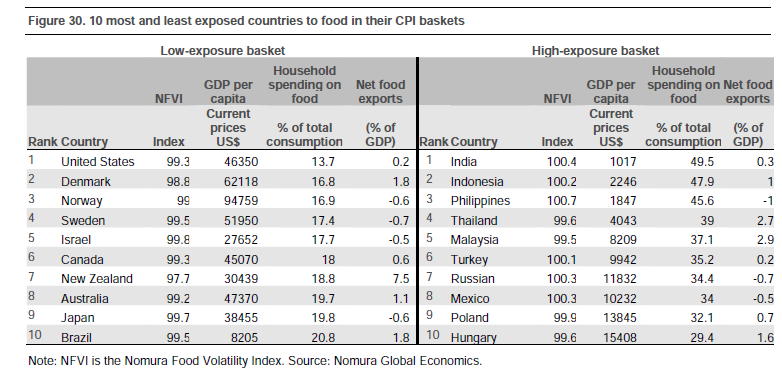
The following chart shows that many developed countries have the least exposure to food in their CPI calculations:

food.png

The emerging countries of India, Indonesia and Philippines are the top three countries with the highest exposure to food in their CPI baskets.

Source: Nomura Global Economics

Americans Are Now Saving More Than Canadians

Generally Canadians have a higher propensity to save compared to Americans in spite of having a better social safety-net such as free healthcare, pensions, job security, etc. under the socialist form of government. Up until the credit crisis hit most U.S. consumers saved very little. In fact, the personnel savings rate in the U.S. went negative a few years ago. As a consumer-driven economy Americans were bombarded with ads to spend their hard-earned money on all types of products and services that promised a rich-lifestyle and most obliged which kept the economy growing. However all that changed after the global financial crisis and the ensuing recession in which millions of jobs disappeared. As a result of the deleveraging process undertaken by American consumers, the savings rate has risen by over 3% in the past three years and the debt to income ration has decreased.

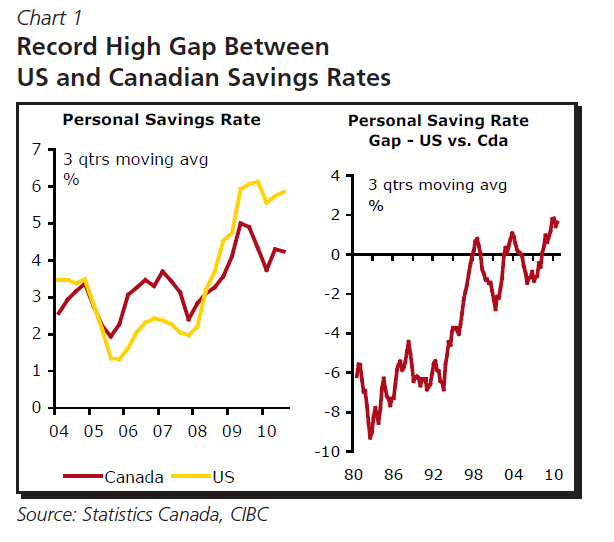
Canadians on the other hand have been saving less in recent years due in part to the soaring real estate prices. This “wealth effect” reduced savings and increased consumption. The Canadian savings rate averaged just 4.2% in the first three quarters of 2010. The American savings rate on the other hand is at near 6% which is 1.6% higher than the rate in Canada as shown in the graph below. This gap is the largest on record, according to a research report from CIBC World Markets.

us-canada-savings-rate.png

Source: Back to Old-Fashioned Saving, Benjamin Tal, CIBC World Markets

The World’s Most Innovative Companies 2011

The Fast Company magazine has published the list of the world’s 50 most innovative companies for 2011. Innovation is critical to the success of most businesses especially in this fast-changing highly competitive environment. The magazine mentioned the following with the introduction of the list:

An artificial heart and its lightweight power drive. A better airline for Brazil. Chocolate from Madagascar and a soccer shirt made of plastic water bottles. A fashion leader escaping its pattern, a smelter, and that little coupon startup in Chicago that’s suddenly worth billions. All this from one simple word: innovation.

The World’s 50 Most Innovative Companies for 2011 are:

[TABLE=881]

Source: Fast Company

It is not surprising to see Apple (AAPL) take the top rank in this list. Apple’s market cap of $324.0 billion is higher than that of General Electric’s (GE) which is ranked at number 45. Other notable publicly-traded tech companies include Google (GOOG), Intel (CSCO), IBM (IBM), Cisco (CSCO), Microsoft (MSFT), Amazon (AMZN) and Netflix (NFLX). While these tech giants are highly innovative, from an investment standpoint not all of them have been best informers. In fact, stocks like Cisco and Microsoft have been dead money since the dot-com implosion.

Disclosure: No Positions