U.S. Dividends and Capital Gains Tax Rate Since 1961

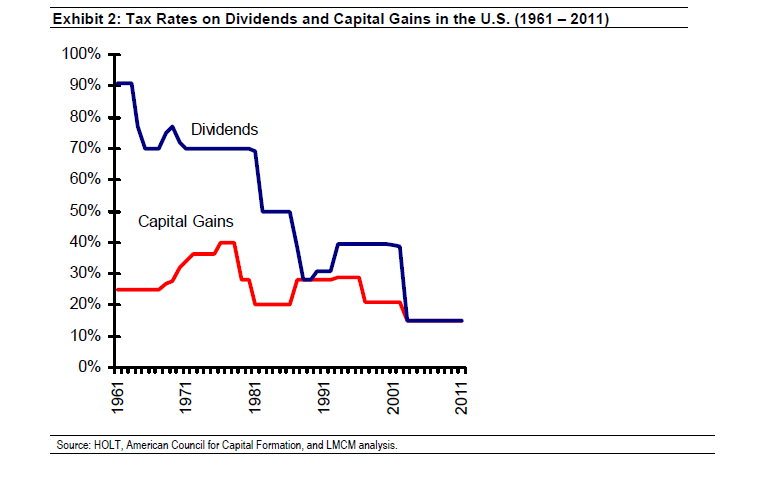
When investing for income with dividend stocks one has to consider the impact of taxes since higher tax rates can significantly reduce the after-tax yield on the investment. In this post lets take a look at historical trend and current tax rates on dividends.

The graphic below shows the U.S. individual dividends and capital gains tax rates from 1961 thru 2011:

Click to enlarge
 

Source:  
Real Role of Dividends in Building Wealth
Michael J. Mauboussin, Legg Mason Capital Management

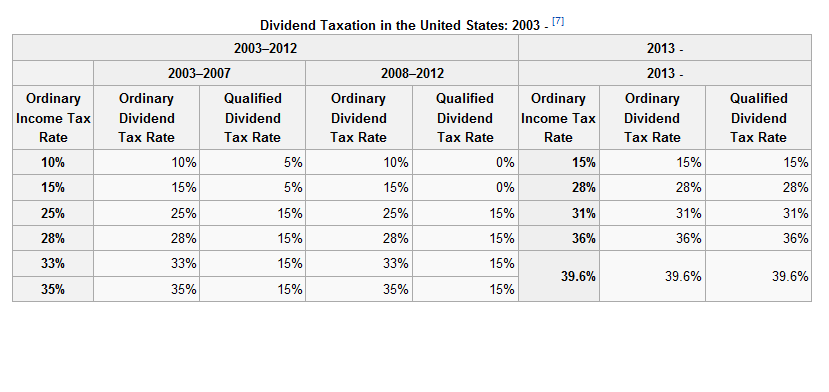
Dividends received by U.S. residents are assigned as either Qualified dividends or Ordinary dividends(non-qualified dividends). Ordinary dividends gets taxed at the individual tax bracket level while Qualified dividends are charged at a much lower rate based on the duration a stock is held and the status of the dividend-paying company. For example, dividends paid by REITs are considered as ordinary dividends. So though REITs have high yields, the actual after-tax yield to an investor may be much lower depending on one’s tax bracket.

The maximum tax rates for ordinary and qualified dividends will be 35% and 15% respectively thru 2012.
Source: Dividend Tax, Wikipedia

The current low tax rates on dividends are big boon to investors compared to the rates in the past. Hence investors looking to take advantage of the extremely volatility in the equity markets now can consider adding high quality dividend stocks.

Related ETFs:
iShares Dow Jones U.S. Select Dividend ETF (DVY)
PowerShares Dividend Achievers ETF (PFM)
Vanguard Dividend Appreciation ETF (VIG)
SPDR S&P Dividend ETF (SDY)

Disclosure: No Positions
Components of the S&P Emerging Asia 40 Index

Last month S&P launched a new index called the S&P Emerging Asia 40 Index to provide exposure to the 40 largest and most liquid securities from the emerging markets of China, India, Indonesia, Malaysia, the Philippines and Thailand.The Index offers equal exposure to two distinctive regions: with 20 stocks from China and India and 20 stocks from South East Asia.

For China and India, the index includes liquid stocks trading on the Hong Kong Stock Exchange, the London Stock Exchange, NASDAQ, and/or the NYSE. For the other four countries, local listings are also eligible.

The Constituents of the S&P Emerging Asia 40 Index are listed below:

[TABLE=1031]

Three of India’s largest banks – ICICI Bank(IBN), HDFC Bank Ltd.(HDB) and State Bank of India are in this index.Similarly from China, Bank of China, China Construction Bank  and ICBC are included. Indonesia-based Astra International recently split its ADR trading under the ticker PTAIY in the ratio of 5:1.

Disclosure: No positions

China’s Investment as a Percentage of GDP Remains High

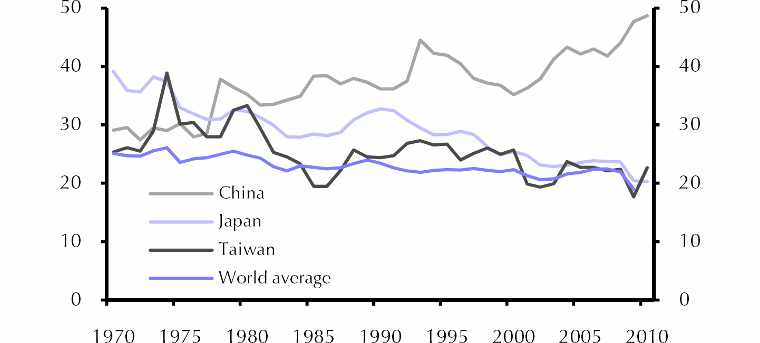
In 2010 China’s GDP increased by 10.1% from the previous year to reach $5.98 Trillion. However a large portion of this GDP is due to the country’s fixed investment in infrastructure, property and manufacturing and not consumption.

Following the trend from last year, investment accounted for more than half of the economic growth in the first half of this year. The chart below shows the rise in Chinese investment as a portion of GDP for many years now:

Click to enlarge


Source: Capital Economics via CityWire

Compared to the world average of under 20% China spends about 50% of the GDP on fixed investments. China’s challenge is to reduce fixed investments and stimulate domestic consumption thereby making the economy healthier and less reliant on exports. But this is proving to a difficult task as the Chinese continue to save too much and not spend on consumption.

To put the Chinese figure in perspective, the U.S. investment as a percentage of GDP for 2010 stood at about 15%. Of course, the U.S. need not spend like the Chinese since a solid infrastructure needed for economic growth already exists here. But much of the U.S. infrastructure like airports, highways, bridges, ports, etc. are old and crumbling and have to be upgraded to be equal to other developed countries.

U.S. Stocks Holding Up Well Relative To Foreign Stocks YTD

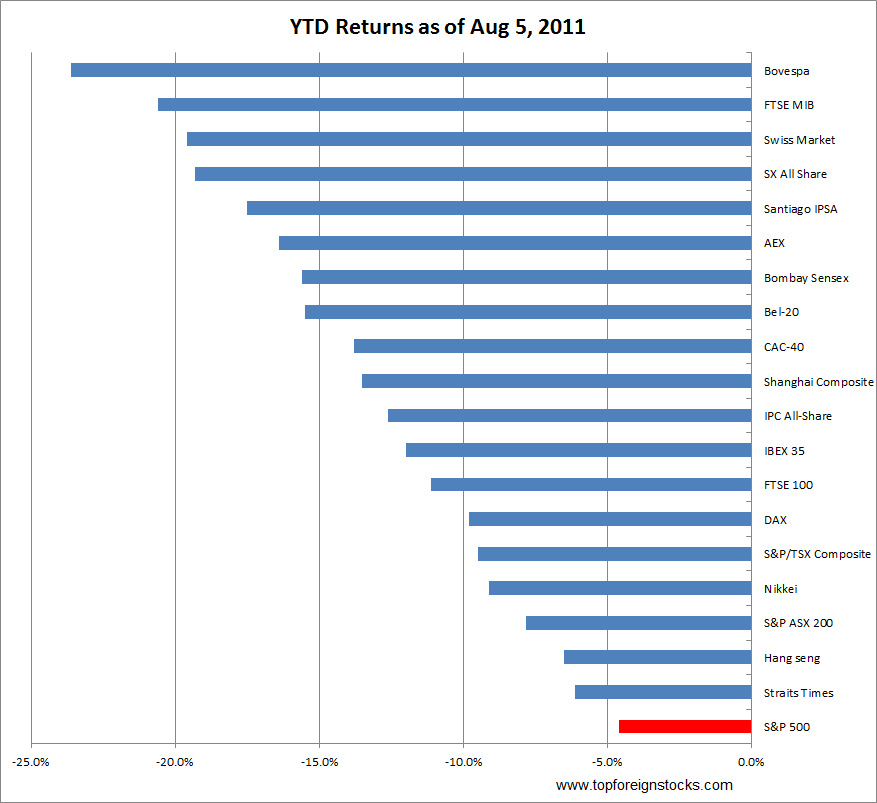
The chart below shows the year-to-date(YTD) performance of the S&P 500 and the major indices of most global markets:

Click to enlarge

Some observations:

  1. With a loss of 4.6% YTD for the S&P 500, U.S. stocks are relatively performing better than the stocks of other developed economies.
  2. Equities in Italy and Spain have entered the bear market territory as the FTSE MIB and Bovespa indices are off by more than 20% YTD.
  3. Germany, home of the largest and strongest economy in Europe, is down by 9.8% as noted by the DAX index compared to double digit losses of the British, French, Spanish, Swiss indices.
  4. In addition to Brazil, the emerging countries of India(Bombay Sensex) and China(Shanghai Composite) are also down more than 10% YTD.
  5. The commodity-based developed economies of Canada (S&P/TSX Composite) and Australia (S&P ASX 200) are off more than the U.S. but still lower than the crisis-ridden European countries.

Related ETFs:

iShares MSCI Canada Index (EWC)
iShares MSCI Australia Index (EWA)
SPDR S&P 500 ETF (SPY)
iShares MSCI Emerging Markets Indx (EEM)
iShares S&P India Nifty 50 (INDY)
iShares FTSE/Xinhua China 25 Index Fund (FXI)
iShares MSCI Brazil Index (EWZ)

Disclosure: No Positions

What are the Types of Stocks Traded in China ?

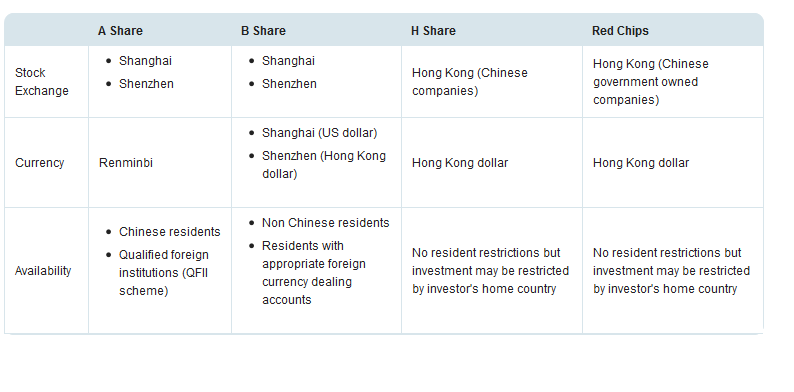
Investing in Chinese stocks is easier if one chooses to invest via ADRs traded on the US markets or stocks listed on other major exchanges. However investing directly in ordinaries on the domestic market in China is complicated. There are many types of stocks for the same company with different rules and restrictions especially for foreign investors.

Types of Share Classes in China:

Click to enlarge

Source: Investing in China: do you know what you’re getting into?, CityWire Money

Related Links:

China ADRs (OTC Listed only)

China ADRs (Only Exchange Listed)

Download China ADRs in Excel

Wikipedia: Shanghai Stock Exchange

Wikipedia: List of companies of the People’s Republic of China

Shanghai Stock Exchange

Yahoo Finance: Shanghai Composite Index