Private Equity Funds Pouring Money Into Distressed U.S. Banks

Private Equity(PE) funds in the U.S. are increasingly attracted to the distressed banking sector in the U.S. While some consider these funds to be agents of change and turnaround experts others consider them destroyers of companies. One German minster called them “locusts”. PE funds usually acquire controlling stakes in companies, engineer changes in management and then exit making a quick profit.

In the past, the banking industry did not highly attract the attention of PE funds. However that is changing since the recent credit crisis as many funds are taking advantage of small and mid-sized distressed banks and are investing large amounts of capital in them. Unlike other industries such as technology, the banking industry is all about dividends, slow-but-steady growth, long-term relationships and regulation. These themes are the exact opposite of what private equity funds believe in. Hence ordinary investors in distressed banks that accept private equity funds have to use caution and monitor the performance closely.

From a report in the latest issue of Bank Direct magazine:

From the beginning of 2007 through the first quarter of this year, PE firms invested more than $33 billion in 149 banks, according to Pitchbook Data, a Seattle firm that tracks PE investments across all industries. Today, more than 100 private equity firms—or companies backed by PE money—are actively kicking tires in the industry, estimates Jim Gallagher, managing director of financial sponsors coverage for Keefe Bruyette & Woods in New York. They range from the multi-industry giants of private equity, such as TPG Capital in Ft. Worth, Texas, Sequoia Capital in Menlo Park, California, and Greenwich, Connecticut-based General Atlantic, on the hunt for megadeals, to smaller firms, such as Hovde Private Equity Advisors LLC in Washington, D.C., and Philadelphia-based Patriot Financial Partners L.P., which write checks almost solely for community banks. In between are all sorts of other players that have been attracted by the scent of potentially big returns.

“Every time there’s a blip like this in the market, there’s an opportunity for private equity to provide capital—either to a healthy company that’s positioned to take advantage of the dislocation or to help fix the balance sheet of a company that’s experienced some illness,” says Richard Thornburgh, Corsair’s vice chairman.

“If, as an investor, you can buy in at tangible book value or below, and banks historically trade at 1.5-to-2.25 times book,” Thornburgh adds, “that’s an attractive environment.”

Some of the small banks in which PE funds have invested capital include:

United Community Banks Inc(UCBI) of Blairsville, Georgia
BankUnited(BKU) of Coral Gables, Florida
Heritage Commerce Corp.(HTBK) of San Jose, California
Guaranty Bancorp(GBNK) of Denver,Colorado
BNC Bancorp(BNCN) of High Point, North Carolina

It must be noted that PE funds are not always successful with their investments. For example, PE funds poured billions into Washington Mutual and National City Bank before both of them failed spectacularly. So it remains to be be seen if the current strategy of PE funds on the distressed banking sector will be successful.

Disclosure: No Positions
Global Cement Industry: A Brief Overview

Cement is one of the basic ingredient in the construction industry. The global cement industry is highly fragmented with many international, regional and local players competing in the market.The global majors account for only about one-fourth of the market. Due to increasing infrastructure and real estate development in emerging markets the cement industry is experiencing strong growth in the past few years.

According to one study:

Cement is made out of limestone, shell, clay mined out of a quarry close to the plant. The raw material is crushed, and then heated at temperature in excess of 1000 ºC in rotating kiln to become clinker. Clinker is then mixed with gypsum and ground to a fine powder to produce final grade of cement. The technology is a continuous process and is highly energy intensive.

Cost of cement is 29% energy, 27% raw materials, 32% labour and 12% depreciation.

Last year cement production worldwide increased by an estimated 9.9% from 2009 to reach 3.3 billion tons with China driving growth. Rising demand led to the construction of 140 new plants over the past two years.

The top five cement consuming countries in 2010 were:  China, India, USA, Brazil and Iran.

The top five cement producing countries in 2010 were:  China, India, USA, Turkey and Iran.

Due to lower production capacity or lack of plants, some countries are major importers of cement. The top five importers last year were: Bangladesh, Nigeria, USA, Iran and Afghanistan.

The top five cement exporters were: Turkey,  China, Thailand, Japan and Pakistan.

Some of the leading global cement companies include:

1.Lafarge (LFRGY)
Country: France
LaFarge is the world’s number one producer of cement and related materials with operations in 78 countries.

2.Holcim
Country: Switzerland

3.HeidelbergCement
Country: Germany

4.Cemex (CX)
Country: Mexico

5.Italcementi
Country: Italy

6.Buzzi Unicem
Country: Italy

Source: International Cement Review

Some of the other cement firms trading on the US markets are:

1.Cementos Lima (CEMTY)
Country: Peru

2.CRH NV (CRH)
Country: The Netherlands

3.Empresas ICA (ICA)
Country: Mexico

4.James Hardie Industries (JHX)
Country: Australia

5.Wienerberger(WBRBY)
Country: Austria

Disclosure: Long LFRGY

Should Investors Avoid Bank Stocks in BRIC Countries ?

The MSCI Emerging Markets Index allocates about 25% to the banking sector because this sector forms an significant part of these growing economies. However some investors including professional fund managers tend to avoid banks in the emerging countries for many reasons including their high exposure to the real estate industry, worries about adverse impacts to earnings due to rising interest rates, etc.

UK-based Jonathan Asante of First State Global Emerging Markets Leaders Fund stated the following as the reason for being underweight in emerging markets banking:

“We are suspicious of banks in a number of GEMs because they are generally arms of the government. They are forced to lend to the people in times of crisis. Though that is great news for the people it does not help minority shareholders like ourselves.”

Note: GEM – Global Emerging Markets

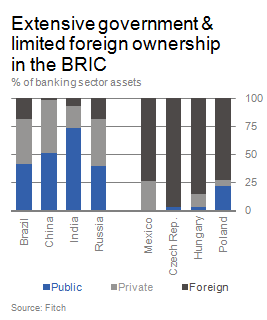
The banking sector is highly controlled by states in the BRIC countries. Accordingly the majority of the banking assets are held by the state-owned banks as shown in the chart below:


Source: BRIC banking systems after the crisis, Deutsche Bank Research

About 75% of banking sector assets in India is under the state control. China’s public-sector banking ownership is just over 50%. In Brazil and Russia also a high portion of this sector remains under state control. In all these countries, the government considers banking as a strategic industry and hence plays an active role in lending credit to the economy by using state-controlled banks.  During the credit crunch of 2008-09, public-sector banks in BRIC increased lending and helped maintain the stability of the economy. As a result of the high government role in this sector, real credit growth averaged almost 25% in China in 2009-10, while public-sector banks in Brazil doubled lending from 10% of GDP in 2008 to 20% of GDP in 2010.

According to Markus Jaeger, author of the DB Report, state-led economic development including lending by state-controlled banks is appropriate during the early “catch-up” phase of economic growth “when per-capita income is low and growth is significantly driven by large-scale investment in physical infrastructure and the introduction of “off-the-shelf” technologies.” However as per-capita income rises, private-sector banking and market-based credit allocation will lead to superior economic growth. As all the BRIC countries are still in the “catch-up” phase, large public-sector ownership of the banking sector is not highly negative.

Private-sector banks in BRIC countries are also performing extremely well despite exponential growth in assets in the past few years. Unlike banks of the developed world, private-sector banks in BRIC have recovered strongly from the credit crisis and their balance-sheets are in a much healthier position. One reason for their success is that most of these banks follow traditional lending practices and maintain strict discipline in reducing risks.

Hence investors should not avoid bank stocks in BRIC. Instead they can add them selectively at current or lower prices.

Some of the banking stocks from Brazil, Russia, China and India are listed below with their current yields:

1.Bank: Banco Santander Brasil SA (BSBR)
Current Dividend Yield: 4.34%
Country: Brazil

2.Bank: Banco do Brasil SA (OTC:BDORY)
Current Dividend Yield: 6.12%
Country: Brazil

3.Bank: Itau Unibanco Holding SA (ITUB)
Current Dividend Yield: 2.17%
Country: Brazil

4.Bank: Bank of China Ltd (OTC:BACHY)
Current Dividend Yield: 4.68%
Country: China

5.Bank: China Construction Bank Corp (OTC:CICHY)
Current Dividend Yield: 4.07%
Country: China

6.Bank: ICICI Bank Ltd (IBN)
Current Dividend Yield: 1.33%
Country: India

7.Bank: HDFC Bank Ltd (HDB)
Current Dividend Yield: 0.64%
Country: India

Disclosure: Long BBD, ITUB

No, There Is No Economic Recovery !

The Global Financial Crisis (GFC) of 2008 wiped out millions of jobs worldwide. In the U.S., the ground zero for the crisis, companies laid off hundreds of thousands of workers. While the media, politicians, regulators, company executives and others hyped that the economy recovered in 2009, in recent weeks doubts have been raised if there was a recovery at all.

The U.S. economy entered a recession from December 2007 thru June 2009, according to National Bureau of Economic Research (NBER). The recession that lasted for 18 months was the longest since World War II. In addition to severe decline in private sector jobs, wages fell and duration of unemployment remained long as competition became intense for any job that was available.

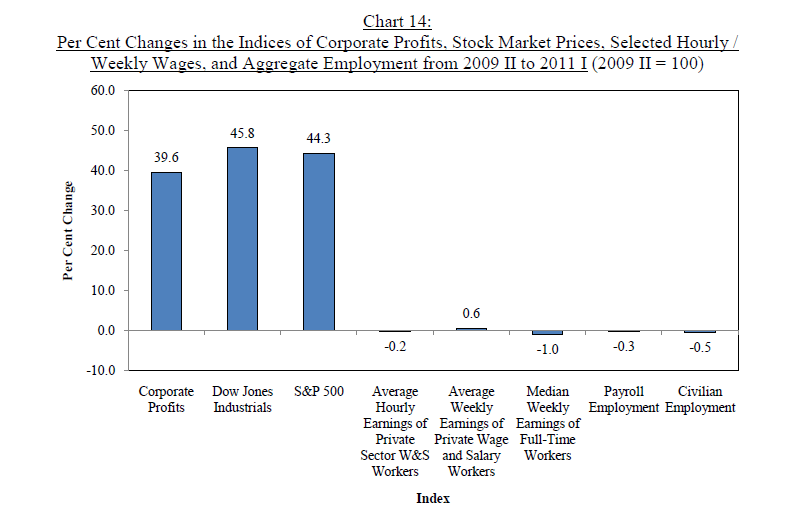
As of June this year, the official unemployment rate stood at 9.2% and the number of unemployed persons continued to remain high at 14.1 million. Unofficial figures are much higher. Meanwhile U.S. corporations hold over $1 Trillion of cash overseas and corporate profits have been increasing consistently since the second quarter of 2009. Corporate profits rose from $1,203 billion in 2Q, 2009 to $1,667 billion in 4Q, 2010. So in the first seven quarters of this “recovery” profits at U.S. companies surged by about $465 billion. Accordingly the Dow Jones Industrial Average rose from 8,447 at the end of 2Q, 2009 to 12,319 at the close of 1Q, 2011 for an increase of 46%. Similarly the S&P 500 gained 44%  in the same period.

While corporate profits and stock markets have soared, growth in wages and jobs have been virtually non-existent as shown in the horrendous chart below:

Click to enlarge

Source:

The “Jobless and Wageless” Recovery from the Great Recession of 2007-2009: The Magnitude and Sources of Economic Growth Through 2011 I and Their Impacts on Workers, Profits, and Stock Values

by Andrew Sum, Ishwar Khatiwada, Joseph McLaughlin and Sheila Palma

Center for Labor Market Studies, Northeastern University, Boston, Massachusetts

Some key takeaways from the research report:

  • “The absence of any positive share of national income growth due to wages and salaries received by American workers during the current economic recovery is historically unprecedented.
  • Pre-tax corporate profits by themselves had increased by $464 billion while aggregate real wages and salaries rose by only $7 billion or only .1%.
  • To date, through the first quarter of 2011, the nation’s recovery from the 2007-2009 recession is both a jobless and a wageless recovery.”

So in summary there is no real economic recovery – meaning no growth in jobs, wages, consumption, etc. Instead we have had a tremendous recovery in equity markets and corporate profits which only benefit the wealthy and elite of this nation. The rest of the public faces a long and uncertain future unless some bold and sensible policy changes occur which seems unlikely under the “Change We Can Believe In” Obama administration.

Bank Director: America’s Top 150 Banks 2011

The Bank Director magazine has published the Bank Performance Scorecard ranking the top 150 banks among the publicly-listed banks based on 2010 earnings data. The scorecard analyzed banks in three critical areas: profitability, capital and asset quality.

From the Bank Director report:

The Scorecard uses two standard measurements of profitability, return on average assets (ROAA) and return on average equity (ROAE). Unlike past rankings, this year’s Scorecard uses only one measurement of capital—the ratio of tangible common equity (TCE) to tangible assets—in recognition of how important that metric has become as federal bank regulators pressure banks to significantly boost their levels of common equity. Tangible common equity is defined as a company’s GAAP book value minus goodwill and other intangibles. It is, in other words, the actual hard dollar amount of common equity that a company has available to it.

Asset quality is also critically important since lending is the banking industry’s bread-and-butter business, and this is gauged using two metrics—the ratio of non-performing assets (NPAs) to loans and other real estate owned, and the ratio of net charge offs (NCOs) to average loans.

Banks that place high on the Scorecard generally do well in all three areas, rather than dominating a single area. As capital ratios have increased in recent years, the interplay between capitalization and profitability is especially telling. A bank that scores well on the two profitability metrics in part because it has leveraged its capital could end up with a lower overall score than a bank that has a higher level of profitability and higher capital.

The Top 10 banks are listed below together with their current dividend yields:

[TABLE=1030]

Source: Bank Director

The winner of this year’s ranking is Macon, Georgia-based State Bank Financial Corp (STBZ). The bank took advantage of the depressed banking market in Georgia by acquiring Security Bank Corp, a failed institution in the local region. Abilene, Texas-based First Financial Bankshares Inc (FFIN) took the second place this year. In November last year, First Financial acquired Sam Houston Financial Corp., a $163-million-asset bank in Huntsville, Texas, for $22.2 million. Charleston, West Virginia-based City Holding Company (CHCO) came in at third place since the bank faced lesser competition in the home market and the real-estate portfolio remained strong as the housing market did not over inflate during the bubble years.  In addition the bank is extremely well positioned in the local community with an average of 2,200 households per branch compared to an industry average of 1,200.

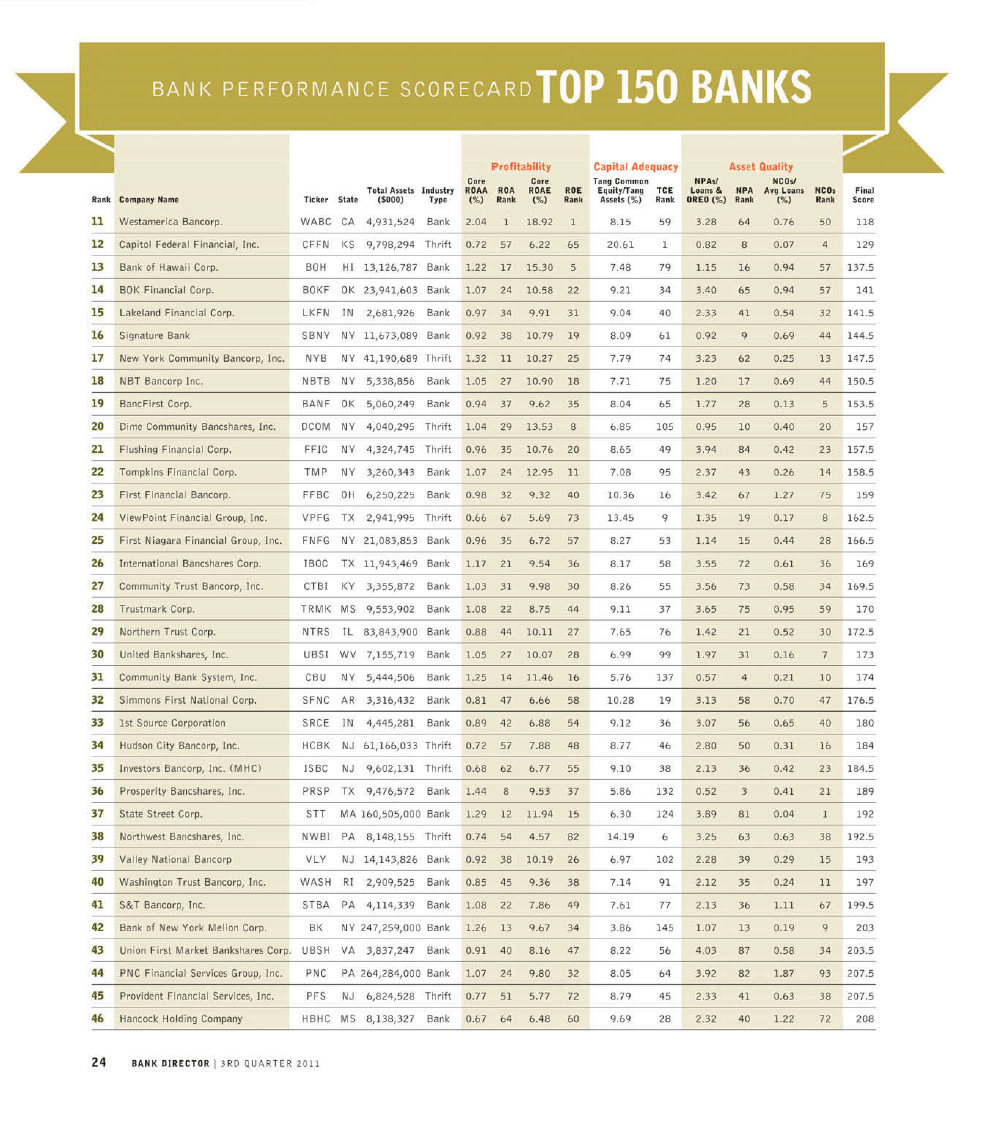
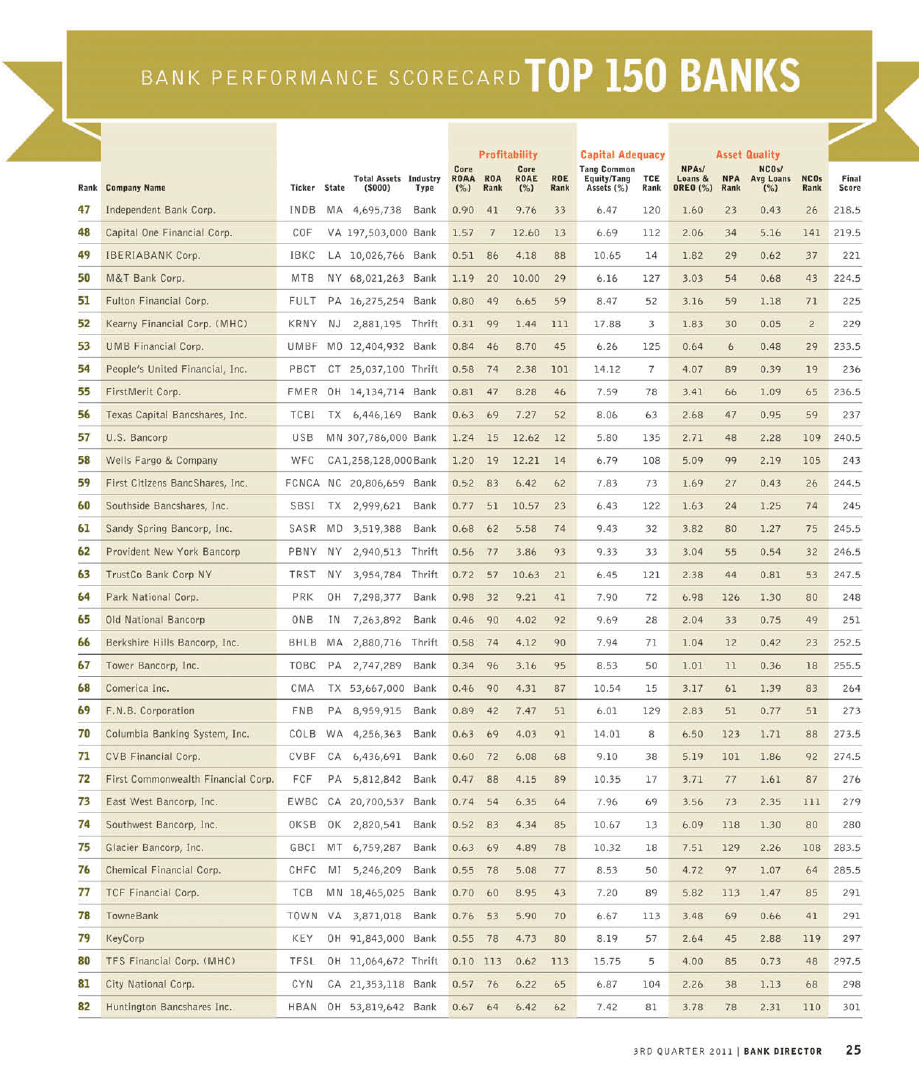
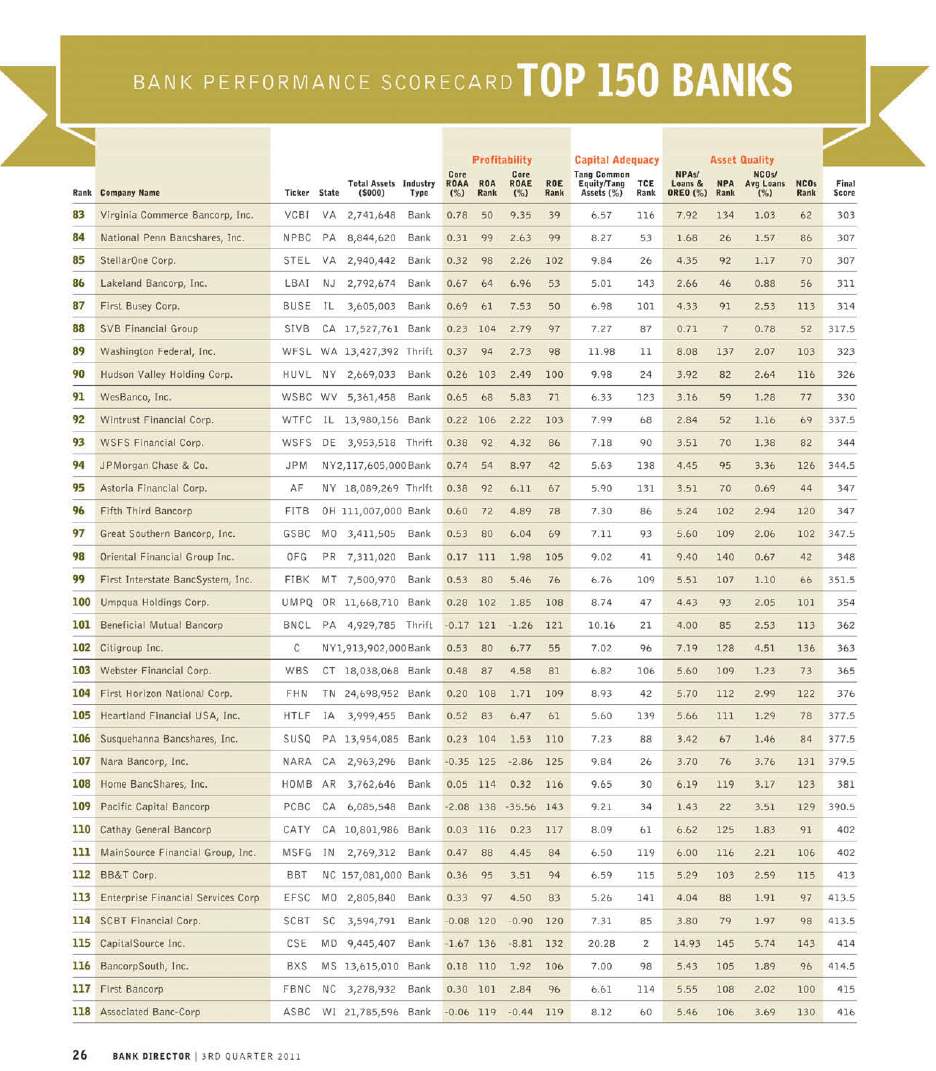
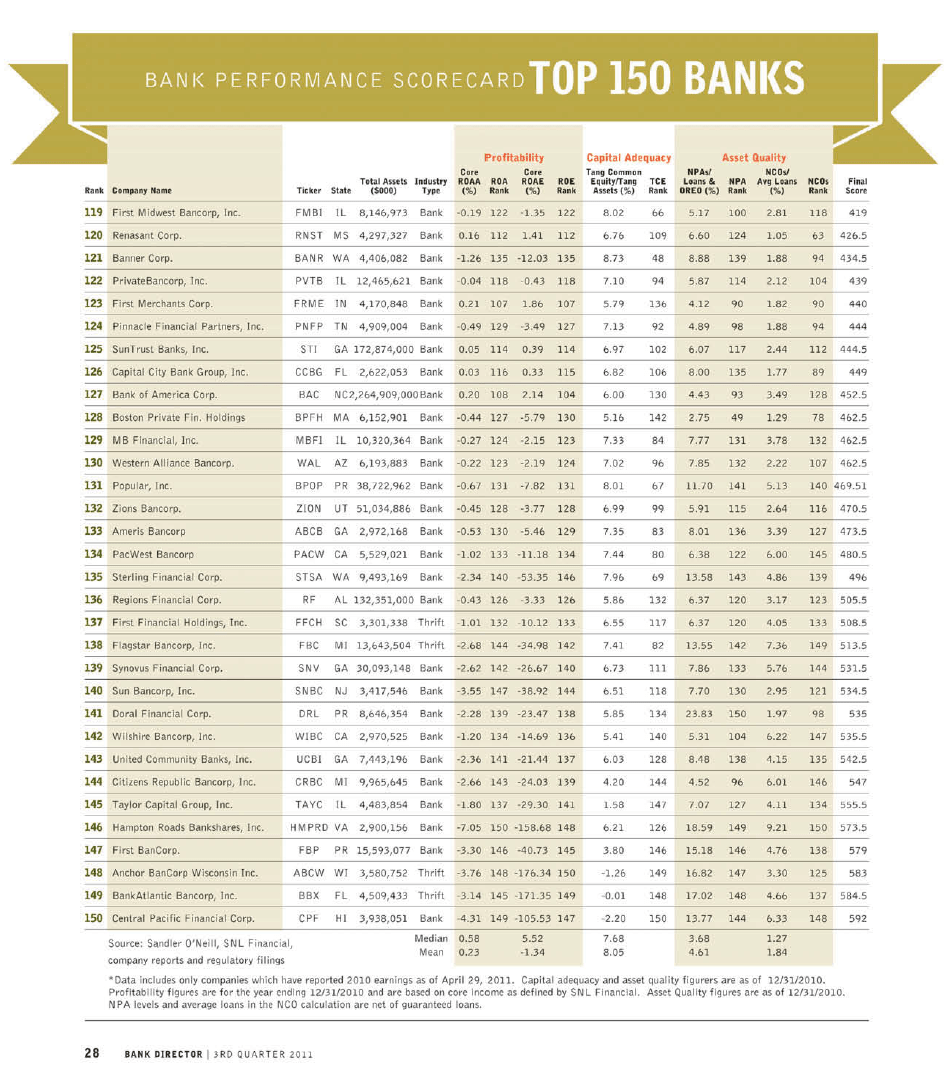
The rest of the Top 150 banks are listed in the screenshots below:

Click to enlarge

Since hundreds of bank stocks trade on the US markets and it is a very difficult sector to evaluate now, investors looking to bank stocks to their portfolios can use the above list as a starting point for further research.

Disclosure: Long GBCI, FBP, DRL, FITB, BBT, PNC, USB, UBSH