To Make Money Just Follow the Equity Sentiment Roadmap

Baron Phillipe Rothschild: “The time to buy is when there’s blood in the streets.”

Warren Buffet: “Be fearful when others are greedy and greedy when others are fearful.”

Extreme turmoil in the market generally excellent creates buying opportunities. Smart investors tend to take advantage of such situations to add high-quality stocks at rock bottom prices.

The following roadmap shows the relationship between emotions and risk/return with respect to investment:

Click to enlarge
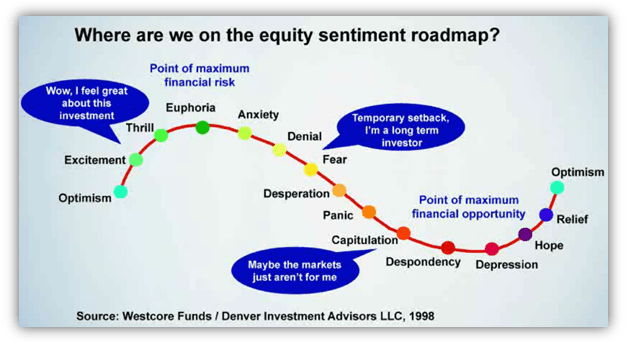
Source: Why turmoil creates opportunities, Trustnet UK

From the Trustnet article:

Chris Spear, managing director of Spear Financial in UK says that investors who remain emotionally removed will stand the best chance of making money.

“It is ridiculously simple. Whatever your emotions are saying, do the opposite,” he explained. “If you think things are really bad in the markets, then it may well be a good time to invest.”

An opportunity of a lifetime presented itself to investors in March 2009. The S&P 500 hit a bear-market low of 676 on March 9 with an intra-day low of 666. By mid February of this year, the S&P 500 closed at 1,332 – virtually doubling from the March, 2009 lows. Some foreign stocks more than doubled during the same period. For example, Banco Santander (SAN) of Chile reached as low as $30.56 in March 2009 only to rebound to about $100 by September 2010. Yesterday it closed at $81.58.  The main point here is that investors who scooped up stocks on the cheap in March 2009 are sitting on strong gains despite the recent volatility in the markets in the past couple of months.

Disclosure: No Positions
Foreign Bank Stocks Are Drowing in a Sea of Red

Bank stocks were hit hard day before yesterday when global equity markets plunged. The dramatic selloff in Bank of America (BAC) and Citibank(C) stocks in the U.S. raised fresh fears of their failures. It is not just U.S. domestic banks that are still reeling from the effects of the credit crisis. Foreign banks are also suffering due to many reasons including pressure on profits due to rising interest rates, loan losses tied to the real estate sector, lack of trust on their balance sheets, further losses due to bad assets, etc.

The table below shows the year-to-date performance of foreign bank stocks:

[TABLE=1033]

Source: BNY Mellon

The only bank that is in positive territory YTD is HDFC Bank (HDB) of India. All the other banks in the red YTD with some European banks especially down heavily.

Disclosure: Long BCH, BBD, ITUB, BMA, STD, RBS, LYG

What Stocks To Buy As The Market Crumbles

Global stocks fell heavily across the board yesterday.Panic selling in the markets usually presents buying opportunities. Investors looking to deploy capital during uncertain times can buy high-quality dividend-paying stocks at cheap prices.

Some of the reasons for investing in dividend-paying stocks are listed below:

  • 90% of the U.S. equity returns in the past century has been delivered by dividends and dividend growth.
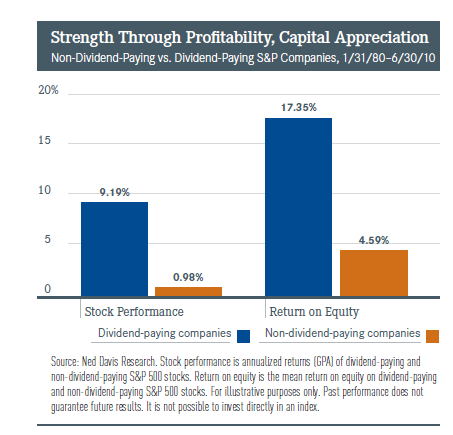
  • Dividend payers usually have superior returns than non-payers as shown in the chart below:


  • Since 1970, more than 80% of European returns have come from a combination of yield and real dividend growth.
  • Over the past 30 years, well over 90% of UK, Germany and France returns have come from dividends and dividend growth according to research by Societe Generale.
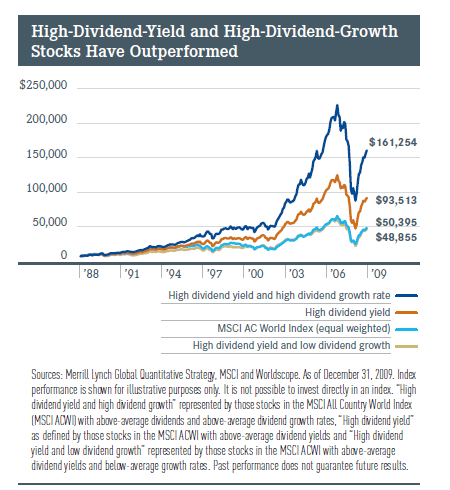
  • Globally, high-dividend-yield and high-dividend-growth stocks have consistently outperformed the broad market while also handily outpacing simple high yield stocks as shown in the graph below:

  • Foreign dividend stocks have consistently higher yields than U.S. stocks.
  • In low-growth environments such as the one we are in now, high-yielding stocks have traditionally outperformed.

Source: Why Dividends Make A Difference, Blackrock

Ten randomly selected foreign stocks yielding more than 5% dividends are listed below for further research:

1.Company:Empresa Nacional de Electricidad SA (EOC)
Current Dividend Yield: 6.75%
Sector:Electric Utilities
Country: Chile

2.Company:National Grid PLC (NGG)
Current Dividend Yield: 6.01%
Sector:Electric Utilities
Country: UK

3.Company:Cpfl Energia SA (CPL)
Current Dividend Yield: 5.66%
Sector:Electric Utilities
Country: Brazil

4.Company:Telstra Corp Ltd (TLSYY)
Current Dividend Yield: 8.87%
Sector: Telecom
Country: Australia

5.Company:Aviva PLC (AV)
Current Dividend Yield: 7.22%
Sector: Life Insurance
Country: UK

6.Company:City Telecom (HK) Ltd (CTEL)
Current Dividend Yield: 7.21%
Sector: Telecom
Country: Hong Kong

7.Company: Philippine Long Distance Telephone Co(PHI)
Current Dividend Yield: 6.49%
Sector: Telecom
Country: Philippines

8.Company:Allianz Se (AZSEY)
Current Dividend Yield: 5.72%
Sector: Life Insurance
Country:Germany

9.Company:Stora Enso Oyj (SEOAY)
Current Dividend Yield: 5.17%
Sector:Paper & Paper products
Country: Finland

10.Company:Gdf Suez SA (GDFZY)
Current Dividend Yield: 6.99%
Sector: Electric Utilities
Country: France

Note: Dividend yields noted above are as of market close August 8, 2011

Disclosure: No Positions

The World’s Most Indebted Nations

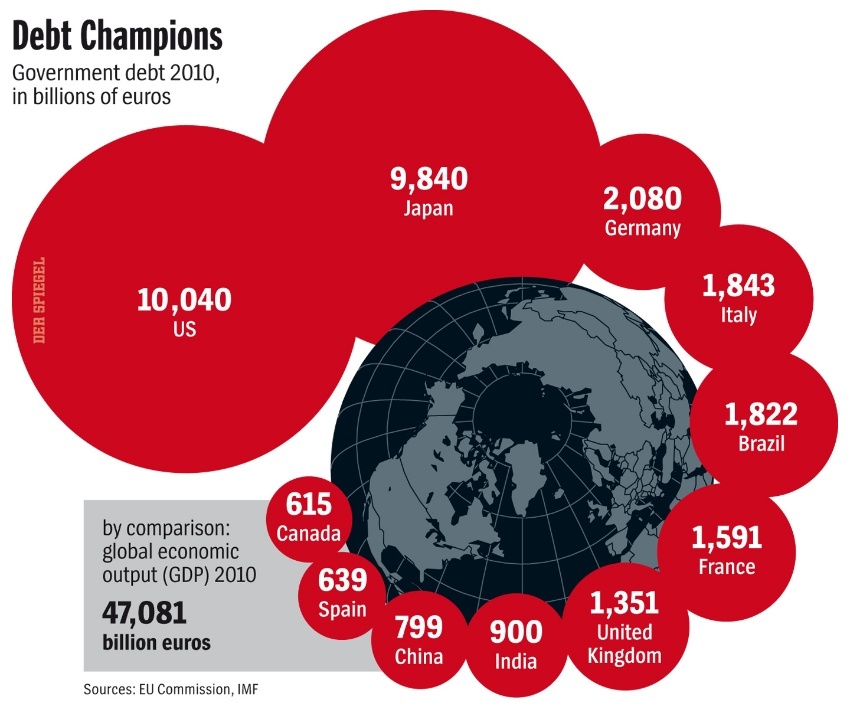
The global financial crisis of 2008-09 started in the U.S. and almost brought the world’s economies to its knees. With the downgrade of the U.S. by S&P and the crash in global markets today it appears that the U.S. might trigger another financial crisis soon if one has not started already.

I came across this graphic showing the world’s most indebted nations:

Click to enlarge


Source:Is The World Going Bankrupt?, De Spiegel

The article notes that the world lacks the political leadership needed to end the current turmoil. This statement can’t be further from the truth especially with respect to the U.S. leadership. After the S&P downgrade, President Obama made a statement hoping that would somehow calm the markets. He even stated that “no matter what some agency may say, we’ve always been and always will be a AAA country.” However the market tanked much more after this statement underscoring the gap between market’s views of  the U.S. fiscal issues and the views held by this administration.

From A crisis of confidence in economy — and Obama by James Pethokoukis of Reuters:

In short, there is again a crisis of confidence in the U.S. economy – but in Washington, too. During his brief speech yesterday at the White House, Obama did nothing to calm jittery markets, perhaps achieving just the opposite. He blamed Tea Party Republicans for the debt downgrade. He said government discretionary spending couldn’t be cut much further. He called for raising taxes. And he repeated his demand for a mini-version of the 2009 stimulus – temporary tax cuts, infrastructure spending, more unemployment benefits.

The stock market, already falling before Obama spoke, saw selling accelerate as Obama made it clear he had no new ideas to offer. And he certainly gave no hint that he’s ready to adopt Republican ideas such as cutting business taxes or slashing regulation. Instead of a pivot, Obama stayed firmly planted in the anti-growth policies of the past two-and-a-half years. He’s even keeping Tim Geithner as Treasury secretary, practically begging the poor guy to stay. (Indeed, it was almost exactly a year ago that Geithner penned his “Welcome to the Recovery” op-ed.)

If confidence is not restored quickly and the market continues to fall the President’s hopes of winning a second-term may have to be set aside.

Download: Dividend Achievers Lists 2011

Mergent publishes the Dividend Achievers list of indices which constitute companies that have consistently increased dividend payments.

For example, the United Kingdom Dividend Achievers™ Index has the following features:

  • Companies in the index must be incorporated in the UK.
  • Companies must have increased their annual dividend payments for the last five or more consecutive years.
  • Companies must also meet certain liquidity and investibility criteria.

Investors hunting for dividend stocks can refer to these indices to select potential candidates for investment.

To download the following Dividend Achievers Indices in Excel format click on the respective links:

UK Dividend Achievers Index

Select Canadian Dividend Index

NASDAQ Dividend Index

International Dividend Achievers Index