The World’s Ten Biggest Employers

I came across an interesting article in The Economist magazine recently that discussed about the biggest employers in the world. When the economy is sluggish private sector is unable to create jobs due to the lack of demand for goods and services. For example, despite having over a Trillion dollar in cash, U.S. companies have been reluctant to invest capital and hire workers in the U.S. However it must be noted that the same companies have hired millions in other countries where labor costs are cheaper. With no or few jobs created in the private sector, trimming of public sector workers by governments adds more unemployment in the short-term but helps in the long-run.

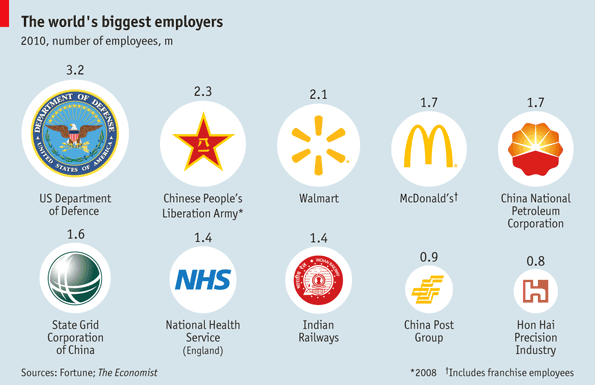
The following graphic shows the world’s biggest ten employers:

Click to enlarge
Source: The Economist

From the article:

In our chart of the ten biggest global employers, below, seven are government-run. America’s defence department had 3.2m people on its payroll last year, equivalent to 1% of the country’s population. China, the world’s most populous nation and a big military spender, employs 2.3m people in its armed forces. And the number of people working for the National Health Service in England is equivalent to over 2.5% of the country’s population. The three private companies are Walmart, McDonald’s and Taiwan’s Hon Hai Precision Industry Company, a subsidiary of which is Foxconn, a secretive electronics manufacturer.

The above chart is a little misleading since it includes military in the comparison. An ideal way to identify the top employers would be to create a separate list for the public and private sectors. The U.S. Department of Defense employing 3.2 million is not a surprise since the U.S. is the sole superpower and a large part of the economy is dependent on the military. Other than China’s Army, the three state-owned Chinese firms shown above may not be as efficient as firms in the private sector. Similarly UK’s NHS  and India’s Indian Railways suffer from atrocious inefficiency as well. The situation with the bloated public sector in UK is changing now as the Cameron government implements long-awaited reforms. Taiwan’s Foxconn is the world’s largest contract electronics manufacturer for many of the global hi-tech firms such as Apple(AAPL), Dell (DELL), etc. Foxconn employs thousands of workers in China to take advantage of the low labor costs there.

Disclosure: No Positions
How to Profit from the Explosive Growth of Global Auto Industry

The global auto population surpassed the 1 billion mark last year according to a report released last month by the auto industry consultant Ward’s Auto.

China topped the ranking with an addition of about 17 million units last year for an increase of 27.5% in registration from previous year. China has the second largest population of cars in the world after the U.S. China also accounted for nearly half of the global growth last year.

Car sales in India rose by 8.9% last year with over 20 million vehicles on the road currently. Brazil took the third place by adding about 2.5 million units. To put the China and India auto figures in perspective, the U.S. total vehicle population is over 240 million making it the home of the largest auto population in the world. The US ownership ratio stands at one car for every 1.3 Americans. On the other hand, with a population of 1.17 billion people, India has one car for every 56.3 Indians.

From its humble beginnings 125 years ago, cars have become an important pillar of the global economy today. The following excerpts are from a special report on the auto industry in Deustche Welle:

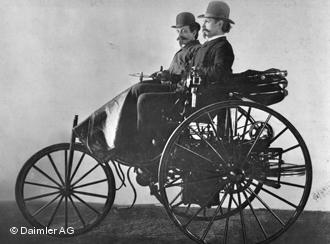
The history of the modern automobile began on Jan. 29, 1886 when engineer Carl Benz registered a patent in the city of Mannheim for his motorcar.

It was a vehicle with three wheels – called a “tricycle” on the patent application – equipped with an internal-combustion engine. The machine could generate 0.8 horsepower (0.6 kilowatts), was started with a crank and had a top speed of 18 km/h (11.2 mph).

Carl Benz (right) in his patented vehicle

Source: Deustche Welle

In the past few years soaring gas prices have forced many consumers to buy fuel-efficient cars. In addition, the demand for ethanol and electric-powered vehicles continues to increase as consumers become more educated on environmental issues. Even the notoriously green-averse Americans have joined Europeans in embracing green-friendly products. For example, a few years ago General Motors (GM) finally stopped production of the Hummer SUVs, a gas-guzzling civilian version of military Humvees.

It is fascinating to note that electric cars beat gasoline-powered cars in setting the first speed records. From the DW report:

In one of history’s little ironies, the first speed records were actually set with electric cars. In 1901, one vehicle exceeded 100 km/h (62 mph).

The gasoline-powered engine was not yet the standard, and around the turn of the century, different types of drives were still competing with one another. Manufacturing data from American producers in 1900 shows that 75 makers assembled a total of 4,192 automobiles during that year, including 1,688 steam-driven vehicles and 1,575 electric cars. Only 929 of the cars made had gasoline engines.

It took about another two decades for gasoline engines to establish themselves. But they eventually took the top spot thanks to their higher speeds, better motors, cheap fuel, and the much greater distances they could cover, especially compared to electric motors with their weak batteries.

Investment opportunities in the Auto industry:

The best way to profit from the growth in the global auto industry is to invest in companies that supply parts to automakers. This includes manufacturers of parts such as tires, sensors, chemicals, windshields, brakes, electrical systems, interiors, etc.

Ten foreign auto parts makers trading on the US markets are listed below for further research:

1.Company: Magna International (MGA)
Country: Canada

2.Company: Autoliv (ALV)
Country: Sweden

3.Company: Bridgestone (BRDCY)
Country: Japan

4.Company: Denso (DNZOY)
Country: Japan

5.Company: Michelin (MGDDY)
Country: France

6.Company: Nokian Tyres (NKRKY)
Country: Finland

7.Company: Rheinmetall (RNMBY)
Country:Germany

8.Company: Continental (CTTAY)
Country: Germany

9.Company: Valeo (VLEEY)
Country: France

10.Company: Geely Automobile (GELYY)
Country: Hong Kong

Disclosure: Long VLEEY and DNZOY

Another Look at the Stock Markets in China

Last month we looked at the various types of stocks traded in China. In this post, lets take a quick look at the vast opportunities available for investors in the Chinese equity markets.

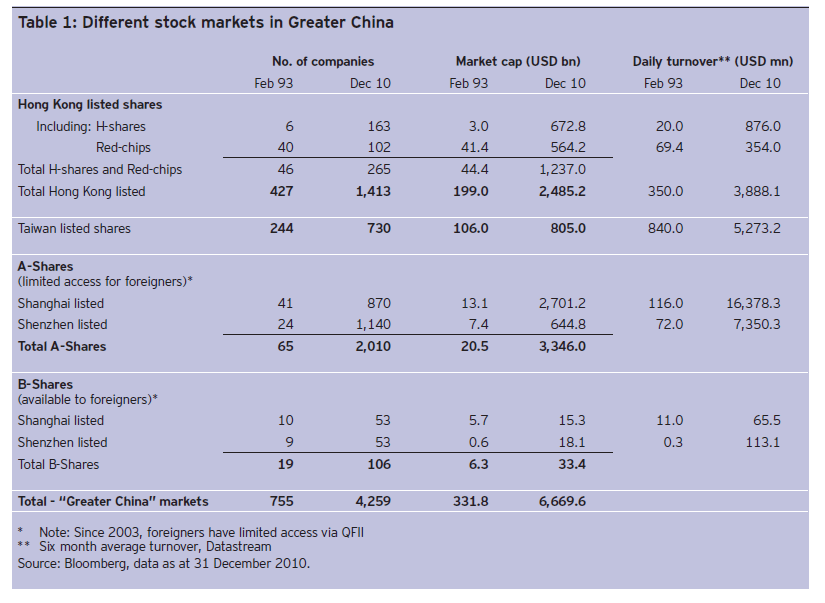
Today, China A-shares alone have a large universe of roughly 2000 companies and total market cap of USD 3.3 trillion (Japan has a market cap of USD 4.0 trillion, the UK’s market cap is USD 3.9 trillion) – constituting approximately a half of the total Chinese equitymarket exposure (table 1).

Click to enlarge

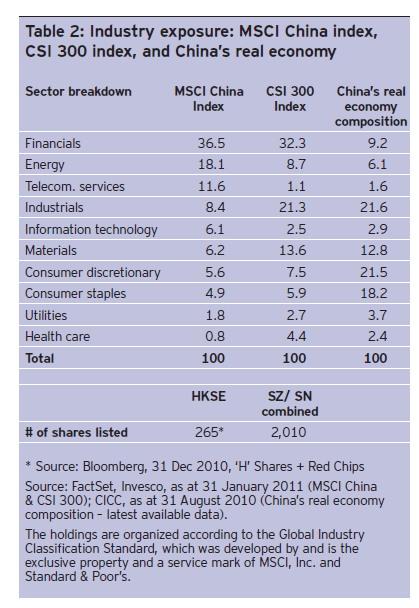
China A-shares offer complementary industry exposures compared to the MSCI China index. While the MSCI China index tends to be heavily skewed toward financial institutions, energy and telecommunication companies, China A-shares, using the CSI 300 index as a proxy, are broader and more diversified across sectors. Additionally, China A-shares’ industry breakdown better reflects China’s real economy (table 2).

Source: Risk & Reward, Q2/2011, Invesco Perpetual, UK

Related ETF:

iShares FTSE China 25 Index Fund (FXI)

Disclosure: No Positions

U.S. Corporate Dividend Payouts Poised To Rise Further

Many U.S. companies have reinstated (or) increased dividend payments since the credit crisis of 2008-09. The amount of payouts and the number of companies with positive dividend actions have increased in recent months. According to Standard & Poor’s, in the first half of 2011, net cash payouts among S&P 500 companies rose by a record $25.5 billion. In addition, the number of companies that raised or initiated dividends during this time rose to 204 from 140 in the prior-year period.

As dividend raises indicate a company management’s confidence in its future stream of cash flows, investors have to pay close attention to this factor when evaluating potential investment opportunities. A report by Cohen & Steers notes that “Dividends have increased at a record pace so far in 2011, and are poised to continue growing.”

While financials have still  a long way to go, most other sectors within the S&P 500 have increased their dividends this year.

According to the report, corporate dividend payouts are poised to rise substantially in the following years due to the following three factors:

  • Strong Earnings
  • Strong Balance Sheets
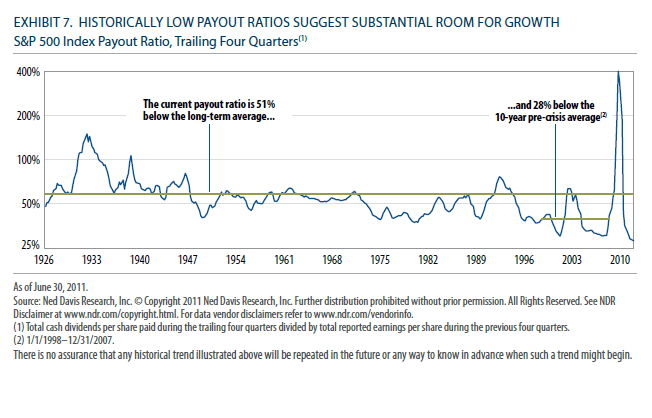
  • Historically Low Payout ratio

Companies in the S&P 500 have amassed a near-record $3.6 trillion in cash and marketable securities.

Although aggregate payouts for companies in the S&P 500 are nearing historical highs, dividends have not kept pace with earnings growth, sending the average payout ratio plummeting to an all-time low of 28%, as shown in Exhibit 7.

Click to enlarge

Related ETF:

SPDR S&P 500 ETF (SPY)

Disclosure: No Positions