Knowledge is Power: Financial Advisor, Emotions, Sustainable Capitalism Edition

Investor fired his adviser and loaded up on dividend stocks

When Should You Use an Advisor?

China’s debt-heavy bosses go on the run

Fool’s gold

Why emotions and investing don’t mix

What’s the use of saving money?

Governments must act on rising long-term unemployment and youth joblessness

Citywire Top Stocks

Germany goes for sustainable capitalism

It is business, not the state, that creates jobs, by David Cameron

Click to enlarge

Volkswagen car storage tower, Wolfsburg, Germany

15 Non-Financial European Companies with Large Government Ownership

Some of the European governments still own large stakes in private sector companies. Traditionally sectors like utilities, airlines used to have large state ownership. With the bailouts during the financial crisis of 2008-09, some of the banks also are majority-owned by governments.

15 non-financial companies with state ownership of more than 10% are listed below with their current yields. This list comes from a research report produced by Morgan Stanley in March 2010. So ownership figures may have changed. Please do your own research before making any investment decisions.

Energy
1.Company: Eni spa (E)
Current Dividend Yield: 7.77%

2.Company: StatoilHydro (STO)
Current Dividend Yield: 5.39%

3.Company: Fortum (FOJCY)
Current Dividend Yield: 5.78%

Industrials
4.Company: Norsk Hydro (NHYDY)
Current Dividend Yield: 2.84%

5.Company: Metso Corp (MXCYY)
Current Dividend Yield: 7.08%

Materials
6.Company: Yara International (YARIY)
Current Dividend Yield: 2.40%

Telecom
7.Company: France Telecom (FTE)
Current Dividend Yield: 11.67%

8.Company: Deutsche Telecom (DTEGY)
Current Dividend Yield: 8.21%

9.Company: Telenor (TELNY)
Current Dividend Yield: 4.47%

10.Company: Telecom Austria (TKAGY)
Current Dividend Yield: 10.32%

Utilities
11.Company: Enel Spa(ENLAY)
Current Dividend Yield: 8.67%

12.Company: EDF (ECIFY)
Current Dividend Yield: 5.38%

13.Company: GDF-Suez (GDFZY)
Current Dividend Yield: 6.62%

14.Company: EDP Energias Portugal (EDPFY)
Current Dividend Yield: 7.61%

15.Company: Vebund (OEZVY)
Current Dividend Yield: 2.69%

Note: Dividend yields noted are as of September 29, 2011

Source: European Strategy 15 March 2010,  Morgan Stanley Equity Research

Disclosure: No Positions

Checking on Brazilian Utility ADRs

The theory that emerging markets are decoupled from developed markets did not hold well during the current turmoil in global equity markets. Emerging market stocks have also fallen sharply in tandem with others. For example, while most of European countries are down more than 20% and the S&P is down 6.5%%, Brazil’s Bovespa is also off 22.2% YTD as of September 27th.

Investors looking to add some exposure to Brazil can consider adding some of the utility stocks. Unlike their peers in the developed world, the yields of Brazilian utilities tend to fluctuate but the potential for growth are higher with them.

Brazilian electricity and natural gas companies trading on the organized US exchanges are listed below with their current dividend yields and YTD price changes:

1.Company: Ultrapar (UGP)
Current Dividend Yield: 3.54%
YTD Change: Unchanged

2.Company: Companhia Energetica de Minas Gerais-CEMIG (CIG)
Current Dividend Yield: 6.62%
YTD Change: -2.56%

3.Company: SABESP  (SBS)
Current Dividend Yield: N/A
YTD Change: -8.80%

4.Company: CPFL Energia (CPL )
Current Dividend Yield: 6.81%
YTD Change: -10.86%

5.Company: Comp. Paranaense de Energia-COPEL (ELP)
Current Dividend Yield: 1.02%
YTD Change: -25.90%

6.Company: Centrais Eletricas Brasileiras-Eletrobras (EBR)
Current Dividend Yield: 6.60%
YTD Change:  -35.49%

Some of the sponsored Brazilian utility ADRs trading on the OTC markets are listed below with their current yields:

1.Company: AES Tiete (AESYY)
Current Dividend Yield: 10.48%

2.Company: Centrais Elet. de Santa Catarina-Celesc (CEDWY)
Current Dividend Yield: 6.58%

3.Company: Comp. de Transmissao-Paulista (CTPZY)
Current Dividend Yield: 11.97%

4.Company: Comp. Energetica de Sao Paulo-CESP (CESDY)
Current Dividend Yield: N/A

5.Company: Comp. Paranaense de Energia-COPEL (ELPVY)
Current Dividend Yield: 4.49%

6.Company:Light SA (LGSXY)
Current Dividend Yield: 14.98%

7.Company: MPX Energia (MPXEY)
Current Dividend Yield: N/A

8.Company: Tractebel (TBLEY)
Current Dividend Yield: 8.68%

Disclosure: No Positions

Comparison of Developed and Emerging Market Banks on P/B Ratios

Ever since the Global Financial Crisis (GFC) of 2008, investors’ confidence in the global banking industry has declined tremendously. In the developed world, banks are still saddled with unknown losses mostly tied to real estate and derivatives despite billions of dollars pumped into them as part of the various bailout programs after the crisis.Though emerging market banks have not been crushed like their peers in the developed world, they also suffer from erosion in investor confidence and other issues like capital costs, exposure to the real estate sector, rising default rates, etc.

From the McKinsey Annual Review on the banking industry report:

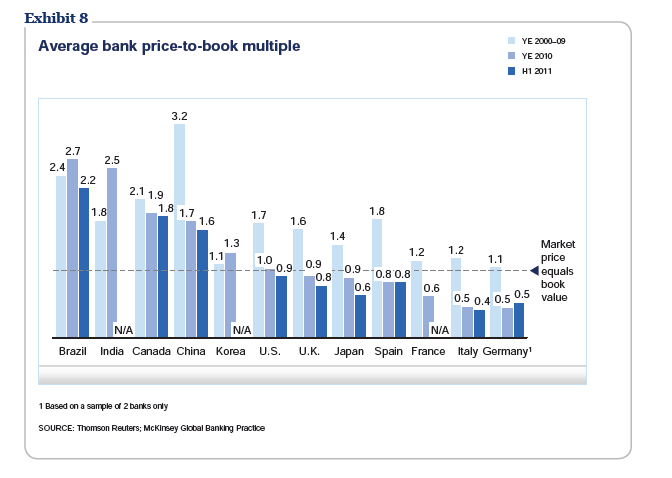
After a rebound in 2009, banks’ total market capitalization remained flat overall in 2010 and the first half of 2011, with gains in many developing markets offset by declines in the US, China, and Western Europe. In both developed and developing markets, banks’ price-to-book ratios fell sharply during 2008-09, failing to recover during 2010 or the first half of 2011. This reflected the market’s view not only that profits would remain depressed, but also that banks would struggle to remunerate their required capital (Exhibit 7). There was also continuing divergence between developed and developing market banks’ price-to-book ratios. By mid-2011, even before the recent turmoil, banks’ market prices were below their book values in several developed countries, including the US, UK, Japan, France, Italy, and Germany (Exhibit 8).

Click to enlarge

After the recent fall, some European banks have gotten cheaper based on P/B and other factors. However one has to be extremely selective. One idea is to consider to banks outside of the Euro Zone such as select Nordic banks. Among U.S. banks, some small and regional banks are worth looking into. For example, U.S Bancorp(USB) offers many compelling reasons to invest as noted in an article in The Globe and Mail. In the emerging markets, some of the bank stocks that investors can review include: Banco Santander Chile (SAN), Banco do Brasil SA (BDORY), HDFC Bank Ltd (HDB) and Malayan Banking BHD (MLYBY).

Disclosure: Long USB

The Top Six Utility Companies in UK

With the winter approaching soon, all six of the major utility firms in UK have increased prices for the second time this year, according to a report in This is Money website. Most of the price increases for electricity and gas are in the double digits.

The six major energy suppliers in the British market are:

  1. Scottish Power
  2. British Gas
  3. Scottish and Southern Energy (SSEZY)
  4. EDF Energy
  5. E.ON (EONGY)
  6. npower

EDF Energy is the British subsidiary of the France-based EDF Group (ECIFY). The company serves operates in 21 countries serving over 38 million customers in Europe, over 28 million of which is in France. Currently the ADR has a dividend yield of 6.0%. Scottish and Southern Energy (SSEZY) has a 5.60% yield. Germany-based E.ON is also one of the largest utilities in Europe. The US-traded ADR fell from over $34 earlier this year to below $18 recently. Based on yesterday’s closing price of $20.98, it pays a hefty a 10.98% dividend.

Disclosure: Long EONGY