Biotech Stocks Are Not For The Faint-Hearted

The biotech sector is soaring this year with the benchmark NYSE Arca Biotechnology Index up by over 27% YTD as of the end of September. Investors’ attraction towards biotech stocks shows no signs of showing as evidenced by many successful IPOs being launched on a weekly basis and also trading volumes. In addition, one of the top viewed pages on this site is the complete list of biotech stocks page.

In general biotech stocks are not suitable for all investors especially retail investors that are risk averse. This is because these equities are highly speculative and most of the companies cannot be analyzed using fundamental factors such as P/E ratio, assets, revenues, etc. The majority of the companies do not have any earnings yet as they are still in the discovery process to create some drug for cancer or other diseases. As such, a company that is successful in the discovery and winning of FDA-approval will be a winner while the unsuccessful ones will be spectacular losers. In addition, equity prices of losers can lose 50% or more almost overnight providing no warning and time to escape the carnage. So investors in biotech need to be aware of these risks and prepare their portfolios accordingly.

The case of two companies that had wild moves recently vividly describes the above scenarios.

On the winning side of the equation, Amarin Corporation plc(AMRN) is based in Dublin, Ireland. Below is short profile from Yahoo Finance:

Amarin Corporation plc, a biopharmaceutical company, focuses on the development and commercialization of therapeutics for the treatment of cardiovascular diseases in the United States. The company’s lead product is Vascepa, a prescription-only omega-3 fatty acid capsule, used as an adjunct to diet for reducing triglyceride levels in adult patients with severe hypertriglyceridemia. It is also involved in developing Vascepa for the treatment of patients with high triglyceride levels who are also on statin therapy for elevated low-density lipoprotein cholesterol levels. Amarin Corporation plc sells its products principally to wholesalers and specialty pharmacy providers through direct sales force. It has collaboration with Mochida Pharmaceutical Co., Ltd. for the development of EPA-Based drug products and indications. The company was formerly known as Ethical Holdings plc and changed its name to Amarin Corporation plc in 1999. Amarin Corporation plc was founded in 1989 and is based in Dublin, Ireland.

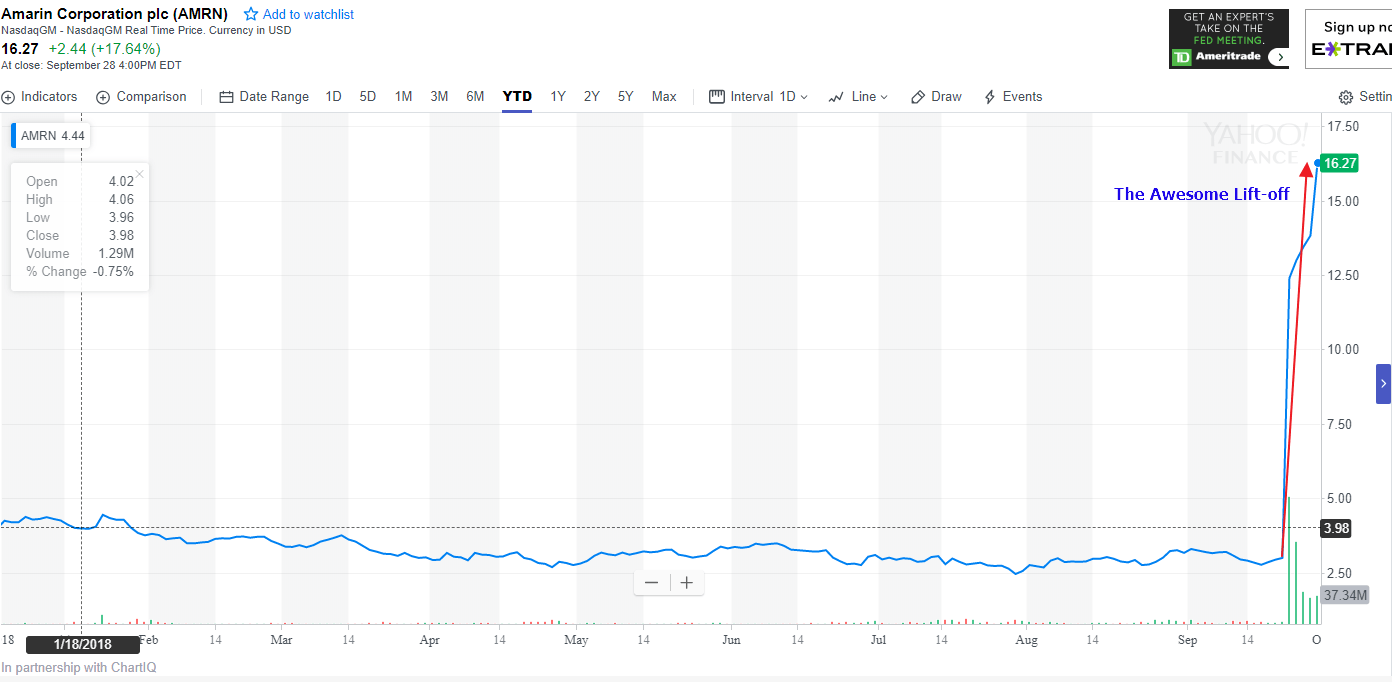
AMRN was trading at under $5 per share for over a year. On Sept 21st, the stock was trading at $2.99. On Monday Sept 24th, the company announced that its fish oil drug reduced the risk of heart diseases. The stock more shot up 315% on this announcement. From a journal article that day:

Amarin Corp. more than tripled in value Monday, after the company said its drug derived from fish oil reduced the risk of heart attacks, strokes and deaths in certain high-risk patients.

The results could open the door for a new line of attack against heart disease, and turn Amarin’s drug Vascepa into a blockbuster, if the data is borne out under closer scrutiny.

“This is indeed huge,” Amarin CEO John Thero said during a conference call with analysts. The result “positions Vascepa to be first to market in addressing a large unmet medical need.”

ADR shares of Dublin-based Amarin jumped 315% on the news, raising the company’s market cap by $2.8 billion, to $3.6 billion.

Source: Amarin Surges on Fish-Oil Drug Data, WSJ, Sept 24, 2018

After ending Sept 24 a $12.4 the stock further rose in the following days. On Friday it shot up another 17% and ended the week at $16.27.

AMRN Year-to-date return chart:

Click to enlarge
Source: Yahoo Finance

This example shows how a biotech stock can soar to the moon on a single day and then some based on a single news announcement.

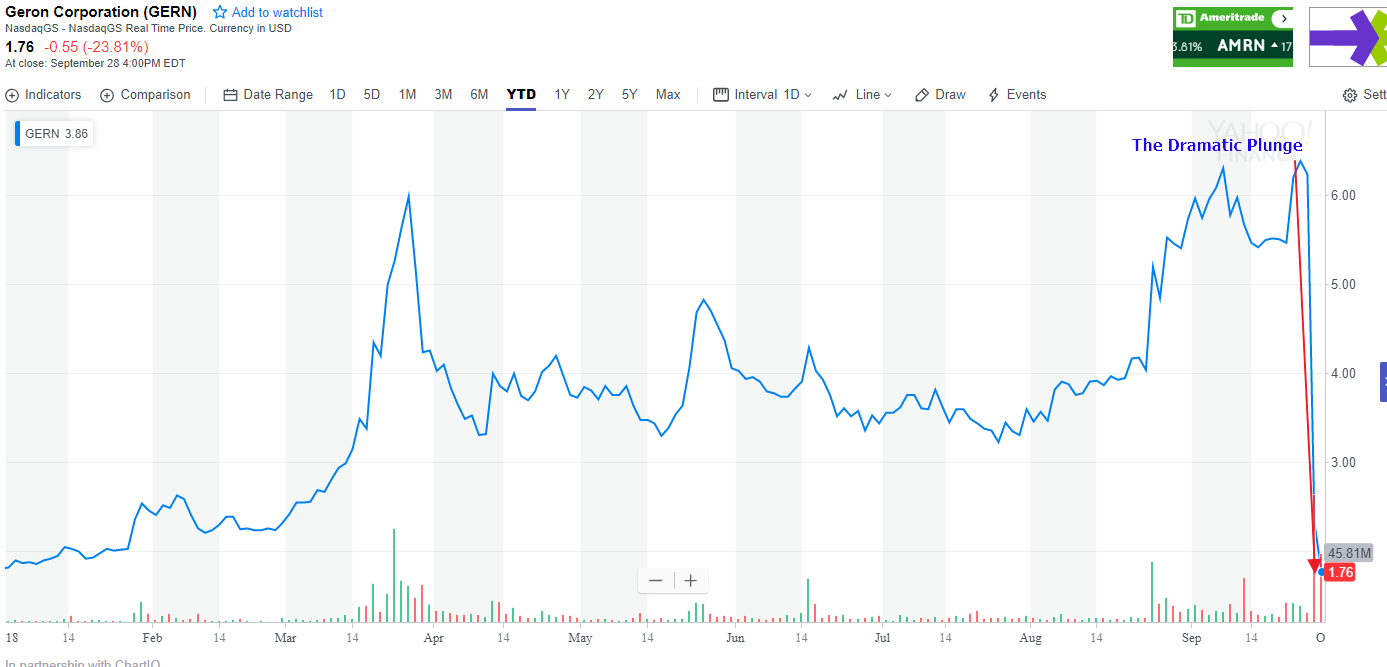
The below case of Geron Corporation (GERN) shows the scary situations that biotech investors face.  On September 26, Geron announced that Johnson & Johnson (JNJ) had terminated a partnership venture with it. The exit of a deep-pocketed partner and future uncertainty caused the  stock by plunge by 68% on a single day. Earlier in the day the stock was down by 76%.

GERN Year-to-date return chart:
Source: Yahoo Finance

On Friday the stock further plunged another 22% in morning trading. The above YTD chart shows the dramatic selloff in Geron’s shares.

The above two sample cases show that biotech stocks are not for the faint-hearted. Investors can earn wonderful returns or lose huge investments within a short period.

The key takeaway is investors in individual biotech stocks have to know the huge risks involved and diversify accordingly. A better option would be to avoid individual firms and simply buy an index fund.

Disclosure: No Positions
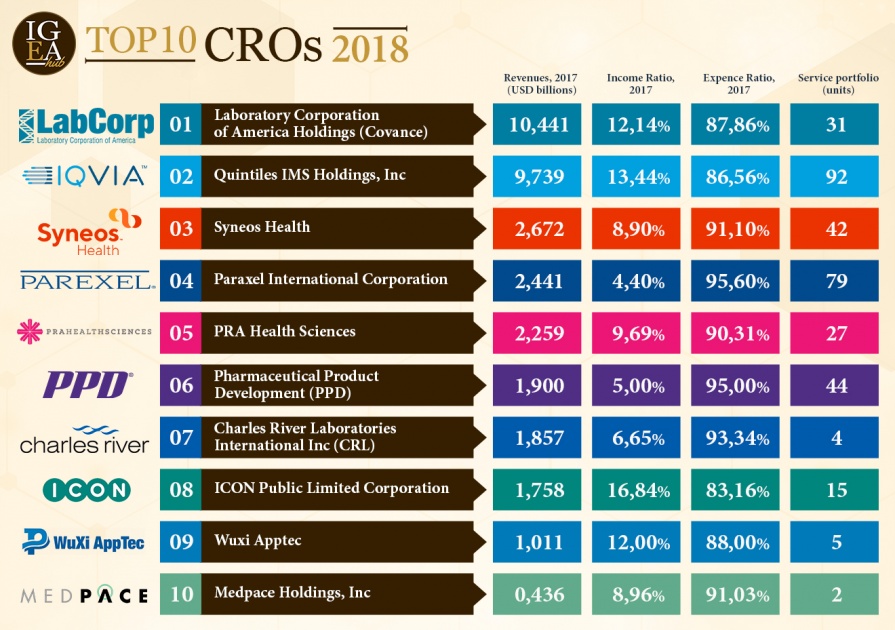
The 10 Best Global Contract Research Organizations (CROs) in 2018

Contract Research Organizations (CROs) play an important role in medical innovation as more pharmaceutical, biopharmaceutical and medical device companies outsource many of their R&D activities. The top 10 global CROs are listed in the chart below.

Here is a brief overview of the CRO industry:

In 2017, the global CRO services market is estimated to be valued at USD 36.27 Billion and projected to grow at a CAGR of 7.6% from USD 39.13 Billion in 2018 to reach USD 56.34 Billion by 2023.  Globally more than 1,100 CRO companies are active in 2017. The global CRO market is centralized with the top 10 companies that generated collective total revenue of USD 34.514 billion in 2017 (including reimbursed out-of-pocket revenue). The global contract research market is growing at a strong rate as increased dependence of pharmaceutical, biopharmaceutical and medical device companies seen due to increased outsourcing of R&D activities, increased R&D expenditures and, increasing number of clinical trials.

The leaders in this market include a mix of public-listed and privately held organizations. Recent collaborations by CRO companies with government agencies and non-profit health organizations has proved that CROs are not just clinical service providers but actively involved in the new drug development process, and immensely contributing to the development of new products and helping advancement in healthcare outcomes.

Click to enlarge

Source: IGEA Hub

Some of the publicly-listed companies from the above rankings are Laboratory Corp. of America Holdings(LH), Charles River Laboratories Intl. Inc (CRL) and Iqvia Holdings Inc(IQV).

From an investment perspective, the CROs are a better bet than drug and biotech firms since they provide a service and are not dependent hugely on the discovery or success of a drug for example.

Earlier:

Disclosure: No Positions

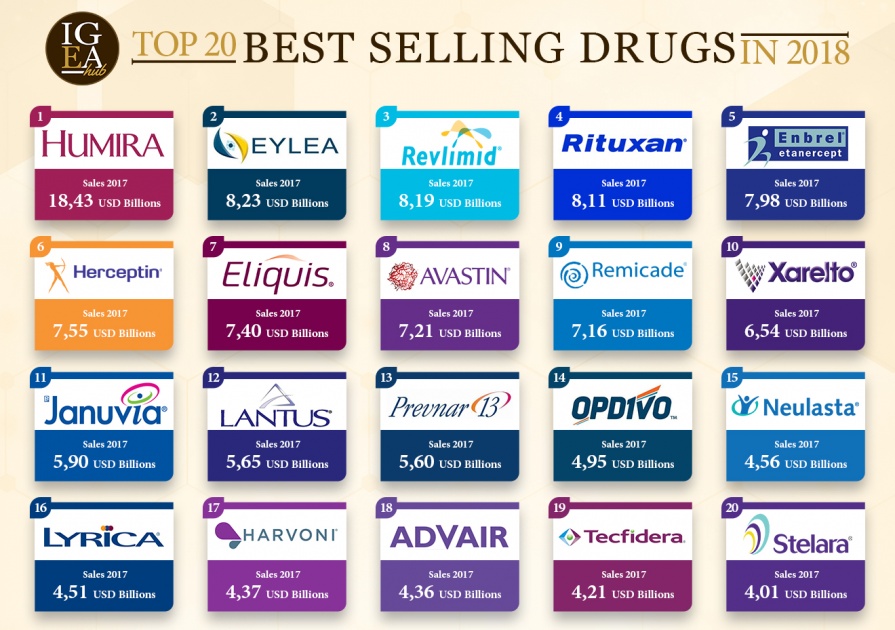
The Top 20 Best Selling Drugs in 2018: Chart

The Top 20 Best Selling Drugs in 2018 are shown in the chart below with their sales figures in 2017:

Click to enlarge

Source: IGEA Hub via microbeminded

All of the top selling drugs above are owned by major pharmaceutical firms. For example, the popular brand drug Humira is used to treat rheumatoid arthritis and other related diseases is made by Abbott Laboratories (ABT). Similar GlaxoSmithKline (GSK) is the maker of Advair.

Disclosure: No Positions

Also checkout:

Australian Stocks Have Climbed a Wall of Worry Since 1900: Chart

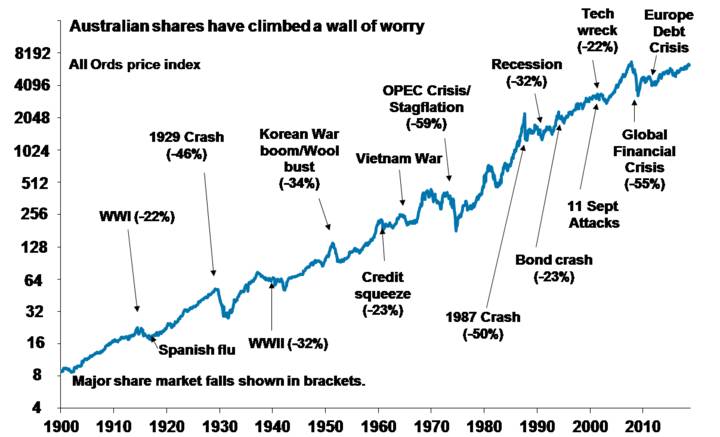
Equity markets have always overcome crises of all shapes and sizes. The long-term return of stocks as measured in decades is positive. There are always fears and crises for investors to worry about. For example, in the recent past we have the Global Financial Crisis(GFC), the Ebola virus scare, Italian debt crisis, multiple Greek sovereign debt crises, sky high crude oil prices, recessions, euro debt crises, SARS virus panic, Brexit, oil price crash, etc. The list is endless.

There is never a year where the world was quiet and peaceful and there was nothing to worry about. Despite the multitude of crises stocks have generally grown higher over the years. This phenomenon is true in the Australian equity market also. An article by Dr.Shane Oliver at AMP Capital discussed the importance of focusing on the long-term returns and ignoring short-term noises.

Australian shares have climbed a wall of worry since the 1900 and have returned an average of 11.8% per year.

Click to enlarge

Source: Successful investing despite 115 million worries and Truth Decay – how to turn down the noise, Dr Shane Oliver, AMP Capital

Relative to Australian equity returns, US stocks have returned 9.8% per year during the same time period.

Related ETF:

  • iShares MSCI Australia Index Fund (EWA)
  • SPDR S&P 500 ETF (SPY)

Related Post:

Disclosure: No Positions

__________________________________________________________________________________________________

Checkout also:

__________________________________________________________________________________________________

On The Valuations of Emerging Equity Markets

Emerging market stocks have had a severe correction so far this year. With many of these markets down substantially some contrarian investors may be considering adding emerging equities at current levels. A few articles I have come across recently have suggested that these stocks are attractive from a fundamental standpoint.

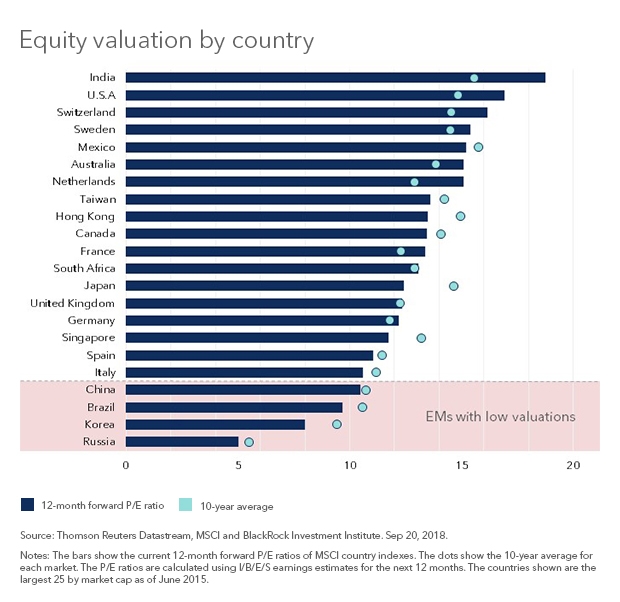
In a post Russ Koesterich at Blackrock states that emerging markets may be a good bet for a potential rebound. He notes a few countries China, South Korea, Russia and Brazil are cheap based on valuation.

From the post:

Following the recent correction, EM stocks are trading at levels that preceded previous rebounds. EM equities are trading at roughly 1.55 times price-to-book (P/B), the lowest since late 2016 and a 35% discount to developed markets. Price-to-earnings (P/E) measures paint a similar picture. Current valuations represent a 33% discount to developed markets. Today, countries from Russia to South Korea are trading at less than 10x earnings (see Chart 1)

Click to enlarge

Source: Emerging markets’ lost (near) decade, Blackrock blog

At Schroders Andrew Rymer makes the argument in favor of emerging stocks based on a few variables. From the article:

Attractive valuations

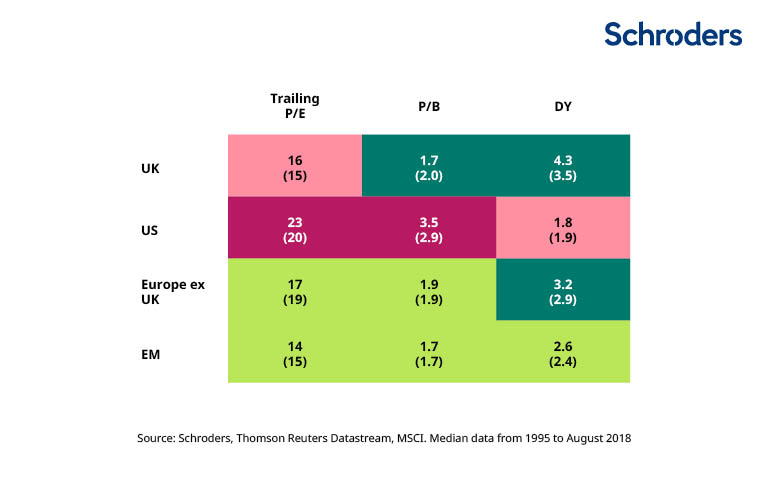
On the face of it, the valuation of emerging markets equities appears to be cheap when compared to their long-run history and relative to developed markets, as the table above highlights. The deepest shade of green indicates the best value while at the other end of the scale, the heavy red highlights expensive valuations.

The trailing price-to-earnings ratio looks at the current emerging markets index price relative to the past 12 months earnings for all of the index companies. The lower the ratio, the cheaper the market.

Emerging markets score relatively well, sitting just below their long-run average.

Price-to-book also uses the value of the emerging markets index but in this case divides by the accounting book value, or net asset value. Again, a low number implies better value. On this measure, emerging markets stocks are trading broadly in line with their long-run historical average at 1.7x.

Dividend yield, meanwhile, is the income paid to investors as a percentage of the current price. In this case, a lower dividend yield has been associated with poor future returns. Emerging markets stocks currently offer a dividend yield of 2.6%, above their long-run average of 2.4%.

Notes: 

DY – Dividend Yield

P/E – Price to Earnings ratio

P/B – Price to Book ratio

Source: Five charts that explain the case for emerging markets, Schroders

Investors hunting for bargains in the emerging market space can find plenty of bargains at today’s prices.