The 10 Best Global Contract Research Organizations (CROs) in 2018

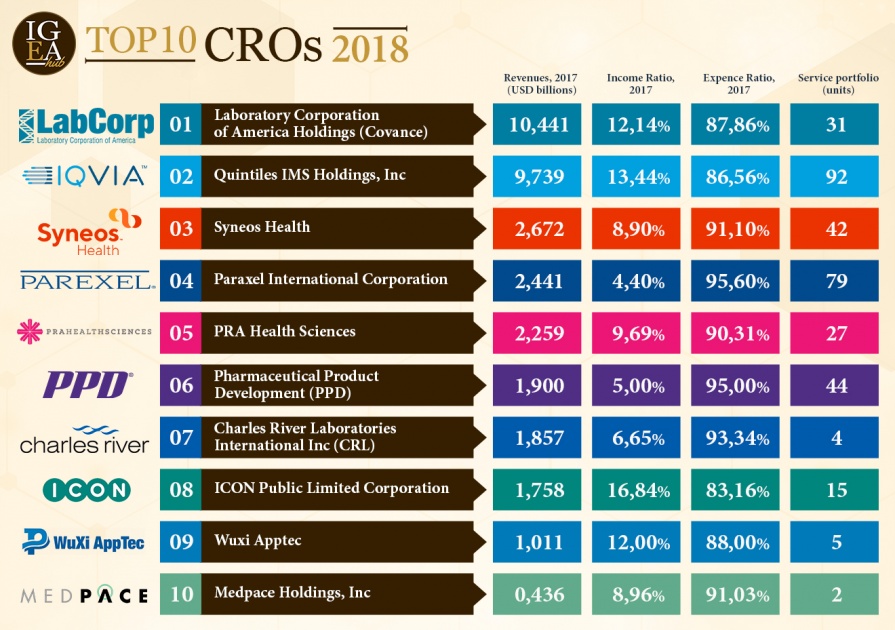
Contract Research Organizations (CROs) play an important role in medical innovation as more pharmaceutical, biopharmaceutical and medical device companies outsource many of their R&D activities. The top 10 global CROs are listed in the chart below.

Here is a brief overview of the CRO industry:

In 2017, the global CRO services market is estimated to be valued at USD 36.27 Billion and projected to grow at a CAGR of 7.6% from USD 39.13 Billion in 2018 to reach USD 56.34 Billion by 2023.  Globally more than 1,100 CRO companies are active in 2017. The global CRO market is centralized with the top 10 companies that generated collective total revenue of USD 34.514 billion in 2017 (including reimbursed out-of-pocket revenue). The global contract research market is growing at a strong rate as increased dependence of pharmaceutical, biopharmaceutical and medical device companies seen due to increased outsourcing of R&D activities, increased R&D expenditures and, increasing number of clinical trials.

The leaders in this market include a mix of public-listed and privately held organizations. Recent collaborations by CRO companies with government agencies and non-profit health organizations has proved that CROs are not just clinical service providers but actively involved in the new drug development process, and immensely contributing to the development of new products and helping advancement in healthcare outcomes.

Click to enlarge
Source: IGEA Hub

Some of the publicly-listed companies from the above rankings are Laboratory Corp. of America Holdings(LH), Charles River Laboratories Intl. Inc (CRL) and Iqvia Holdings Inc(IQV).

From an investment perspective, the CROs are a better bet than drug and biotech firms since they provide a service and are not dependent hugely on the discovery or success of a drug for example.

Earlier:

Disclosure: No Positions
The Top 20 Best Selling Drugs in 2018: Chart

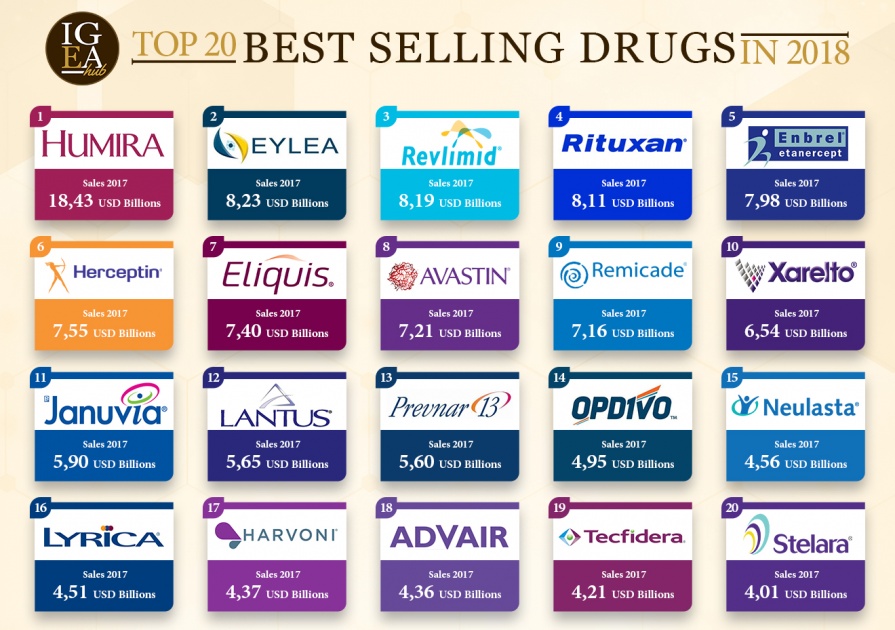
The Top 20 Best Selling Drugs in 2018 are shown in the chart below with their sales figures in 2017:

Click to enlarge

Source: IGEA Hub via microbeminded

All of the top selling drugs above are owned by major pharmaceutical firms. For example, the popular brand drug Humira is used to treat rheumatoid arthritis and other related diseases is made by Abbott Laboratories (ABT). Similar GlaxoSmithKline (GSK) is the maker of Advair.

Disclosure: No Positions

Also checkout:

Australian Stocks Have Climbed a Wall of Worry Since 1900: Chart

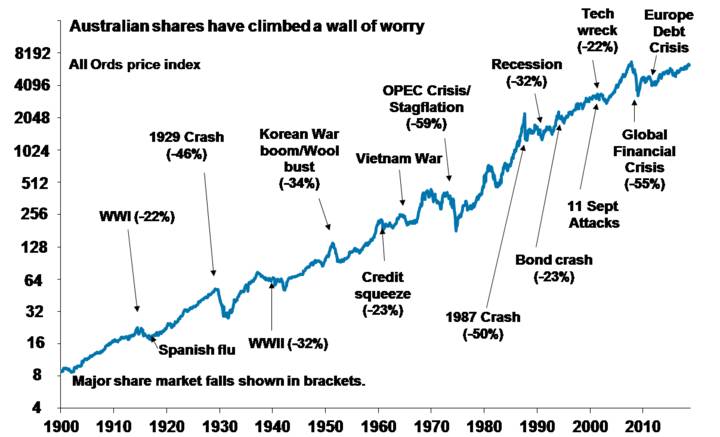
Equity markets have always overcome crises of all shapes and sizes. The long-term return of stocks as measured in decades is positive. There are always fears and crises for investors to worry about. For example, in the recent past we have the Global Financial Crisis(GFC), the Ebola virus scare, Italian debt crisis, multiple Greek sovereign debt crises, sky high crude oil prices, recessions, euro debt crises, SARS virus panic, Brexit, oil price crash, etc. The list is endless.

There is never a year where the world was quiet and peaceful and there was nothing to worry about. Despite the multitude of crises stocks have generally grown higher over the years. This phenomenon is true in the Australian equity market also. An article by Dr.Shane Oliver at AMP Capital discussed the importance of focusing on the long-term returns and ignoring short-term noises.

Australian shares have climbed a wall of worry since the 1900 and have returned an average of 11.8% per year.

Click to enlarge

Source: Successful investing despite 115 million worries and Truth Decay – how to turn down the noise, Dr Shane Oliver, AMP Capital

Relative to Australian equity returns, US stocks have returned 9.8% per year during the same time period.

Related ETF:

  • iShares MSCI Australia Index Fund (EWA)
  • SPDR S&P 500 ETF (SPY)

Related Post:

Disclosure: No Positions

__________________________________________________________________________________________________

Checkout also:

__________________________________________________________________________________________________

On The Valuations of Emerging Equity Markets

Emerging market stocks have had a severe correction so far this year. With many of these markets down substantially some contrarian investors may be considering adding emerging equities at current levels. A few articles I have come across recently have suggested that these stocks are attractive from a fundamental standpoint.

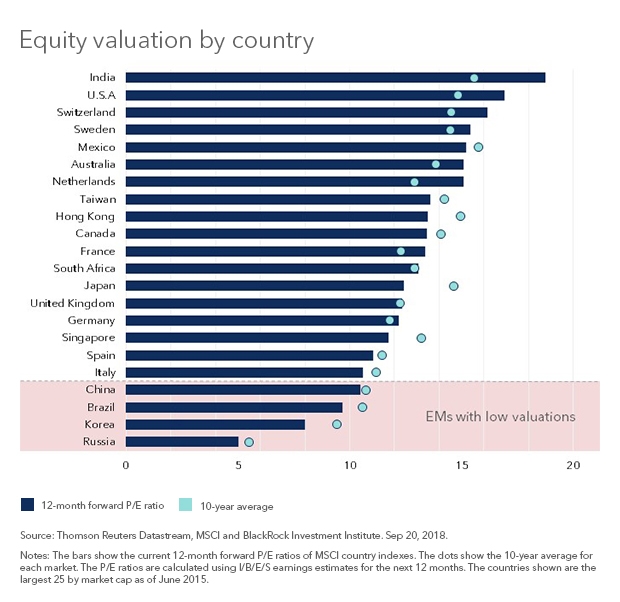
In a post Russ Koesterich at Blackrock states that emerging markets may be a good bet for a potential rebound. He notes a few countries China, South Korea, Russia and Brazil are cheap based on valuation.

From the post:

Following the recent correction, EM stocks are trading at levels that preceded previous rebounds. EM equities are trading at roughly 1.55 times price-to-book (P/B), the lowest since late 2016 and a 35% discount to developed markets. Price-to-earnings (P/E) measures paint a similar picture. Current valuations represent a 33% discount to developed markets. Today, countries from Russia to South Korea are trading at less than 10x earnings (see Chart 1)

Click to enlarge

Source: Emerging markets’ lost (near) decade, Blackrock blog

At Schroders Andrew Rymer makes the argument in favor of emerging stocks based on a few variables. From the article:

Attractive valuations

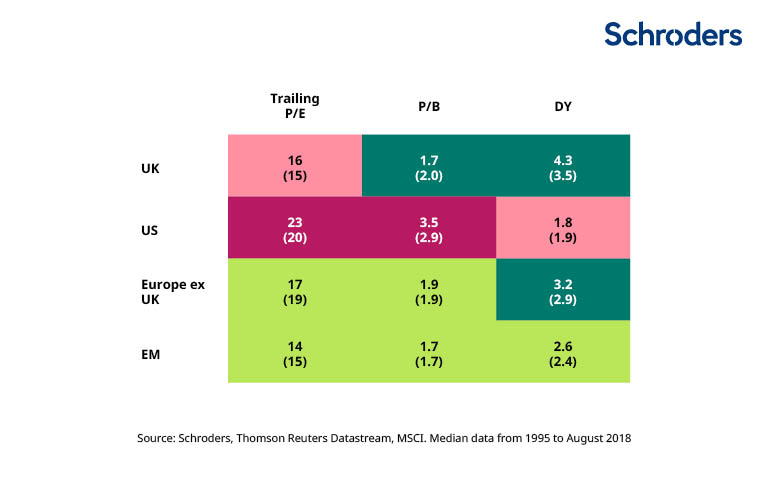
On the face of it, the valuation of emerging markets equities appears to be cheap when compared to their long-run history and relative to developed markets, as the table above highlights. The deepest shade of green indicates the best value while at the other end of the scale, the heavy red highlights expensive valuations.

The trailing price-to-earnings ratio looks at the current emerging markets index price relative to the past 12 months earnings for all of the index companies. The lower the ratio, the cheaper the market.

Emerging markets score relatively well, sitting just below their long-run average.

Price-to-book also uses the value of the emerging markets index but in this case divides by the accounting book value, or net asset value. Again, a low number implies better value. On this measure, emerging markets stocks are trading broadly in line with their long-run historical average at 1.7x.

Dividend yield, meanwhile, is the income paid to investors as a percentage of the current price. In this case, a lower dividend yield has been associated with poor future returns. Emerging markets stocks currently offer a dividend yield of 2.6%, above their long-run average of 2.4%.

Notes: 

DY – Dividend Yield

P/E – Price to Earnings ratio

P/B – Price to Book ratio

Source: Five charts that explain the case for emerging markets, Schroders

Investors hunting for bargains in the emerging market space can find plenty of bargains at today’s prices.

The Top 10 Pharmaceutical Companies 2018

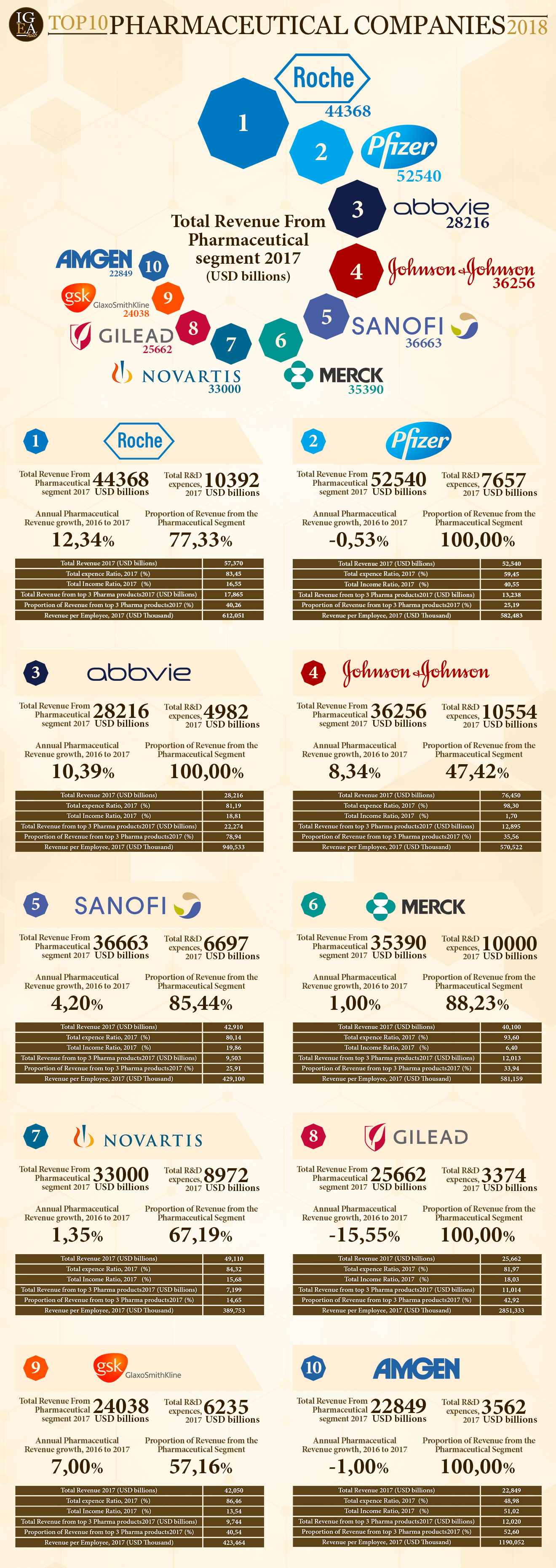
The global pharmaceutical industry is huge and was estimated to be over $1.11 Trillion in 2017. The Top 10 firms alone generated revenues of over $437.0 billion accounting for about 40% of the global market share according to a report published earlier this year by IGEA Hub. They analyzed the top 15 companies to develop and identify the top ranked 10 companies. The criteria used in the ranking is described below:

The ranking model incorporated seven criteria for each organization with focus on revenues generated by pharmaceutical products and growth in pharmaceutical revenues (2016 – 2017). The criteria includes pharmaceutical revenues, annual pharmaceutical revenue growth, total R&D expense, total expense, total income, proportion of revenue from top three pharmaceutical products and revenue per employee. A score statistic was developed based on these selected criteria. Each company was assigned a score for each criteria and a weighted sum was used to arrive at the final score statistic. Pharmaceutical revenue received the highest weight (45%) while revenue from top 3 products (5%) receives the lowest. The score statistic represented the pharmaceutical financial health and diversity of product portfolio of each company.

The following infographic shows The Top 10 Pharmaceutical Companies 2018 based on revenues in 2017:

Click to enlarge

Source: IGEA Hub

The US market tickers of the above firms are listed below:

Europe-based: Roche Holding AG (RHHBY), Novartis AG (NVS), Sanofi (SNY), GlaxoSmithKline (GSK)

US-based: Pfizer Inc (PFE), AbbVie Inc(ABBV), Johnson & Johnson (JNJ), Merck & Co Inc (MRK), Gilead Sciences, Inc.(GILD), Amgen(AMGN)

Investors looking to add some exposure to the pharma sector can start their research beginning with these drug giants.

Disclosure: No Positions

Also checkout: