A Review of Australia’s S&P/ASX 200 Index

The S&P/ASX 200 Index is the benchmark index of the Australian equity market. The index is composed of the largest 200 companies listed on the ASX by float-adjusted market capitalization.

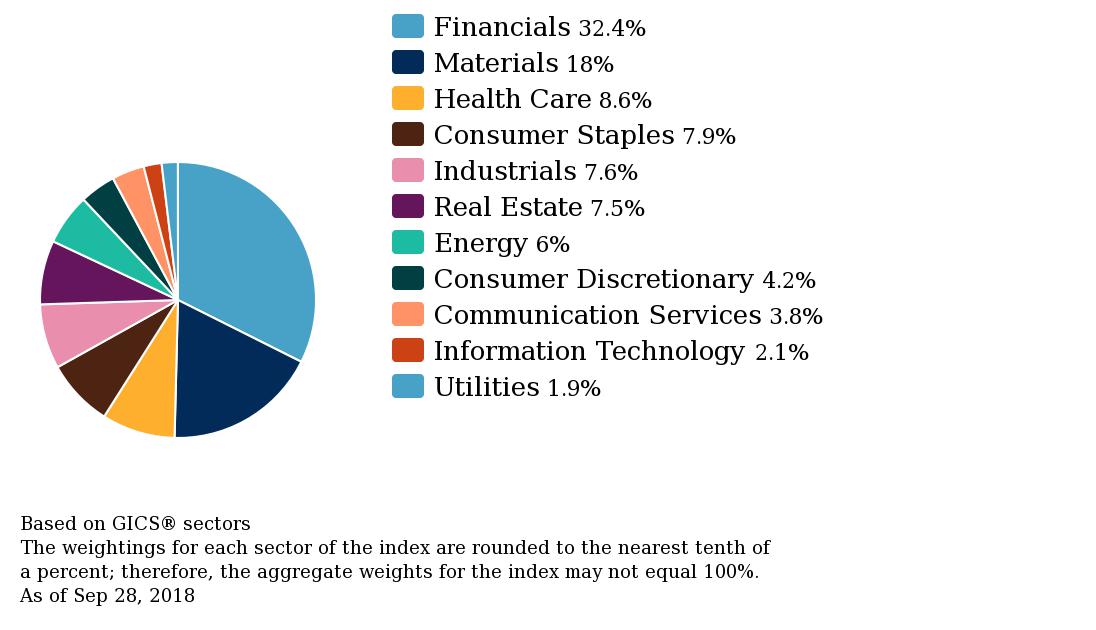
The composition of the Index is shown in the chart below:

Click to enlarge
Source: S&P Indices

Nearly one-third of the index is concentrated in financials with the materials sector accounting for 18%. Together these two sectors amount to over 50% of the index. Though Australia is a resource-based economy the financials play a major role than the resources sector.

The tech sector in Australia is tiny compared to the US. Hence the IT sector has an allocation of just over 2% in the index.

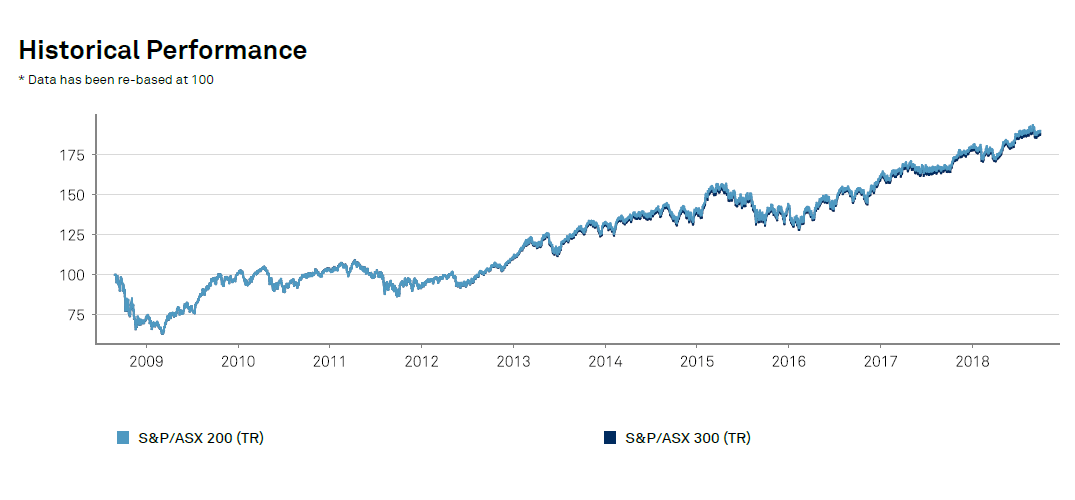
The long-term performance of the index in local currency is shown below:

Click to enlarge
The top 10 constituents in the index amount to over 45% of the index weightage. These 10 companies are listed below with their ticker on the US market and current dividend yield:

1.Company: Westpac Banking Corp (WBK)
Current Dividend Yield: 7.08%
Sector:Banking

2.Company: Australia and New Zealand Banking Group Ltd (ANZBY)
Current Dividend Yield: 8.96%
Sector:Banking

3.Company: National Australia Bank Ltd (NABZY)
Current Dividend Yield: 7.36%
Sector:Banking

4.Company:Commonwealth Bank of Australia (CMWAY)
Current Dividend Yield: 9.79%
Sector: Banking

5.Company: BHP Billiton Ltd (BHP)
Current Dividend Yield: 4.74%
Sector:Metals & Mining

6.Company: CSL Ltd (CSLLY)
Current Dividend Yield: 1.18%
Sector:Healthcare

7.Company: Wesfarmers(WFAFY)
Current Dividend Yield: 4.60%
Sector:Consumer Staples

8.Company: Macquarie Group(MQBKY)
Current Dividend Yield: No dividends paid
Sector:Financials

9.Company: Telstra Corp Ltd(TLSYY)
Current Dividend Yield: 7.13%
Sector:Telecom

10.Company: Woolworths Group Ltd
Sector:Consumer Staples
Woolworths does not trade on the US markets.

Note: Dividend yields noted above are as of Sept 28, 2018. Data is known to be accurate from sources used.Please use your own due diligence before making any investment decisions.

Download:

Disclosure: Long WBK and NABZY

Emerging Markets: Intra-Year Pullbacks and Yearly Returns 2004 Thru 2017

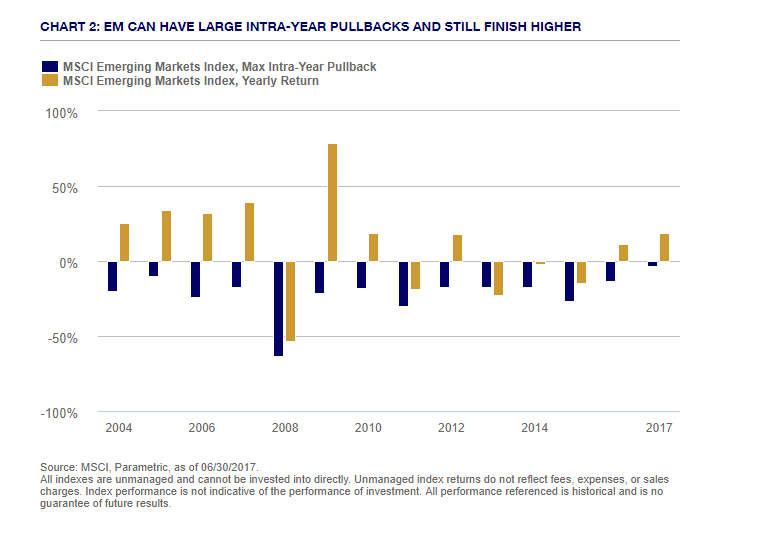
Emerging market equities are a volatile asset class. Though these stocks go through dramatic declines sometimes in a very short period of time, over the long run they offer above average returns. Investors who are able to wait out the downturns are rewarded for their patience.

The following chart shows how emerging markets can have big intra-year declines but still have positive annual returns:

Click to enlarge

Source: Who’s Afraid of an Emerging Markets Meltdown?, Thornburg Investment Management

From the above linked article:

While this has been painful for those invested in EM, the experience is not exactly unusual for the asset class. Over the last 15 years, the MSCI EM Index pulled back 15% or more 11 times, and it still finished the year higher six of those 11 times.

Related ETFs:

  • iShares MSCI Emerging Markets ETF (EEM)
  • Vanguard MSCI Emerging Markets ETF (VWO)

Disclosure: No Positions

The Top 10 Consumer Health Companies 2018: Infographic

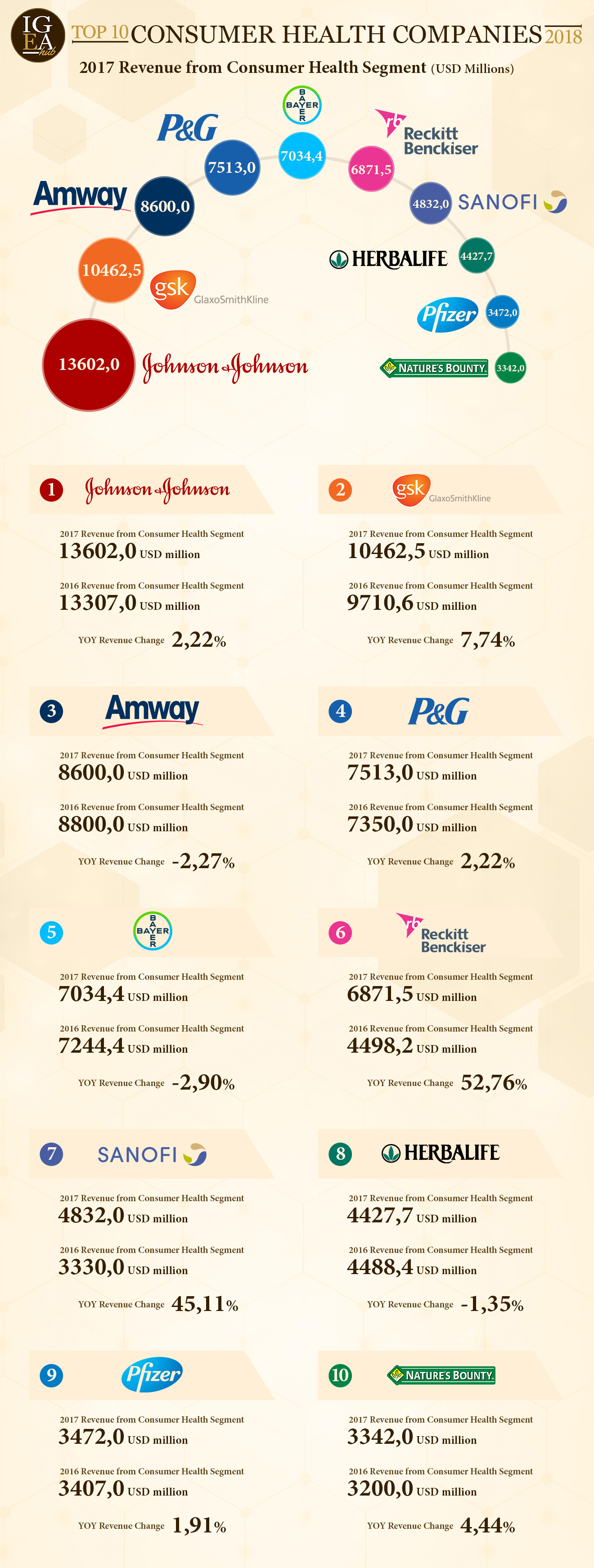
The consumer health industry is a multi-billion industry worldwide. Some of the consumer items in this area include band-aids, teeth whitening products, vitamin products, acne removing creams, etc. In this post, let’s take a quick look at The Top 10 Global Consumer Health Companies in 2018.

Below is a short overview of this industry:

Consumer health companies deals with products in wellness, oral health, nutrition, and skin health. These consumer healthcare products primarily include the “over-the-counter” (OTC) drugs that are sold without a prescription from registered medical practitioner. Globally large number of acquisitions, mergers, and shutdowns has resulted in industry consolidation and large market share is controlled by the top 10 firms. In 2017, top 10 consumer health companies accounted for the collective revenue of USD 70157.1 million, a moderate growth from USD 65335.6 million in 2016.

Click to enlarge

Source: IGEA Hub

Some of the companies from the above list are: Johnson & Johnson (JNJ), Procter & Gamble Co (PG), Reckitt Benckiser Group plc (RBGLY), GlaxoSmithKline (GSK), Bayer(BAYRY), Sanofi (SNY) and Pfizer Inc (PFE).

Investors can avoid PG due to lack of any growth and management issues.

Also checkout:

Disclosure: Long RBGLY

On the Total Number of Mutual Funds in the US Market

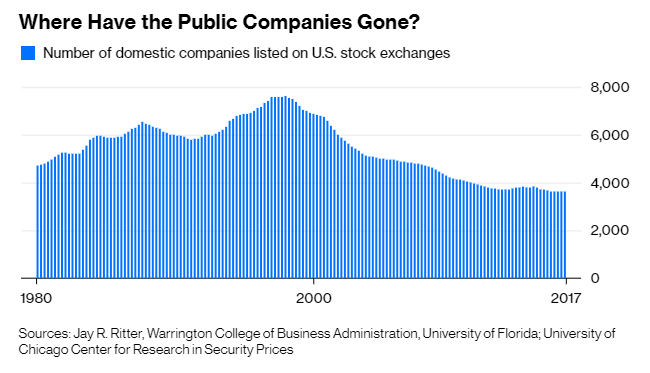
The number of publicly-listed US companies continues to decline each year. From a peak of over 7,600 in 1997 the number has shrunk to about 3,600 at the end of 2017. That is a reduction of over 50%.

Click to enlarge

Source: Where Have All the Public Companies Gone?, April 8, 2018, Bloomberg

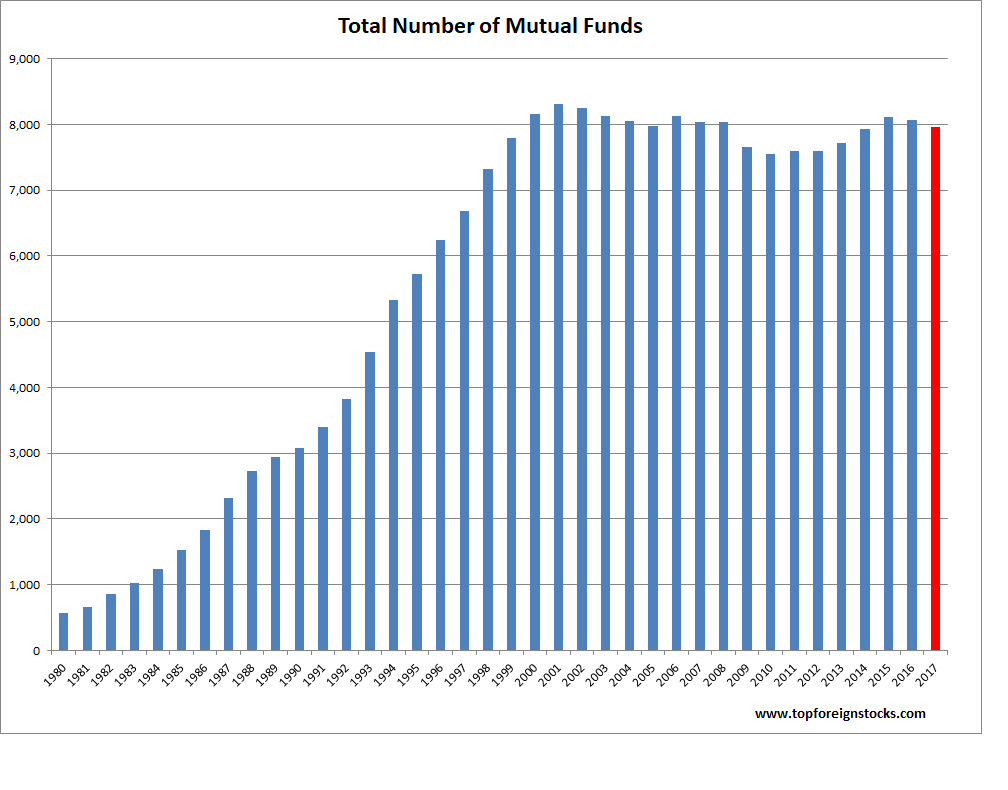
Despite the fall of public companies, the number of mutual funds available in the market has exploded in the past few decades and remains high. At the end of 2017, nearly 8,000 mutual funds existed in the US market as shown in the chart below. To put this number in perspective, there were only 361 funds in 1970. Then the number jumped to 564 in 1980. Since then the number of funds have steadily increased year over year until the dot-com crash of early 2000 and the global financial crisis of 2008-09.


Click to enlarge

Data Source: 2018 Investment Company Institute Fact Book

Note: The above figure includes equity, debt and money market funds.

There were a total of 4,706 pure equity funds at the end of last year.

Mutual funds typically have high expense ratios in the range of 1.20% to 1.50% on an average. Many funds have much higher fees than these ratios. Investors looking to avoid these high fees can consider index funds or ETFs.

Biotech Stocks Are Not For The Faint-Hearted

The biotech sector is soaring this year with the benchmark NYSE Arca Biotechnology Index up by over 27% YTD as of the end of September. Investors’ attraction towards biotech stocks shows no signs of showing as evidenced by many successful IPOs being launched on a weekly basis and also trading volumes. In addition, one of the top viewed pages on this site is the complete list of biotech stocks page.

In general biotech stocks are not suitable for all investors especially retail investors that are risk averse. This is because these equities are highly speculative and most of the companies cannot be analyzed using fundamental factors such as P/E ratio, assets, revenues, etc. The majority of the companies do not have any earnings yet as they are still in the discovery process to create some drug for cancer or other diseases. As such, a company that is successful in the discovery and winning of FDA-approval will be a winner while the unsuccessful ones will be spectacular losers. In addition, equity prices of losers can lose 50% or more almost overnight providing no warning and time to escape the carnage. So investors in biotech need to be aware of these risks and prepare their portfolios accordingly.

The case of two companies that had wild moves recently vividly describes the above scenarios.

On the winning side of the equation, Amarin Corporation plc(AMRN) is based in Dublin, Ireland. Below is short profile from Yahoo Finance:

Amarin Corporation plc, a biopharmaceutical company, focuses on the development and commercialization of therapeutics for the treatment of cardiovascular diseases in the United States. The company’s lead product is Vascepa, a prescription-only omega-3 fatty acid capsule, used as an adjunct to diet for reducing triglyceride levels in adult patients with severe hypertriglyceridemia. It is also involved in developing Vascepa for the treatment of patients with high triglyceride levels who are also on statin therapy for elevated low-density lipoprotein cholesterol levels. Amarin Corporation plc sells its products principally to wholesalers and specialty pharmacy providers through direct sales force. It has collaboration with Mochida Pharmaceutical Co., Ltd. for the development of EPA-Based drug products and indications. The company was formerly known as Ethical Holdings plc and changed its name to Amarin Corporation plc in 1999. Amarin Corporation plc was founded in 1989 and is based in Dublin, Ireland.

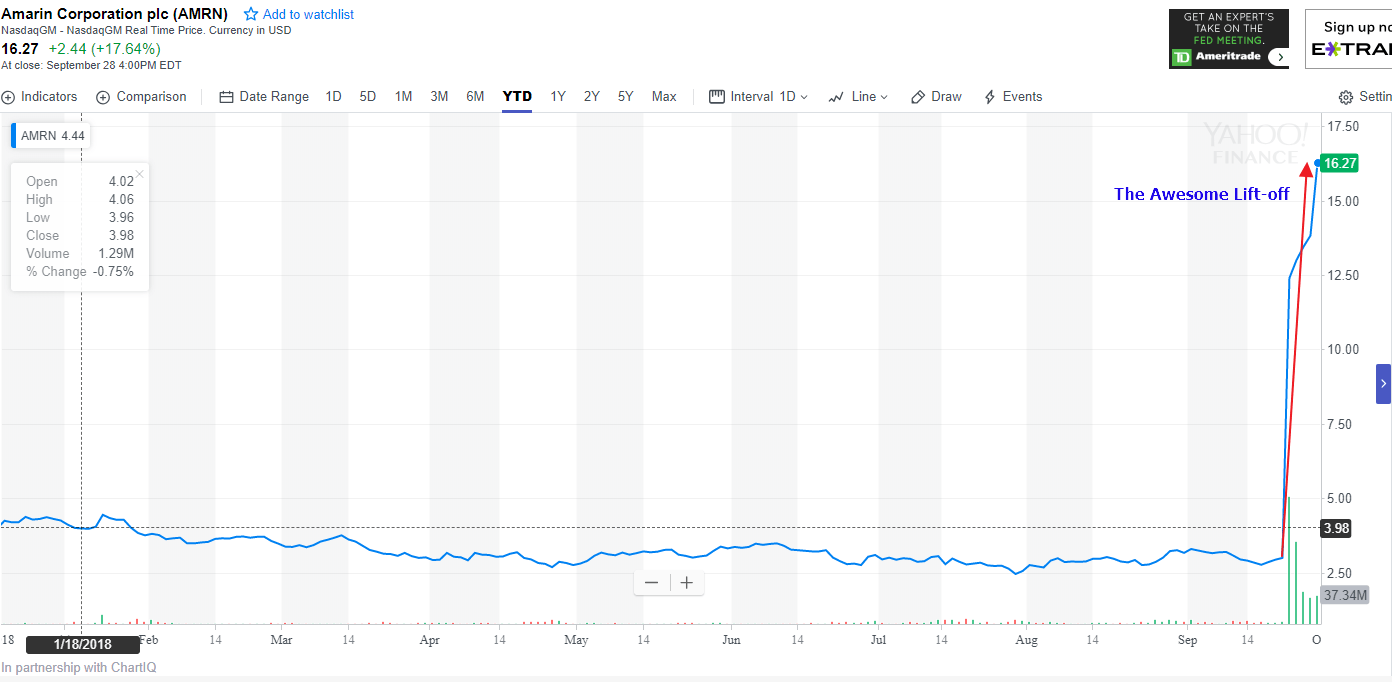
AMRN was trading at under $5 per share for over a year. On Sept 21st, the stock was trading at $2.99. On Monday Sept 24th, the company announced that its fish oil drug reduced the risk of heart diseases. The stock more shot up 315% on this announcement. From a journal article that day:

Amarin Corp. more than tripled in value Monday, after the company said its drug derived from fish oil reduced the risk of heart attacks, strokes and deaths in certain high-risk patients.

The results could open the door for a new line of attack against heart disease, and turn Amarin’s drug Vascepa into a blockbuster, if the data is borne out under closer scrutiny.

“This is indeed huge,” Amarin CEO John Thero said during a conference call with analysts. The result “positions Vascepa to be first to market in addressing a large unmet medical need.”

ADR shares of Dublin-based Amarin jumped 315% on the news, raising the company’s market cap by $2.8 billion, to $3.6 billion.

Source: Amarin Surges on Fish-Oil Drug Data, WSJ, Sept 24, 2018

After ending Sept 24 a $12.4 the stock further rose in the following days. On Friday it shot up another 17% and ended the week at $16.27.

AMRN Year-to-date return chart:

Click to enlarge

Source: Yahoo Finance

This example shows how a biotech stock can soar to the moon on a single day and then some based on a single news announcement.

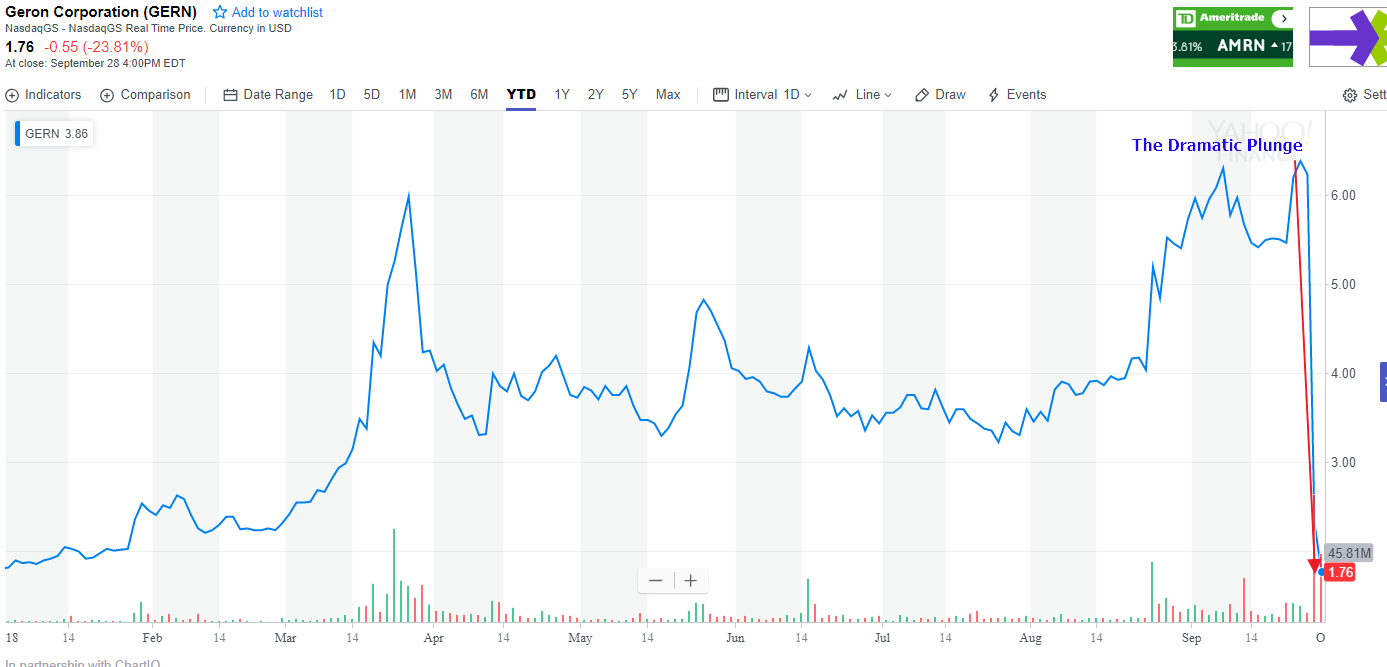
The below case of Geron Corporation (GERN) shows the scary situations that biotech investors face.  On September 26, Geron announced that Johnson & Johnson (JNJ) had terminated a partnership venture with it. The exit of a deep-pocketed partner and future uncertainty caused the  stock by plunge by 68% on a single day. Earlier in the day the stock was down by 76%.

GERN Year-to-date return chart:

Source: Yahoo Finance

On Friday the stock further plunged another 22% in morning trading. The above YTD chart shows the dramatic selloff in Geron’s shares.

The above two sample cases show that biotech stocks are not for the faint-hearted. Investors can earn wonderful returns or lose huge investments within a short period.

The key takeaway is investors in individual biotech stocks have to know the huge risks involved and diversify accordingly. A better option would be to avoid individual firms and simply buy an index fund.

Disclosure: No Positions