U.S vs. Canadian Financials: Which Is Better?

The U.S. financial sector is similar to the Canadian financial sector in some ways but different in others. For example, the banking industry in Canada is dominated by just 5 or 6 major banks forming a nice oligopoly. However it is not the case south of the Canadian border.

From the standpoint of equity returns, is the US financial sector better than the Canadian one or the other way around?

The answer to the above question is US financials are better in the short term but Canadian financials beat their US peers in the long run.

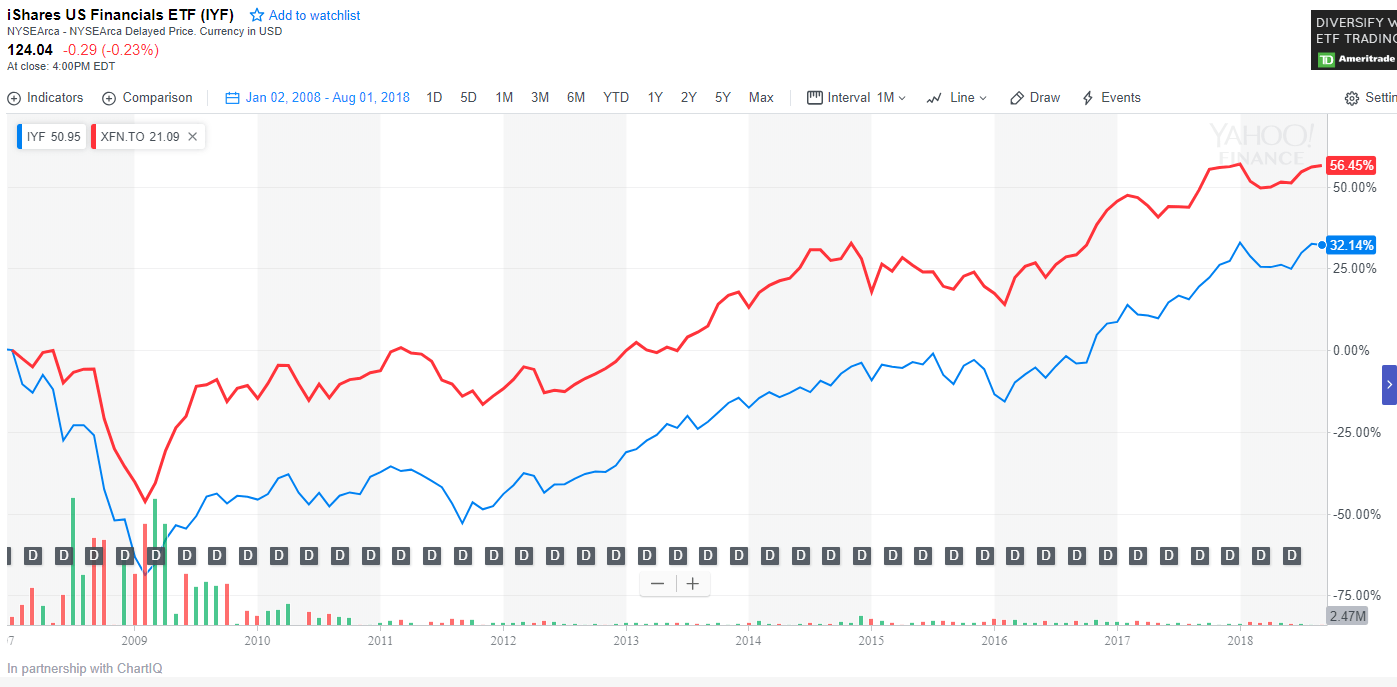
For instance, while US financials have performed very well in the recent past – say 5 years compared to their Canadian counterparts. Let us use the iShares S&P/TSX Capped Financials Index ETF(XFN.TO) trading on the TSX as a proxy for Canadian financials and the iShares U.S. Financials ETF (IYF) for the US. The big five Canadian banks account for about 65% of the ETF while five major banks constitute only about 23% of the US ETF.

Click to enlarge
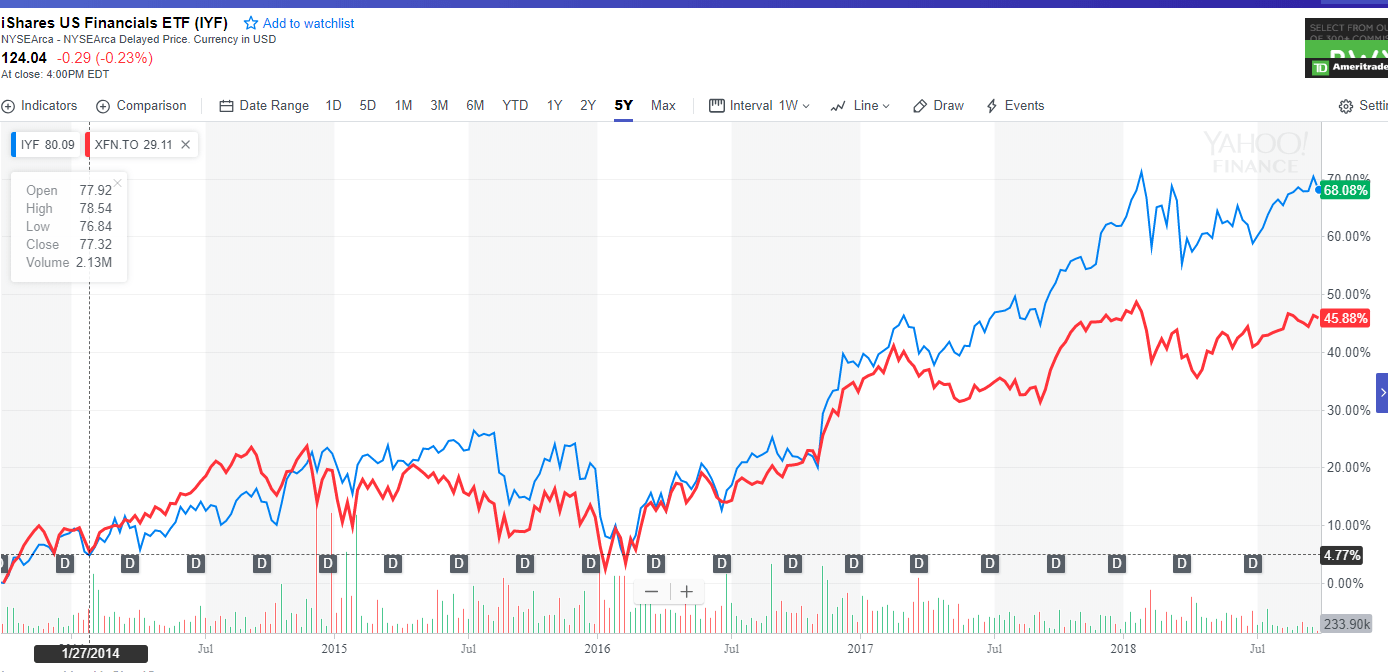
Source: Yahoo Finance

Clearly the US financial sector has strongly outperformed the Canadian peer in the past 5 years.

However comparing returns from Jan 1, 2008 thru Sept 25, 2018 shows that Canadian financials yielded 24% more in return than their American counterparts.

Click to enlarge
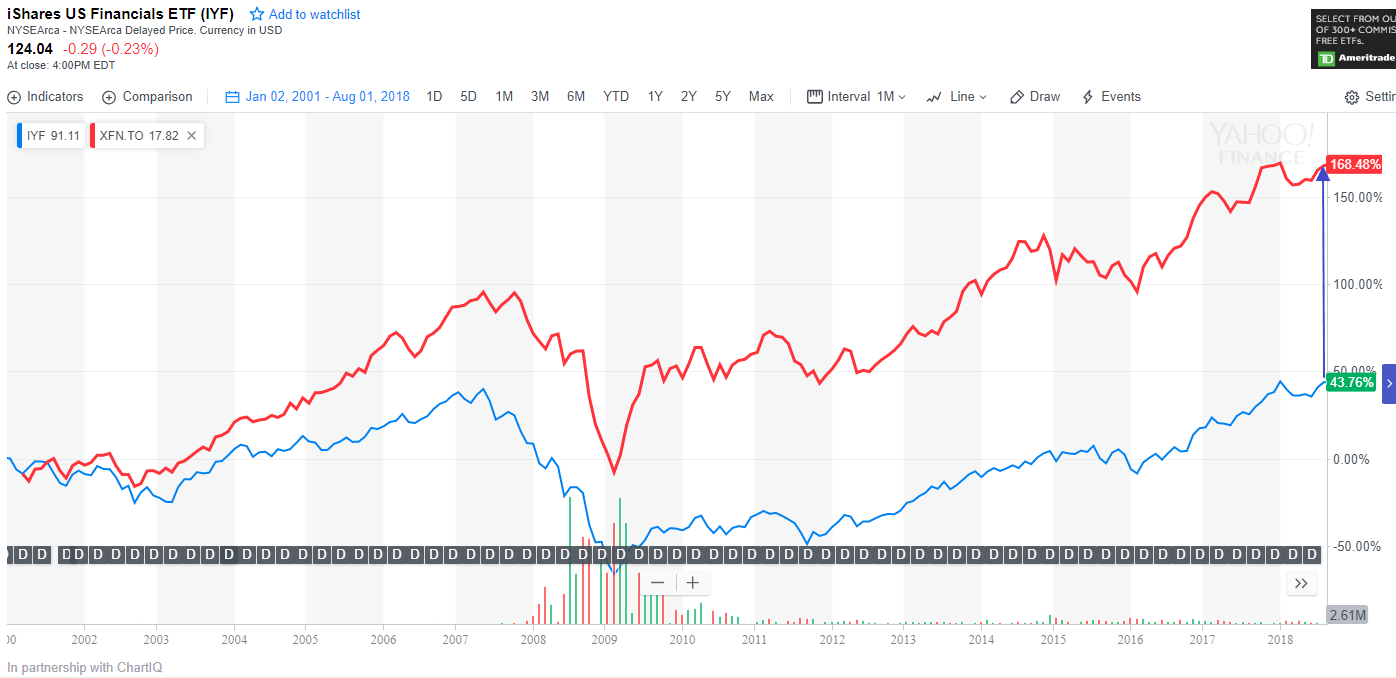
In terms of long-term returns from 2001, Canadian financials have vastly outperformed US financials as shown in the chart below. In fact, the gap between the two returns is huge.

Click to enlarge
 

Source: Yahoo Finance

In the recent past, the commodity-driven economy of Canada has been adversely affected by falling commodity prices particularly oil. Hence financials under-performed. But over long periods Canadian financials have earned much higher returns over their American peers.

Note: The above comparison does not include the impact of taxes and foreign exchange rate fluctuations.

Disclosure: No Positions

Related:
Five Global Currencies That Are Closely Tied To Commodities

Some of the major countries in the world are commodity based economies.Heavy dependence on commodity exports affects the relative value of their currencies. The five currencies that are closed tied to commodities are:

1.Australian Dollar – Australia is the world’s largest producer and exporter of iron ore. Demand for the ore strongly impacts the Australian dollar value.

2.Canadian Dollar – Crude oil is the largest export product in terms of revenues to the government. Rising oil prices positively impact the Canadian currency.

3.Russian Ruble – As one of the largest exporters of oil and natural gas, the prices of these commodities directly impact the Russian Ruble.

4.Colombia Peso – Oil is the major export product and the major contributor of revenue to the government.

5.Peruvian Sol – Peru is a major copper producing and exporting country. The country is the second largest exporter of Copper after Chile. Copper price movements have an impact on the Sol.

Source: 5 World Currencies That Are Closely Tied to Commodities, U.S. Funds

Interest Payments on National Debt: Chart

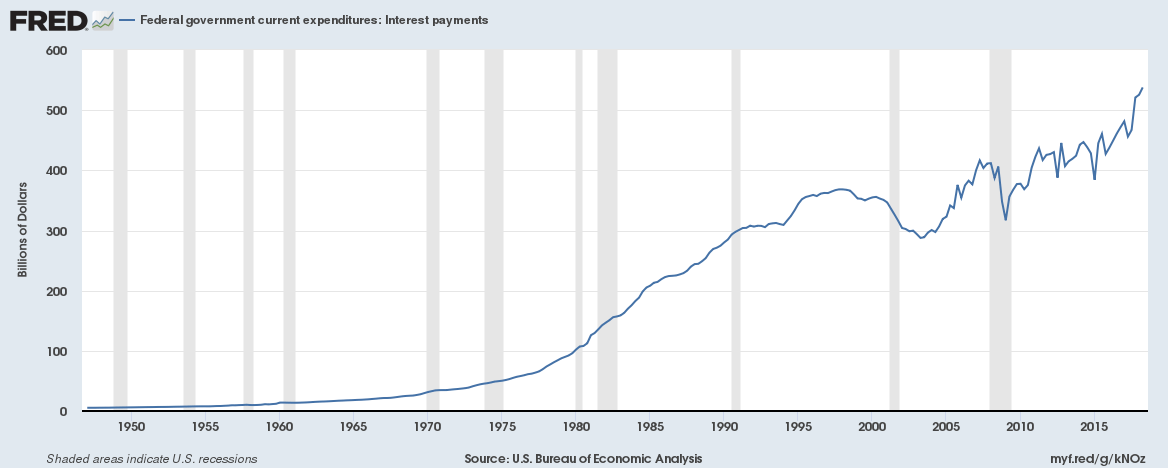
The current US National Debt is over $15.7 Trillion or 15,760,417,329,521.12 to be exact as of Sept 20, 2018 according to the US Treasury. The interest due on this huge mountain of debt is also huge. According to an article, the interest on this debt accounts for 7.4% of the US Federal Budget making it the fifth largest budget item. The only four expenses that are larger than the interest payments are Social Security benefits ($987 billion), military spending ($874.4 billion), Medicare ($582 billion), and Medicaid ($400 billion) according to a piece in The Balance.

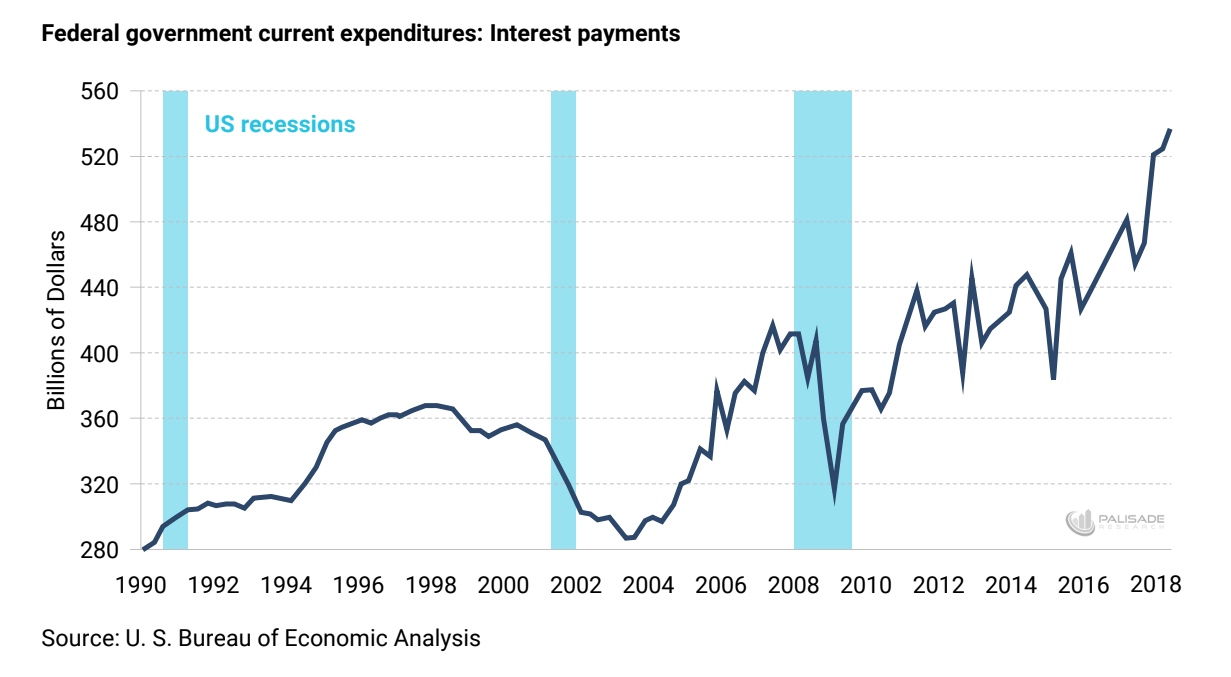
As the accumulated debt continues to grow year after year so does the interest paid. The chart below shows the interest payments since 1950:

Click to enlarge

Source: FRED, St. Louis Fed

Here is another chart with recessions noted:

Source: Palisade Research

Rising interest rates should further exacerbate the interest issue. As the economy continues to grow the US should try to payoff and reduce outstanding public debt.

Related:

Robot Density in Emerging and Developed Countries

Automation is being embraced by many industries across the world. No longer automation simply involved using robots to perform complex physical and dangerous tasks in the industrial sector. Today robots are used not only for physical tasks but also for cognitive tasks according to a report on automation by Deutsche Bank. The author Jim Reid notes the following in the fascinating report:

There are differences with this coming automation revolution. Today’s robots are automating cognitive tasks rather than the physical tasks they have done in the past. But given the weight of historical evidence in favour of automation, the burden of proof  should lie on those who argue against automation improving our lives rather their those who embrace it in the hope of higher living standards.

So we say, learn to love your robot colleague. In this edition of Konzept we look at the future of automation from different angles. Our cover feature expands on the macroeconomic discussion but a common thread throughout is that robots and automation will complement humans and make the world a different place. They will not destroy the fabric of work. One statistic to consider: In 1907, Britain had 40,000 cars on the road. By 1939, this had risen to 2,000,000. Today, it is ten times that number. Could robots be the 21st century version of the car?

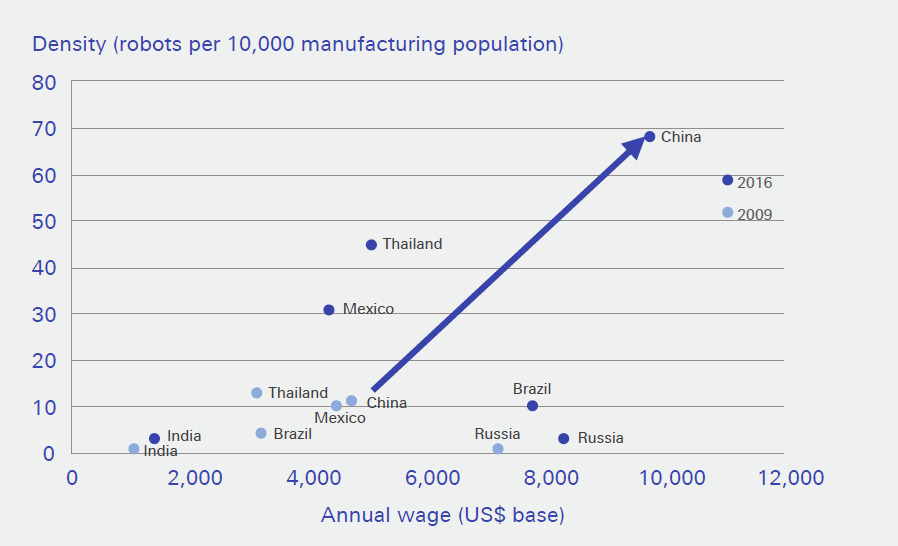
In terms of robot density China leads the emerging world. Robot usage has grown significantly from 2009 to 2016 as shown in the chart below:

Click to enlarge

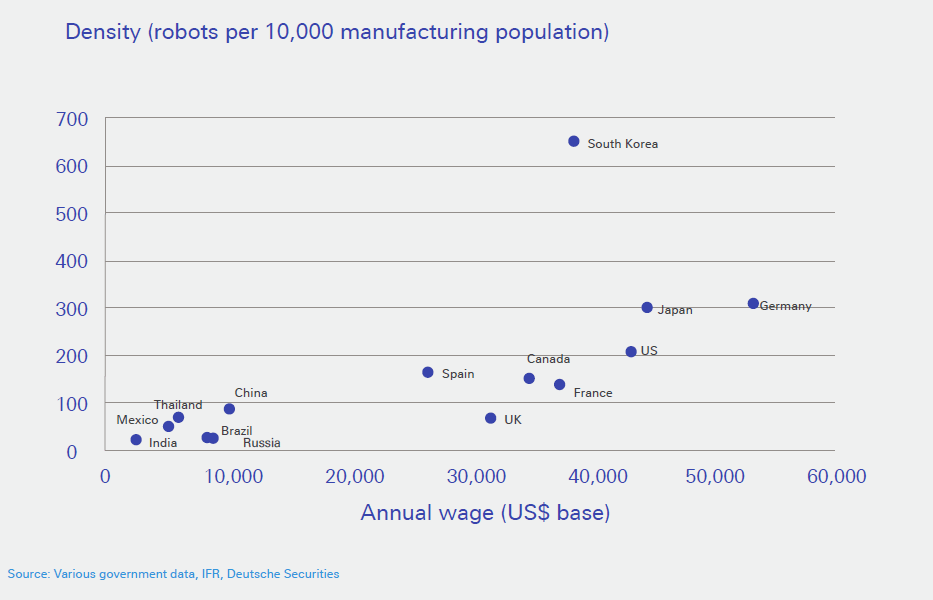
In the developed world, South Korea leads in robot density followed by Germany and Japan. US still lags in the use of robots. 


Though robot use is growing in China and other developing countries, they still have a long way to go before catching up with the developed world.

SourceAutomation – not a job killer, Will I take your job …… or work with you?, June 2018, Konzept, Deutsche Bank

Download Report: 

Related:

Foreign Stocks To Watch: Money-Laundering Danske and Declining Deutsche Bank

Foreign stocks in the news and to watch for the following week are listed below. Additional links for items of interest are also included.

  • Denmark’s Danske Bank(DNKEY) is involved in a massive money-laundering fraud at its Estonian branch. The CEO quit and the stock may suffer for months to come.
  • The German government is in favor of merging problem-ridden Deutsche Bank(DB) with Commerzbank AG.
  • Investors need to keep an eye on rising oil prices and oil stocks. The OPEC meeting held today in Algiers ended without any commitment to increase supply. Oil producers’ stocks may continue their upward trend.
  • Indian stocks plunged dramatically last week only to recover strongly on the same day. Banks were especially hit hard with some crashing as much as 50%.

Click to enlarge

Museu Nacional d’Art de Catalunya, Barcelona

Disclosure: Long DNKEY