The Relationship Between Economic Growth and Stock Market Returns is Weak

One of the important factors that investors are advised to consider when selecting a country for investment is the economic growth of that country. Generally higher economic growth leads to higher equity market returns. However this is not always the case.I have written many articles on this topic before which can be found here and here and here and here and here.

The relationship between equity returns and economic growth is weak especially in the context of emerging markets. Let’s take the example of Indian equity markets. Indian stocks are soaring and the Sensex crossed the 41,000 mark recently. However economic growth has been on the decline for a few quarters. As forecasted, the GDP fell to 4.5% for the quarter ending September today. From a journal article:

NEW DELHI—India’s economy slowed for the sixth quarter in a row during the past period, with gross-domestic-product growth dipping to a six-and-a-half-year low as concerned companies and consumers continued to hold back on spending.

The slowdown—which has been particularly tough on the rural regions where most Indians live—is emerging as the biggest challenge for Prime Minister Narendra Modi, who was voted back into office this year pledging better days.

Gross domestic product in Asia’s third-largest economy slowed to 4.5% growth in the three months ended September, according to government data released Friday. That was down from 5% in the previous quarter and its worst performance since the quarter through March 2013.

While New Delhi has launched multiple measures to boost lending, investment and consumption in recent months, it maintains that the downturn is only temporary.

Source: India’s GDP Growth Slows to More Than 6-Year Low of 4.5%, WSJ

A recent article at Live Mint discussed the reasons for market rising when economy is slowing down. One of the points analyzed in the piece was the disconnect between economic growth and equity market growth. From the article:

Simply put, the markets are up purely on the hope of a better future. And this dissonance between the markets and economic numbers naturally causes confusion in the minds of observers.

It’s another matter that there is nothing on the ground to support the optimism. Jefferies India, for instance, points out that its economic activity index slipped to a 15-year low in September. The broker’s Activity Index is based on 36 indicators including credit growth, automobile sales and electricity demand.

The latest reason for hope is the number of measures the government has taken to bolster the economy. Among other things, the Centre announced a massive cut in corporate tax rate. But analysts worry that the impact of these measures will take a long time to benefit the economy.

“We remain fairly sceptical about any imminent recovery in the Indian economy,” say Kotak’s analysts, citing multiple reasons. The current slowdown is because of structural factors such as low household income and poor job creation. Besides, the government’s finances are stretched and there is hardly any room for it to boost the economy by increasing spends. And while the Reserve Bank of India (RBI) is trying its best to bring interest rates down, the high borrowing needs of the government have kept real interest rates from falling meaningfully.
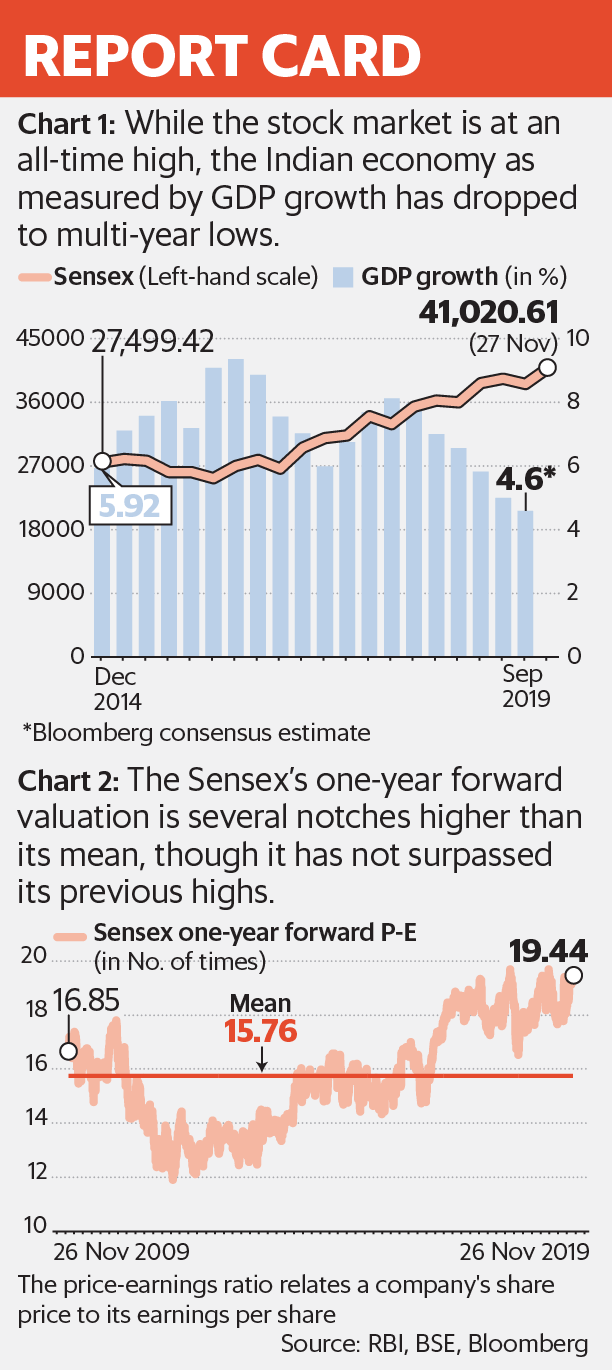
Source: Why markets are rising in times of slowdown, Live Mint, Nov 28, 2019

As I mentioned in the beginning of the post, the disconnect between equity markets and GDP is not surprising. Markets can continue to rise even economic growth is anemic. This is because stock prices are driven by a multiple of factors including optimism on the future, fundamentals of a firm, foreign portfolio investors, rumors, short-covering and many others. So the key to remember is that investors should not simply assume higher economic growth will lead to higher equity prices and vice versa.
India’s Sensex Crosses 41,000 and Hits Yet Another Record High

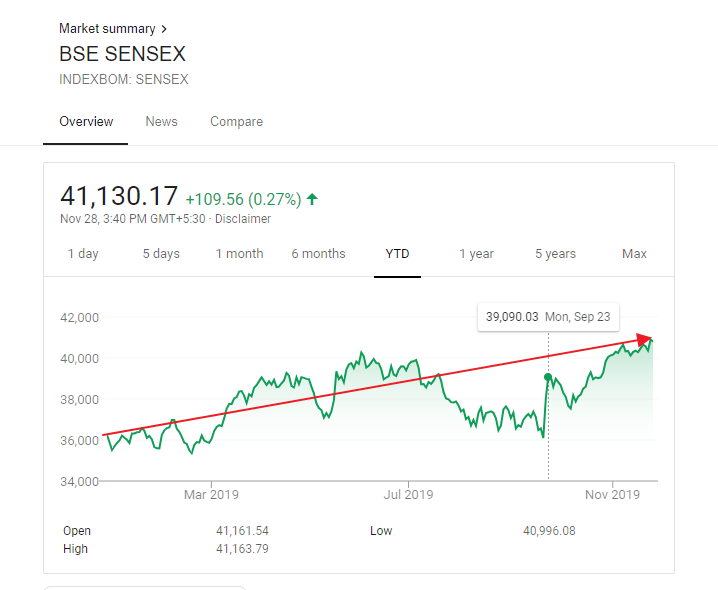
The bull market in Indian equities continues as we approach the end of the year. Yesterday the benchmark Sensex Index crossed 41,000 for the first time ever in its history. Today the it closed at a new peak of 41,130 after reaching an intra-day high high of 41,163.

Click to enlarge

Source: Google Finance

Indian stocks have been soaring this year despite the economy performing not well. The GDP has declined for many quarters in a row and is well under 5%.  With the rise in stock prices, the forward P/E has shot up to over 19 which is much higher than the mean of around 16.

It remains to be seen if the current bull market can hold thru the rest of the year and possibly reach higher highs in 2020.

Related:

Public Social Spending as a Percentage of GDP by Country: Chart

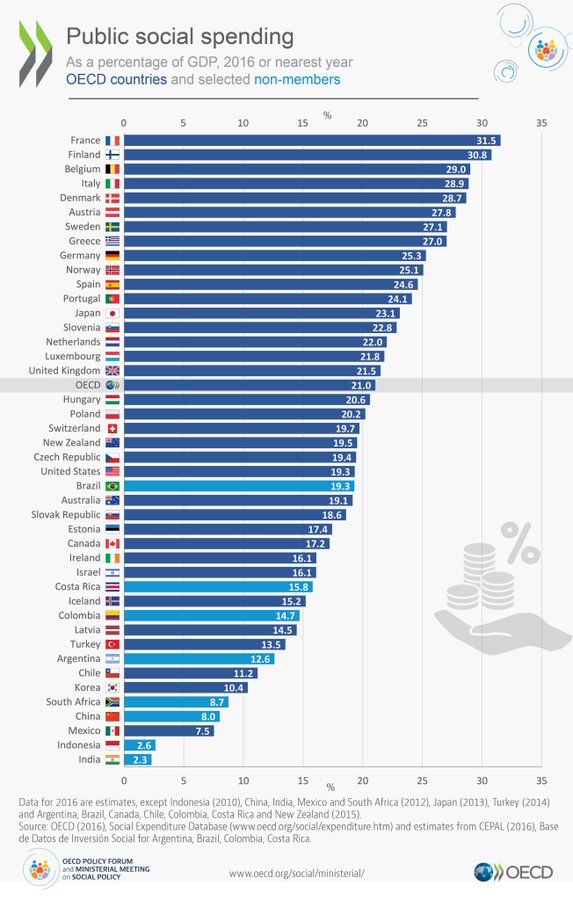
The socialist countries of Europe tend to spend a higher portion of their GDP on public social spending. France has the highest public social spending as percentage of GDP at 31.5%. The next high spenders are Finland, Belgium, Italy and Denmark.

The US public social spending is lower than the OECD average. The US is just ahead of Brazil in social spending.

Click to enlarge


Source: OECD

US IT Sector: Another Sector With High Market Concentration

Many industries in the US are highly concentrated with a handful of players dominating the market. In the past I have written about the monopoly and oligopoly madness in many industries. Some of these articles can be found here, here, here, here, and here. In this post, let me discuss about the market concentration in the IT sector quoting from a recent article at Schroders.

Sean Markowicz, CFA at Schroders discussed the growing influence of superstar firms in the US IT industry. From the article:

Why has this happened?

Technological innovation has significantly transformed the US competitive landscape. The proliferation of digital products and intangible inputs such as data and software have enabled tech firms to rapidly acquire new customers and dominate their respective market at virtually zero marginal cost. Some industry leaders have also benefitted from the network effects that are present on social media platforms, where the value of their service increases with the number of participants.

These effects have been particularly marked in the IT sector. For instance, Google receives 88% of all US internet search activity, Facebook controls 42% of US social media and almost all mobile operating systems are provided by either Apple (iOS) or Google (Android). The dominance of these digital platforms and products have created powerful barriers to entry for competitors.


Competition has been further weakened by the flood of mergers and acquisitions (M&A). Over the past three decades, the average number of US M&A deals per year increased from around 5,600 to more than 10,000. Lax antitrust enforcement has facilitated this wave of market consolidation, as regulatory authorities have challenged fewer deals on anticompetitive grounds than in the past. This has paved the way for large companies in industries such as telecoms, pharmaceuticals and airlines to consolidate their market shares. (emphasis mine)

Source: The rise of US superstar firms and its implications for investors, Schroders

Some of the reasons why the IT sector is highly concentrated just like so many other industries include:

Lax antitrust enforcement of laws. About a century ago, monopolies were hated and anti-trust enforcement was strong. Over the decades high lobbying and a general antipathy towards anything has led to the situation where giants continue to gobble up smaller companies with impunity and without fearing any regulatory intervention.

Greed is another factor that has destroyed competition in the industry. For example, early investors such as venture capitalists try to cash out as quickly as possible as opposed to growing a company for years.

Young founders of all the startups are not interested in creating huge companies such as Google(GOOG) or Microsoft(MSFT). Their dream is to sell out their startup at a good price to one of the giants and cash out. There is no need to be patient or try to demolish Apple(AAPL) or Amazon(AMZN) in the next 20 years or 50 years. In fact, many of these founders boast when their firm is acquired by the big firms.

Venture capitalists is another group that deserves mention for the sorry state of competition. Contrary to popular belief they do not want thousands of companies competing for their share of the pie. Instead they want to create firms that use monopoly power to highest extent legally possible and cash out at the right time as well. During the dot com era, decent search engines such as Looksmart, Altavista, Yahoo, etc. were completely abandoned as the new star Google came into the picture. The rest as they say is history.

Disclosure: No Positions

Motor Vehicle Production in the EU by Country 2018 : Chart

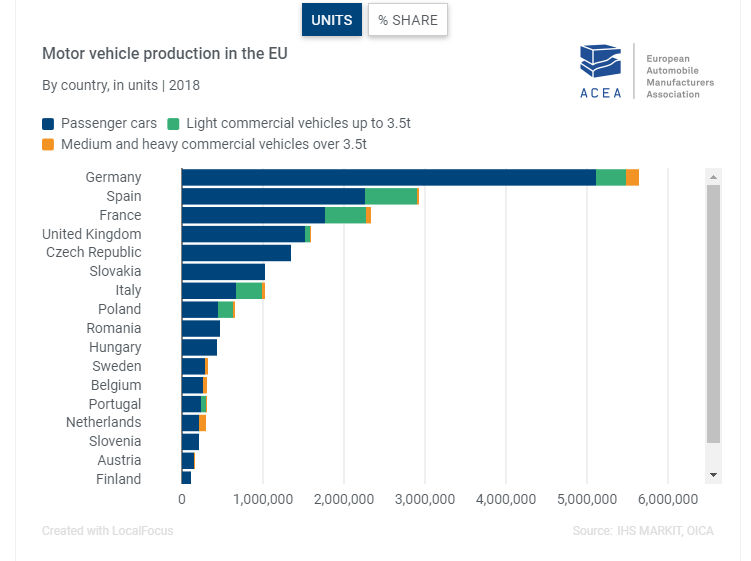
In 2018, 19.2 million motor vehicles were manufactured in the European Union. Germany is the top manufacturer followed by Spain and France. At about 5.1 million passenger vehicles, Germany made more than double that of Spain.

Click to enlarge

Source: European Automobile Manufacturers Association (ACEA)

Compared to European production, the US produced 10.98 autos in 2018. That is more than twice the number of German production.