Promise of Too Many “Free” Things May Have Doomed Britain’s Labor Party

The Conservatives are projected to win UK’s election yesterday. Fears of Labor Party revival has been laid to rest. There are many reasons why Labor lost this election. But one reason that stood out is the promise of too many freebies to the general public.

Britain has been a nanny state for many years now. The state is the largest employer in the country. I wrote on this topic back in 2010 when David Cameron became the Prime Minister. Inefficiency and low productivity is rife in the country’s public sector. For example, during  a recent visit I observed there were 3 workers involved in picking up trash from each house. One was the trash truck driver. The other two were literally picking up trash cans with their hands and dumping trash into the truck. In the US, trash pickup is done with just one worker – the driver of the truck which is equipped to pickup and empty trash in an automated way. There is no need for 2 more workers and work is far more efficiently as the sole driver is cover more streets.

Coming back to the UK election, according to a recent article at Financial Post, the Labor party promised to offer many free things to Britons such as free broadband, free cricket broadcast, free dental care, free bus passes, etc. From the article:

So it’s not outside the realm of possibility that Labour wins. “Nightmare on Downing Street: Friday the 13th” is the headline this week above analysis of that outcome in the Tory-supporting Spectator magazine. Labour’s election platform, its “manifesto,” as it calls it, “for the many, not the few,” would be the playbook for a Labour government and maybe also, if Labour does better than currently expected, for Left parties around the world, including here.

What jumps off the manifesto’s pages — 35 of them, in fact — is the word “free.” The first use, by Corbyn in an introduction, is rhetorical: “The big polluters, financial speculators and corporate tax-dodgers have had a free ride for too long.” But most of the others are with reference to the proposed new price of many public services: zero. Corbyn uses it six times in his intro, highlighting “full-fibre broadband free to everybody in every home in our country,” “free university tuition with no fees,” “free lifelong learning, giving you the chance to re-skill throughout your life,” “free prescriptions for all” from the National Health Service, “free basic dentistry,” and “free personal care for older people.”

The rest of the document provides details: “free annual NHS dental checkups,” “free bus travel for under-25s,” “free hospital parking for patients, staff and visitors,” “free personal care, beginning with … older people, with the ambition to extend this provision to all working-age adults,” “free education for everyone throughout their lives,” “free preschool education,” “free school meals for all primary school children,” “free support and advice (from a new Business Development Agency) on how to launch, manage and grow a business,” “free entry to museums,” “free TV licences for over-75s,” and “free bus passes” for pensioners.

My favourite of all, however, is: “we will add the … Cricket World Cup to the list of crown jewel sporting events that are broadcast free-to-air.” At the moment, legislation provides that certain “crown jewel” events — the Olympics, soccer’s World Cup and FA Cup Final, Wimbledon finals, Rugby World Cup finals and so on — must be offered to free-to-air broadcasters at fair and reasonable costs. Labour will add cricket to the list. Not being a cricket fan, I’m not quite sure whether that says more about Labour moving upmarket or cricket moving down.

Source: William Watson: God help the West if ‘free-cricket Corbyn’ wins in the U.K.,  Financial Post

We all know there no such thing as “free” especially from the state. No wonder the Labor Party lost.

Instead of giving so many things for free, Labor might as well promised Britons to simply give them free everything anyone needs like food, shelter, TV, cell phone, car, vacation, jewelry,high-end perfumes, quality clothes,  etc. This way there would be no need for any private enterprise. The government can simply act as the nanny for the whole country including adults.

After all this is done, Labor might have as well declared UK to be a communist country to make everything easier !………😊

Luckily they did not win.
 

Which is Better for Long-Term Investment: Nike (or) Adidas?

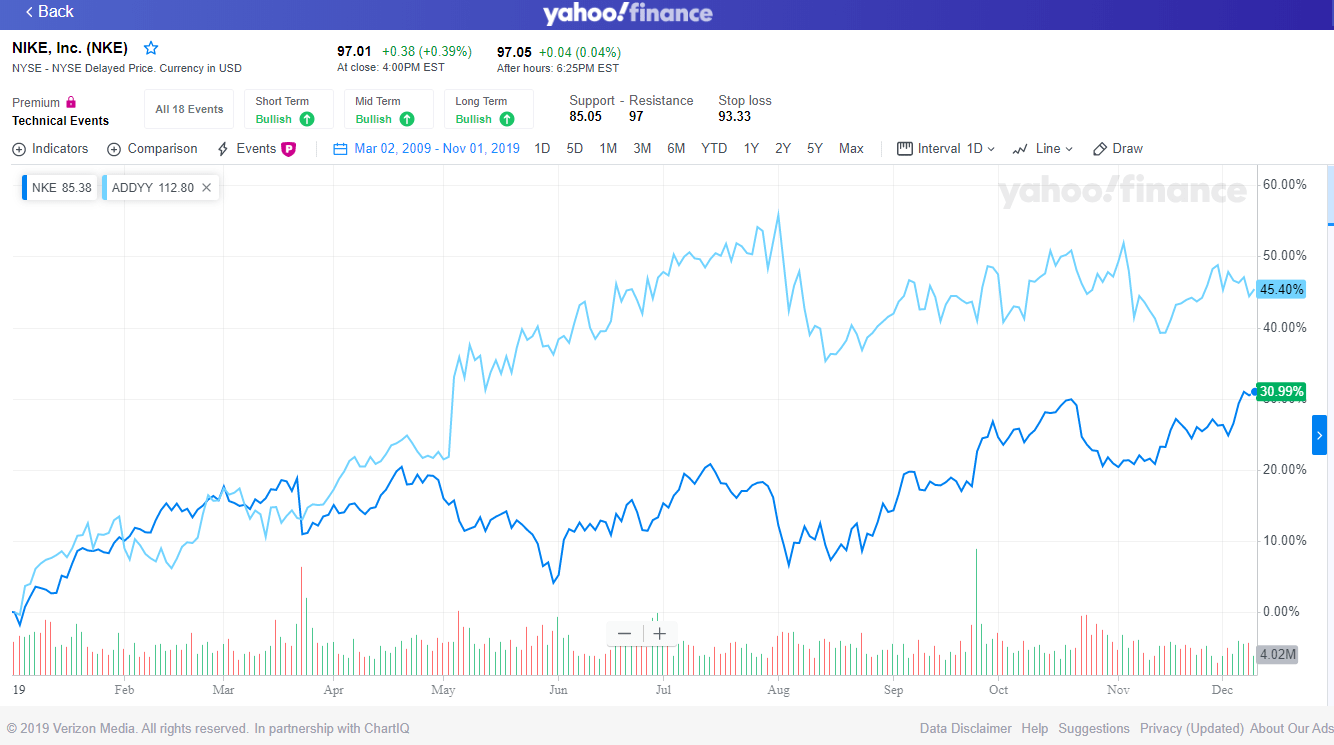
American company Nike(NKE) is the world leader in the footwear and sports apparel industry. It is so large and important to the US economy that it is a constituent of the Dow Jones Index. Germany-based Adidas (ADDYY) is the competitor of Nike. In this post, let us take a look at the performance of these firms over the short and long-terms.

Nike vs. Adidas –  Year-to-date Return:

Click to enlarge

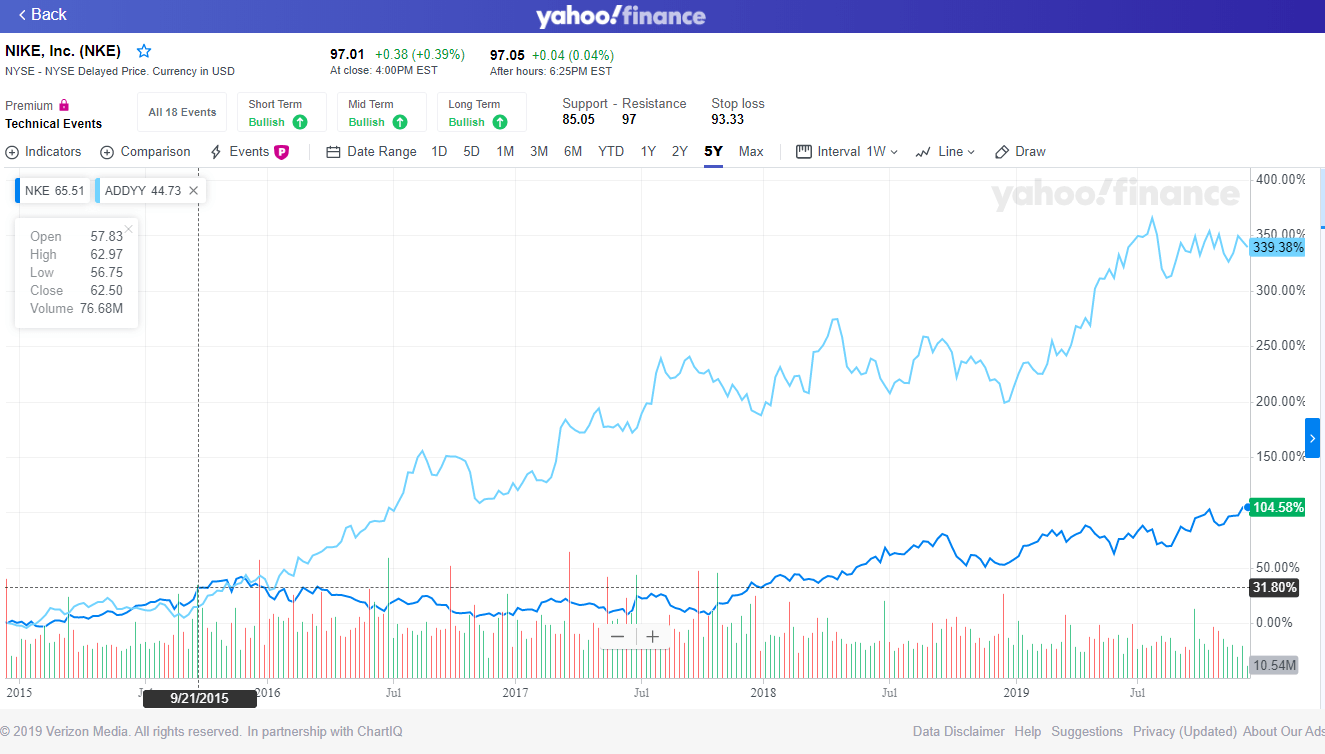
Nike vs. Adidas – 5-Year Return:


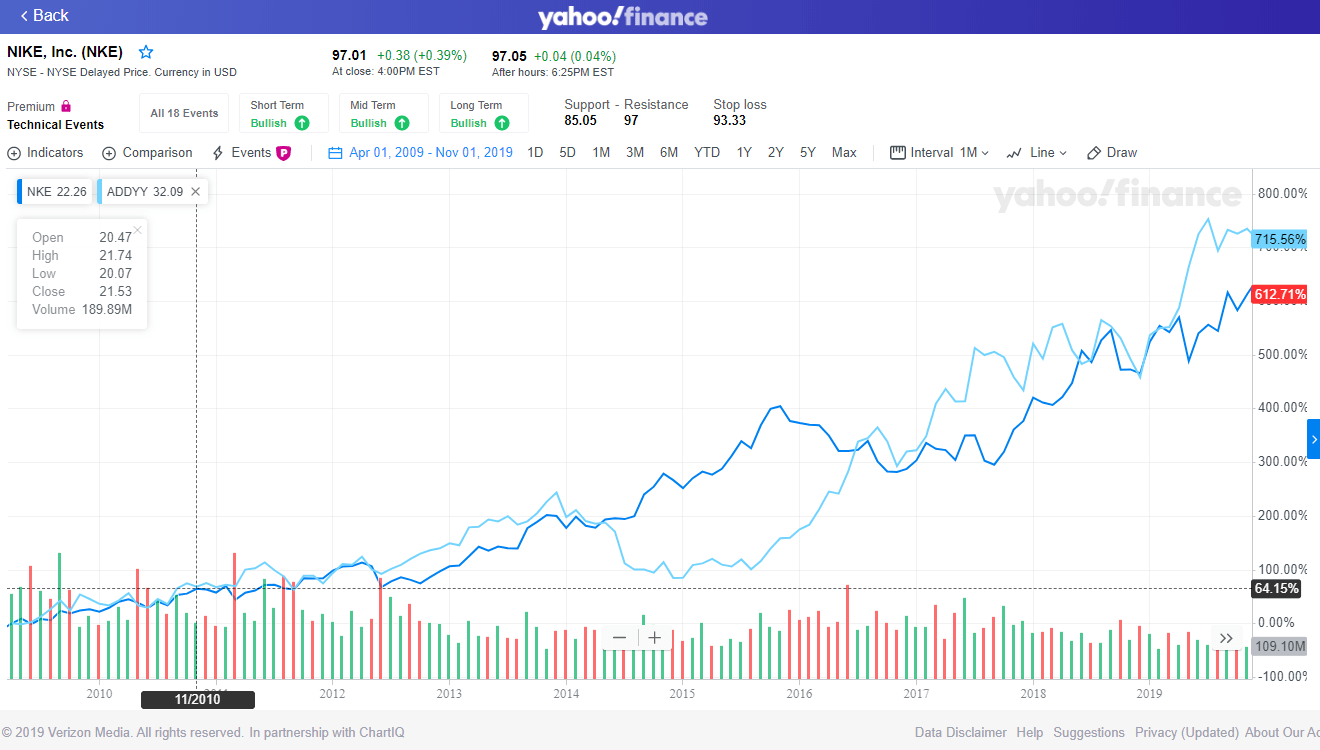
Nike vs. Adidas – Return since Global Financial Crisis trough:

Note: The returns shown above are price only (excluding dividends)

Source: Yahoo Finance

So far this year, Adidas is well ahead of Nike by a wide margin in terms of equity returns.Over the 5 year period, the difference is even huge. Adidas has returned 339% while Nike has grown by only about 105%. Adidas has beaten Nike in the long-term also as represented by the chart since the lows of the Global Financial Crisis.

From a return perspective, Adidas is clearly the winner.

Disclosure: No Positions

Why Invest in the 10 Largest European Companies

European companies offer many of the features that are common in their US peers. Among the developed countries, firms in Europe are the closest to American counterparts in terms of quality, governance, growth, scale and other factors.

I have written many times before about the need for investors to hold European stocks. Some of the reasons that tilt the scale towards companies from the continent include: higher dividend yields, strong global presence due to centuries of colonization of countries around the world, equal or even better governance in some firms, ability to plan and invest in R&D for the long-term as opposed to the rat race of worrying about beating quarterly numbers like US firms, etc.

Some of the factors were noted in an interesting article on international investing at American Funds. From the article:

2. Revenue has become more important than real estate

If real estate is all about “location, location, location,” investing may be all about “revenue, revenue, revenue.” As the shift toward globalization continues, the address of a company’s headquarters has become less important to its growth prospects than where it makes money.

Consider that a company’s products are often made with parts manufactured in several countries and then sold to customers around the world. This rise of multinational companies means investors should re-evaluate how they think about global stocks. Instead of where a company is based, look at where it earns its revenue.

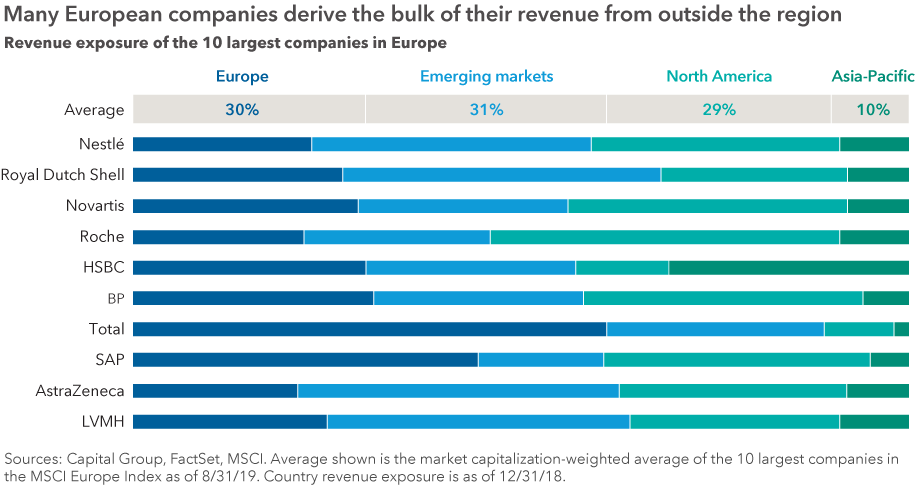
For example, the 10 largest companies in Europe generate less than a third of their revenue from their home region. Political strife or an economic slowdown can still hinder European stocks, but will affect every business differently. A careful examination of revenue exposure can help identify companies that are less likely to be disturbed by macro headwinds.

The bottom line? Follow the money, not the mail.

SourceInternational investing in 2020: Your comprehensive guide by Rob Lovelace and David Polak, Capital Group

Clearly the above chart shows that the top 10 European firms’ earnings are impacted more from macro conditions outside of the continent. For instance, food giant Nestle(NSRGY) derives less than one-third of its revenues from Europe.

So from an investment perspective, investors looking to diversify and gain exposure to world-class firms can consider adding the above stocks at opportune times.

The top 10 European firms are listed below with their tickers on the US market and the dividend yields:

1.Company: Nestle SA (NSRGY)
Current Dividend Yield: 2.33%
Sector: Food Products
Country: Switzerland

2.Company: Royal Dutch Shell PLC (RDS.A)
Current Dividend Yield: 6.56%
Sector: Oil, Gas & Consumable Fuels
Country: The Netherlands

3.Company: Novartis AG (NVS)
Current Dividend Yield: 3.08%
Sector: Pharmaceuticals
Country: Switzerland

4.Company: Roche Holding AG (RHHBY)
Current Dividend Yield: 2.79%
Sector: Pharmaceuticals
Country: Switzerland

5.Company: HSBC Holdings PLC (HSBC)
Current Dividend Yield: 6.92%
Sector: Banking
Country: UK

6.Company: BP PLC (BP)
Current Dividend Yield: 6.63%

Sector: Oil, Gas & Consumable Fuels
Country: UK

7.Company: Total SA (TOT)
Current Dividend Yield: 5.48%
Sector:Oil, Gas & Consumable Fuels
Country: France

8.Company: SAP SE(SAP)
Current Dividend Yield: 1.26%
Sector: Software
Country: Germany

9.Company: AstraZeneca PLC (AZN)
Current Dividend Yield: 2.94%
Sector: Pharmaceuticals
Country: UK

10.Company: LVMH Moet Hennessy Louis Vuitton SA (LVMUY)
Current Dividend Yield: 1,56%
Sector: Software
Country: France

Note: Dividend yields noted above are as of Dec 9, 2016. Data is known to be accurate from sources used.Please use your own due diligence before making any investment decisions.

Disclosure: No Positions

On The Year to Date Return of US Food Makers

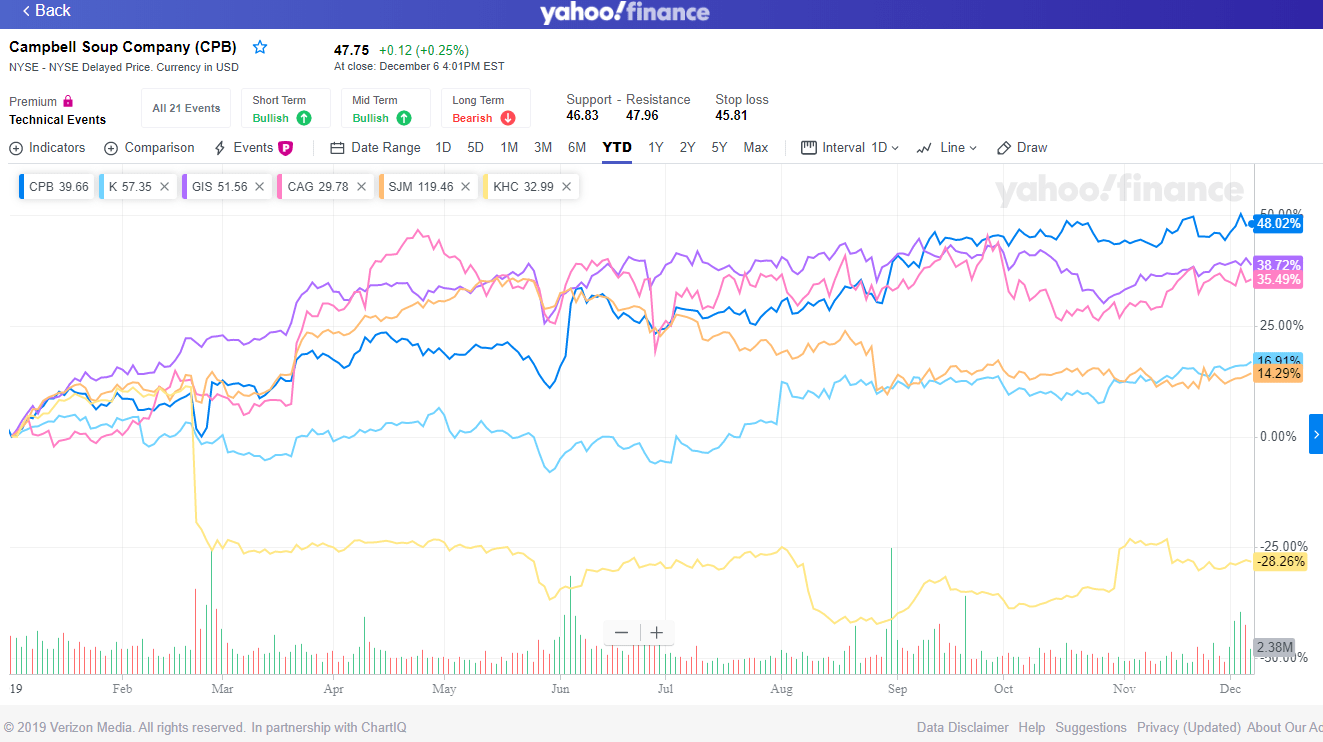
Campbell Soup(CPB) is the top performing stocks year-to-date in the US food maker sector. The stock is up by 48% YTD. The worst performing stock is Kraft Heinz(KHC) with a loss of 28%. The second best performer is General Mills(GIS).

The following chart shows the relative return of food companies so far this year:

Click to enlarge

Source: Yahoo Finance

However CPB is trading at the highest forward P/E ratio of over 17.5. Investors are bidding up the stocks as if the turnaround is already complete. A recent journal article advises investors to wait until the stocks cools down.

Disclosure: Long GIS