Five Foreign Stocks To Consider Now

US equity markets have had a splendid return so far this year. Relative to the performance of American stocks, some foreign markets are performing not great. For example, Chile is down about 14% suddenly when protests erupted in that emerging market a few weeks ago. However this type of reaction can lead to wonderful opportunities for long-term investors.

That said, below are five foreign stocks to consider adding at current levels:

1.Company: Banco de Chile (BCH)
Current Dividend Yield: 5.17%
Sector:Banking
Country: Chile

From a 53-week high of about $33, the stock plunged to a 52-week low of $20.39 on Friday. Though political risk in emerging markets can be high, Chile is an exception and current fears may be overblown. The stock boasts a high dividend yield and should be higher in 5 years from current levels.

2.Company: Ecopetrol SA (EC)
Current Dividend Yield: 7.89%
Sector:Oil
Country: Colombia

The oil and gas sector is one of the most hated sectors right now. One smart way to accumulate stocks is to identify the stocks that nobody likes and then consider them for addition. In this case, Ecopetrol should perform well when oil prices recover and investors’ re-evaluate this sector.

3.Company: Equinor ASA (EQNR)
Current Dividend Yield: 5.45%

Sector:Oil
Country: Norway

Norway’s premier oil producer used to be called Statoil.

4.Company: Veoneer Inc (VNE)
Current Dividend Yield: N/A
Sector:Auto Parts
Country: Sweden

Veoneer is a spin-off from Autoliv(ALV) and has excellent prospects in car automation and mobile technologies.

5.Company: Sasol (SSL)
Current Dividend Yield: 5.24%
Sector: Oil & Gas Producers

Country: South Africa

Note: Dividend yields noted above are as of Nov 29, 2019. Data is known to be accurate from sources used.Please use your own due diligence before making any investment decisions.

Disclosure: Long BCH, EC, VNE, ALV

Knowledge is Power: Market Headwinds, Peak Oil, Emerging Markets Edition

US markets have soared so far this year with the S&P 500 up by 25.30% based on price returns alone. Semiconductors are the stars of 2019 with a growth of over 48% for the Philadelphia semiconductor index. Even the normally boring bank stocks are up by 28% as represented by the KBW index. The important transportation index has shot up by a decent 18% and biotechs have increased by 23%. It remains to be what December brings to US equity markets.

With that said below are some interesting reads for this weekend:

Animal Park in UK

The Relationship Between Economic Growth and Stock Market Returns is Weak

One of the important factors that investors are advised to consider when selecting a country for investment is the economic growth of that country. Generally higher economic growth leads to higher equity market returns. However this is not always the case.I have written many articles on this topic before which can be found here and here and here and here and here.

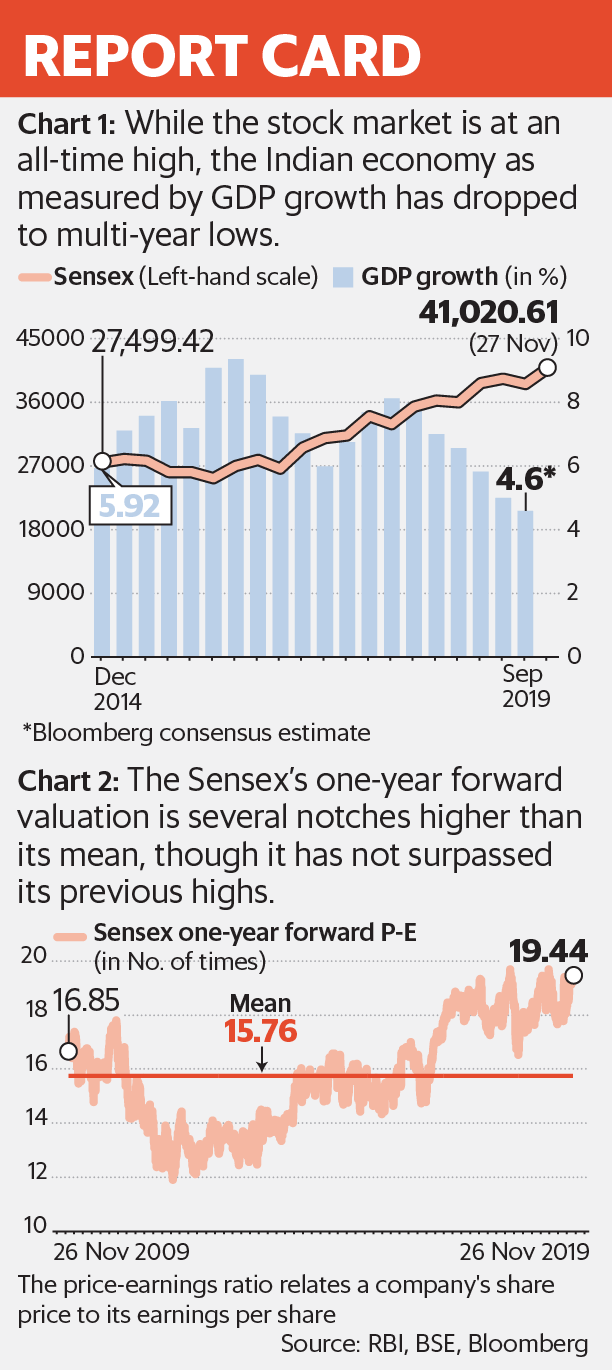
The relationship between equity returns and economic growth is weak especially in the context of emerging markets. Let’s take the example of Indian equity markets. Indian stocks are soaring and the Sensex crossed the 41,000 mark recently. However economic growth has been on the decline for a few quarters. As forecasted, the GDP fell to 4.5% for the quarter ending September today. From a journal article:

NEW DELHI—India’s economy slowed for the sixth quarter in a row during the past period, with gross-domestic-product growth dipping to a six-and-a-half-year low as concerned companies and consumers continued to hold back on spending.

The slowdown—which has been particularly tough on the rural regions where most Indians live—is emerging as the biggest challenge for Prime Minister Narendra Modi, who was voted back into office this year pledging better days.

Gross domestic product in Asia’s third-largest economy slowed to 4.5% growth in the three months ended September, according to government data released Friday. That was down from 5% in the previous quarter and its worst performance since the quarter through March 2013.

While New Delhi has launched multiple measures to boost lending, investment and consumption in recent months, it maintains that the downturn is only temporary.

Source: India’s GDP Growth Slows to More Than 6-Year Low of 4.5%, WSJ

A recent article at Live Mint discussed the reasons for market rising when economy is slowing down. One of the points analyzed in the piece was the disconnect between economic growth and equity market growth. From the article:

Simply put, the markets are up purely on the hope of a better future. And this dissonance between the markets and economic numbers naturally causes confusion in the minds of observers.

It’s another matter that there is nothing on the ground to support the optimism. Jefferies India, for instance, points out that its economic activity index slipped to a 15-year low in September. The broker’s Activity Index is based on 36 indicators including credit growth, automobile sales and electricity demand.

The latest reason for hope is the number of measures the government has taken to bolster the economy. Among other things, the Centre announced a massive cut in corporate tax rate. But analysts worry that the impact of these measures will take a long time to benefit the economy.

“We remain fairly sceptical about any imminent recovery in the Indian economy,” say Kotak’s analysts, citing multiple reasons. The current slowdown is because of structural factors such as low household income and poor job creation. Besides, the government’s finances are stretched and there is hardly any room for it to boost the economy by increasing spends. And while the Reserve Bank of India (RBI) is trying its best to bring interest rates down, the high borrowing needs of the government have kept real interest rates from falling meaningfully.

Source: Why markets are rising in times of slowdown, Live Mint, Nov 28, 2019

As I mentioned in the beginning of the post, the disconnect between equity markets and GDP is not surprising. Markets can continue to rise even economic growth is anemic. This is because stock prices are driven by a multiple of factors including optimism on the future, fundamentals of a firm, foreign portfolio investors, rumors, short-covering and many others. So the key to remember is that investors should not simply assume higher economic growth will lead to higher equity prices and vice versa.

India’s Sensex Crosses 41,000 and Hits Yet Another Record High

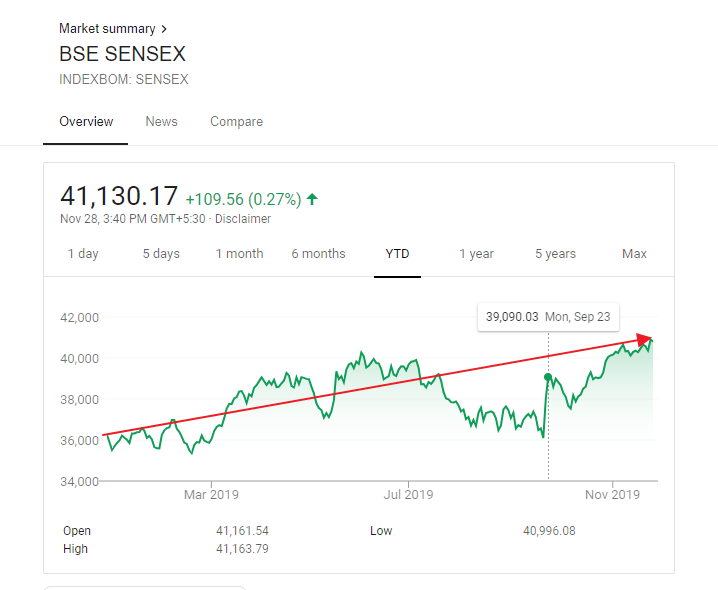
The bull market in Indian equities continues as we approach the end of the year. Yesterday the benchmark Sensex Index crossed 41,000 for the first time ever in its history. Today the it closed at a new peak of 41,130 after reaching an intra-day high high of 41,163.

Click to enlarge

Source: Google Finance

Indian stocks have been soaring this year despite the economy performing not well. The GDP has declined for many quarters in a row and is well under 5%.  With the rise in stock prices, the forward P/E has shot up to over 19 which is much higher than the mean of around 16.

It remains to be seen if the current bull market can hold thru the rest of the year and possibly reach higher highs in 2020.

Related:

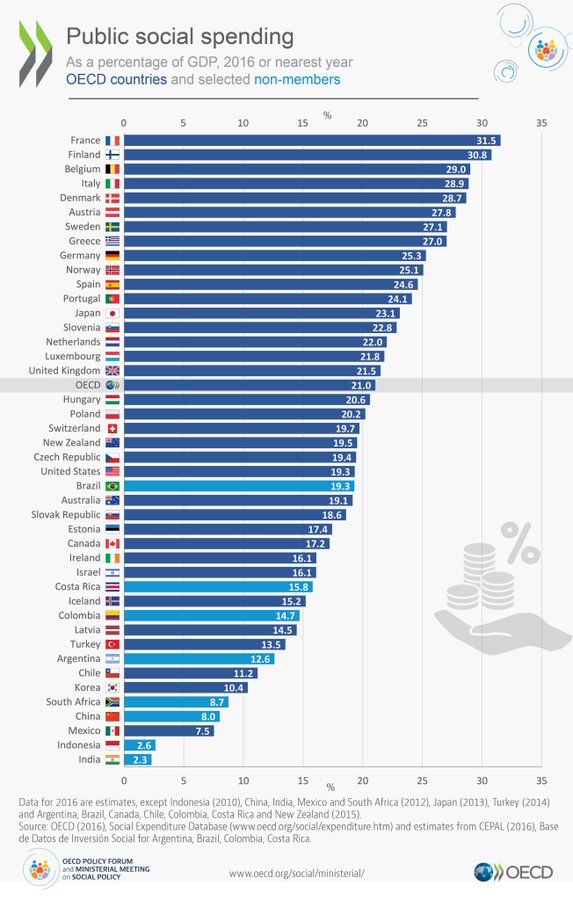
Public Social Spending as a Percentage of GDP by Country: Chart

The socialist countries of Europe tend to spend a higher portion of their GDP on public social spending. France has the highest public social spending as percentage of GDP at 31.5%. The next high spenders are Finland, Belgium, Italy and Denmark.

The US public social spending is lower than the OECD average. The US is just ahead of Brazil in social spending.

Click to enlarge


Source: OECD