Top 10 European Utilities available as ADRs

In this post, lets discuss the Top 10 European utility companies and their ADR stocks.

For our analysis lets use the Dow Jones STOXX® 600 Utilities Index as the proxy.This contains all the largest utility companies of Europe.There are a total of 33 components in this index.The components are:

Utility Name:
AEM
Atel Holding AG
British Energy Group plc
Centrica plc
Drax Group Plc (New)
E.D.F
E.ON
EDP
Enagás
ENEL
Fortum
Gas Natural
Gaz de France
Hera Spa
Iberdrola (New)
Iberdrola Renovables
International Power plc
National Grid
Northumbrian Water Group plc
Pennon Group plc
Public Power Corp.
Red Eléctrica ESP
Renewable Energy
RWE
Scottish and Southern Energy plc
Severn Trent plc
Snam Rete Gas
Solarworld
Terna S.p.A.
Union Fenosa (new)
United Utilities Group plc
Veolia Environnement
Verbundgesellschaft

For comparison, I used the db x-trackers Dow Jones STOXX® 600 Utilities ETF. The top ten holdings in both the Index and the ETF are the following stocks. These are some of the largest utilities in Europe.All these stocks are available as ADRs in the US markets.Most of them are listed in the OTC markets.

1.E.ON AG – EONGY
Based in Düsseldorf,Germany EON operates in the electricity and natural gas business in many European countries like Hungary,Switzerland,etc. and also in the US (Kentucky).

EON has a P/E ratio of 12.5 and a dividend yield of 3.63%. The market cap is about $108B with 1.9B shares outstanding. The annual dividend growth rate for the past 5 years is 18.56%.

2.Gaz de France – GZFCF (now GDF Suez)
Gaz De France is a natural gas provide in France. The current stock price is $54.35.The company merged with Suez last month to become GDF Suez.

3.Iberdrola SA – IBDRY
Iberdrola is an electric utility in Spain.IBDRY has a dividend yield of 4.2% and currently goes for $46.75.

4.RWE AG – RWEOY
RWE is another large utility in Germany. It is a multi-utility operating in electricity, water and gas industries.

RWEOY has a dividend yield of 4.61% and a PE of 19.50. The 5 year annual dividend growth rate has been 23.42%.

5.Enel Spa – ENLAY
This Italian Utility Enel Spa is short name for Ente Nazionale per l’energia ELettrica –
Societa Per Azioni.ENLAY has a dividend yield of 19.70%.Currently the stock
goes for $9+.

Enel has cancelled it ADR from NYSE and the stock now trades on the OTC with very light volume. As per this news release “ENEL ANNOUNCES ITS INTENTION TO DELIST FROM NYSE AND TO TERMINATE REGISTRATION OF ITS ORDINARY SHARES AND ADSs UNDER THE EXCHANGE ACT

Enel has not arranged for listing in any exchange.So detailed research is needed on this stock.

6.National Grid plc – NGG
NGG is an electric and gas utility in UK.NGG has a dividend yield of 6.07% and a PE of 12.08.The 5-year annual dividend growth rate is 13.92%.

7.Scottish and Southern Energy plc – SSEZY
This is another British utility.It has a dividend yield of 4.39%.The stock currently trades for $27.18.

8.Electricite de France – ECIFF
As the name implies this is another French electric utility. The OTC stock does not seem to trade often.The last trade was at $83.15.

9.Centrica plc – CPYYY
Again this British utility does not seem trade often as well. The last price per share was $57.60 and a dividend yield of 4.48%.

10.Veolia Environment – VE
This multi-utility from France has a dividend yield of 3.42% and a PE of 18.0.The 5-year annual dividend growth rate is 17.08%.

The 5-year growth of the Dow Jones STOXX® 600 Utilities Index (in Euros) is displayed below:
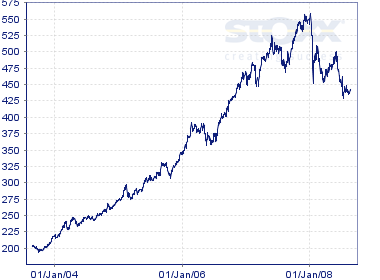
5-year=dj-stoxx-utils

Source: DJ Stoxx

Full Disclosure: I currently own EONGY and VE.

Related Posts:
Top Banks of the World available as ADRs
Top Banks of Canada

Five Cheap Asian Closed-End Funds

The following country specific closed-end funds are trading at a discount to their NAVs. This means they are cheap to pick up at these levels. This is not the only factor that must be considered before investing in them. But its a good point to starting one’s research into the world of closed-end funds. In bear markets investing in individual stocks is not for the faint-hearted especially when it comes to investing in foreign markets. So taking the funds route like an ETF or a closed-end fund is a good idea.

1.Templeton Dragon Fund – TDF
Discount to NAV: -12.98%
Distribution Rate: 1.37%

2.India Fund – IFN
Discount to NAV: -4.7%
Distribution Rate: 0.34%

3.Korea Fund – KF
Discount to NAV: -8.33%
Distribution Rate: 0.95%

4.Taiwan Fund – TWN
Discount to NAV: -8.22%
Distribution Rate: 3.02%

5.Singapore Fund – SGF
Discount to NAV: -9.05%
Distribution Rate: 7.78%

Note: All data as of August 25,2008.

Knowledge is Power – Edition #3

Tulip mania

Photo: Tulips in The Netherlands

1.Dan Hyde of “This is Money” says in the article Stock markets: A history of boom and bust that “History is littered with stock market dips, shocks and crashes, throwing entire economies into turmoil. With the FTSE 100 down 23% on its recent high in 2007 and a potential recession on the horizon, Dan Hyde takes a look at the history of the stock market crash..”

2.Georgia — A Blow to US Energy. In this piece, Steve LeVine of Der Spiegel says ”
The plans of the US and Western oil companies for expanded pipelines in the Caspian region may well be a casualty of Russia’s attack.”

3. Frontier Markets are getting popular nowadays. Kuwait is one such market that investors are flocking to. So here is the link for the Kuwait Stock Exchange.

4.A preview from William Bernstein’s – The Four Pillars of Investing: NO GUTS, NO GLORY

5.With the bear market in full swing, its time to review this neat article:
May 24, 2007 – Gurus Explain Why They Were Wrong About the Stock Market

A Tale of Two Countries – Singapore Vs. Malaysia

Recently there was an article in the Legal Affairs magazine about Malaysia. The article mentioned that researchers have concluded a country’s legal system is a major that determines its success or failure in overall growth. Thoughtfully they agreed that this factor was in addition to other traditional factors like political system, economic policies, etc.

The article mentioned that Malaysia has advanced so much when compared to Indonesia though they share many things in common such as Islam as the main religion, former colonies of major powers, commodity based economy, etc. The reason for Malaysia’s success was attributed to its legal system which is based on the British legal system since Malaya used to be a colony of Great Britain.

On the other hand, Indonesian legal system is based on the Dutch legal system. Holland used to be the colonial master of Indonesia.The Dutch legal system is based on the Napoleonic French legal system which is considered inferior to the British one. Hence Indonesia which followed the Dutch system remains a poor country whereas Malaysia has prospered after Independence from UK.This kinda made me thinking about another question:

Why does Malaysia lag Singapore in terms of economic growth?

Singapore is a tiny island city state neighboring Malaysia. But Singapore is today considered a first world country where Malaysia falls under the emerging market category.

I think Malaysia lags Singapore in many aspects because of its political system which is influenced heavily the predominant religion. Malaysia has been unable to invest and promote high tech “knowledge” based industries such as IT. The famous Petronas Towers in Kuala Lumpur was built to house many of the IT and other hi-tech companies that were to start operations. But that never materialized and today the majority of the building is occupied by the oil company and other regular foreign multinationals. Today Malaysia remains a commodity driven economy based on oil palm and other natural resources. Malaysia recently discovered oil offshore and hence is a net exporter of crude oil. Malaysia is an example to prove that a country does not need more land or people to become a first world nation.

Singapore has not much land at all. The island can be crossed from one end to the other in less then 30 minutes. The population is small as well. When Singapore broke off from Malaysia and became an independent country, it implemented many successful economic policies the fruits of which are evident today. The country is not democratic by any means. It is tightly ruled by a kinda of dictatorship but there are some freedoms. Media is heavily controlled by the government. However Singapore invested in the right industries such as marine shipping, finance, IT,trading, etc. to become a global powerhouse today. Many top banks of the world are setting up shops in Singapore as it tries to attract capital from other capital friendly locales like Switzerland, Isle of Man, Bermuda,etc. The country’s success can be attributed to its statesman Lee Kuan Yew who implemented the economic policies when he ruled the city state with an iron fist for many years.

Comparison of ETFs – EWS Vs. EWM:

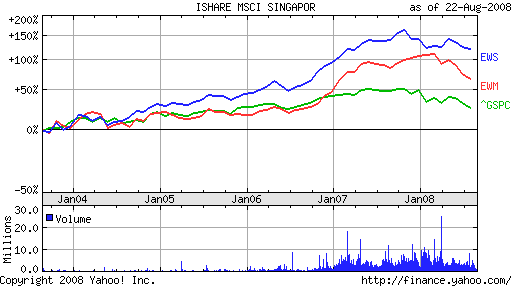
The iShares Singapore ETF has an asset base of about $1.5B compares to iShare’s Malaysia ETF EWM which has asset size of only $479M. About 50% of EWS are made up of financials. EWM has about 30%. YTD EWS is down 8.6%. EWM is down 17.6% YTD due to the crash in commodity prices world-wide.

The 5-Year Performance Chart of EWS, EWM and S&P 500 Index:

5-Year-EWM-EWS-SP500-Chart

Due to the reasons mentioned above, Singapore is a better investment destination than Malaysia. Readers – What is your opinion?.

You may want to subscribe to our site’s RSS feed by clicking here.

Top Banks of Canada

In this post, lets review the top banks of Canada.Specifically we will analyze the Canadian bank stocks that trade as interlisted stocks in the US.

Toronto

Photo: Toronto Skyline

The following are some of the large banks in Canada:

1. Royal Bank of Canada
2. Bank of Nova Scotia
3. Bank of Montreal
4. TD Canada Trust
5. Canadian Imperial Bank of Commerce (CIBC)
6. ING Direct Canada
7. President`s Choice Financial
8. Business Development Bank of Canada (BDC)
9. National Bank of Canada
10. HSBC Canada

In the above, ING Direct, HSBC Canada and President`s Choice Financial are online banks.Business Development Bank of Canada is for National Bank of Canada trades in the Toronto Stock Exchange (TSX) only with ticker “NA”.Business Development Bank of Canada is a government bank that offers loans and other services to businesses. Besides the above banks there are many credit unions such as the Desjardins group based in Montreal,Quebec.There are many other local and smaller banks and credit unions in the country.

Out of the above ten banks, the first five are the top national banks with each having thousands of branches all over Canada. Fortunately all these banks trade as interlisted stocks as well in the US for the benefit of US investors.

The TOP BANK in Canada is the “Royal Bank of Canada” due to the following reasons:
1. Most Profitable bank.
2. Largest Market Capitalization.
3. Largest Asset base.
4. Consistent long-term performance of stock.
5. Excellent dividend yield and dividend growth rates.

The next top bank is Bank of Novo Scotia.

Canada is a large country blessed with bountiful of natural resources. Canadians save a high portion of income compared to Americans.This savings flow and the funds received by Canadian companies from exporting the natural resources all end with the top five banks.One big problem for the cash-rich Canadian banks is that there is not much room to
grow in Canada.The population is small and the market is already saturated.So these banks head to other countries to invest their capital.That means they try to grow in places that they feel comfortable dealing with such as the US, Caribbean, Chile, Mexico, etc.

Canadian banks have heavy exposure to US since they have acquired many US banks,brokers and have operations here.For example, Bank of Montreal owns the Harris Bank in Chicago.TD Bank bought Commerce Bank in the North East and a few other banks.And it owns the former Ameritrade now renamed as TD Ameritrade.Royal Bank owns the Centura banks in North Carolina. Scotiabank has a major presence in the Caribbean countries, Mexico and Chile.CIBC has operations in the Caribbean countries.
All these banks have big investment banking operations as well like RBC Capital Markets of Royal Bank.

A brief overview of the five banks:
1. Royal Bank of Canada – RY
RY has a dividend yield of 4.41% and a PE ratio of 12.15.Outstanding shares total 1.3 Billion.The dividend growth for the past 3 years is 21.69% which is more than double the
industry average. In the $40 range the stock is attractive.

2.Bank of Nova Scotia – BNS
Another Canadian bank with almost a billion shares out- 987.7 M shares to be exact.BNS has a dividend yield of 4.09% and a beta of 0.9.The 3-year dividend growth is 16.5%. BNS has lots of potential to grow due to its overseas operations.Widely known by its cute name “ScotiaBank”.

3. Bank of Montreal – BMO
BMO has a dividend yield of 6.06% and a 3-year dividend growth of 19%+. The bank wrote down a lot of money some months ago due to losses in the subprime meltdown.Thats why the stock went down from 60s to 40s now raising the yield to this high.

4. TD Canada Trust – TD
TD has a dividend yield of 3.94% and about 804M shares outstanding.TD has not been affected adversely like BMO and other major financials. Stock is now trading near the 52 week high.

5. Canadian Imperial Bank of Commerce – CM
CM has dividend yield of 5.85% and a market cap. of about $21B. Like BMO, CM went down a lot recently.3-year annual growth rate has been 12%+.CM is probably the least popular stock among the five banks.

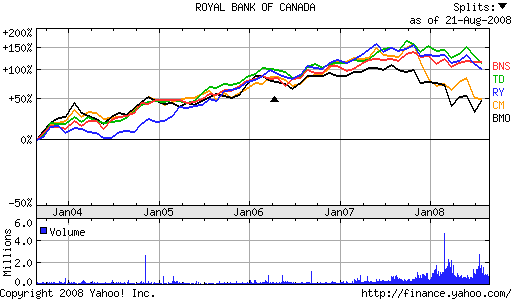
5-Year Chart of all Five Canadian Bank interlisted stocks.:

canada-banks-5-yr-comparison.png

Related Links:
The Best Banks of the World 2008
Wikipedia- List of banks in Canada
Canada Stocks List !!