Update: The Callan Periodic Table

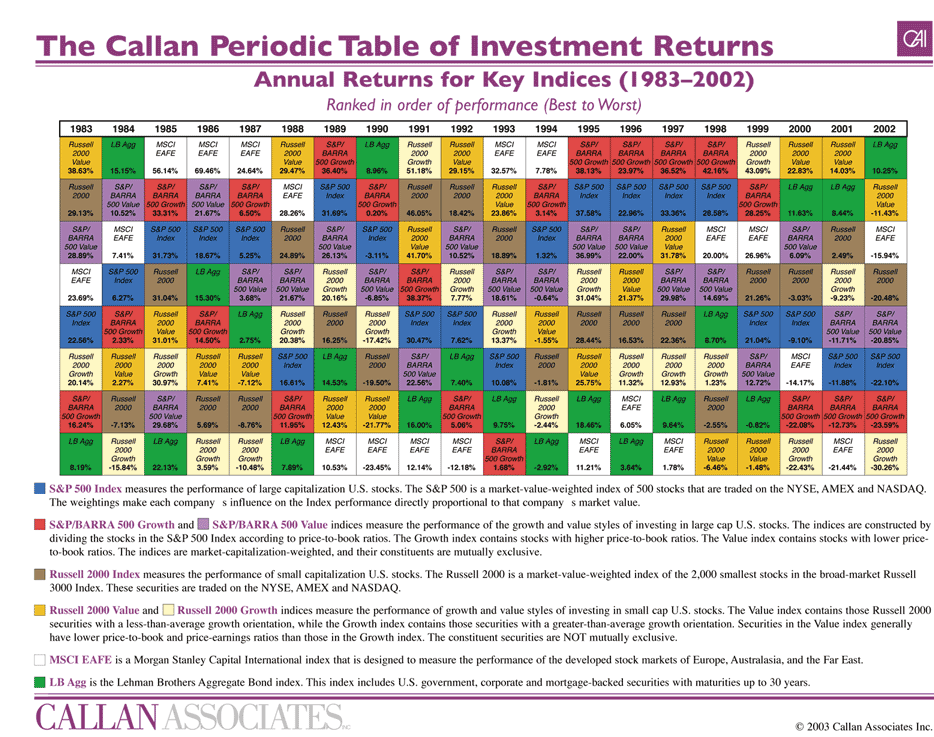
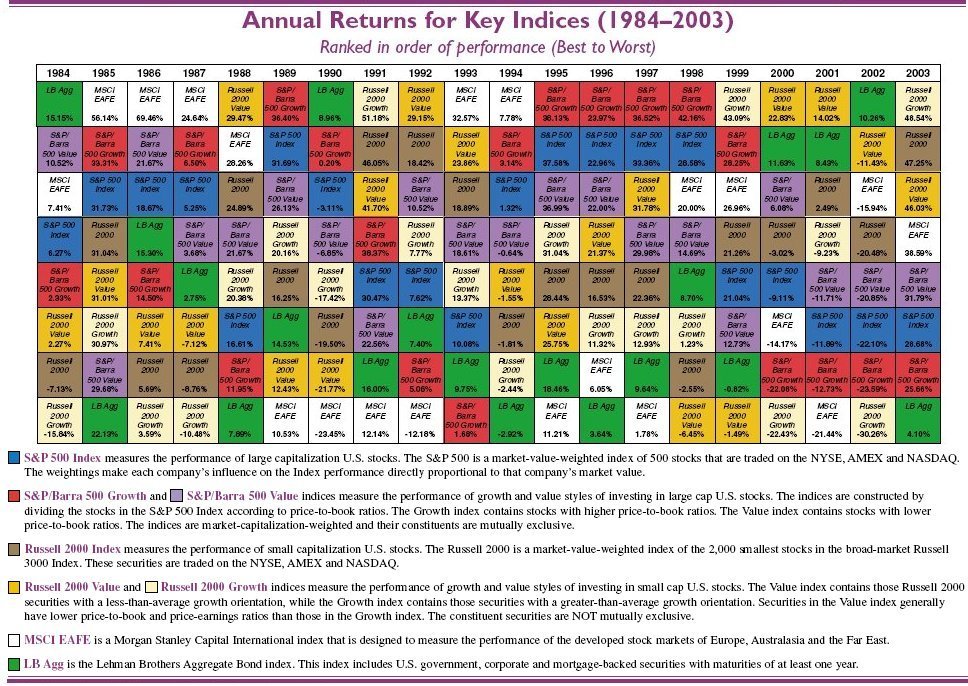
The Callan Periodic Table of Investment Returns from Callan Associates is widely used by investors to compare performance of various market indices. Recently I found the Callan Chart that lists the Best and Worst Performing Indices from 1985 to 2004. To access this chart click on the image below:Callan Chart Annual Returns – The Best and Worst Performing Indices from 1985 to 2004:

Click to Enlarge

Callan Chart Annual Returns 1985 to 2004

Related Charts:
1. For Top 10 Emerging Markets in 2008,
The Top 5 Best and Worst Performing Countries Chart
Go here.

2. For The Callan Periodic Table of Investment Returns for 2008 click here.

3. For The Callan Period Table of Investment Returns (1988-2007),
Callan’s – Equity Return of Developed Markets Chart
Go here.

4. The Callan Period Table of Investment Returns (1983-2002)

Click to Enlarge
Callan-Chart-1983-2002

5. The Callan Period Table of Investment Returns (1984-2003)

Click to Enlarge
Callan-Chart-1984-2003

Charts: Economic Crisis Impact of East Asia and Pacific Countries

This month, World Bank released the “Battling the forces of global recession” , an economic update for the East Asia and Pacific Region report. The following are some interesting charts from this report that show the effects of the current global recession on these countries :

1. Industrial Production

Taiwan is the worst affected country in terms of industrial production.On a year-over-year basis it fell by over 40% in January. Since Taiwan is mainly an export-driven electronics manufacturing hub, it is heavily impacted due to the fall in demand for these consumer discretionary items in the developed world. China has a small positive growth probably due to domestic demand for industrial goods.

2.Exports Relative to GDP

Singapore and Hong Kong top the list as they are the mostly trading hubs involved in exporting goods to other countries.

3.Impact of Commodity Price Declines

As the graph shows, economies that are more dependent on commodities are affected more than the ones whose economies are mode diversified. For eg- Malaysia is a significant exporter of rubber and palm oil.

4. Non-Performing Assets

The non-performing loans of financial institutions are relatively low when compared to the western countries. It is under 2% in Korea and China which is very good.

5. Equity Prices

The stock prices of emerging markets fell more than the developed markets late last year.However they have recovered much faster and are now leading the developed market indices.Countries such as China and India are up over 25% from recent lows.

The Top 25 Housing Markets for 2009

Despite the housing market crash in many states, there are markets which are holding up well. A few of these markets are not only strong but are actually projected to show an increase in home values in 2009, as per a report by Housing Predictor, an independent real estate markets forecasting site.

The Top 25 Housing Markets for  2009 are:

Top Housing Markets 2009
Source: http://www.HousingPredictor.com

The above table shows that the states of Montana and North Dakota dominate the list with Montana holding five positions and North Dakota with four positions. Both these states have relatively low unemployment rates in the 5% to 6% range. In addition,banks in these states were very conservative in their lending during the housing bubble times and did not offer many of the risky loans such as Alt-A mortgages.

According to the report, Billings,MT has one of the strongest job markets in the country followed by Fargo,ND. Not surprisingly none of the cities from the bubble markets of  California, Nevada, Florida, etc. made it to the rankings.

Knowledge is Power: Obama The Economic Magician Edition

1.Capitalism with Chinese CharacteristicsFEER Editor Hugo Restall reviews Yasheng Huang’s timely critique of China’s brand of capitalism.

2.The German government has launched a takeover bid for the bank Hypo Real Estate by offering shareholders €1.39 per stock. If they refuse, Berlin has the right to expropriate them under a new law.Berlin Launches Hypo Real Estate Takeover

3.Policies aimed at easing home-loan terms for troubled borrowers may not be as effective in preventing foreclosures as more-direct aid to homeowners, Federal Reserve economists found. Fed Economists Say Mortgage Changes May Do Little to Prevent Foreclosures

4.The U.S. budget deficit surged in March as tax payments by companies and individuals dropped and the government spent more to rescue banks and revive the economy. U.S. Budget Gap Swells to $192.3 Billion as Recession Reduces Tax Revenue

5. Failing economy creates a nation of part-timers- Recession’s main victims are full-time workers: Almost 80,000 of them lost their jobs last month

obama-magician.jpg6.Where did all the money go? This is a question that has been posed more than a few times since the financial world crashed down around our ears.

Is Obama the economic magician for the ultimate con trick?


With Low Debt, Latin America Should Do Better This Year

One of the factor that influences the performance of an economy is the external debt owed – which is the amount owed by locals to non-residents (or foreigners). According to  Finance & Development of IMF’s Statistics Department, in Latin America external debt as a percentage of GDP has fallen significantly over the past five years. During the same time external debt has increased in Europe.

Latin America’s debt  has decreased from 59% of GDP in 2003 to 32% in 2008.Brazil, for example, reduced its debt from $43B to $16B in the same time period. Just like for individuals, having a low debt helps a country by reducing interest expenses and other related costs.

Another factor to note about the debt in Latin America is that most of the debt is owed by  private nonbank and public sectors. Debts owed by banks is just 16%  of the GDP.But in Europe, in 2008 banks owed 54% and 45% of foreign borrowing in Europe and Asia respectively. With many banks in trouble around the world, having less bank debt is better forcountries.

Chart -  Latin America Debt CompositionLatin America Debt

Chart – Europe, Asia and Latin America Debt Composition

Latin-Asia

Source: Finance & Development – March 2009, IMF

Some investors believe that  countries with low debt or a surplus are better for invstments than those with excessive debt. Based on this logic, some of the economies listed above are good investment destinations. Mexico, Chile and Brazil are three picks. An easy way for investors to get exposure to these eocnomies is via an ETF. The ETFs for these countries are listed below:

1.Brazil – iShares MSCI Brazil Index (EWZ)

2.Chile – iShares MSCI Chile Index (ECH)

3.Mexico – iShares MSCI Mexico Index (EWW)