ADR Stocks Listed in the NYSE in 2009

The appetite for foreign stocks among U.S. investors is high since last year despite the credit crisis and the current recession.Last year’s market performance proved that the so-called decoupling theory of emerging markets being different from the developed markets is not entirely correct. In fact,many of the emerging market indices such those in Russia, India, Brazil, China actually fell much more than the developed market indices.

U.S. investors’ attraction towards overseas stocks started increasing after the dot-com bubble burst.These investors hold foreign stocks for a variety of reasons like diversification, high dividend yields,explosive growth in emerging markets,etc.The interest in foreign company stocks via American Depository Receipts (ADRs) continued thru the crisis last year.According to Bank of New York Mellon’s ADR site over 735 New Depositary Receipt Programs from around the world were introduced between Oct. 1,’08 and Aug.17,’09.The majority of these companies were listed in the OTC markets.Some of the well-known companies listed in the OTC markets include: Credit Aricole(CRARY) and Careefour (CRERY) of France, Linde (LNAGY) of Germany,Konica Minolta(KNCAY) of Japan,Standard Bank(DBGOY) of South Africa.The 735 ADRs have very thin daily trading volumes since they are new and are not listed in the organized exchanges.

Four foreign stocks were listed in the New York Stock Exchange this year (Source: The Bank of New York Mellon DR Directory). Lets take a quick look at these four companies.

1.China-based Chemspec International Limited (CPC) is a contract manufacturer of specialty chemicals. The ADR effective date was June 24, 2009. The current market cap is $246M and the company pays no regular dividends. Total sales in 2Q,2009 was $34.2 M, an increase of 8.1% from 2Q,2008. Net Income amounted to $7.9M. Chemspec holds US$69.3 million in cash primarily from the proceeds of IPO.

2.Duoyuan Global Water(DGW) is a domestic water treatment equipment supplier in China. “The Company’s product offerings focus on addressing the steps in the water treatment process, such as filtration, water softening, water-sediment separation, aeration, disinfection and reverse osmosis. It offers a set of more than 80 complementary products across the three product categories: Circulating Water Treatment Equipment, Water Purification Equipment and Wastewater Treatment Equipment.” Since pollution is a major problem in many Chinese cities Duoyuan may be a good pick. Since its June launch, DGW is up more than 50%. The stock closed at $30.42 last Friday. The P/E ratio is 78.81.

3. Denmark-based fixed-line telecom services provider Invitel(IHO) started trading in New NYSE Amex in late February. Invitel has operations in Romania thru its subsidiary Euroweb Romania. The company provides its services to about 17% of population in Hungary. IHO is down 23% since its IPO. “Invitel Holdings’ net income attributable to ordinary shareholders for the quarter ended June 30, 2009 was EUR 16.7 million, or EUR 1.00 per ordinary share”.

4.Votorantim Celulose e Papel(VCP) is a pulp and paper products company based in Brazil.The company also makes wood-free printing and writing papers and specialty papers. VCP is up 114% YTD. Votorantim has 390M shares outstanding and the beta is 2.9.

Top 25 Middle East Banks

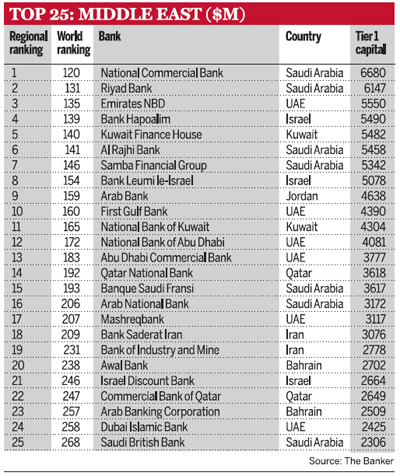
The list Top 25 Banks in the Middle East was published The Banker magazine last month. The National Commercial Bank of Saudi Arabia was the highest ranked bank in the region. But its Tier 1 capital fell 15% last year and it slipped 12 places to end at 120th spot in the world’s top  bank rankings.The second rank was also held by a Saudi Arabian bank. Saudi Arabia-based Riyad Bank doubled its Tier 1 capital in 2008 to $6.1B.

The Top 25 Banks in the Middle East:

Top-25-Middle-East-Banks

Source: The Banker

According to the magazine “The Middle Eastern banking sector has remained relatively isolated from the worst of the crisis in the financial markets, but its banks are being hit indirectly by the wider global economic downturn and plunging commodity prices, in particular oil.”

Are Too Many Financial Institutions in the U.S. the Problem?

The FDIC shutdown 4 more banks yesterday bringing the total bank failures this year 81. The failed four banks are:

Guaranty Bank of Texas
CapitalSouth Bank of Alabama
First Coweta Bank of Georgia
ebank of Georgia

Guaranty Bank is the 3rd largest bank failure this year with assets of $13 B and deposits of $12 B. Bilbao Vizcaya Argentaria (BBV) of Spain assumed control of Guaranty Bank thru its US subsidiary BBVA Compass. Commenting on the acquisition, the chairman of BBVA Compass Jose Maria Garcia Meyer,  said: “excellent strategic sense” and represents an opportunity for BBVA to expand its presence in the “high growth Sunbelt Region.”

In a Bloomberg Television interview, the analyst Meredith Whitney predicted that more than 300 banks would fail this year. This brings us to the title of my post. Yes. There are too many financial institutions in this country. All these institutions are chasing the fewer number of customers and their deposits. Some of the smaller banks may have to consolidate their operations with other branches. Other banks such as the “problem banks” may have to be closed if they continue to suffer with losses and recovery is not possible in any way.

From the FDIC’s Quarterly Banking Profile, 1Q, 2009:

“The number of FDIC-insured commercial banks and savings institutions reporting financial results declined from 8,305 to 8,246 in the first quarter.During the quarter, the number of insured banks and thrifts on the FDIC’s “Problem List” increased from 252 to 305, and total assets of “problem” institutions rose from $159 billion to $220 billion.”

There are a total number of 8,147  U.S. Credit Unions in the US (Source: CUNA).

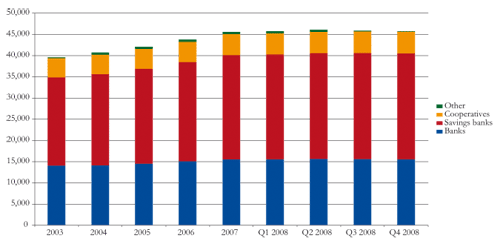
This phenomenon of having too many banks is not a problem just in the US. In Spain, Savings banks expanded too fast in the past decade and now must merge with other banks in order to survive. While most Spanish banks are run very conservatively they are still exposed to economic problems such as the growing high unemployment and the collapse of the real estate sector. The following chart shows the growth of savings banks in Spain since 2003:

Spain-Banks-Growth

Source: Euromoney

From a total of 20,871 branches at the start of the decade, savings banks in Spain expanded by more than 4,100 in the next 5 years. The two large Spanish banking giants Santander (STD) and BBVA (BBV) are not interested in acquiring some of these savings banks as they do not want domestic expansion. This is one reason why Bilbao Vizcaya Argentaria (BBV) acquired Guaranty Bank and eyes strong growth in the US markets.

One of the senior banking executive of the two large Spanish banks said:

“There are simply too many of these financial institutions. Ultimately we must reduce installed capacity.”

His statement probably holds true for US as well. Due to high profit margins a large number of banks opened in the US in the past few decades. As the economy contracts and Americans reduce consumption, some of the banks may not be needed.

Top 10 Banks in the World by Assets

BankersAlmanac.com, a site run run by the information database provider Reed Elsevier, tracks the world’s top banks based on assets.

The World’s Top 10 Banks ranked by Total Assets:

[TABLE=173]

Note: Data compiled from banks’ balance sheet information included on Bankersalmanac.com on 5th August 2009

European banks dominate the above list. Royal Bank of Scotland (RBS) ranks the number one bank in terms of assets held. Currently the British government is the largest owner of the bank and due to severe losses and conditions of government bailout, RBS stopped paying dividends. The total assets held by RBS  is more than double the size of assets held by Bank of America. Deutsche Bank (DB) has a large global presence  but now offers a low yield.

Among the large French banks, BNP Paribas fared the credit crisis better than Societe Generale. And
Societe Generale took a $7.2 B loss last year due to the rogue trader Jérôme Kerviel. US-based banks JP Moran Chase(JPM) and Bank of America(BAC) are two of the so-called “too big to fail” banks. JP Morgan Chase is in a much better shape than Bank of America. As shown above, JPM also has the highest dividend yield.

Related Post from 2008:

Top Banks of the World available as ADRs

Most Valuable Brands of Canada 2009

“Branding is about having a unique personality, a point of view and a positioning.”
David Haigh
CEO, Brand Finance plc

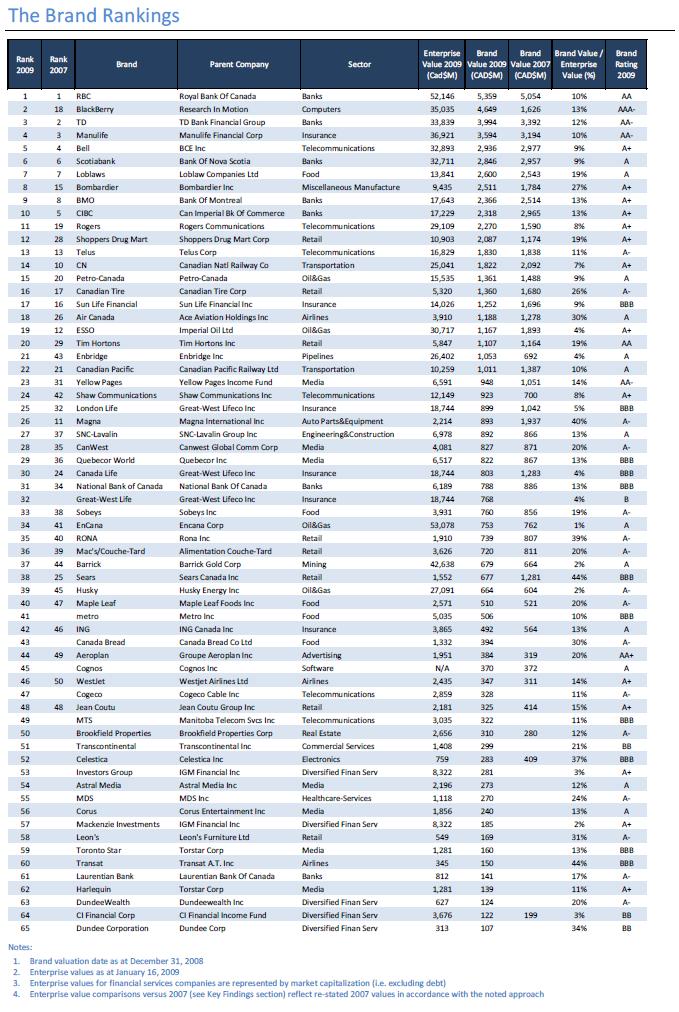
The Most Valuable Brands of Canada for 2009 were published by Brand Finance a while ago. The rankings ” represents a point-intime examination of the Canadian ‘brandscape’, including many brands who are ‘getting it right’ – and consequently are playing an increasingly important role on the global stage during these challenging times.”

Royal Bank of Canada is the top brand with an estimated brand value of almost C$5.4 B. RIM’s BlackBerry is Canada’s highly rated brand with a score of AAA-. Canada Post ranks the best among ‘Iconic’ brands. In 2009, 65 companies were included in the most valuable brands list.

The Ten Most Valuable Canadian brands are listed by rank order (ascending):

Royal Bank of Canada (RY)

Research In Motion (RIMM)
Toronto-Dominion Bank (TD)
Manulife Financial (MFC)
BCE Inc. (BCE)
Bank of Nova Scotia (BNS)
Loblaw Companies Ltd
Bombardier
Bank of Montreal (BMO)
CIBC (CM)

Mining, Oil & Gas and Banking form the top 3 sector by enterprise value in 2008. So its not surprising to see the five large banks in the list above.

To see the complete list of 65 most valuable brands click on the icon below.

Canada-Top-Brands-List-2009