Two Electric Utility ADRs of Chile

The country of Chile is a top copper producer in the world. While many banks have failed in the developed countries Chilean banks have remained stable. The economy has held up well. Recently an article in Business Week discussed about the growth of the IT industry in Chile. US companies are outsourcing their IT work to Chile since the cost of labor is cheap and the workforce is highly educated compared to other outsourcing destinations. In addition to banks and commodities, Chilean utilities hold good potential for future growth.

Two electric utilities of Chile trade in the New York Stock Exchange (NYSE). A brief overview of these two ADRs follows:

1.Enersis SA (ENI) is generates, transmits and distributes power in in Chile, Argentina, Brazil, Colombia and Peru. ENI is one of the largest private sector electricity companies in South America. Endesa of Spain is the largest shareholder in Enersis.”For the six months ended on June 30, 2009, Enersis’ Net Income was Ch$360.906 million, an increase of 46.0% with respect to the same period in 2008. This better outcome is mainly explained by the increase in energy sales and lower purchases of fuel and other operating expenses, which implied a 15.2% higher Gross Income.”

Enersis is also one of the top 10 largest traded stock in Santiago Stock Exchange in the first 6 months of this year. The current yield for ENI is 4.45%. From a low of about $10 the stock has rebounded to $18+ as of today’s close.

2.Chile-based Empresa Nacional de Electricidad SA (EOC) is another electric utility with operations in Argentina, Colombia and Peru as well. At the end of 2008, Empresa had 25 generation facilities outside of Chile.

Total revenue increased consistently for the past 5 years and the average annual dividend growth rate is 36.18%.The current dividend yield is 3.56%.

List of Surplus and Deficit Countries of Europe

One of the factors considered by investors when selecting a country for investment is the amount of deficit/surplus held by that country.Generally surplus countries are better than deficit countries.

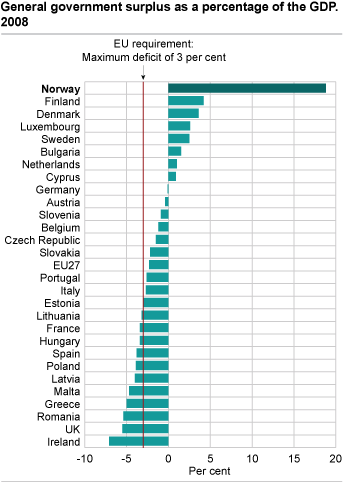
The following chart shows the general government deficit/surplus as a percentage of GDP countries in Europe as of 2008:

Surplus-Deficit-Countries-in-Europe

Source: Statistics Norway

Scandinavian countries top the ranks of surplus countries in Europe. Norway had the most surplus in Europe with about 18% of GDP followed by Finland, Denmark, Luxembourg and Sweden. The countries with the highest deficits were Ireland, UK and Romania. Deficits in Ireland and UK were more than the double of the maximum EU requirement. Many of the East European countries such as Latvia, Estonia, Lithuania have high deficits. The economy of these Baltic countries fell heavily last year during the height of the credit crunch.Similarly the British and Irish economies collapsed as well.

Related ETFs:
Global X FTSE Nordic 30 ETF (GXF)
iShares MSCI Sweden Index (EWD)
iShares MSCI Netherlands Investable Market Index (EWN)
iShares MSCI Germany Index (EWG)

Top 10 Banks of Australia by Assets, Deposits

The Top Ten Australian Banks based on Assets and Deposits as of June 2009 are listed below. This list was compiled with data from the “Monthly Banking Statistics” report released by the Australian Prudential Regulation Authority (APRA) on July 31st.The Top Ten Australian Banks by Assets

[TABLE=175]

The Top Ten Australian Banks by Deposits

[TABLE=174]

The five large banks in terms of both assets and deposits are Commonwealth Bank of Australia,National Australia Bank Limited, Westpac Banking Corporation,Australia and New Zealand Banking Group Limited and St.George Bank Limited. Assets is defined as the “Total gross loans and advances” in the APRA statistics report.Except St.George Bank, all the other four banks are also the Australia’s most valuable brands according to BrandFinance. In 2008, these four banks were in the top 10 list with National Australia Bank Limited ranked as the number one brand.

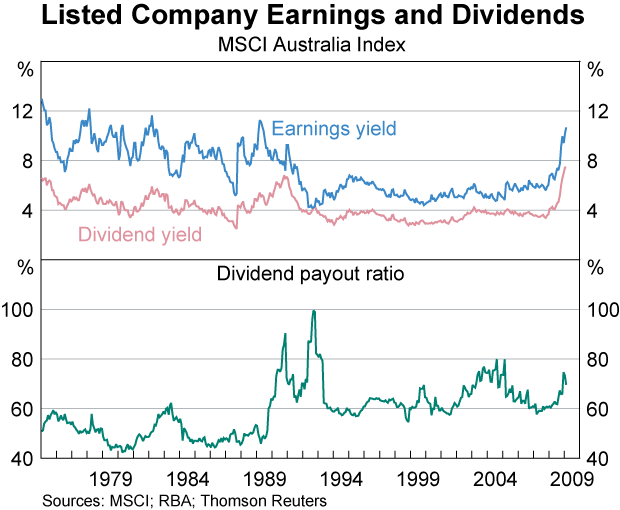
Australian companies usually have high dividend payout ratios and dividend yields as shown in the chart below:

Australia-Companies-Dividend-Yield

The current yields of the top 5 banks are shown below:

Commonwealth Bank of Australia(OTC: CMWAY)
Dividend Yield: N/A
Started trading from March this year

National Australia Bank Limited(OTC: NABZY)
Dividend Yield: 5.18%

Westpac Banking Corporation(WBK)
Dividend Yield: 4.63%

Today Westpac posted earnings of $1.1 billion in the first quarter but bad debt went up to to $865 million from $811 due to deterioration in commercial real estate and New Zealand.

Australia and New Zealand Banking Group Limited(OTC: ANZBY)
Dividend Yield: 4.57%

St.George Bank Limited(OTC:STGKY)
Dividend Yield: N/A

Australian housing market has held up well since the recession began as the demand for housing is high but the supply is down. As the domestic economy and the Asian countries recover Australian banks must do well.

Three Top Performing Financial Services Funds

In the Fund Track column Not All Bank Funds Fell Over Past Year on August 13, The Wall Street Journal highlighted three top performing financial services mutual funds. These three funds were up in the past year when most financial stocks and ETFs collapsed. Two of the funds were up more than 10% in the past year. In addition, all three funds were ahead of their peers in this sector. A brief summary of the three funds is presented below.

1. Dryden Financial Services Fund (PFSAX)
Total Assets: $139.5 M
Yield: 0.20%
Expenses: 2.19%
Foreign Stocks: 52.9% of portfolio
Performance YTD: 71.54%

The top three holdings are Canadian banks Bank of Nova Scotia (BNS), Toronto-Dominion bank (TD) and Norwegian Bank DnB NOR ASA.  The fund manager Mark Lynch said:”Canadian banks came through [the crisis] the strongest of any in the world”. The Morningstar rating for the fund is 5-stars and is the number one fund in the category. Other holdings in the portfolio include Nordea bank, BNP Paribas, Societe Generale, Itau Unibanco (ITU), Svenska Handelsbanken, etc.

2.FBR Small Cap Financial Fund (FBRSX)
Total Assets: $189.9M
Yield: 1.17%
Expenses: 1.49%
Performance YTD: 24.14%

FBR Small Cap Financial is a small cap value fund. The top 3 holdings are Webster Financial Corporation, Fifth Third Bancorp (FITB) and Astoria Financial Corporation (AF). In 2008, the fund was down just 8.7%.A few other stocks in the fund include: Glacier Bancorp (GBCI), Key Corp(KEY), First Horizon National Corporation (FHN) and Zions Bancorp (ZION).

3.Burnham Financial Services Fund (BURKX)
Total Assets: $55.0 M
Yield: 3.28%
Expenses: 1.60%
Performance YTD: 17.23%

This is a mid-cap fund with a small asset base of just $55M.  The fund has been avoiding companies that are focused on real-estate in bubble areas such as Arizona, Nevada, California and Florida.

Top holdings in the fund are JP Morgan Chase(JPM), Bank of America(BAC) and Chimera Investment Corporation(CIM). In 2008, the fund had a negative return of 14.8%.

As for the strategy about picking financial stocks in this market, David Ellison, manager of FBR Small Cap Financial Fund said “in some ways the financial sector today is “playing like biotechnology stocks. You take a chance on names that may or may not make it, but if they do make it you’ll win big.” I would agree with his opinion.Indeed most of the bank stocks have become like biotech stocks of the dot com era.Nobody knows which bank would  survive or which bank Uncle Sam would forcibly seize and offer to one of the “too-big-to-fail” banks at dirt-cheap prices. The seizure and subsequent sale of Wamu and National City are some examples.

Note: All data  is from Morningstar. Please do you own research before making any investment decisions.

Tier 1 Capital Ratios Comparison: U.S. Vs. European Banks

On August 20th, the Journal had a piece titled “At Europe’s Banks, Riskier Tack on Capital” discussing the financial strength of European and U.S.banks.

Banks in continental Europe have strengthened their finances through  “strong earnings, benign markets, dividend cuts and some asset sales”. However unlike their British and American peers, they have not increased their capital by issuance of shares. “So far this year, banks on the Continent have raised only $11.6 billion in new equity capital, compared with $48.3 billion in the U.S. and $26 billion in the U.K., according to figures from Dealogic.”

Continental European bank’s reluctance to raise new capital easily by issuing shares is good for existing shareholders. Long-term investors hate it when companies dilute their holdings by issuing new shares.

However as the article mentions, in the U.S. most banks don’t give a second-thought of issuing new shares. For example, regional bank BB&T (BBT) issued 33.5 million shares at $26 per share on August 18th raising $837.1 M. Four days before the new offering on August 14th, BB&T bought the failed Colonial Bank of Alabama.

Some other examples of share offerings include:

Suntrust (STI) – 124.3 million shares at $13.00 per share
KeyCorp (KEY) – 205.4 million shares at $4.87 per share
U.S. Bancorp (USB) – 139 million shares at $18 per share

Big banks in the U.S. have raised billions of dollars in such new share offerings. One of main reason cited by these banks to issue shares is to raise their capital levels to bring it to the levels required by the regulators that conducted the stress tests. So in a way regulators helped banks dilute the holdings of existing shareholders.

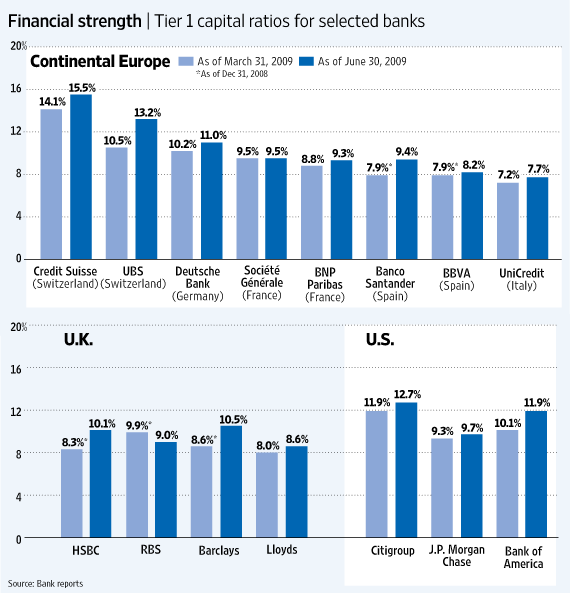
Tier 1 Capital Ratios of select US and European Banks:

Tier1-Capital-Ratios-Europe-US-Banks

Source: The Wall Street Journal

In continental Europe, Swiss-banks UBS (UBS)  and Credit Suisse(CS) have strong Tier 1 capital ratios at 13.2% and 15.5% respectively at the end of June. This is higher than the Tier1 ratios of US banks like Citibank(C), JP Morgan Chase (JPM) and Bank of America (BAC). To bring up Tier1 to at least 10%, BNP Paribas (BNPQY), BBVA(BBV) and Banco Santander(STD) and Unicredit must try to increase their earnings.