The World’s 10 Largest Non-German Auto Industry Suppliers Offer Excellent Investment Opportunities

The auto industry is one of the best industries to invest in in emerging markets or developed markets as autos have become the preferred mode of transportation for everyone. However the industry is a low margin business and many automakers are not highly profitable.Then how does one profit from this industry?

One way to profit from the growing auto business worldwide is to invest in the automotive parts suppliers.These suppliers produce everything from tires to wipers that become part of a vehicle.

Germany is one of the largest makers of world-class cars. The automotive industry is the largest in Germany employing over 723,000 workers directly and accounting for about 20% of total revenues of all the German industries. The country is also one of the top leaders in auto production with 20.4 million vehicles produced in 2009 which is equivalent to 17% of global vehicle production. About 70% all vehicles made in Germany are exported.

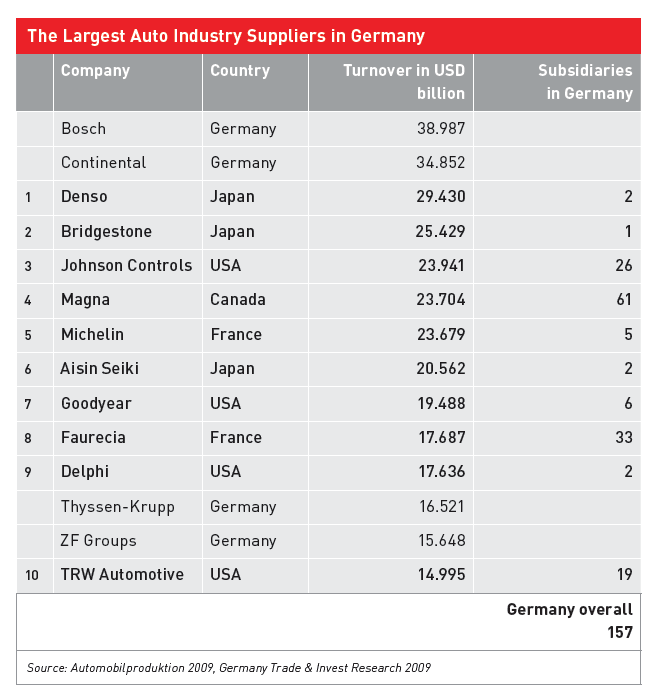
The highly successful German auto industry offers huge market opportunities for auto components suppliers. Hence in addition to thousands of small and medium-sized domestic suppliers, Germany hosts all of the ten largest auto suppliers in the world. As the value added in the industry increasingly moves to the supplier side these international suppliers play an integral part of the growth of the auto makers not just in Germany but in other countries as well.

The chart below shows the 10 largest international auto-industry suppliers in Germany:
Top-10-Non-German-Auto-Suppliers

Source: The Automotive Industry in Germany, Issue 2010/2011, Germany Trade & Invest

The following is a short overview of each of the suppliers:

1.Denso Corp (OTC:DNZOY) is headquartered in Kariya, Aichi prefecture, Japan. Denso is a leading automotive supplier of advanced technology, systems and components in the areas of thermal, powertrain control, electric, electronics and information and safety to the world’s major car makers. The company has more than 200 subsidiaries and affiliates in 34 countries (including Japan) and employs approximately 120,000 people.In the first half of fiscal year that ended in September 2010, Denso announced net sales of $19.0 billion which was a 22% increase from the previous year.In Europe, due to an increase in production volume by BMW, Ford and Land Rover, operating income totaled US$64.2 million, a 115.4 percent increase from the previous year. The ADR closed at about $18 on Friday. After a strong run, the stock split 8 for 1 in October, 2010.

2. Japan-based Bridgestone (BRDCY) operates in two segments: tire segment and diversified product segment. The tire segment is engaged in the manufacture and sale of tires.  The diversified product segment produces auto-related parts, sports products such as golf balls and golf club, etc. The stocks closed at $37.66 this past Friday.

3. Johnson Controls (JCI) provides automotive interiors, batteries for automobiles and hybrid electric vehicles, along with related systems engineering, marketing and service expertise . For buildings, the Johnson Controls offers products and services that optimize energy use.With the market cap of $27.4 billion, the company’s annual revenue has increased about 20% in the last five years.

4. Magna International Inc (MGA) is an Aurora,Ontario based diversified automotive supplier with operations in 25 countries. Magna designs and manufactures automotive systems, components mainly for sale to makers of cars and light trucks. Annual revenue has increased by about 36% in the past 5 years. Magna expects total sales to be between $25.6 billion and $27.1 billion this year.

5. Founded in 1888, French tire maker Michelin owns the Michelin, BFGoodrich, Taurus, Kormoran and Uniroyal (in North America) brands.

6. Aisin Seiki Ltds (ASEKY) is a leading Japanese manufacturer with a complete range of automotive parts. Aisin is a Fortune Global 500 company with operations in many countries.

7. Ohio-based Goodyear Tire & Rubber Company (GT) is a manufacturer of tires. In addition to manufacturing tires, the company operates 1,500 tire and auto service center outlet. Goodyear has 57 manufacturing facilities in 23 countries.

8. Faurecia SA(FURCF), is a French specialist in the engineering and production of automotive solutions. The company operates 200 production sites in 32 countries  and is Europe’s third largest automotive supplier.Annual revenues in 2009 exceeded 92 billion Euros.

9. Based in the U.S., Delphi is a leading global supplier of electronics and technologies for automotive, commercial vehicle and other market segments with operations in 30 countries. In 2009 Delphi exited from bankruptcy protection and is now a private company.

10. Headquartered in Livonia, Michigan, TRW Automotive Holding Corp (TRW) operates in 26 countries and employs over 60,000 people worldwide.TRW’s products include integrated vehicle control and driver assist systems, braking systems, steering systems, suspension systems, occupant safety systems (seat belts and airbags), electronics, engine components, fastening systems and aftermarket replacement parts and services. In 2009, sales totaled $11.6 billion.

German auto suppliers ThyssenKrupp AG and Continental AG trade on the US OTC markets under the tickers TYEKF and CTTAY respectively. A complete list of auto suppliers listed on the NYSE can be found here.

Disclosure: No Positions

Focus on the Long-Term Potential with International Investments

Investing in stocks of foreign companies offers many advantages including diversification benefits, lower correlations with home markets, etc. However investors must focus on the long-term returns of overseas investments and not try to time the markets or trade often looking to make higher returns in the short-term.

The chart below shows the annual total returns of foreign stocks during each of the past 25 years compared with the 25-year average annual total return (13.1%):

foreign-stocks-returns-by-year.PNG
Source: Standard & Poor’s. Foreign stocks are represented by the calendar-year returns of the MSCI EAFE Index. Returns shown include dividends reinvested.

In the short-term, as the chart shows there is high volatility in international investing. However over the long-term such as 25 years investors are nicely rewarded with a double-digit return.

Related ETF:
iShares MSCI EAFE Index Fund (EFA)

Disclosure: No Positions

The Top 10 Most Risky and Least Risky Countries

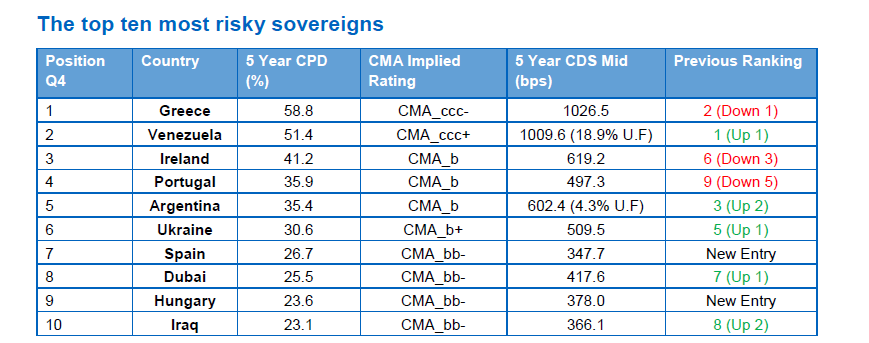
CMA, the London-based world’s leading credit default swap pricing service has published the ‘Sovereign Debt Credit Risk Report’ for Q4 2010. Sovereign debt investors will find this report extremely valuable.

The top 10 most risky countries are listed below:

Click to enlarge

Most-Risky-Countries

Greece continues be the most risky country in terms of defaulting on its obligations. Ireland and Portugal are among the top five.

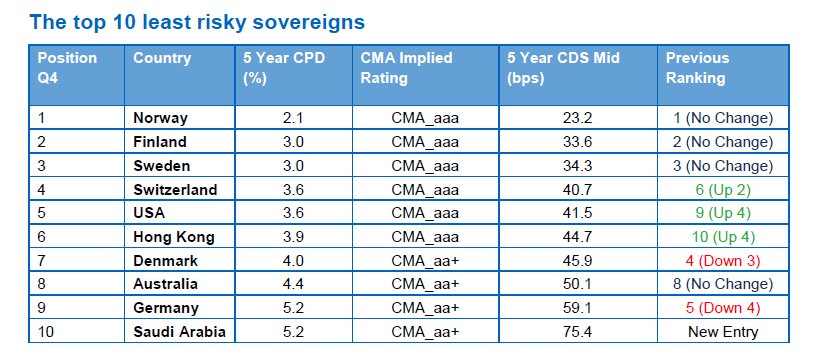
The top 10 least risky countries are listed below:

Least-Risky-Countries

Source: CMA

Norway tops this ranking followed by Finland and Sweden. Norway is a creditor country. It is interesting to note that the U.S. takes the fifth place in this list. From an investment standpoint it is a wise idea to invest in creditor countries such as the Scandinavian countries. China ranks 14th among the least risky countries. The U.S. is the world’s largest debtor country. China holds about $906.0 billion of U.S. treasury securities as of October, 2010 making it the largest creditor to the U.S.

Canadian Banks’ Stress Test Results Remain Secret

In 2009 the U.S. conducted stress tests on the largest banks in the country. The results of these tests were widely published. These tests were merely a huge PR exercise to boost confidence of the investing public in the banking system. The government succeeded in that effort as there was no widespread panic expressing doubts over the strength of the major banks and investors slowly returned to banking stocks.

Not to be left behind, the Europeans conducted their own stress tests on major European banking institutions last year. Except seven banks, all others passed these tests. Commenting on the results, The Wall Street Journal noted that these tests relied on mild assumptions.

While Europeans and Americans conducted these tests, it appeared that Canada did not perform any such testing on its major banks. However it has now been revealed that Canada also conducted these tests but did not publish the results.

From a recent story in the Financial Post:

Canada’s financial regulator has been hard at work for the past two years stress testing the banks but ordinary investors can forget about ever seeing the results, according to a senior official there.

Speaking at an investor conference in Toronto on Tuesday, Mark White, assistant Superintendent of Financial Institutions, justified the decision, saying that the Canadian bank regulator doesn’t want to get involved in what it sees as a public relations exercise.

In the aftermath of the financial crisis regulators around the world carried out stress tests on their banks and published the results. The idea was to allay fears that some banks were holding back information about losses and were not as strong as they appeared. By making the results of the tests public, regulators hoped to rebuild confidence so that the financial system could start functioning normally again.

The United States, Britain and Europe all adopted the practise — in fact, most of the developed world — but not Canada.

Other countries had legitimate reasons for trying to boost confidence in their banks because so many lenders had to be rescued by government, Mr. White said.

“We don’t believe we have that situation [in Canada],” he said.

Canadian banks emerged from the crisis mostly unscathed with none requiring direct government bailouts.

Nevertheless OSFI has been hard at work digging through bank balance sheets, trying to gauge what would happen in a range of scenarios.

Rather than relying on the banks’ own internal tests OSFI in partnership with the Bank of Canada have developed a sophisticated “macro” stress test that can be applied to all the lenders so the results can be easily compared. The work has put this country at the forefront of “macroprudential” testing, said Mr. White.

It is interesting to note that unlike their European and American peers, Canadian regulators were pro-active and conducted the stress tests on the major banks in-spite of them remaining strong during the height of the credit crisis. In addition, Canadian regulators are one step ahead of other developed countries with the development of their sophisticated “macro” stress tests.

The five largest Canadian bank stocks and their current dividend yields are listed below:

1.The Bank Of Nova Scotia (BNS)
Current Dividend Yield: 3.44%

2.Bank Of Montreal (BMO)
Current Dividend Yield: 4.80%

3.Canadian Imperial Bank of Commerce (CM)
Current Dividend Yield: 4.41%

4.Royal Bank Of Canada (RY)
Current Dividend Yield: 3.78%

5.Toronto Dominion Bank (TD)
Current Dividend Yield: 3.25%

Disclosure: Long all five stocks noted above.

Personal and Corporate Tax Income Tax Rates by Country

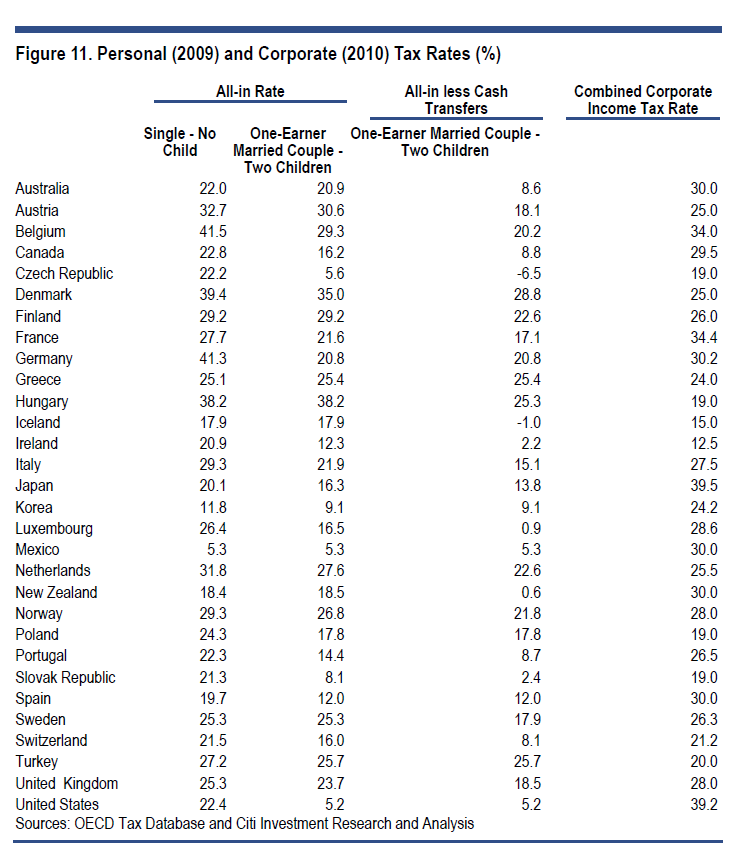
The chart below shows the Personal and Corporate Income Tax Rate for OECD countries:

Click to enlarge

Personal-Corporate-Tax-Rates-by-Country-OECD

Source: The Debt of Nations, Citigroup Global Markets

Among OECD countries, Japan has the highest corporate tax rate at 39.5%. The U.S. has the next highest rate at 39.2%. However most U.S. companies do not pay taxes at such a high rate. In fact some of them such as General Electric (GE) do not pay any tax at all due to many legal loopholes Uncle Sam allows for corporations to evade taxes. While corporations are considered as “human” according to U.S. laws they are allowed to evade taxes legally but breathing and living “real humans” will be thrown in jail if they try do the same thing. But despite the preferential treatment of corporations, some people consider the high corporate income tax rate in the U.S. as an impediment to economic growth. They would like the rate to be set at levels like other countries such as Ireland with 12.5% or even Canada or UK with rates under 30%.

Disclosure: No Positions