Withholding Tax Rates by Country for Foreign Stock Dividends

****** UPDATE ****:

For the 2021 tax rates go to: Dividend Withholding Tax Rates By Country 2021

One of the factors that investors need to consider when investing in foreign stocks is taxes since it reduces the effective rate of return on an investment. Governments of most countries try to recoup millions in taxes from dividends that are paid to foreign investors by companies located in their countries. For example, when a U.S.-based investor invests in France Telecom (FTE) ADRs, the French government will deduct 25% in taxes on all dividends paid. Hence though TEF currently has a 6.98% dividend yield, the actual yield that this investor receives will be less. However the IRS allows a foreign tax credit (filed with IRS Form #1116) to be taken using which this investor can deduct the taxes paid to the French government. This is done to avoid double taxation of dividends. There is a maximum limit to this tax credit.

A few countries do not charge any taxes on dividends paid to foreign investors. So foreign investors receive the entire dividends paid by companies based in those countries. For example, the U.K. charges no taxes on dividends paid by British companies (excluding REITS) to U.S. investors. So an investor in National Gird Plc (NGG) will receive the complete dividends paid at the current dividend yield of 4.68%.

*Companies incorporated in mainland China and listed in Shanghai and Shenzhen. These companies are quoted in Renminbi and are only available to Mainland and Qualified Foreign Institution Investors (QFII).
** Companies incorporated in mainland China and listed in Shanghai and Shenzhen. B-shares in Shanghai are traded in U.S. dollars, while B-shares in Shenzhen are traded in Hong Kong dollars. B-shares are available to mainland and foreign investors.
***Companies incorporated in mainland China and listed on the Hong Kong Stock Exchange.
^Companies incorporated in Hong Kong and listed on the Hong Kong Stock Exchange.

Source: Dow Jones Indexes, Other

Note: Please note that the above information is known to be accurate from the sources used. These rates do not apply to non-U.S. residents. Consult with a tax adviser before making any investment decisions.

Some points to remember before investing in foreign stocks:

1. Germany charges 26.4% tax on dividends only on stocks held in taxable accounts.

Update (2/23/17): Germany charges dividend withholding taxes on stocks held in any qualified retirement account such as a Roth, Traditional IRA, etc.

2. The following countries have tax-treaties with the U.S. which allows favorable treatment of dividends earned by US investors investing in those countries:

Australia, Austria, Bangladesh, Barbados, Belgium, Canada, China, Cyprus, Czech Republic, Denmark, Egypt, Estonia, Finland, France, Germany, Greece, Hungary, Iceland, India, Indonesia, Ireland, Israel, Italy, Jamaica, Japan, Kazakhstan, Korea, Latvia, Lithuania, Luxembourg, Mexico, Morocco, Netherlands, New Zealand, Norway, Pakistan, Philippines, Poland, Portugal, Romania, Russian Federation, Slovak Republic, Slovenia, South Africa, Spain, Sri Lanka, Sweden, Switzerland, Thailand, Trinidad and Tobago, Tunisia, Turkey, Ukraine, United Kingdom, and Venezuela.

Source: The IRS

Without the tax treaties U.S investors will pay higher taxes. The Netherlands has a statutory tax rate of 25%. But due to the special tax treaty with the U.S., American investors in Dutch companies are charged only 15% as shown in the table above.

3.  It is generally not advisable to hold foreign dividend-paying ADRs in IRAs and other non-taxable accounts since one cannot recover the taxes paid to a foreign country.

4. Canada charges a 15% tax on dividends held in non-taxable accounts. But due to a policy change in 2009, dividends and interest income are exempt from this 15% tax if the investments are held in IRA or 401(K) accounts. So U.S. investors can hold Canadian banks such as bank of Novo Scotia (BNS), Royal Bank of Canada(RY) or other dividend-paying stocks like Enbridge (ENB)  in their IRAs for the long-term without worrying about taxes on dividends.

5. Though the above table shows that Chile has a 35% withholding tax rate, in my personal accounts the depository has deducted only about 22% in taxes on my Chilean dividends. This could be due to any recent change in Chilean tax laws.

For more information about U.S. tax treaties with other countries refer to the Publication 901 on the IRS web site.

Click to download:

  1. Withholding Tax Rates by Country (as of Feb, 2013) document in pdf (Source: Dow Jones Indexes).
  2. Withholding Tax Rates by Country (as of March, 2012) document in pdf (Source: Dow Jones Indexes).
  3. Withholding Tax Rates by Country (as of Sept, 2010) document in pdf (Source: Dow Jones Indexes).

Also checkout:

Disclosure: Long BNS, RY

Small Investors and the U.S. Equity Market

Jason Zweig wrote an interesting piece titled “Will Small Investors Ever Warm Up to Stocks Again?” in The Intelligent Investor column of The Wall Street Journal. From the article:

For millions of Americans, spare cash is a lot scarcer than it was in the days when unemployment ran at 6% and home-equity loans made houses ring like cash registers. “Those [money managers] who have been buying are looking for the greater fool to take them out, and the greater fool has always been the little guy,” says Charles Biderman, TrimTabs’ chief executive. “But maybe the little guy doesn’t have the money this time to play the greater fool.”

It has been ages since stocks nearly doubled and investors didn’t give a darn. In early 1948—nearly two decades after the Crash of 1929—the Federal Reserve surveyed 3,500 investors nationwide about their attitudes toward stocks. Only 5% were willing to invest in equities, and 62% were opposed. Asked why, 26% said stocks were “not safe” or “a gamble.” Just 4% felt that stocks offered a “satisfactory” return.

Even after stocks had doubled over the preceding five years, the wounds of the Great Crash still hadn’t healed.

It could be a long slog, again, before today’s small investors forgive the market for the pain it inflicted on them. After the 2008-09 bear market and the flash crash of May 6, 2010, when the Dow dropped 583 points in roughly five minutes, “a lot of people have said, ‘Never again,'” says Morningstar analyst Kevin McDevitt.

I think when comparing the small investor’s apathy towards the stocks market in 1930s and 40s and now one has to take into consideration several other factors that Jason did not include in his article. While it took a few decades back then for small investors to be attracted to stocks again, investors today may have no choice but to return to the equity markets since they are the only “game in town” that can earn decent returns compared to other investments. They returned in droves to the market after the dot-com crash.

For example, the 1-year and 5-year returns on bank CDs are a puny 1.03% and 2.27% according to the latest Bankrate data. Similarly U.S. treasury bonds yield 0% and 2.125% on the 1-year and 5-year bonds. These yields are nowhere near what investors expect in order to keep up with price increases of many goods and services. Prices of basic necessities such as food, gasoline, healthcare, banking and others have increased in recent months. At the same time it must be noted that the average wage of U.S. workers in the private sector has been flat to down for many decades.Workers in the public sector have not been affected as much by these increases since they get cost living allowances in addition to higher pay and other luxurious benefits.

Another factor that we need to consider is how people save for retirement. In the 1930s and 1940s the majority of workers were covered by pensions paid by their employers. That is not true today. Most U.S. companies have eliminated the usual pensions and replaced them with defined contribution plans involving 401-K and other retirement vehicles. Hence workers have no other option to save for retirement other to sign up with one of the 401-K and other plans. These plans invest their funds in equities mostly. Though they also have options to invest in bond funds, most of the funds go into equities as companies push equity funds offered by their 401K providers. Small investors may switch to bond funds in the short-term but they will return to equities as the returns become appealing when the market takes off and investors desire above-average returns.

22 Stocks to Profit from Emerging Market Consumer Sector Growth

Last year many of the emerging and frontier markets were the best performers in equity returns. However that is not the case this year. Year-to-date China’s Shanghai Composite, India’s Sensex, Brazil’s Bovespa, Mexico’s IPC All-Share, Chile’s Santiago IPSA are all down 3.3%, 7.3%, 0.2%, 3.2% and 1.1% respectively.But many developed markets are up nicely. The YTD returns of the S&P, DAX, CAC 40 and Spain’s IBEX 35 are 2.0%, 2.1%, 5.6% and 9.8% respectively. Some of the reasons for the poor performance of emerging markets are soaring inflation, rising interest rates, regulators clamping down on rampant speculation in equity markets, etc. In addition to emerging markets, frontier markets are also falling this year. Big crashes in Bangladesh shares have triggered wide-spread protests there.

Considering the facts above, should investors completely avoid emerging and frontier markets this year?. Absolutely not. Though the markets are falling in the short-term there are plenty of opportunities for the long-term investor. The consumer sector is one of the key areas that investors can focus on to invest in these markets. Consumption of goods and services is growing sharply in India, China, Brazil, Kenya, Nigeria, etc. A recent study by HSBC and Standard Chartered predicts that the share of global output for emerging economies is likely to grow while that of the U.S. and Europe will fall in the coming years. Accordingly, the GDP per capita for those countries is projected to increase faster than developed markets in the next 20 years with China’s per capita GDP rising over 220% (Source: Bloomberg BusinessWeek).

From an article in the Financial Post:

Rising disposable incomes, high savings rates and low credit penetration have made the emerging market consumer one of the most attractive themes for investors in recent years.

Since emerging markets are only at the beginning of their consumer credit cycle, the strong consumption growth witnessed during the past 20 years should continue to for some time.

While the population of emerging markets is more than 3.9 billion people – more than 80% of the global population – the market cap of consumer stocks in emerging markets is just US$500-billion, according to strategists at Bank of America Merrill Lynch. That compares to a market cap of US$4.7-trillion for consumer companies in the United States, Europe and Japan.

“Simply put, there is far more liquidity in the developed market consumer stocks,” they said.

One way to profit from the growth in consumer sector in emerging markets is to invest in developed market companies with high exposure to emerging markets.  The strategists at BofA Merrill Lynch identified the following 22 large-cap companies that generated at least 30% of their 2009 sales from emerging markets:

[TABLE=873]

The majority of the companies in the list are US-based multinationals. German firms Henkel and Adidas have strong brands that are popular in developing countries. European giants Unilever, Nestle, Danone, Heineken are highly successful companies with a portfolio of brands that hold leadership positions across the globe. Switzerland-based Nestle (NSRGY) is a perfect example with a history of innovation and conservative growth .Overall, with the exception of Swatch Group all the companies noted above sell high-quality, affordable consumer products that are in high demand in developing countries. Hence investors looking to gain exposure to emerging markets can add these consumer sector stocks selectively before adding stocks from other sectors.

Disclosure: Long Henkel

Knowledge is Power: Oil Price, Top Canadian Stocks, Microcredit Edition

Six golden rules for profitable investing

Union Membership in U.S. Fell to a 70-Year Low Last Year

Oil price to break $200, says Jim Rogers

Gold’s steel grip on buyers

Bank on dividend compounding

Top 200 Canadian stocks 2011

Emerging Africa Expected To See Rise in Investment

Economy: Well functioning housing markets are key for stability and growth

DRs: BRIC Countries To Lead DRs in 2011

Equities focus shifts back to U.S.

What’s gone wrong with microcredit?

Reunion-Island

Reunion Island, Indian Ocean


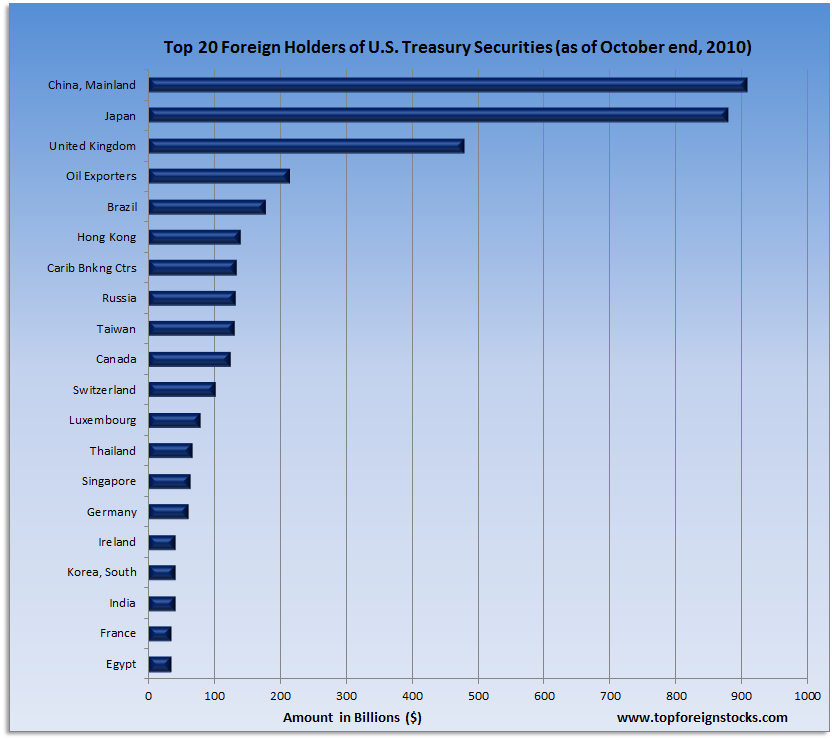
The Top 20 Foreign Holders of U.S. Treasury Securities

The graphic below shows the top 20 foreign holders of U.S. Treasury Securities at the end of October, 2010:

Click to enlarge

Top-20-Foreign-Holders-US-Debt

Source: Department of the Treasury/Federal Reserve Board

Note:
United Kingdom includes Channel Islands and Isle of Man.

Oil exporters include Ecuador, Venezuela, Indonesia, Bahrain, Iran, Iraq, Kuwait, Oman, Qatar, Saudi Arabia,the United Arab Emirates, Algeria, Gabon, Libya, and Nigeria.

Caribbean Banking Centers include Bahamas, Bermuda, Cayman Islands, Netherlands Antilles and Panama.Beginning with new series for June 2006, also includes British Virgin Islands.

Holdings represent U.S. Treasury marketable and non-marketable bills, bonds, and notes. China continues to be the largest holder of U.S. treasury debt followed by Japan and UK. Japan has increased its holdings from $742 billion in October 2009 to $877 billion in October 2010. The UK has more than tripled its US treasury debt holdings from over a year ago.

The total U.S. debt held by foreign countries jumped from about $3.5 Trillion in October 2009 to $4.3 Trillion in October last year. It must be noted however the data above denotes only the debt held by foreigners. The majority of the total outstanding U.S. debt is still held by the American public.