The Top 10 Most Risky and Least Risky Countries

CMA, the London-based world’s leading credit default swap pricing service has published the ‘Sovereign Debt Credit Risk Report’ for Q4 2010. Sovereign debt investors will find this report extremely valuable.

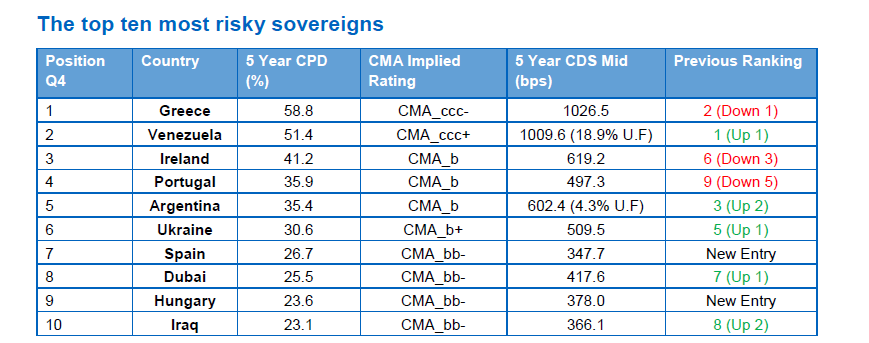
The top 10 most risky countries are listed below:

Click to enlarge
Most-Risky-Countries

Greece continues be the most risky country in terms of defaulting on its obligations. Ireland and Portugal are among the top five.

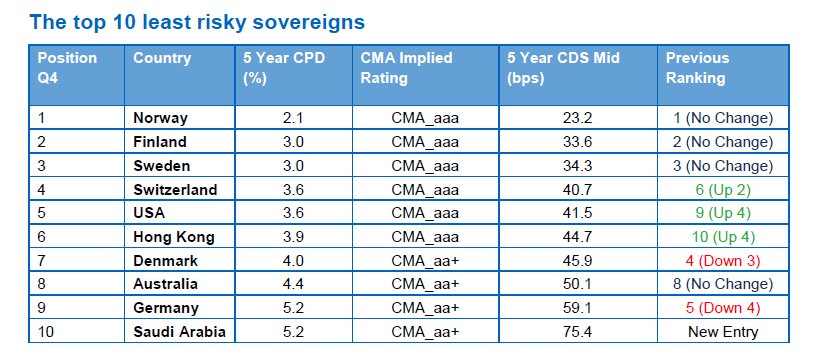
The top 10 least risky countries are listed below:
Least-Risky-Countries

Source: CMA

Norway tops this ranking followed by Finland and Sweden. Norway is a creditor country. It is interesting to note that the U.S. takes the fifth place in this list. From an investment standpoint it is a wise idea to invest in creditor countries such as the Scandinavian countries. China ranks 14th among the least risky countries. The U.S. is the world’s largest debtor country. China holds about $906.0 billion of U.S. treasury securities as of October, 2010 making it the largest creditor to the U.S.
Canadian Banks’ Stress Test Results Remain Secret

In 2009 the U.S. conducted stress tests on the largest banks in the country. The results of these tests were widely published. These tests were merely a huge PR exercise to boost confidence of the investing public in the banking system. The government succeeded in that effort as there was no widespread panic expressing doubts over the strength of the major banks and investors slowly returned to banking stocks.

Not to be left behind, the Europeans conducted their own stress tests on major European banking institutions last year. Except seven banks, all others passed these tests. Commenting on the results, The Wall Street Journal noted that these tests relied on mild assumptions.

While Europeans and Americans conducted these tests, it appeared that Canada did not perform any such testing on its major banks. However it has now been revealed that Canada also conducted these tests but did not publish the results.

From a recent story in the Financial Post:

Canada’s financial regulator has been hard at work for the past two years stress testing the banks but ordinary investors can forget about ever seeing the results, according to a senior official there.

Speaking at an investor conference in Toronto on Tuesday, Mark White, assistant Superintendent of Financial Institutions, justified the decision, saying that the Canadian bank regulator doesn’t want to get involved in what it sees as a public relations exercise.

In the aftermath of the financial crisis regulators around the world carried out stress tests on their banks and published the results. The idea was to allay fears that some banks were holding back information about losses and were not as strong as they appeared. By making the results of the tests public, regulators hoped to rebuild confidence so that the financial system could start functioning normally again.

The United States, Britain and Europe all adopted the practise — in fact, most of the developed world — but not Canada.

Other countries had legitimate reasons for trying to boost confidence in their banks because so many lenders had to be rescued by government, Mr. White said.

“We don’t believe we have that situation [in Canada],” he said.

Canadian banks emerged from the crisis mostly unscathed with none requiring direct government bailouts.

Nevertheless OSFI has been hard at work digging through bank balance sheets, trying to gauge what would happen in a range of scenarios.

Rather than relying on the banks’ own internal tests OSFI in partnership with the Bank of Canada have developed a sophisticated “macro” stress test that can be applied to all the lenders so the results can be easily compared. The work has put this country at the forefront of “macroprudential” testing, said Mr. White.

It is interesting to note that unlike their European and American peers, Canadian regulators were pro-active and conducted the stress tests on the major banks in-spite of them remaining strong during the height of the credit crisis. In addition, Canadian regulators are one step ahead of other developed countries with the development of their sophisticated “macro” stress tests.

The five largest Canadian bank stocks and their current dividend yields are listed below:

1.The Bank Of Nova Scotia (BNS)
Current Dividend Yield: 3.44%

2.Bank Of Montreal (BMO)
Current Dividend Yield: 4.80%

3.Canadian Imperial Bank of Commerce (CM)
Current Dividend Yield: 4.41%

4.Royal Bank Of Canada (RY)
Current Dividend Yield: 3.78%

5.Toronto Dominion Bank (TD)
Current Dividend Yield: 3.25%

Disclosure: Long all five stocks noted above.

Personal and Corporate Tax Income Tax Rates by Country

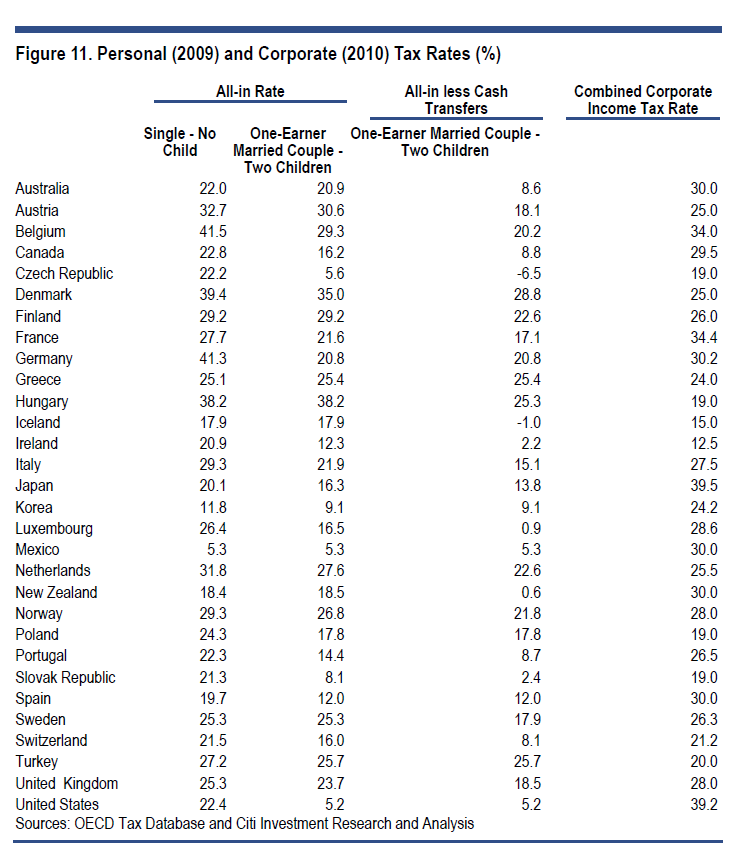
The chart below shows the Personal and Corporate Income Tax Rate for OECD countries:

Click to enlarge

Personal-Corporate-Tax-Rates-by-Country-OECD

Source: The Debt of Nations, Citigroup Global Markets

Among OECD countries, Japan has the highest corporate tax rate at 39.5%. The U.S. has the next highest rate at 39.2%. However most U.S. companies do not pay taxes at such a high rate. In fact some of them such as General Electric (GE) do not pay any tax at all due to many legal loopholes Uncle Sam allows for corporations to evade taxes. While corporations are considered as “human” according to U.S. laws they are allowed to evade taxes legally but breathing and living “real humans” will be thrown in jail if they try do the same thing. But despite the preferential treatment of corporations, some people consider the high corporate income tax rate in the U.S. as an impediment to economic growth. They would like the rate to be set at levels like other countries such as Ireland with 12.5% or even Canada or UK with rates under 30%.

Disclosure: No Positions

World Economic Forum: Global Risks 2011

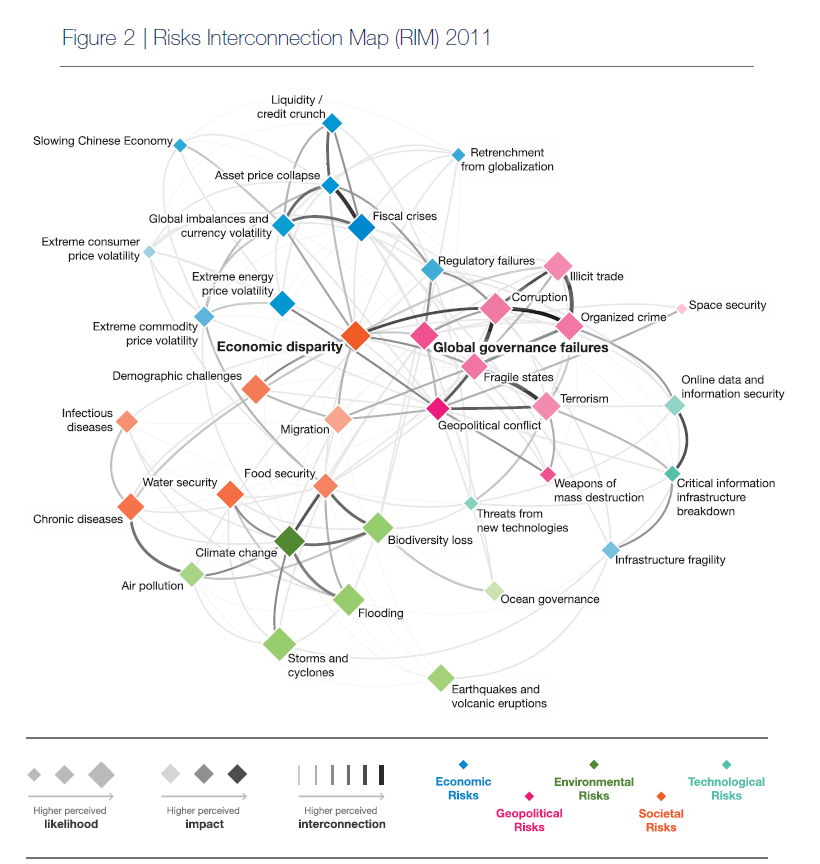
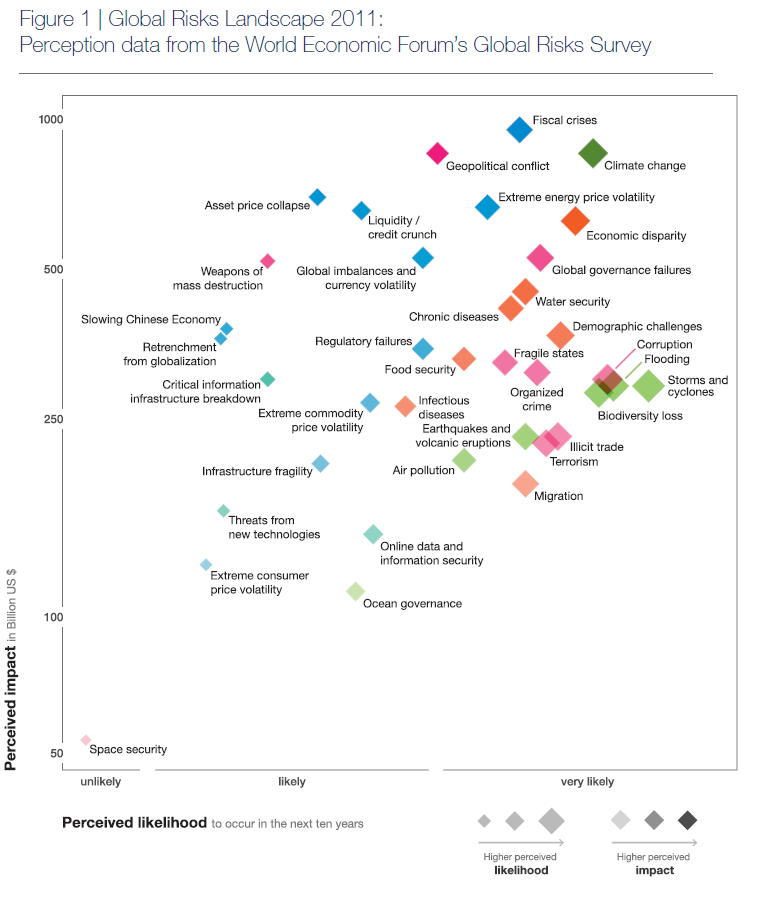
The prestigious Switzerland-based World Economic Forum has published the Global Risks 2011 report. The graphic below shows the top global risks in 2011:

Click to enlarge

WEF-Global-Risks-2011
The top 10 risks by likelihood and impact combined are listed in ranked order below:

  1. Climate change
  2. Fiscal crises
  3. Economic disparity
  4. Global governance failures
  5. Extreme weather events
  6. Extreme energy price volatility
  7. Geopolitical conflict
  8. Corruption
  9. Flooding
  10. Water security

The graphic below shows the interconnection between various risks:

Click to enlarge

Risks-interconnection-Map

Source: World Economic Forum

Bill Miller: U.S. Stocks Are Attractive Based On Valuation

Legg Mason Capital Management’s chairman and chief investment officer Bill Miller believes that currently U.S. stocks are cheap based on valuation and prices. He thinks the S&P 500 could rise as much as 15% this year. He advises investors to take advantage of U.S. stocks especially those in the large-cap market.

For this year, Miller’s favorite areas are: financials, healthcare and technology. From a report in Trustnet:

Miller thinks that investors need to bite the bullet and increase their exposure to US equities before they miss out on attractive valuations.

He explained: “Ironically, most investors wait for reassurance in the form of higher prices as the green light to invest. We believe now is the time to for investors to focus on the valuation and prices available in the US.”

He says that the state of the US economy is far more promising than many give it credit.

“Profit margins are at record levels, and corporate balance sheets are very strong, yet stocks languish below where they were in late August 2008, and that was hardly a bull market,” he said.

“The economy is expanding, liquidity is ample, inflation is under control, corporate profits are growing and are set to pass their all time high, nominal GDP is at its all time high and real GDP will have fully recovered to its all time high within a quarter.”

Miller says that financials are especially cheap at current levels. He believes that they will be a key driver of incremental growth over the next 12 months and could drive as much as 25% of the earnings for the S&P 500. The Legg Mason US Equity Fund has 25% of portfolio assets in financials with Capital One (COF) and Citigroup(C) among the top 10 holdings.

Source: via Trustnet

I agree with Bill’s thoughts. Some of the U.S. banks are attractive at current prices and investors can add them selectively. Large U.S. banks are in a much better than their European peers. Last year the KBW Bank Index outperformed the Euro Stoxx Banks Index. With most of the U.S. banks in solid footing and with some expected to raise dividends they should outperform this year as well. However I would not allocate 25% of a portfolio’s assets to financials.

Some U.S. large-caps with high exposure to emerging markets are listed here.

Related ETFs:
SPDR S&P 500 ETF (SPY)
iShares S&P 500 Index Fund (IVV)
SPDR KBW Bank ETF (KBE)

Disclosure: No Positions