Credit Suisse Global Investment Returns Yearbook 2011: A Review

The Credit Suisse Global Investment Returns Yearbook is the definitive record on long-run market returns. The 2011 edition provides 111 years of data on market returns in 19 countries from 1900 to date. These 19 countries represent 90% of the global stock market value. The following are two of the takeaways from this report:

1. The chart below shows that the US yield gap was mostly positive (i.e. equities yielded more than long bonds) until the mid-1950s, while since then it has been mostly negative. The main reason for this has been inflation and inflationary expectations.
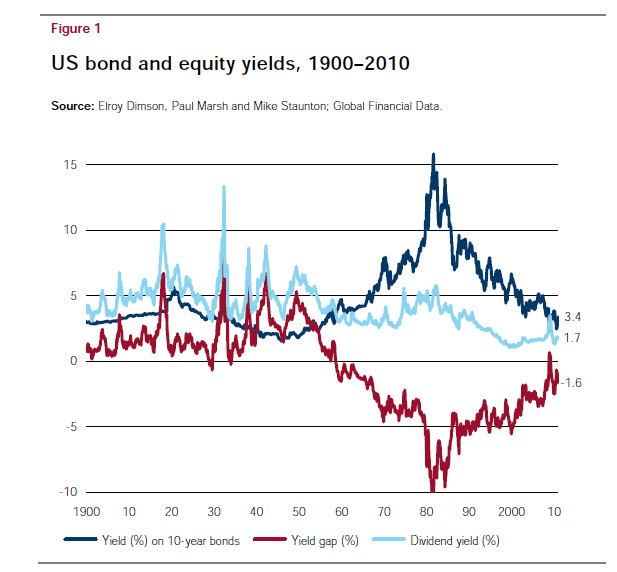
us-bond-equity-yields.png

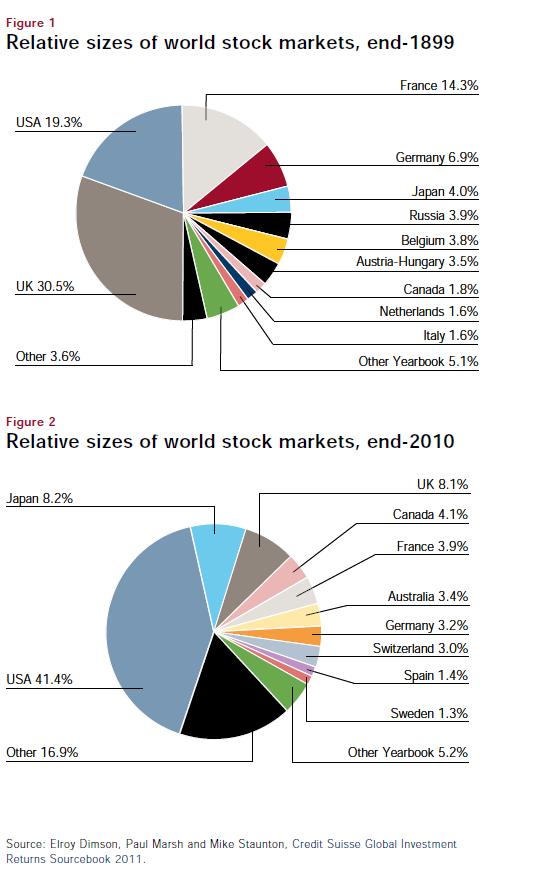
2.The following figure shows the relative sizes of world equity markets at the end of 1899 and how they had changed by end-2010.
world-market-value-1900-2010.jpg

This year’s yearbook is filled with many other interesting facts. To download the complete report in pdf format click:  Credit Suisse Global Investment Returns Yearbook 2011.
Sharp Sell-off Presents Opportunities in Uranium and Utility Stocks

In the past few days uranium and some utility stocks have seen a sharp sell-off due to fears of radiation from the quake-stricken nuclear power plants in Japan. However today the radiation level fell in the immediate zone of the plants. Paranoia about this situation turning into a Chernobyl-type disaster is just scare-mongering. In addition, it is “unlikely that any radiation capable of causing harm to people will be left in atmosphere after seven days and 2,000-plus miles of travel distance, says a forecast of trajectories of radioactive emissions/fallout from Japan given by the US National Oceanographic and Atmospheric Administration (NOAA).”(emphasis added)

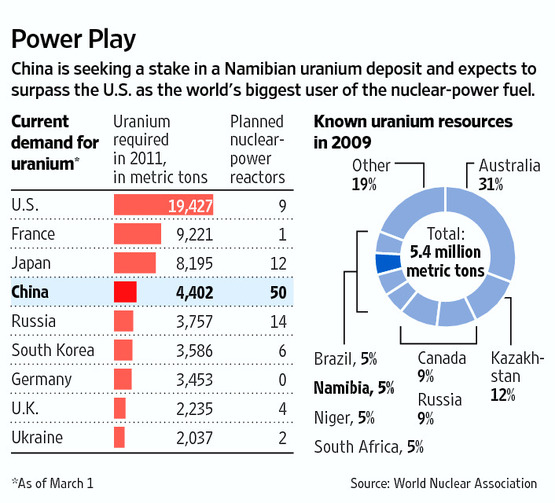
Rising demand for electricity is forcing many countries such as China to turn to nuclear power generation. From a recent Journal article:

nuclear-power-top-countries.jpg

Qian Zhimin, deputy director of China’s National Energy Administration, said China’s planned construction of dozens of nuclear reactors in the next decade meant that it would overtake the U.S. in terms of uranium use.

“It is a question of time. We will not have to wait long for it to be true. It should happen some time before 2030,” he told the China Daily newspaper.

The China Nuclear Energy Association said last year that China planned to build at least 60 reactors by 2020, with each requiring 400 metric tons of uranium to start operating. China already has 13 working civil nuclear reactors with a combined annual capacity of 10.8 gigawatts.

From a related piece in the Financial Post:

The consensus among industry experts is that the uranium price could come under significant pressure as the issue of nuclear safety rises back to the forefront. But the odds are against a meaningful slowdown in nuclear construction.

The simple reason is China, which has huge power requirements and needs more nuclear energy. China has the most ambitious nuclear development plans of any country, with 27 reactors under construction and another 160 in the planning stages, according to the World Nuclear Association.

“Half of the [uranium demand] growth over the next 10 years is all coming from China,” said Orest Wowkodaw, an analyst at Canaccord Genuity. “And I don’t see this [emergency] changing their energy policy.”

The impact could be more pronounced elsewhere, experts said. Marshall Auerback, a director of Pin-etree Capital Ltd., which runs Toronto-based Mega Uranium Ltd., said the Japanese disaster could lead to a slowdown in the permitting process for new reactors in the United States and other countries where nuclear power is a sensitive issue. However, he sees little chance that this will hinder demand in a major way.

Germany’s Chancellor Angela Merkel has announced the temporary shutdown of seven of the 17 nuclear plants for safety checks. But most consider it as a calculated political move to gain votes in the upcoming regional elections. In the neighboring country of France nuclear power plants generate the majority of the electricity. Though politicians may play into the public’s anxiety now nuclear power will continue to play a role in meeting the energy demands of many countries.

How to profit from the current sell-off?

In the uranium mining space, some of the producers are Canada-based Cameco Corp(CCJ) and Denison Mines Corp (DNN), USEC Inc (USU), Uranium Energy Corp (UEC), BHP (BHP), Rio Tinto (RTP),France’s Areva(ARVCY), Russia’s ARMZ and Kazatomprom. The Global X Uranium ETF(URA) offers a simple and easy way to invest in many of the uranium companies.

Among the utilities that operate nuclear reactors are Germany’s E.ON AG(EONGY) and RWE AG (RWEOY), Spain’s Iberdrola SA (IBDRY), France’s GDF Suez SA (GDFZY) and Electricite de France SA (ECIFY).Long-term investors looking to gain exposure to European utility stocks can add some of these companies at current levels. An added benefit is that most of these firm have excellent dividend yields.

Disclosure: Long EONGY, GDFZY

Which U.S. Banks Are Growing Revenues?

Some investors are completely avoiding stocks in the U.S. banking sector due to the recent credit crisis and the continuing failure of banks on a weekly basis. While there are many known unknowns with this industry such as further writedowns of real-estate loan losses, plenty of opportunities abound for astute investors. With thousands of banks operating in the country and hundreds of them publicly-traded, the universe for finding suitable candidates for investment is large. In general, for most of the banks the worst is behind them.

One way of evaluating banks in the current environment is to look for banks that are growing their revenues. Well-capitalized local and regional banks are attracting customers in droves from the other banks especially from the Too-Big-To-Fail banks such as Bank of America(BAC), Citibank (C), Wells Fargo(WFC), JPMorgan Chase (JPM), etc. where customer service is poor and aggressive business practices are the norm.

A recent article in the Bank Director magazine discussed about banks that are growing revenues. The article notes that the secret to growing revenues is that there is no secret. All it takes is hard work and a little bit of creativity. Most of the major banks lack this trait and instead depend on trading, reckless lending and other easy ways to earn quick profits. The unquestionable faith of Uncle Sam in propping up these giant banks even in the event of failure is an additional incentive for these banks to not perform hard work.

From the article titled “Who Says Banks Can’t Grow Revenues?“:

Banks with a strong revenue-growth story are indeed rare. Only 87 out of 504 publicly-traded banks were able to grow operating revenues by 20 percent or more over four linked quarters ending June 30, 2010, according to a list compiled by Sandler O’Neill + Partners in New York, based on data provided by SNL Financial in Charlottesville, Virginia.

Sandler looked at a universe of roughly 500 publicly traded banks. The firm defines revenue as net interest income plus noninterest income, less gains from sales of securities and nonrecurring events. Using this definition, revenues for the industry as a whole were $166 billion in the second quarter, down from $172 billion a year earlier, according data from the Federal Deposit Insurance Corp. in Washington DC.

The top 100 revenue growers were primarily banks with $10 billion in assets or less. Only one bank with more than $100 billion in assets made the top 100: McLean, Virginia-based Capital One Corp., which placed 32nd with revenue growth for the period of 37 percent. The company benefited from the high spreads it gets from its $62-billion-asset credit card portfolio, and also from low-cost deposits in its retail branches.

Large banks with a big retail presence have had a tough time of it, with few generating any meaningful growth. Retail banking is facing a strong headwind, caused in part by recent developments such as higher FDIC premium assessments, new government restrictions on debit card charges for overdrafts and limits on how banks can charge fees for credit card customers.

Some of the revenue-growing banks mentioned in the article are:

1.Bank: Umpqua Holdings Corporation (UMPQ)
Current Dividend Yield: 1.82%
Operating Locations: Based in Portland,Oregon with operations throughout Oregon, northern California, and Washington.

2.Bank: Texas Capital Bancshares (TCBI)
Current Dividend Yield: N/A
Operating Locations: Based in Dallas, Texas with operations in Dallas, Houston, Fort Worth, Austin, and San Antonio.

3.Bank: First Niagara Financial Group Inc. (FNFG)
Current Dividend Yield: 4.58%
Operating Locations: Based in Buffalo,NY with operations in Upstate New York and western Pennsylvania.

4.Bank: Herald National Bank (HNB)
Current Dividend Yield: N/A
Operating Locations: New York City-based with operations in Brooklyn and Melville, New York.

5.Bank: U.S. Bancorp (USB)
Current Dividend Yield: 0.74%
Operating Locations: Based in Minneapolis, MN with 3,013 branches in the mid-west.

6.Bank: M&T Bank Corp. (MTB)
Current Dividend Yield: 3.19%
Operating Locations: Based in Buffalo, New York with operations in New York State, Pennsylvania, Maryland, Delaware, New Jersey, Virginia, West Virginia, and the District of Columbia, as well as a branch in George Town, Cayman Islands.

7.Bank: Beneficial Mutual Bancorp Inc. (BNCL)
Current Dividend Yield: N/A
Operating Locations: Based in Philadelphia, Pennsylvania with operations in greater Philadelphia and South Jersey regions.

Some of these strong banks mentioned above are already buying weaker banks on the cheap in order to expand their footprint.In August, 2010 First Niagara announced the acquisition of NewAlliance Bancshares of New Haven, Connecticut. And in November Buffalo,NY-based M&T Bancorp. announced the acquisition of beleaguered Delaware-based Wilmington Trust Corp.and the purchase of Randallstown, Maryland-based K Bank from the FDIC.

Note: Dividend yields noted above are as of March 11, 2011.

Disclosure: Long USB

Latin America’s Long-Term Growth Remains Intact

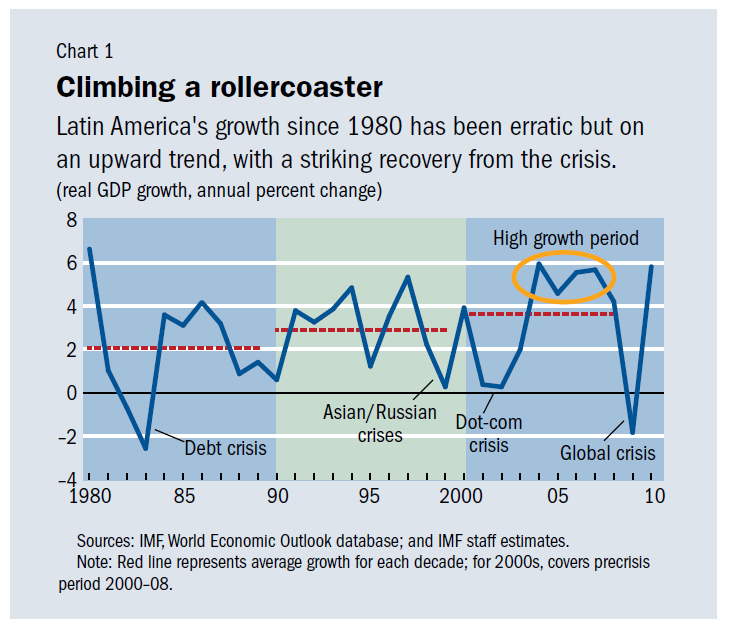
Before the credit crisis struck Latin American markets were the hottest destination for foreign investors. However in recent months Latin American countries such as Brazil, Argentina, Mexico, etc. have been lagging other emerging markets in terms of equity market performance. The economies of Latin American countries were relatively unscathed by the recent financial crisis and rebounded strongly from the depth of the crisis as shown in the graphic below:

latam-econ-growth.png

Source: Finance & Development, March 2011, IMF

In the past, Latin America has gone thru many boom and busts. But overall the economic growth remains intact and is heading in the right direction. In recent years, the soaring global demand for commodities and low interest rates worldwide have tremendously helped the export-driven countries such as Brazil. As a result of the growing exports and rising domestic consumer market, the long-term potential for the region’s economic success is promising. Some of the reasons for this optimism include improved government finances, reduced external debt, higher international reserves and strengthened financial regulation in the past few years. In addition, income distribution has improved and poverty rates have fallen across the region leading to the creation of millions of new middle-class consumers.

Ten stock picks to profit from Latin America’s surging growth:

1.Company: Ecopetrol (EC)
Current Dividend Yield: 2.90%
Sector: Oil
Country: Colombia

2.Company: Vale SA (VALE)
Current Dividend Yield: N/A
Sector: Mining
Country: Brazil

3.Company: Itau Unibanco (ITUB)
Current Dividend Yield: 0.40%
Sector: Banking
Country: Brazil

4.Company: Pampa Anergia (PAM)
Current Dividend Yield: 0.53%
Sector: Electric Utility
Country: Argentina

5.Company: Enersis (ENI)
Current Dividend Yield: 14.18%
Sector: Electric Utility
Country: Chile

6.Company: Compania de Minas Buenaventura (BVN)
Current Dividend Yield: 0.74%
Sector: Mining
Country: Peru

7.Company: Coca-Cola Femsa (KOF)
Current Dividend Yield: 1.48%
Sector: Beverages
Country: Mexico

8.Company: Banco Santander Chile (SAN)
Current Dividend Yield: 3.40%
Sector: Banking
Country: Chile

9.Company: Creditcorp (BAP)
Current Dividend Yield: 1.82%
Sector: Banking
Country: Peru

10.Company: Gafisa (GFA)
Current Dividend Yield: N/A
Sector: Household Goods and Home Construction
Country: Brazil

Disclosure: Long ITUB

Is the U.S. Corporate Tax System A Major Barrier to Economic Growth?

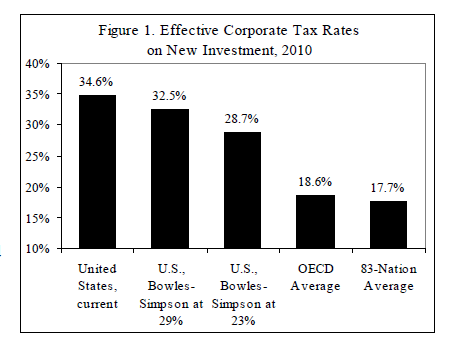
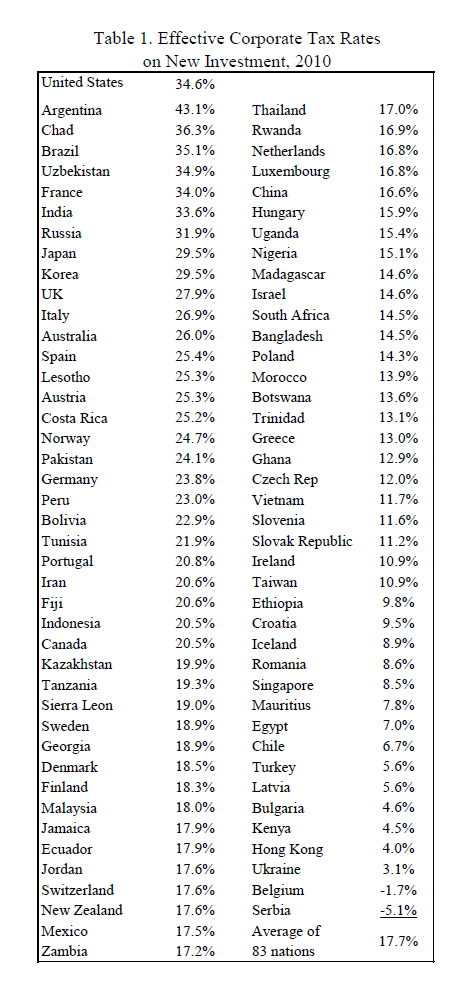
The U.S. has one of the highest corporate tax rates in the world. Only Brazil, Uzbekistan, Chad and Argentina have higher corporate tax rates than the U.S. According to a research study by the Cato Institute, the effective U.S. corporate tax on new investment was 34.6% in 2010. This was higher than the average OECD rate of 18.6% and the average rate for 83 countries at 17.7% as shown in the chart below:

US-OECD-Effective-Corp-tax-Rate

The table below lists the corporate tax rates on new investments by country:

Corporate-tax-Rates-by-Country-2010

From the research report:

Many industrial and emerging countries have reduced their corporate tax rates over the last decade or so. The largest rate cuts were in Austria, Bulgaria, Canada, the Czech Republic, Germany, Greece, Iceland, Ireland, Italy, Netherlands, Poland, Slovakia, Turkey, Egypt, Georgia,Kazakhstan, Lesotho, Mauritius, and Singapore. America’s largest trading partner, Canada, cut its statutory corporate rate from 43 percent to 29 percent, which helped to bring down its effective rate from 44 percent to 21 percent,  according to our calculations. Substantial cuts were also achieved in Australia, Belgium, China, Denmark, Finland, Korea, Luxembourg, Mexico, New Zealand, Taiwan, and the United Kingdom. Taiwan cut its statutory rate from 25 percent to 17 percent in 2010, and now has an effective rate of just 10.9 percent.

The authors of the report propose that the current U.S. corporate tax rate must be reduced by at least 10% or even higher in order to be in-line with the OECD average. New academic study suggests that reducing corporate tax rates in high-rate countries will not cause significant revenue losses. In addition, lower tax rates will encourage U.S. companies to repatriate their profits stashed abroad and subsequently will lead to higher tax revenue collection for the government and stimulate more investment.

In conclusion, the authors suggest that the goal of tax reforms should be to make the U.S. corporate tax rate competitive relative to other countries. Hence a sharp reduction in the federal corporate tax rate of 10% of more would generate higher economic growth and ultimately more jobs and income.

Source: New Estimates of Effective Corporate Tax Rates on Business Investment, by Duanjie Chen and Jack Mintz, School of Public Policy, University of CalgaryÂ