10 Foreign Stocks For Dividend Income

Foreign stocks generally have high dividend payouts compared to U.S. stocks. Investors looking for dividend income can consider some of the foreign stocks trading as depository receipts in the U.S. To get started, here is a list of ten foreign stocks currently having dividend yields of over 5%:

1.Company: AstraZeneca PLC (AZN)
Current Dividend Yield: 7.58%
Sector: Drugs
Country: UK

2.Company: Imperial Tobacco Group PLC (ITYBY)
Current Dividend Yield: 5.84%
Sector: Tobacco
Country: UK

3.Company: Telecom Italia SpA (TI)
Current Dividend Yield: 5.82%
Sector: Telecom
Country: Italy

4.Company: Australia And New Zealand Banking Group Ltd (ANZBY)
Current Dividend Yield: 5.87%
Sector: Banking
Country: Australia

5.Company: Philippine Long Distance Telephone Co (PHI)
Current Dividend Yield: 6.59%
Sector: Telecom
Country:Philippines

6.Company: BBVA Banco Frances SA (BFR)
Current Dividend Yield: 9.52%
Sector: Banking
Country: Argentina

7.Company: Telefonica SA (TEF)
Current Dividend Yield: 7.16%
Sector: Telecom
Country: Spain

8.Company: Eni Societa per Azioni (E)
Current Dividend Yield: 5.70%
Sector: Oil & Gas
Country: Italy

9.Company: Enel SpA (ENLAY)
Current Dividend Yield: 7.82%
Sector: Electric Utility
Country: Italy

10.Company: Gas Natural Sdg SA (GASNY)
Current Dividend Yield: 5.15%
Sector: Gas Utility
Country: Spain

Disclosure: No Positions
Five Major Banks of South Korea

Some of the banks in South Korea are still struggling from bad real-estate loan losses. The country’s Financial Services Commission is considering the creation of a “bad bank” to take on all the non-performing assets currently held by lenders.

Of the roughly 100 small savings banks in South Korea, regulators have shut down eight weak banks so far this year. However collectively all these banks hold just 86.89 trillion South Korean won in assets which represents less than half of the assets of Hana Financial Group, one of the major lenders in the country.So the impact of the eight bank closures on the overall economy have been minimal.

The Five Major Banks of South Korea are:

  1. Hana Financial Group
  2. Woori Finance (WF)
  3. KB Financial Group (KB)
  4. Shinhan Financial Group (SHG)
  5. KDB Financial Group

Woori Finance’s ADR currently has a 1.82% yield and Shinhan has a 0.83% yield. KB does not pay a regular dividend.

Source: The Wall Street Journal

Related ETF:
iShares MSCI South Korea Index Fund(EWY)

Disclosure: No Positions

How to Profit from the Growth of Nuclear Power Sector?

The huge earthquake and tsunami that devastated Japan also dealt a huge blow to the nuclear power industry when the world learned of radiation leaks from Fukushima Daiichi nuclear plant owned by Tokyo Electric Power Co. Germany ordered safety inspections of its aging plants and temporarily suspended operations of some plants. Despite fears of a large-scale radiation incident such as the one that occurred in Chernobyl, Ukraine in 1986 so far Japanese engineers have mostly succeeded in containing the radiation leaks. Tokyo Electric Power Co said today that it plans to bring the crisis under control by the end of this year.

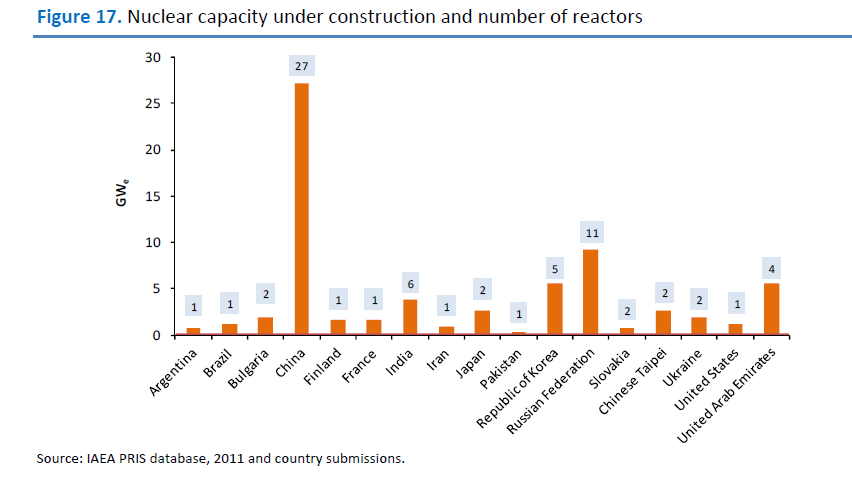
Despite the current events, power generation from nuclear energy is set to rise in many countries. The following chart shows the number of nuclear plants under construction by country :

nuclear-plants-construction.png

A total of 15 countries are currently constructing new nuclear capacity. Given the lengthy period for construction it can be assumed that capacity under construction provides a good overview of the growth of this industry in the next few years.Most of these plants will come online by 2015. Of the 66 units under construction in 2010, 27 are in China. China had only 3 plants under construction at the end of 2005. Hence the current upturn in the growth of this industry is mainly in part due to China’s rising  demand for nuclear power.

The top five countries investing in nuclear fission R&D are USA, Canada, Japan, France and Brazil.

Source: Clean Energy Progress Report, International Energy agency

The U.S. is the world’ largest producer of nuclear power for electricity. In 2009, the country’s 104 nuclear reactors produced 799 billion kWh representing over 20% of total electrical output. It is interesting to note that no new nuclear power plant construction have been started in the U.S. since 1977. (Source: World Nuclear Association)

There are many ways to invest in and profit from the growth of this sector. Some of the investment options include nuclear power plant builders, utilities and uranium miners.

Nuclear power plant builders: The French company Areva is the world’s largest builder of nuclear plants. Areva projected that about 150-300 plants will be built globally by the year 2030 with at least 50 of them built in china and India. Other companies in this field include Toshiba through its Westinghouse unit, General Electric (GE), Kajima, Mitsubishi Heavy Industries, etc.

Electric Utilities: Electric utilities own and operate nuelar plants.Some of the electric utilities that operate nuclear plants include E.ON(EONGY) anbd RWE AG (RWEOY) of Germany, Spain’s Iberdrola (IBDRY),  France’s Electricite de France(ECIFY), Exelon (EXC), Duke Energy (DUK), Progress Energy (PGN), NextEra Energy (NEE) and many other utilities in the U.S.

Uranium Miners: Uranium mining companies provide Uranium, the raw material for nuclear power plants. Some of the uranium miners include Uranium Energy Corp. (UEC), Uranium Resources, Inc. (URRE), Aurora Energy Resources, Denison Mines Corp (DNN), Cameco (CCJ), Paladin Resource, etc.

ETFs: Another simple way to invest in this sector is via the Market Vectors Uranium + Nuclear Energy ETF (NLR). This ETF tracks the DAX global nuclear energy index which contains 40 nuclear energy-related companies listed on global exchanges.The iShares S&P Global Nuclear Energy index ETF (NUCL) also offers a simple and easy way to gain exposure to this sector.

Disclosure: Long RWEOY, NEE, DUK, EONGY

India’s Airline Industry Soars Ahead

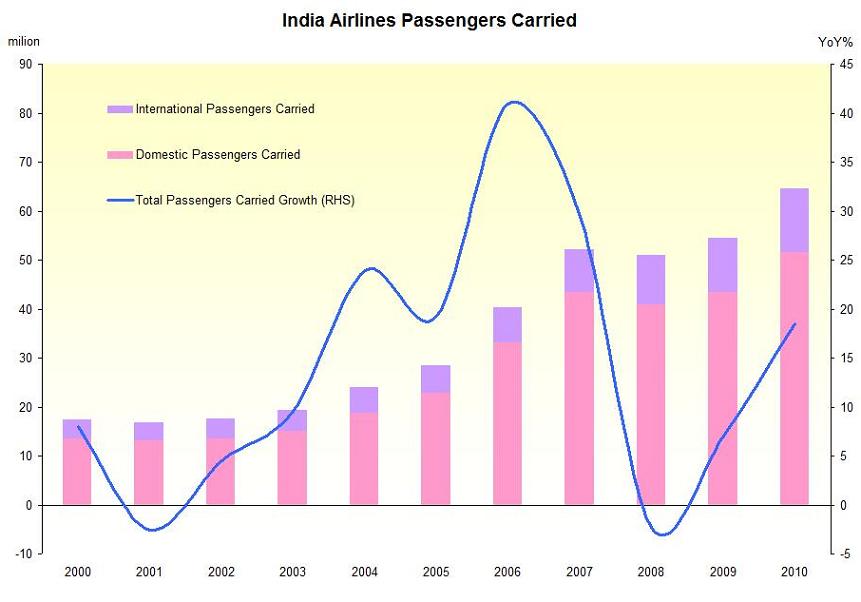
India liberalized the airline industry in the early 1990s. After the deregulation the monopoly of the state-owned airlines was eliminated and many new entrants started operations. Since then air travel has increased exponentially as the chart shows below:

Click to enlarge

india-airtravel.jpg

Source: CEIC India Data Talk

Some of the major airlines currently in operation include Jet Airways, IndiGo, Kingfisher Airlines, SpcieJet, GoAir etc. Many other carriers that entered the market since the deregulation have ceased operations or merged with larger rivals. The full list of defunct and current air carriers in India can be found in the Wikipedia page here.

Related ETFs:

WisdomTree India Earnings (EPI)
PowerShares India (PIN)
iShares S&P India Nifty 50 (INDY)
EGS Indxx India Infrastructure (INXX)
Market Vectors India Small-Cap Index ETF (SCIF)

Disclosure: No Positions

U.S. Financial Asset Holdings of BRIC Countries

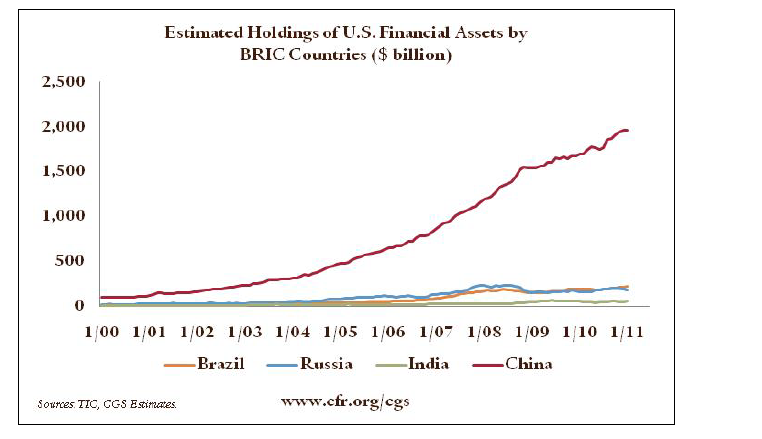
The chart below shows the estimated U.S. Financial Asset Holdings of BRIC countries:

brics-holdings-of-us-assets.png

Source:  Quarterly Update: Foreign Exchange Reserves and U.S. Assets of Brazil, Russia, India, and China, Council on Foreign Relations

China tops the group in financing the U.S. The growth in Chinese reserves in 2010 alone exceeds the stocks of reserves of Brazil, Russia and India. According to the latest U.S. Treasury data, Chinese held over $1.1 Trillion worth of treasury securities at the end of February 2011.