The U.S. Ratings Industry Monopoly

On August 5th, the ratings agency Standard & Poors downgraded U.S. debt from AAA to AA+ for the first time in 70 years. This is the same agency that rated worthless junk such as sub-prime paper as AAA before the credit crisis began in 2008. In a way the standard followed by Standard & Poors is poor to say the least.

Long before this S&P downgrade, in July of last year China’s leading rating agency Dagong stripped the USA, Britain, France and Germany of their AAA ratings. However not many in the west paid any attention to this.

From an article in The Telegraph:

Dagong Global Credit Rating Co used its first foray into sovereign debt to paint a revolutionary picture of creditworthiness around the world, giving much greater weight to “wealth creating capacity” and foreign reserves than Fitch, Standard & Poor’s, or Moody’s.

The US falls to AA, while Britain and France slither down to AA-. Belgium, Spain, Italy are ranked at A- along with Malaysia.

Meanwhile, China rises to AA+ with Germany, the Netherlands and Canada, reflecting its €2.4 trillion (£2 trillion) reserves and a blistering growth rate of 8pc to 10pc a year.

Dagong rates Norway, Denmark, Switzerland, and Singapore at AAA, along with the commodity twins Australia and New Zealand.

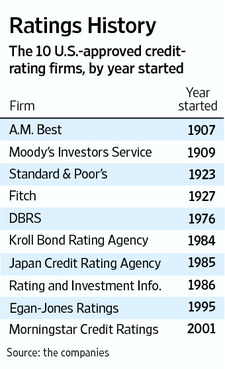
In late July of this year, Egan-Jones Ratings Co, a rating Company based in Haverford, Pa downgraded U.S. debt but nobody attention either according to an article in The Wall Street Journal. In fact, there are 10 rating agencies in the U.S. as shown in the graphic below:
But Standard & Poors, Moody’s and Fitch have a 95% U.S. market share. These three firms effectively operate as a monopoly due to years of consistent support by Uncle Sam. Hence when the other little guys issue ratings they are pretty much ignored by the media and others. Just like telecom, airlines, media, rail, auto manufacturing, credit reporting agencies (on individuals) and other industries a handful of companies in the rating industry have a formed a oligopoly. While U.S. oligopolies in other sectors do not have much influence on foreign countries, the three rating agencies have tremendous power over countries and companies around the world making them both feared and respected at the same time.

In addition to slapping AAA rating on questionable paper, the rating agencies have fared poorly in predicting default rates on government debt. From a Journal article titled Raters Fail to See Defaults Coming:
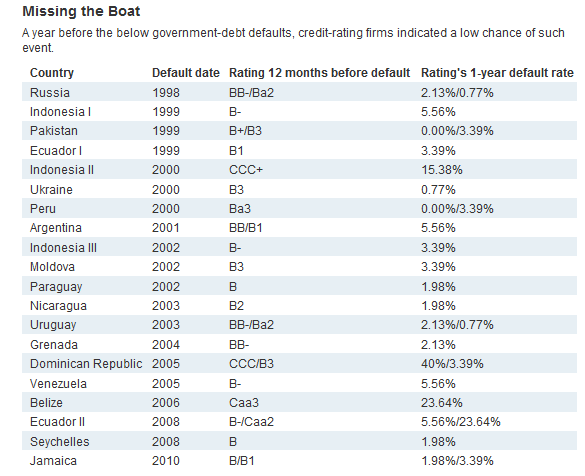
Source: The Wall Street Journal
Some Bailed Out Global Banks May Require Bailout Again

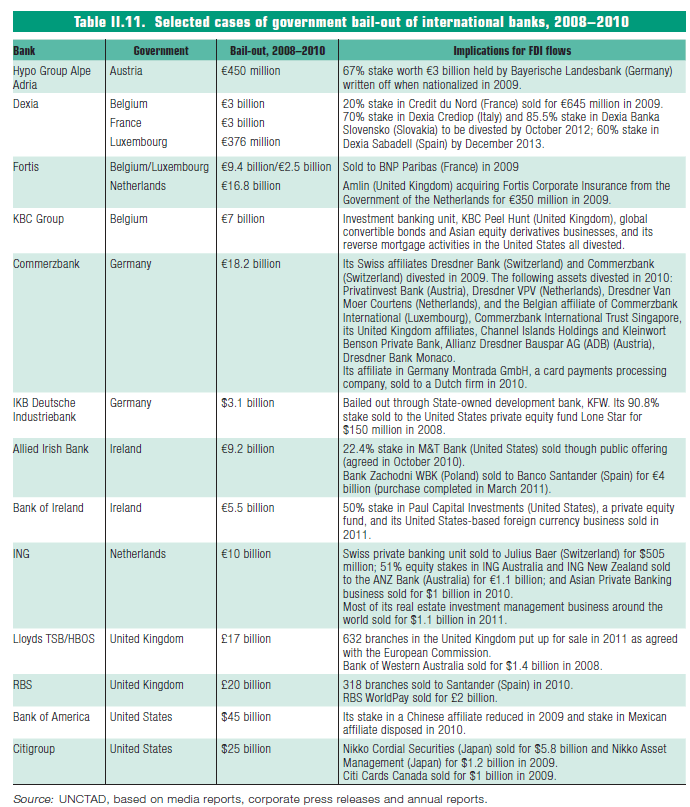
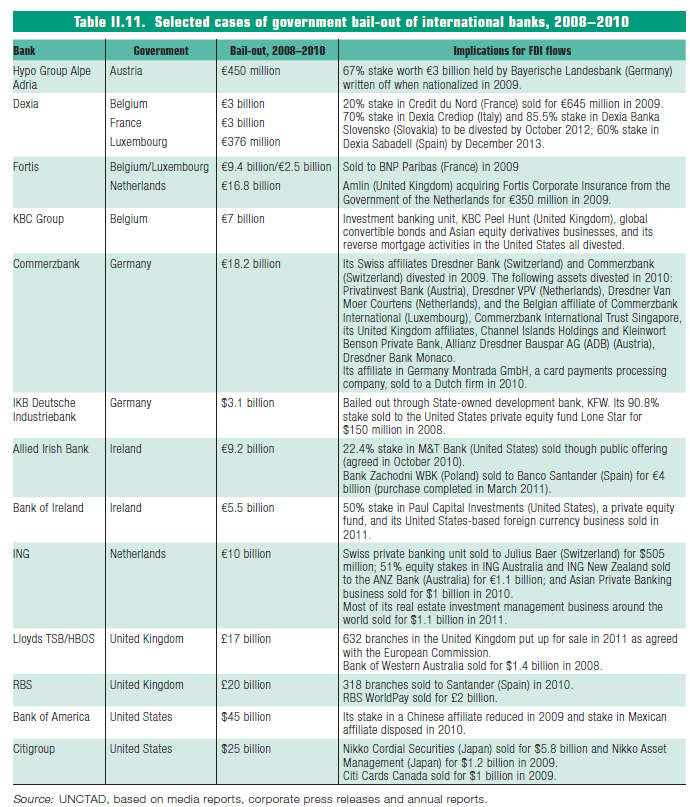
At the height of the global financial crisis in 2008 many banks in the developed world were on the edge of failure. To protect the financial system from total collapse, governments bailed out most of these institutions by injecting billions of dollars in capital. Some of these banks were bailed out by foreign banks and Sovereign Wealth Funds (SWFs). These bailouts were so large that they qualified as Foreign Direct Investment (FDI) according to a report by UNCTAD.

In the UK, the British government injected £37 billion into two of the largest banks, Llyods Banking Group (LYG) and Royal Bank of Scotland(RBS) there with additional support in the following year. These bailouts came with conditions such as the sales of branches by the recipients, reduction of market shares and others.

The table below shows the state bailout of select banks during the financial crisis:

Click to enlarge


Source: World Investment Report 2011, UNCTAD

While the governments were successful in preventing a global armageddon back then, it appears that the very institutions they rescued may require another bailout soon. With fear of losses mounting from exposures to the PIIGS countries some European banks need to raise additional capital to cushion against such losses.

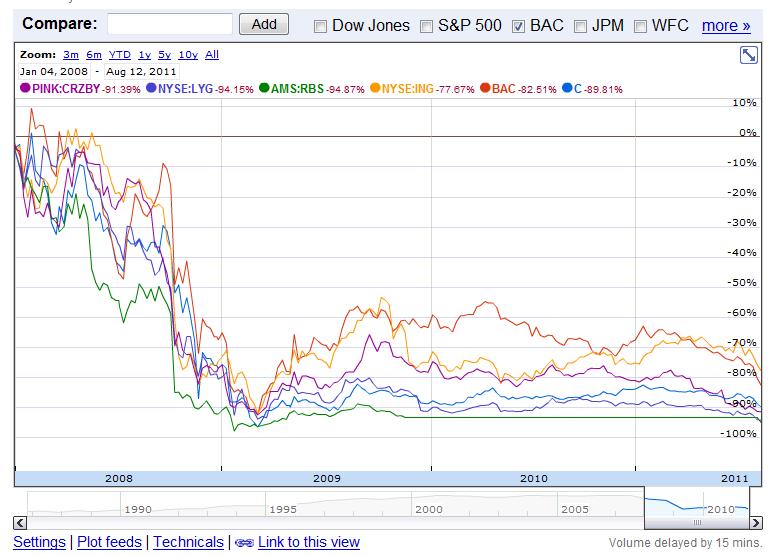
The chart below shows the disastrous equity performance of six bailed-out banks since 2008:

Click to enlarge

Llyods Banking Group and RBS, both majority-owned by the British state, have been the worst performers with losses of about 95%. US-based Bank of America (BAC) and Citigroup (C) have not fared any better either with some experts suggesting that these TBTF banks should be split into multiple pieces for the benefit of the economy and also to increase competition in the banking industry. As many investors question the survivability of Bank of America, Barry Ritholtz of CEO and Director for Equity Research for Fusion IQ recently said in a Bloomberg interview that BofA should should seek a GM-style bankruptcy.

Disclosure: Long RBS, LYG, CRZBY, ING

The World’s 50 Largest Pharmaceutical Companies by Sales

The pharmaceutical industry used be a highly profitable industry and pharma stocks were long considered as conservative investments that offered slow, steady growth with attractive yields. However that has changed in the past couple of decades. Though profit margins for blockbuster drugs are high, drug companies’ earnings are under enormous pressure due to many factors including regulatory issues, high R&D expenses, length of time for FDA approvals, legal costs, etc. Despite these issues, stocks of some pharma companies are good long-term investment opportunities. For example, companies that have high exposure to emerging markets offer potential for growth as the demand for drugs grows in those countries. For example the Danish drug maker Novo Nordisk(NVO) is a world leader in diabetes care. With diabetes becoming more prevalent in emerging countries such as China, Novo Nordisk can tap this huge growing market. According to one estimate, the number of Chinese having Type 2 diabetes may reach 80 million over the next 15 years. As of this year, China is the third biggest market for Novo Nordisk and the second largest insulin market.

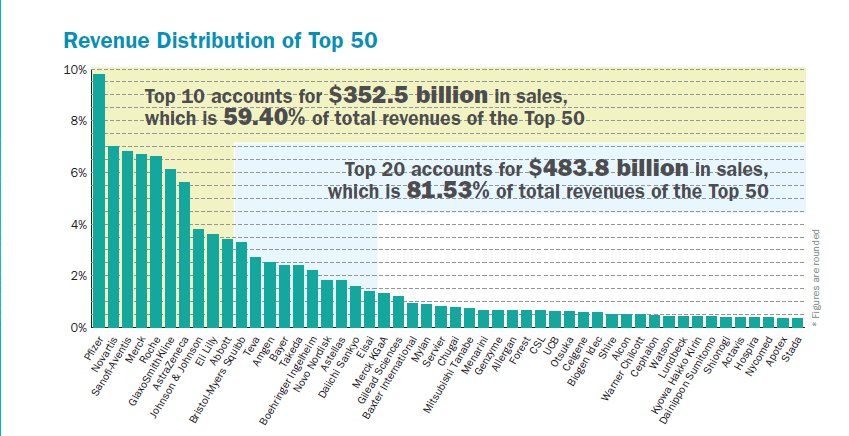
The chart below lists the World’s 50 Largest Pharma Companies for 2010 by sales of prescription drugs:

Click to enlarge

Source: Pharm Exec

Some interesting stats from the report discussing the rankings:

  • The top 50 companies accounted for $593.4 billion of prescription drug sales in 2010.
  • Swiss-drug maker Novartis(NVS) moved to the second place beating Sanofi-Aventis (SNY) and Merck (MRK) jumped from 7th to 4th place.
  • Fueled by the acquisition of Wyeth,  Pfizer(PFE) grew its prescription drugs revenue from $45.4 billion to $58.4 billion.
  • For the first time, all the 50 companies in the above list have sales of at least $2 billion.
  • Similar to Pfizer, Merck(with the acquisition of Schering Plough) and Abbot (with the acquisition of Piramal and Solvay) also increased their annual revenues substantially in 2010.
  • Irish drug maker Warner Chilcott raised its drug revenues by a whopping 111% due to its acquisition of the drug business of P&G.
  • Many of these drug firms stand to profit when 30 million previously uninsured Americans obtain heatlh insurance coverage as a result of the healthcare reform.
  • Half of the top 10 drug firms shown in the rankings above are based in Europe.
  • North America alone accounted for 42% of global pharma sales.
  • The top five drugs by global sales are Lipitor, Nexium, Plavix, Advair Diskus and Abilify.
  • Israel-based Teva Pharmacetuicals (TEVA) took the 12th rank with 2010 sales of $16.1 billion (16.0% higher than 2009 sales). Teva spent $933 million last year in R&D.
  • The US patents of top selling drugs Lipitor and Advair will expire this year adversely impacting the earnings of Pfizer(PFE) and GlaxoSmithkline(GSK) respectively.

To download the full Pharma Exec Top 50 report in pdf format click here.

You may also like to check out:

The Top 25 Global Pharmaceutical Companies by 2011 Sales

Chart: Top 50 Global Drug Companies by Sales in 2011

Disclosure: No positions

Nine U.S. Consumer Staples Companies With High Emerging Market Sales

In my earlier post we looked at some European firms with strong sales in emerging markets. In this post let us take a quick look at some U.S. companies which have a strong presence in emerging countries.

The table below lists nine U.S. consumer staples companies with emerging market sales of 20% or more:

[TABLE=1035]

Source: Global Equity Strategy, Credit Suisse

Philip Morris(MO) is a good pick for long-term investment due to consistent past performance. Currently the stock has a 6.24% dividend yield.It is surprising to see that PepsciCo’s (PEP)emerging market sales is only 20%. As the main competitor to Coca Cola one would expect PepsiCo to have ta much larger exposure to EM. Overall as consumer staples all these stocks can offer stability to a well diversified portfolio during wild market conditions.

Disclosure: No positions

21 European Consumer Staples Companies With Strong Emerging Markets Exposure

The exponential rise in the middle class population in emerging countries offers excellent growth opportunities for multinational companies that have presence in those countries. In countries such as Brazil, India, China, Turkey,Indonesia the growing demand for consumer goods continues to increase with the rise in the standard of living of the middle class.

Since many multinational companies based in Europe have large exposure to emerging markets one simple way to profit from the growth in emerging markets is to invest in these companies. The current turmoil in European markets has significantly reduced the equity prices of some of the these European MNCs. So investors looking to gain some emerging market exposure  can add these stocks at current levels.

The following table lists 21 European consumer staples with emerging market sales of more than 15%:

[TABLE=1034]

Source:  Global Equity Strategy, Credit Suisse

UK-based cigarette makers British American Tobacco PLC (BTI) and Imperial Tobacco Group PLC(ITYBY) have dividend yields of 4.65% and 4.50% respectively.Diageo, one of the largest international producer of alcoholic beverages, is the owner of many famous brands including Diageo Johnnie Walker scotch whisky, Baileys Original Irish Cream liqueur, Captain Morgan rum, etc.Netherlands-based beer brewer Heineken NV (HINKY) owns over 125 breweries in more than 70 countries.

Disclosure: Long HENKY