Revenue and Expenditure of the U.S. Government 2011

Here is a simple chart depicting the Federal Budget for 2011:

Source: Der Spiegel

Income Tax and social security contributions constitute over 50% and 37% of total revenue respectively. With high unemployment ans stagnant wages, this is bound to be under pressure for the foresseable future. With healthcare costs and other expenditures rising, the current deficit of $1.6 Trillion will also increase unless the economy improves and revenues increases.
Unlike Other Developed Countries, Denmark Refuses to Rescue Banks

Since the start of the global financial crisis of 2008, most of the developed countries have bailed out distressed banks with taxpayer funds. The U.S. government allows the failure of small and tiny banks but bails out large and TBTF banks by pouring billions in bailout funds with programs such as the now-forgotten TARP program.

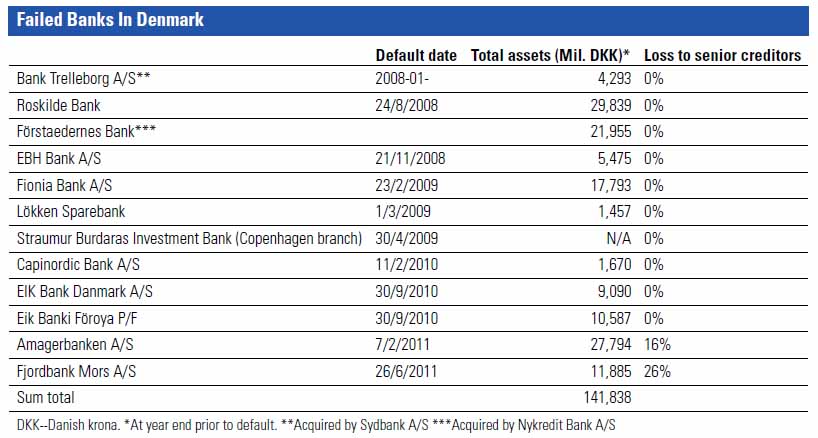
The small country of Denmark has been plagued by bank failures in the past three years due to their over exposure to the real estate industry and inability to obtain funding from foreign investors. However the Danish government refuses to rescue the distressed banks. Instead it has followed procedures to encourage consolidation in the industry with the restructuring of the troubled banks. Only the largest creditors and depositors have been forced to take the losses when banks failed. Ordinary depositors are protected by a deposit-guarantee fund created by the industry. The Danish banking sector is set for consolidation by 2013 according to a Bloomberg report.

Denmark has about 130 banks and so far 12 banks have failed. The failed banks are listed below:

Click to enlarge


Courtesy: Zero Hedge

In a report titled “Further Bank Failures Likely In Denmark”, S&P stated last month that 15 more Danish banks could fail this year.

Due to the current policies of the state, the Danish banking industry will suffer in the short-term , but in the long-run it should become healthier as consolidation leads to fewer and stronger banks and the weaker banks are eliminated. This is a smart strategy compared to the ones followed in other developed countries where “zombie” banks are allowed to survive.

In the U.S. three of the large Danish banks – Danske Bank(DNSKY), Jyske  Bank(JYSKY) and Sydbank A/S (SYANY) trade on the OTC market as unsponsored ADRs.

Source: CEIC Macro Watch, Europe and Central Asia

Disclosure: Long DNSKY

Knowledge is Power: Gold Standard, Taxes, Eurozone Edition

Is it time to restore the gold standard?

Return of the Gold Standard as world order unravels

Why the US Should Raise Taxes

Most Americans don’t have $1,000 saved for emergency

The bonds that turned to dust

Can the eurozone be saved?

The end of buy-and-hold investing?

Is There A Safe Savings Rate?

Click to enlarge

Catherine Palace, St.Petersburg, Russia

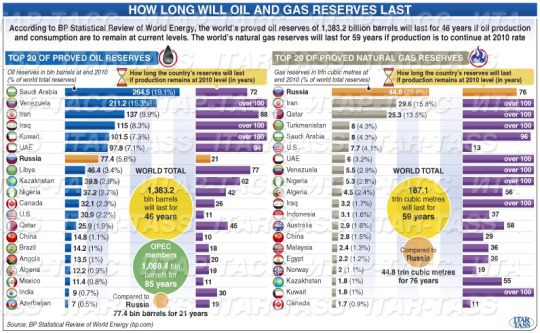
How Long Will the Global Oil and Natural Gas Reserves Last

The world’s proven oil reserves of 1,383.2 billion barrels will last for only 46 years if oil production and consumption are to remain at current levels, according to BP Statistical Review of World Energy. The world’s natural gas reserves will also last for just 59 years if production is to continue at the 2010 rate.

Note: Graphic quality shown as in the original source.

Source: Itar-Tass

The top 5 countries with proven oil reserves: Saudi Arabia, Venezuela, Iran, Iraq and Kuwait.

The top 5 countries with proven natural gas reserves: Russia, Iran, Qatar, Turkmenistan and Saudi Arabia.

The U.S. is the world’s largest consumer of crude oil using 19,148,000 barrels/day or 378 million gallons/day for motor gasoline. Canada is the largest supplier of crude oil to the US at 1,972,000 barrels/day. (Source: U.S. EIA)