Ten Asian Stocks For Yield and Growth

Asian equity markets have established a reputation for growth. However investors often overlook the fact that Asian equities yield high incomes also in addition to capital gains and hence generate solid total-returns. The traditional thinking that growth markets cannot sustain attractive dividend yields is no longer true. In fact, emerging market companies are starting to pay or increasing dividends in order to attract foreign and domestic capital.

Some of the reasons in favor of investing for income in Asia are discussed below:

1. Investors should not consider investing in Asia solely for growth. Asian stocks currently yield more income than the global average and significantly more than their US counterparts as shown in the chart below:
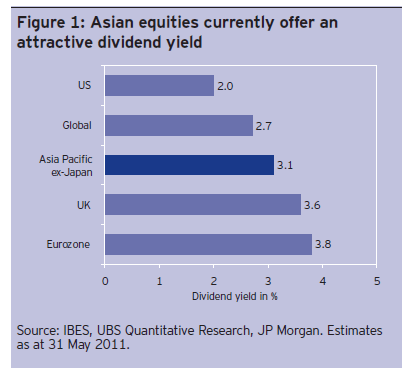
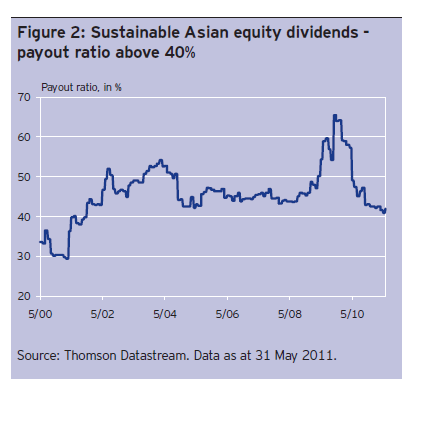
2. The average payout ratio of companies within the Asia Pacific (ex-Japan) universe has hovered around a sustainable 40-50% in the last decade.
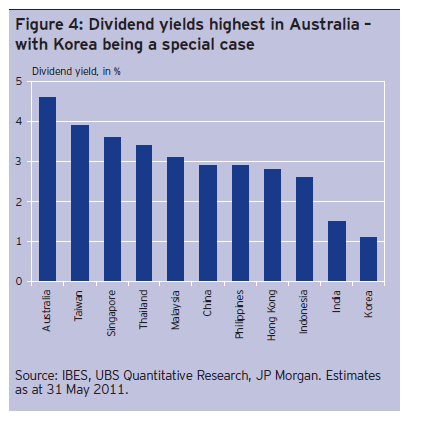
3. Dividend yields are high in mature economies such as Australia and Taiwan, but they are slowly improving in emerging countries such as India and China.
From the Invesco report:

According to CLSA Asia-Pacific Markets (CLSA), 87% of companies in the Asia-Pacific ex-Japan universe will pay dividends this year – up from 60% at the start of the decade. This group of companies is expected to distribute USD 147 billion worth of dividends, with 23 companies expected to pay more than USD 1 billion each, and another 38 to pay more than USD 500 million, accounting for an additional USD 25 billion. By comparison, five companies are expected to account for 40% of all dividend payments in the UK.

Source: Risk & Reward, Asian Equity Income – a total-return strategy, Invesco Perptual, UK

Ten Asian stocks trading on the US markets are listed below with their current dividend yields for review:

1.Company: Taiwan Semiconductor Manufacturing Co Ltd (TSM)
Current Dividend Yield: 4.18%
Sector:Semiconductors
Country: Taiwan

2.Company: Chunghwa Telecom Co Ltd (CHT)
Current Dividend Yield: 5.58%
Sector: Telecom
Country: Taiwan

3.Company: Philippine Long Distance Telephone Co (PHI)
Current Dividend Yield: 6.78%
Sector: Telecom
Country: Philippines

4.Company: Huaneng Power International Inc (HNP)
Current Dividend Yield: 6.81%
Sector:Electric Utilities
Country: China

5.Company: Telekomunikasi Indonesia Tbk PT (TLK)
Current Dividend Yield: 4.47%
Sector: Telecom
Country: Indonesia

6.Company: China Yuchai International Ltd (CYD)
Current Dividend Yield: 3.14%
Sector:Capital Goods
Country: Singapore

7.Company: City Telecom (HK) Ltd (CTEL)
Current Dividend Yield: 7.54%
Sector: Telecom
Country: Hong Kong

8.Company: China Mobile Ltd (CHL)
Current Dividend Yield: 3.98%
Sector: Telecom
Country: Country: Hong Kong

9.Company: United Overseas Bank Ltd (UOVEY)
Current Dividend Yield: 4.44%
Sector: Banking
Country: Singapore

10.Company: PetroChina Co Ltd (PTR)
Current Dividend Yield: 4.13%
Sector: Oil and Gas operations
Country: China

Note: Dividend yields noted are as of September 16, 2011

Disclosure: No Positions

Update:

Bloomberg: Record Dividends Lure Morgan Stanley to Asia
Apple: The Factors Behind its Success And Why it’s Time To Sell the Shares

Apple is one of the most successful technology companies in the world.The company has created a niche position in the consumer electronics and computer industry with many world-class products such as the iPhone, Macs, iPad, iPod, etc. Apple has established its brand to be synonymous with the highest quality and is able to charge a premium for its products.

Apple’s common stock goes for about $400 today and it commands a market cap of just over $371 billion. Apple surpassed Exxon Mobil’s(XOM) market cap in August this year making it the most valuable company in the world. From an an investment standpoint, Apple has been an a classic example for brand investing – the theory where a company’s brand plays an integral part in making investment decisions.

Credit Suisse Research Institute published an interesting report on brand investing last year. The following is a brief summary of the some key takeaways from the report:

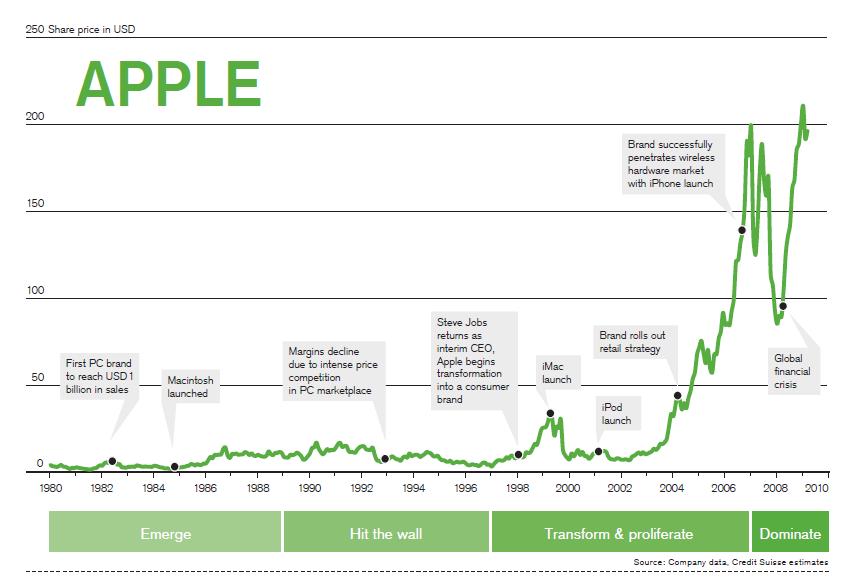
According to Credit Suisse, most brands go through the following five unique brand lifecycle stages:

1) Emerge
This is the phase when a brand establishes itself as a relevant new presence in a marketplace and is identified by consumers for its unique product or service proposition.This stage usually takes 5–10 years and is characterized by fast growth, an IPO and strong shareholder returns.

2) Hit the wall
In this is phase, a company has difficulty making the critical step of transforming itself from a product company to a brand company.

3) Transform and proliferate
This is the phase when a company “makes the leap” from product company to brand company, in a process that can last 10–30 years. Brands are validated in this stage by expanding distribution to new markets or product categories while simultaneously continuing product development and innovation.From an investment standpoint, this is the best phase to own brand stocks since they generate the most market value.

4) Dominate
The ultimate goal of any brand company is to reach this stage. A brand is dominant when it has the number one or two market share, the brand essence is universally understood by consumers and the company starts to generate meaningful free cash flow because it has less need to invest heavily.

Some of the negative effects of this phase is that companies experience much slower growth and there is little margin opportunity. When brands achieve dominant status, it is usually the best time to sell the shares as they can stagnate for years once becoming dominant. Example of this phenomenon are Wal-Mart(WMT) and Sony(SNE) whose shares have remained sluggish for many years. While Wal-Mart’s shares have returned about just 14% in the past 10 years Sony’s shares have actually lost about 50%. In my opinion tech companies such as Intel, Microsoft, EBay, Cisco, Dell, etc. also fall in this category.

5) Reemerge
Sometimes a once-popular brand that faded from the marketplace can reinvent itself and emerge as a strong growth brand once again, sometimes even stronger than before. Investors can reap high-returns from companies which undergo this situation. Examples of such companies include Apple and Coach.

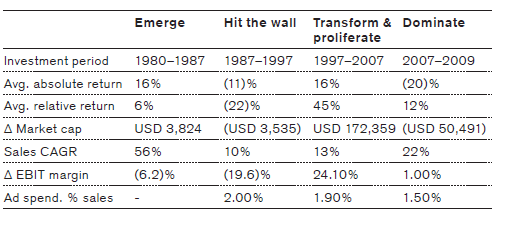
The five phases of the brand lifecycle of Apple:

Click to enlarge


Source: The Power of Brand Investing, Credit Suisse Research Institute, February 2010

Nine factors determine whether a brand moves successfully through the “transform and proliferate” phase. Some of these are required and some are optional. These factors are:

  1. Marketing strategy
  2. Reliable product/service quality
  3. Leadership/management
  4. Corporate culture
  5. Product innovation
  6. Process innovation
  7. Sourcing/distribution control
  8. Network externalities
  9. Unique brand intangibles

From the Credit Suisse report on Apple’s Leadership/Managment:

Steve Jobs was one of the three founders of Apple Computer in 1976 and was a leader in pushing for ground-breaking innovation and distinctive design. In 1979, while visiting Xerox PARC research facility, he saw the graphical user interface, which centered on a “mouse,” and adopted this as Apple’s platform for software development. Jobs led the team that developed the Macintosh in 1984, with its anti-establishment ad based on Orwell’s “1984.” Despite the Macintosh’s success, Jobs was forced to resign from the company in 1985 after a power struggle with new CEO John Sculley. During the next decade, Apple continued to innovate with the Powerbook, which was ground-breaking for laptop computer design. Model proliferation followed with other less successful products, such as the Newton, cameras and TV appliances, none of which were break-out hits. With the rise of Microsoft in the 1990s and its market share gains through cheaper PCs, Apple looked expensive and not as cutting-edge, while the Macintosh platform was not powerful enough.

In 1997, Jobs returned, first as an advisor and then as CEO, and in 1998, Apple returned to profitability with the iMac. Jobs led the company with his vision of breakthrough technological innovation and his passion for aesthetic design. He became the face of the brand, presenting Keynote speeches as well as product introductions, as well as embodying its anti-establishment corporate culture, going barefoot around the office. With Jobs at the helm, Apple launched the iPod, iTunes store, and the iPhone. None of these products was the first mover in its segment, but all dominated and set the industry’s direction once introduced.

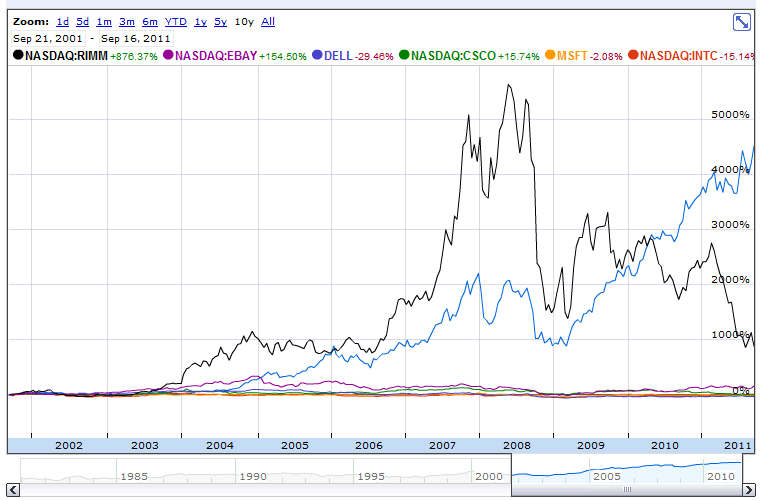
Apple was lucky to have the visionary leader Steve Jobs at the helm and the other eight attributes noted above. Other companies lack one or many of these factors. For example, Cisco Systems(CSCO) lacks leadership and product innovation, EBay(EBAY) lacks leadership and process innovation, Research In Motion (RIMM) lacks in product innovation, Netflix (NFLX) suffers from a lack of marketing strategy and unique brand intangibles, etc. All these problems are reflected in the equity returns of these firms.

10-year performance of Apple and select few tech firms:

Click to enlarge


Source: Google Finance

As Apple is in the dominant phase now its shares may remain stagnant for many years unless the company is able to keep the momentum on its marketing strategy and come up with innovative products that consumers embrace.

In a recent article Der Speigel mentioned that Apple is like Sushi. From the article:

The economic victory parade of the iPad and iPhone is accompanied by a dreadful emotional letdown, a bit like with the latte macchiato before it. Something that was pleasingly different, that gave its supporters a certain feeling of hipness, has been sucked dry by its sheer ubiquity. What was once cool has now become the epitome of uncool. If everybody has something, it can no longer set you apart. The most valuable company in the world produces exactly what all the other most valuable companies in the world have produced: soulless junk. Apple is like sushi: What was once exclusive is now as common as a lower back tattoo.

Back in the day, when everything was better, the Macintosh enjoyed a reputation for being a well-designed tool for graphic designers. Apple was a protest against the evil empire embodied by Bill Gates. Its sleek devices were designed by people like Hartmut Esslinger of Frog Design, and inspired by Dieter Rams of Braun fame. They turned the brand into a statement. They combined functionality with a feeling of Californian liberalism.

Mac users basked in a feeling of belonging to a select group. Steve Jobs, the eternal hippie, was the chummy opposite of the hyper-ambitious nerd Bill Gates. People happily paid more for the products so that they could feel they were somehow on the right side. The high prices were always also a kind of donation. And it fitted perfectly that the Silicon Valley company was on the verge of going bankrupt in the 1990s.

Disclosure: No Positions

Morgan Stanley’s Most Preferred and Least Preferred European Utilities

This week Morgan Stanley upgraded several European Utilities to in-line from cautious “as fundamentals within the power and gas market improve, leverage is now more sustainable and earnings revisions have reached their nadir.”

The bank’s most preferred names in this sector are:

1.Company: Centrica (CPYYY)
Current Dividend Yield: 5.09%
Country: UK

2.Company: Energias de Portugal (EDPFY)
Current Dividend Yield: 7.37%
Country:Portugal

3.Company: E.ON AG (EONGY)
Current Dividend Yield: 9.98%
Country: Germany

4.Company: International Power (IPRPY)
Current Dividend Yield: 2.81%
Country: UK

5.Company: Enagas SA (ENGGY)
Current Dividend Yield: 6.09%
Country: UK

A Bloomberg report yesterday noted that E.ON had a record weekly gain of 17% in Frankfurt trading this week as investors bet on a turnaround for the industry.

Morgan Stanley’s least preferred utilities include Veolia (VE), GDF SUEZ (GDFZY), Drax (DRXGY) and Essar Energy (ESSR.L). London-listed Essar Energy is an integrated energy company in India with operations in the power and oil and gas industries. France-based Veolia Environnement Ve SA has operational issues and the stock fell heavily last month. Hence investors may want to avoid Veolia at this time.

Disclosure: Long EONGY and VE

Chart: Another Look At Why Diversification Matters

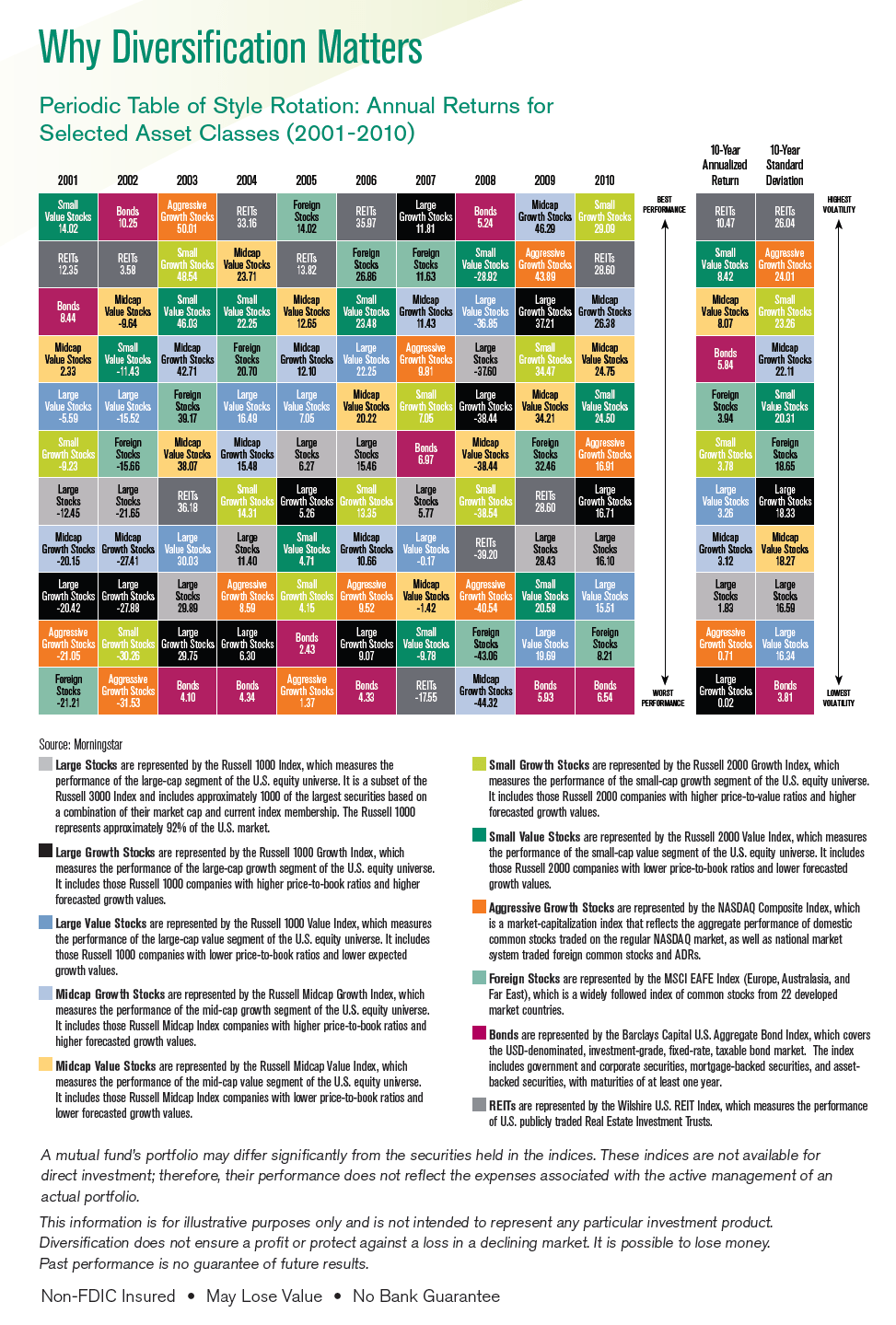
The following chart shows the returns of various asset classes from 2001 to 2010:

Click to enlarge

The 10-year annualized return for foreign stocks was 3.94%. However they returned over 32% in  2009 and 8% in 2010. While foreign stocks fell over 43% during the credit crisis in 2008, they yielded double digit returns every year except 2001 and 2002.

Small cap value stocks performed better than large caps in the period shown. Compared to large cap stocks, the annualized returns of small and mid cap stocks over the 10-year period was higher as well.

Source: Time-Tested Investment Strategies for the Long Term, American Century Investments

Related:

Why Diversification Matters:The Randomness of Returns (Chart from 1997 to 2011 in pdf)

Hunting for Investment Options Among Foreign Oil Stocks

Crude oil prices continue to fall this year with the price for October delivery dropping to $88.61 on the New York Mercantile Exchange according to a Bloomberg report today. Demand is projected to decline as economic growth slows especially in the developed world.  In addition, the Paris-based IEA lowered its estimates for oil consumption this year by 200,000 barrels a day and by 400,000 in 2012.

Partly due to economic uncertainties and lower demand, stock prices of global oil companies have declined year-to-date this year. Hence investors looking for income opportunities in the oil sector may want to consider foreign oil companies. At current levels many overseas oil stocks have higher dividend yields than U.S. firms. For example, the current dividend yields of Exxon Mobil (XOM), ConocoPhillips (COP), Sunoco (SUN), Marathon Oil (MRO) and Chevron Texaco (CVX) are 2.62%, 4.11%, 1.61%, 2.46% and 3.25% respectively. Compared to these yields, income-focused investors may want to consider some of the overseas oil and gas companies mentioned below:

1.Company: Total SA (TOT)
Current Dividend Yield: 7.34%
Country: France

2.Company: BP PLC (BP)
Current Dividend Yield: 4.61%
Country: UK

3.Company: Royal Dutch Shell Plc (RDS.A)
Current Dividend Yield: 5.26%
Country: The Netherlands

4.Company: Royal Dutch Shell Plc (RDS.B)
Current Dividend Yield: 5.20%
Country: UK

5.Company: Eni SpA (E)
Current Dividend Yield: 8.16%
Country: Italy

6.Company: Ecopetrol SA (EC)
Current Dividend Yield: 4.54%
Country: Colombia

7.Company: Petroleo Brasileiro SA (PBR)
Current Dividend Yield: 4.72%
Country: Brazil

8.Company: YPF Sociedad Anonima (YPF)
Current Dividend Yield: 8.56%
Country: Argentina

9.Company:Repsol YPF SA (REPYY)
Current Dividend Yield: 5.57%
Country: Spain

10.Company: Statoil ASA (STO)
Current Dividend Yield: 5.21%
Country: Norway

11.Company: Sasol Ltd (SSL)
Current Dividend Yield: 3.55%
Country: South Africa

12.Company: PetroChina Co Ltd (PTR)
Current Dividend Yield: 4.28%
Country: China

13.Company: China Petroleum & Chemical Corp (SNP)
Current Dividend Yield: 3.39%
Country: China

14.Company: CNOOC Ltd (CEO)
Current Dividend Yield: 3.70%
Country: China

Disclosure: Long EC, PBR