Are Foreign Bank Stocks Worth A Look Now?

Most global bank stocks are in the negative territory so far this year. Especially European financials have been hit hard in recent months due to the resurgence of sovereign credit crisis. However some foreign bank stocks may be getting cheaper now and are worth a look at current levels.

From a Bloomberg article titled Europe Banks Valued at Post-Lehman Lows Show Sovereign Risks Intensifying published yesterday:

Investors are valuing European banks at levels not seen since the depths of the credit crunch that followed the collapse of Lehman Brothers Holdings Inc. as concern over a Greek default and debt contagion escalates.

A Bloomberg index shows 46 lenders trading at 0.56 times book value, the cheapest since the post-Lehman lows of March 2009, signaling investors estimate their net assets are worth less than the companies claim and are demanding discounts for perceived risks. Valuations reflect the impact of a potential sovereign default for some banks, according to Barclays Capital analysts led by Jeremy Sigee.

Based on the market’s reactions, it appears that investors are assuming the worst case scenario for European banks. This is especially true with lenders with heavy exposure to the PIIGS countries. The article added:

The Bloomberg Europe Banks and Financial Services Index of stocks dropped 4.1 percent today to the lowest level in almost 2 1/2 years. The index has slumped 37 percent so far this year, led by financial companies based in peripheral Europe, such as Banco Comercial Portugues SA and National Bank of Greece SA, as well as those with investments there, such as Commerzbank AG of Germany and France’s Societe Generale (GLE) SA.

The table below lists the YTD returns all the exchange-traded foreign bank ADRs:

[TABLE=1042]

Source: BNY Mellon

Except Bancolombia(CIB) all the banks noted above are in the red YTD with a few down over 50%. While European financials are hurt by the credit crisis, emerging market financials are off for other reasons such as rising interest rates, inflation, lack of loan growth, etc.

In order to evaluate the performance of foreign bank stocks from another perspective, I calculated their returns from the highs reached after the March, 2009 lows as shown in the table below:

[TABLE=1043]

Source: Yahoo Finance

While it seemed that most banks recovered strongly from the abyss of the Global Financial Crisis (GFC), the returns above show that the erosion in share prices since then have been terrible.

Note: Data shown above is known to be accurate from the sources used. Please do your own research before making any investment decisions.

Disclosure: Long BCH, BBD, ITUB, STD, BBVA, RBS, LYG, BMA
Bear Markets Are Always Followed By Positive Returns

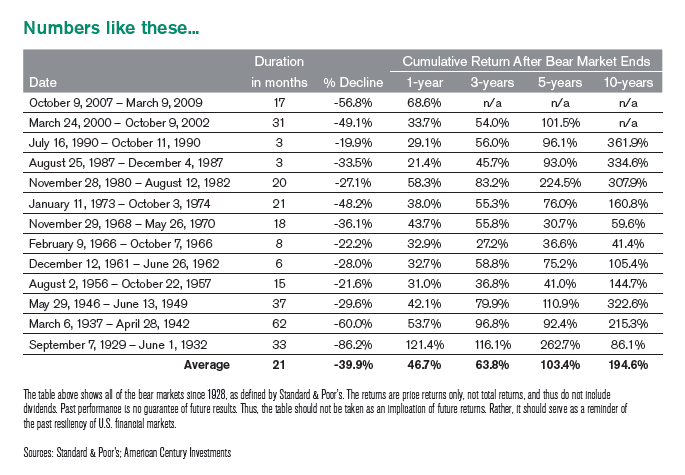
Equity market returns after bear markets are positive and sometimes the rebound is higher than the percentage of decline. So investors with a long-term horizon can take advantage of lower stock prices when markets are in a downward trend.

The following graphic shows the cumulative equity returns once the bear market ends:

Click to enlarge

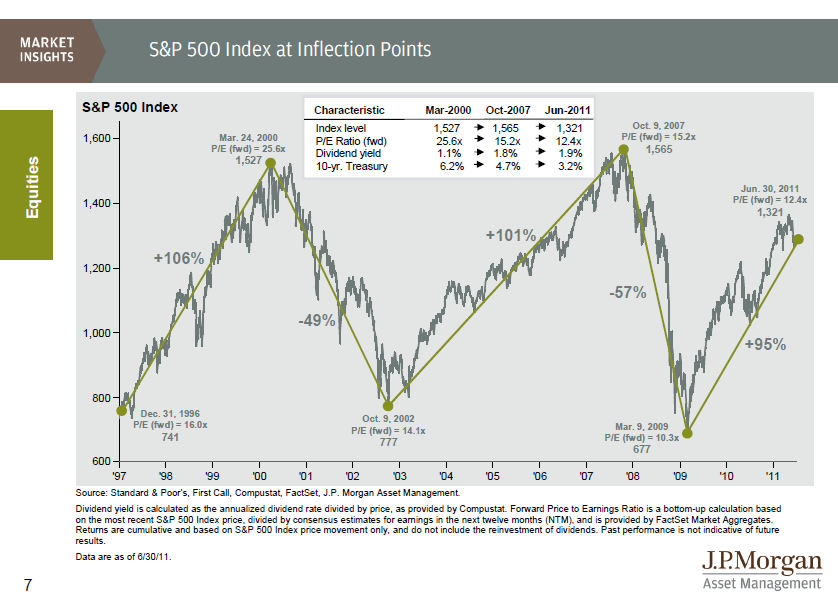
Equity prices fell about 57% during the recent bear market that ended in March, 2009. But within one year, the markets rebounded by about 67%. After reaching a peak, equity markets worldwide are again falling in recent months due to European debt crisis, lack of growth in the U.S. economy, inflation in emerging markets, etc.

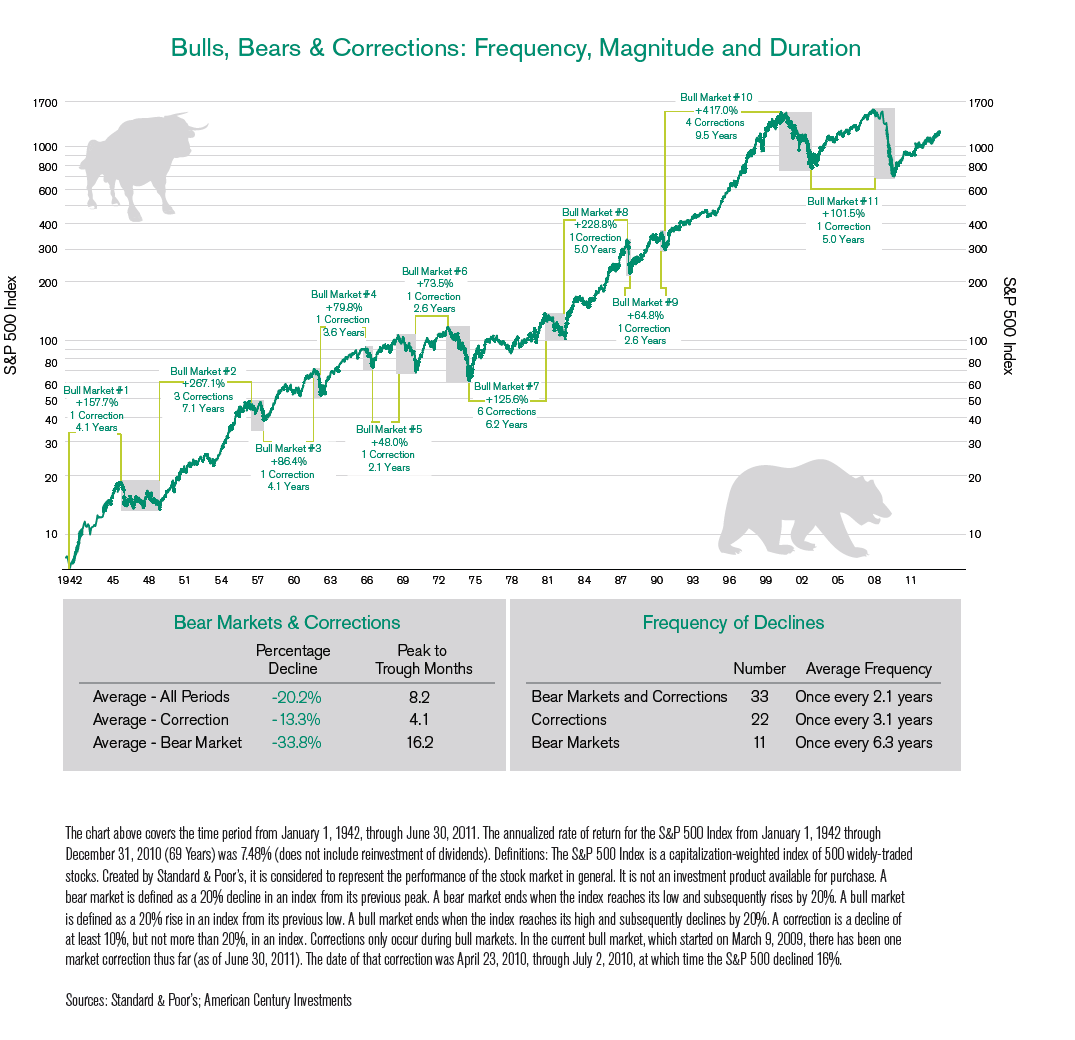
The chart below shows bull markets with their duration and returns since the 1940s:

Click to enlarge

Source: Time-Tested Investment Strategies for the Long Term, American Century Investments

Related ETF:

SPDR S&P 500 ETF (SPY)

Disclosure: No Positions

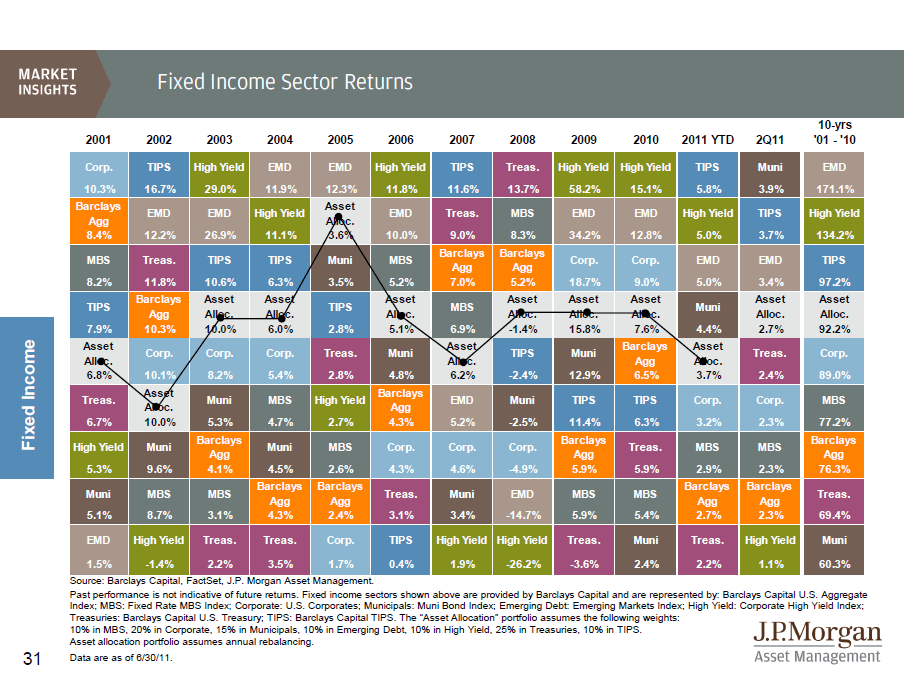
Chart: Fixed Income Sector Returns from 2001 to 2010

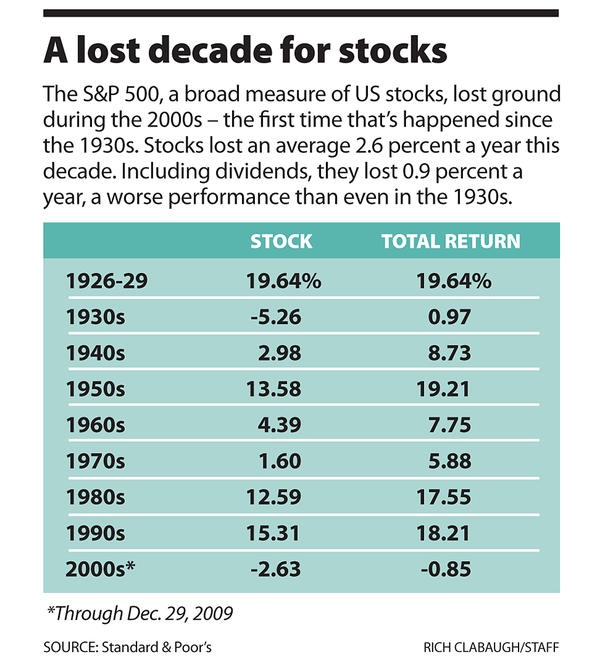
U.S. equities fared very poorly in the lost decade with the nominal S&P 500 stock price down 20% for the decade excluding dividends. The graphic below shows the performance of the S&P 500 index by decades:

Click to enlarge

Source: A lost decade for stocks. Will next one be better?, Christian Science Monitor

While U.S. stocks practically went nowhere in the past decade, fixed income investments performed extremely well in the period from 2001 thru 2010 as shown in the graphic below:

Click to enlarge

Source: JPMorgan Funds

For the 10-years, High yield bonds, Corporate bonds, TIPS and Munis returned 134.2%, 89.0%, 97.2% and 60.3% respectively.

The key takeaway from this post is that fixed-income should be part of a well-diversified portfolio.

Disclosure: No Positions

Review: Russell Australia High Dividend Index

One of the indices offered by the index provider Russell Investments is the The Russell Australia High Dividend Index. This index is comprised of diversified Australian blue chips that pay high dividends.

The average market cap of companies in the index is over $34 billion and the dividend yield of the index is 5.72%. Financials account for about 45% of the index.

The Top 10 holdings in the index are:

  1. BHP Billiton Ltd  (BHP)
  2. Commonwealth Bank of Australia (CMWAY)
  3. Westpac Banking Corp (WBK)
  4. National Australia Bank Ltd (NABZY)
  5. Australia New Zealand Banking Group Ltd (ANZBY)
  6. SP AusNet
  7. Woolworths Ltd
  8. Tatts Group Ltd
  9. Wesfarmers Ltd
  10. Metcash Ltd

The Russell High Dividend Australian Shares ETF tracks the performance of this index. The ETF trades on the Australian Stock Exchange under the ticker RDV. The list of 53 components of this ETF can be found here.

Disclosure: No Positions

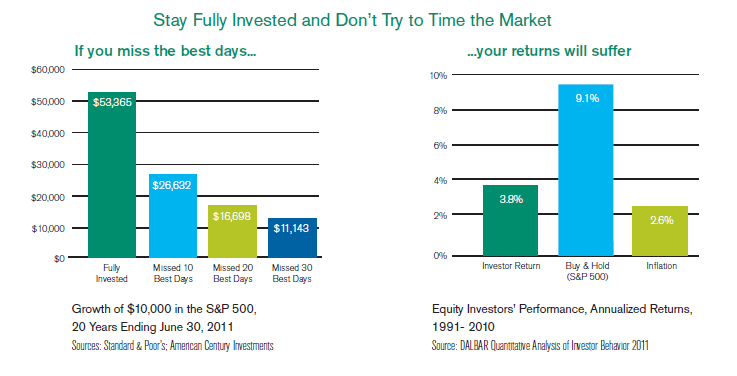
Ordinary Investors Should Not Try To Time The Markets

Equity markets fall and rise for a multitude of reasons that no one can predict. So investors should not try to time the market moves. This is especially important for ordinary investors. Sophisticated professional investors such as hedge funds and other traders are able to reap fantastic profits from taking advantage of volatility in the markets but even some of the fail when the strategy backfires.

Click to enlarge

Source:  JPMorgan Funds via The Big Picture

To take advantage of the market gains, one is better off staying fully invested as opposed to repeated buying and selling. As no one can predict the movement of equity markets, even missing out a few days can lower one’s return substantially as shown in the graphic below. However it should also be noted that even staying fully invested does not guarantee a profit.

Source: Time-Tested Investment Strategies for the Long Term, American Century Investments

Related ETF:

SPDR S&P 500 ETF (SPY)

Disclosure: No Positions