The 29 Global Too-Big-To-Fail Banks

The Financial Stability Board (FSB) has published the list of global banks that are too-big-to-fail. These banks are required to hold as much as 2.5% more capital than other banks by the end of 2012.

The 29 global systemtacially important banks are:

Bank of America Corp.(BAC)
Bank of China Ltd. (BACHY)
Bank of New York Mellon Corp.(BK)
Groupe Banque Populaire
Barclays Plc (BCS)
BNP Paribas SA (BNPQY)
Citigroup Inc. (C)
Commerzbank AG (CRZBY)
Credit Suisse Group AG (CS)
Deutsche Bank AG (DB)
Dexia SA
Goldman Sachs Group Inc.(GS)
Credit Agricole SA
HSBC Holdings Plc (HBC)
ING Groep NV (ING)
JPMorgan Chase & Co.(JPM)
Lloyds Banking Group Plc (LYG)
Mitsubishi UFJ Financial Group Inc.(MTU)
Mizuho Financial Group Inc. (MFG)
Morgan Stanley (MS)
Nordea Bank AB (NRBAY)
Royal Bank of Scotland Group Plc (RBS)
Banco Santander SA (SAN)
Societe Generale SA (SCGLY)
State Street Corp (STT)
Sumitomo Mitsui Financial Group Inc. (SMFG)
UBS AG (UBS)
Unicredit SpA
Wells Fargo & Co. (WFC)

Via: Financial Post

Disclosure: Long many banks in this list
Some Interesting Facts About Investing in the 1800s

I

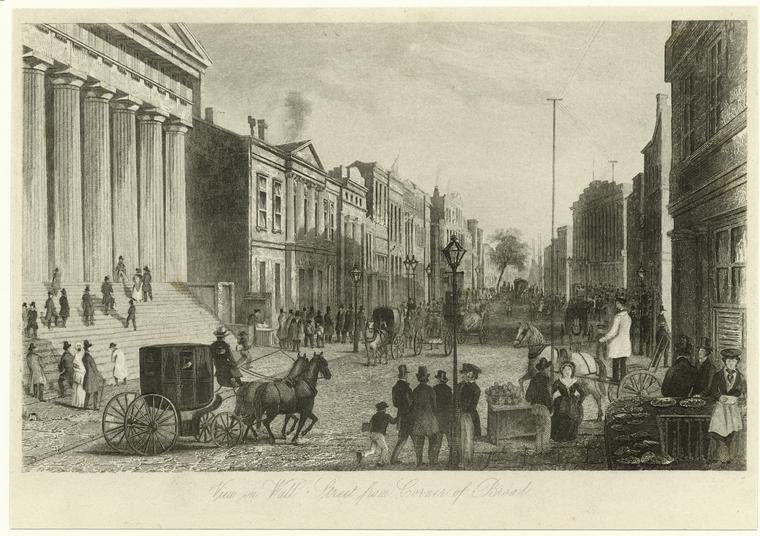
Wall Street in the 1800s

I came across a paper on total returns of bonds, stocks and bills by Dr. Bryan Taylor of Global Financial Data, Inc. The following are some interesting facts from the paper about investing in financial assets during the 1800s in the U.S. :

  • “Most people invested in bonds, not stocks
  • Virtually all of an equity investor’s returns came in the form of dividends, not capital gains
  • There was little difference in the returns to stocks and bonds
  • Since the government did not issue treasury bills and deposits were not federally insured, there was no “risk free” investment available to investors
  • Bond and dividend yields declined over the course of the century as the risk to investors and inflation declined.
  • Although prices rose and fell in any given year, from 1815 to 1914, there was no overall inflation in the US and in most countries on the Gold Standard.”

By the end of the 20th century, most investors were investing in stocks and not bonds and were dependent more on capital gains rather than dividends. In addition, they had risk-free alternatives, saw the interest rates during most of the 20th century and endured one of the worst inflation in human history. It will be interesting to see how the investment world changes in the next century.

Source: GFD Guide to Total Returns on Stocks, Bonds and Bills, Dr. Bryan Taylor, Global Financial Data, Inc.

Related:

Ten Foreign Utility Stocks To Consider

Utility stocks are generally considered to be defensive stocks. However in recent years they have been volatile and many have not recovered fully from the March 2009 lows.

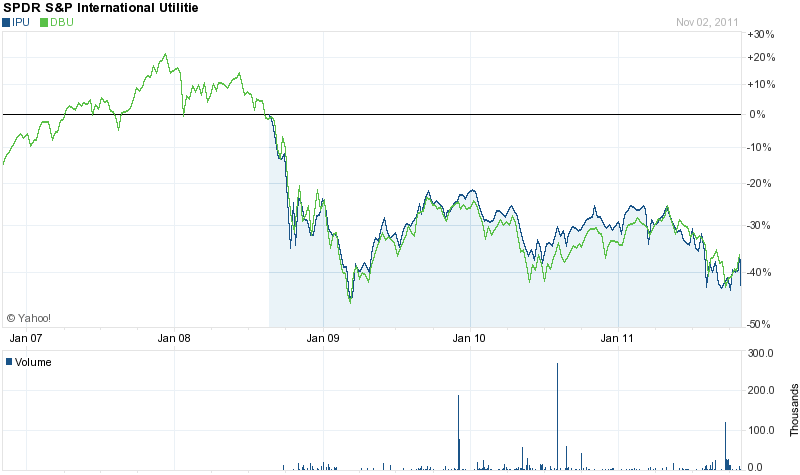
The following chart shows the relative performance of SPDR S&P International Utilities Sector ETF (IPU) and WisdomTree Global ex-US Utilities ETF (DBU):

Click to enlarge


Both these ETFs offer easy access to invest in foreign utilities with the WidsomTree and SPDR funds currently having dividend yields of 4.91% and 5.34%  respectively.

nvestors looking to invest directly in individual foreign utilities trading on the organized exchanges have a only few options available. But many more companies trade on the OTC markets.  The following is a list of ten foreign utility ADRs trading under $10  for further review:

1.Company: Empresa Distribuidora Y Comerci (EDN)
Current Price: $8.20
Current Dividend Yield: N/A
Country: Argentina

2.Company: Enel Spa (ENLAY)
Current Price: $4.46
Current Dividend Yield: 6.00%
Country: Italy

3.Company: Electricite de France SA (ECIFY)
Current Price: $5.75
Current Dividend Yield: 5.61%
Country: France

4.Company: Verbund (OEZVY)
Current Price: $5.71
Current Dividend Yield: 2.69%
Country: Austria

5.Company: SNAM Rete Gas SpA (SNMRY)
Current Price: $9.22
Current Dividend Yield: 2.69%
Country: Italy

6.Company: Red Electrica (RDEIY)
Current Price: $9.28
Current Dividend Yield: 8.30%
Country: Spain

7.Company: Gas Natural (GASNY)
Current Price: $3.35
Current Dividend Yield: N/A
Country: Spain

8.Company: EVN AG (EVNVY)
Current Price: $3.00
Current Dividend Yield: 3.85%
Country: Austria

9.Company: Fortum Oyj (FOJCY)
Current Price: $4.67
Current Dividend Yield: $6.19%
Country: Finland

10.Company: Centrais Eletricas Brasileiras-Eletrobras (EBR)
Current Price: $9.90
Current Dividend Yield: N/A
Country: Brazil

Note: Prices and Dividend Yields changes noted are as of market close Nov 2, 2011.

Disclosure: No Positions

The Five Best and Worst Performing Latin American ADRs YTD

Most of the emerging market equity indices are down so far this year. In addition to domestic factors, the European debt crisis and worries about the state of the global economy have pulled down emerging markets. Emerging markets such as Brazil, Peru and Chile are off by double digits YTD. The MSCI index returns for select Latin American countries are listed below:

Brazil: -17.07%
Chile: -14.49%
Colombia: -2.78%
Mexico: -9.69%
Peru: -21.42%

Source: MSCI Barra

Due to the decline in prices some of the Latin American stocks are looking attractive at current levels. Hence investors looking to add exposure to this region can take advantage of the cheap prices now. To get started here is the list of the five best and worst performing Latin American ADRs trading on the organized exchanges.

The five best performing exchange-listed Latin American ADRs YTD:

1.Company: BRF – Brasil Foods (BRFS)
Current Price: $21.05
YTD Change: 24.70%
Country: Brazil

2.Company: Fomento Economico Mexicano (FMX)
Current Price: $67.05
YTD Change: 19.90%
Country: Mexico

3.Company: Telefonica Brasil (VIV)
Current Price: $29.02
YTD Change: 18.59%
Country: Brazil

4.Company: Companhia Energetica de Minas Gerais-CEMIG (CIG)
Current Price: $14.10
YTD Change: 12.98%
Country: Brazil

5.Company: Ultrapar (UGP)
Current Price: $17.76
YTD Change: 9.90%
Country: Brazil

The five worst performing exchange-listed Latin American ADRs YTD:

1.Company: Maxcom Telecomunicaciones (MXT)
Current Price: $1.40
YTD Change: -62.16%
Country: Mexico

2.Company: Banco Macro (BMA)
Current Price: $20.05
YTD Change: -60.06%
Country: Argentina

3.Company: Cemex (CX)
Current Price: $4.37
YTD Change: -57.57%
Country: Mexico

4.Company: Desarrolladora Homex (HXM)
Current Price: $14.96
YTD Change: -55.75%
Country: Mexico

5.Company: Gafisa (GFA)
Current Price: $7.44
YTD Change: -48.70%
Country: Brazil

Note: Prices and YTD changes noted are as of market close Oct 31, 2011.

Disclosure: Long UGP, BMA

Importance of Foreign Banks to Select Emerging Countries and Vice Versa

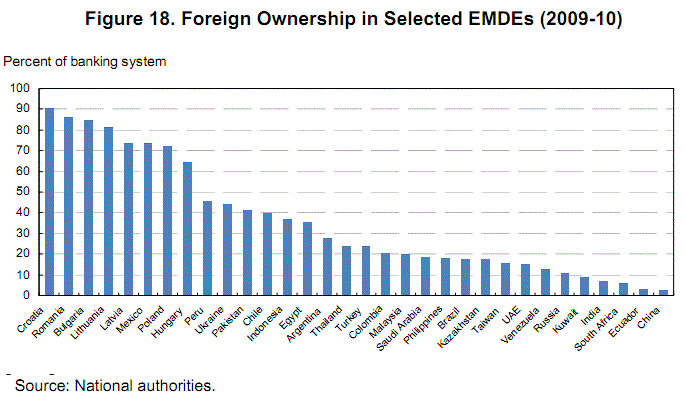
Foreign banks have a strong presence in some emerging countries. In a few of those countries they dominate the local banking market more than the domestic banks.

The following chart shows the foreign ownership in select Emerging Market and Developing Economies (EMDEs):

Click to enlarge


It is interesting to note that foreign banks own more than 50% of the market share in the Central and East European countries noted above. Some of the foreign banks with heavy exposure to these countries include Austria’s Erste Bank (EBKDY) and Raiffeisen Bank (RAIFY) , France’s Societe Generale (SCGLY), Holland-based ING Group (ING), etc. However in the BRIC countries they account for a small part of the total banking system.

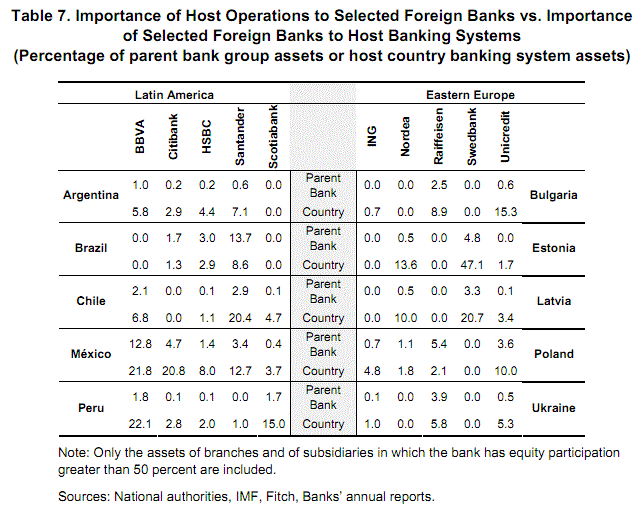
The following graphic shows the importance of select foreign banks to the host banking system and vice versa:

Source: Won’t somebody think of the emerging sovereigns?, FT Alphaville

From the FT Alphaville article:

Argentina, Chile and Mexico have big “exposure” to Santander, but each country is a relatively small proportion of the bank’s own assets. On the other hand, Brazil’s importance to Santander, far outweighs the reverse.

Over in Europe look at, say, Bulgaria and Unicredit, or Latvia and Nordea. Or Peru and Scotiabank… in all these cases, the bank accounts for 10 to 15 per cent of the host country’s banking system assets.

From an investment perspective, because some of these banks have high exposure to emerging markets, their earnings are more diversified and may be better investment options than banks that solely focus on the home markets.

Disclosure: Long BNS, ING, SCGLY, EBKDY, SAN