The Global Risks Landscape 2014

The World Economic Forum publishes The Global Risks report every year when its annual meeting takes place in Davos, Switzerland.

The latest report lists the following as the Ten Global Risks of Highest Concern in 2014:

  1. Fiscal crises in key economies
  2. Structurally high unemployment/underemployment
  3. Water crises
  4. Severe income disparity
  5. Failure of climate change mitigation and adaptation
  6. Greater incidence of extreme weather events (e.g. floods, storms, fires)
  7. Global governance failure
  8. Food crises
  9. Failure of a major financial mechanism/institution
  10. Profound political and social instability

The chart below shows the global risks mapped to their likelihood of occurring and impact:

Click to enlarge
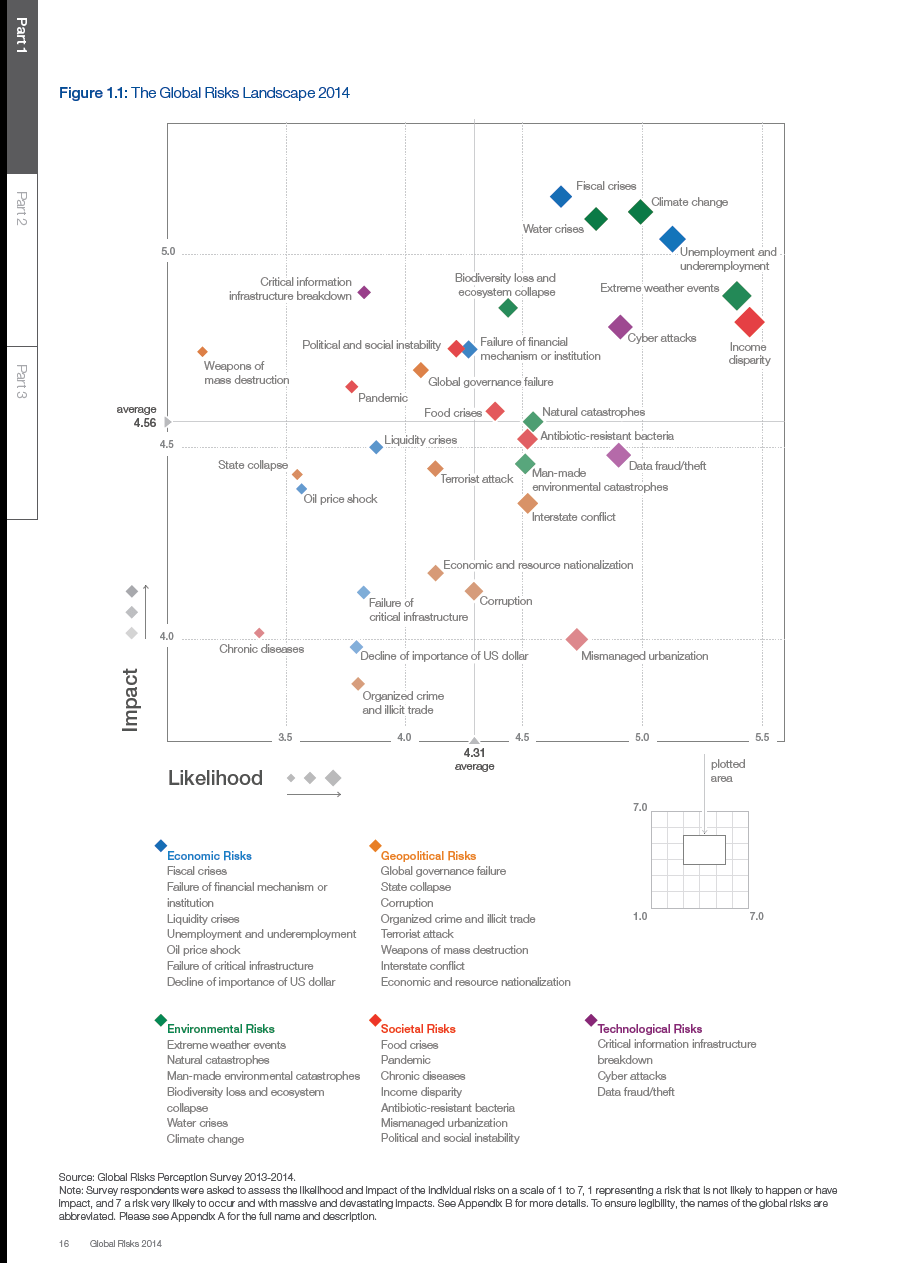
Global-Risks-Lanscape-2014

Source: Global Risks 2014 Ninth Edition, Insight Report, World Economic Forum

It is surprising that fiscal crises in key economies appears as the top risk of highest concern for this year even though we had multiple crises in the past few years including the global financial crisis and sovereign debt crises in Europe.
How Not to Invest In Dividend Stocks

Dividend stocks were mostly ignored by investors during the dot com era of the 1990s. Soaring stock prices of high-tech companies made dividend-payers of traditionally boring  industries such as utilities, consumer staples, industrials, etc.  unattractive to most investors. However since the recent global financial crisis, dividend stocks are back in vogue again as yield-hungry investors have rediscovered them.

While selecting and investing in dividend-paying stocks seem pretty straight-forward it is that easy. According to a research report by David Ruff, CFA, Portfolio Manager of Forward Management, LLC, investors make mistakes that may reduce their income and total return. He discussed the following seven mistakes investors commonly make:

Mistake #1: Chasing lofty yields

Very high dividend yield stocks may seem like the top choice for income investors. But high-yielders do not necessarily perform better over the long run. In fact, very high yields may not be sustainable and may lead to dividend cuts or even eliminations. Research studies have shown that companies that slowly and consistently increase their dividends outperform high-yielders with no dividend growth. So investors are better off going with such stocks instead of very high-yeiding stocks.

Mistake #2: Relying on Overly Mechanical Strategies

Some investors follow the passive dividend investing strategy which focuses too much on growth and dividend yield but may ignores fundamentals of a company or the sector. This stragey may not yield the best results. For example, in 2011 investors flocked to European telecom firms for their high dividend yields. But many firms’ dividend yields were unsustainable as payout ratios exceeded 100%. Eventually they reduced or eliminated dividend payments.

Mistake #3: Overlooking Growth Factors

Dividend paying stocks generally perform well over the long-term in terms of total returns. However dividend growers and initiators perform even better due to the effect of compounding and consistent dividend increases. So simply picking dividend stocks is not a wise strategy. One has to choose stocks which can grow their earnings and raise dividends over time.

Mistake #4: Succumbing to Home Market Bias

Generally US investors tend to prefer investing in domestic stocks. This is not a sound strategy especially for income investors since the S&P 500 has a dividend yield of around 2% but many overseas markets have much higher yields. So going abroad can yield higher returns. It is true that US multinationals like The Coca-Cola Company (KO), The Procter & Gamble Company (PG), Colgate-Palmolive Co. (CL), etc. offer foreign exposure. But they do not have the high dividend yields like their overseas peers. So it is imperative that investors allocate some portion of their portfolios to overseas stocks.

Mistake #5: Having Blue-Chip Tunnel Vision

Professional and retail investors alike love large-cap blue chips for their liquidity and stability. However these blue-chips may not offer the best value as they may be expensive since everyone wants to own them in their portfolios. So instead of going with the usual blue-chips, investors should select smaller firms that offer decent yields and are cheaper in valuation.

Mistake #6: Following the Herd

Investors should not follow others and pile into the widely held and popular dividend-paying stocks. Such stocks have high liquidity but should investors exit at the same time it can turn into a stampede leading to a huge price crash. Hence owning other lesser-known dividend stocks in addition to the popular ones can offer diversification benefits and potentially higher growth.

Mistake #7: Giving Macro Factors Too Much Weight

Investors should be mindful of market fundamentals but they should not put too much weight on macro factors and avoid companies in one region because of macro-economic issues. For example, during the European sovereign crises many investors avoided European stock altogether. This was a big mistake since there are hundreds of world-class European companies that operate globally and had better earnings potential despite the troubles in Europe. Investors who picked up European stocks during the height of the crises have earned solid returns since most European markets rebounded sharply last year.

Similarly some investors are now painting a broad brush on all emerging markets of the world as they have been laggards since last year. As with the European example, some emerging markets are better than others and there are plenty of emerging firms that offer potential investment opportunities now. These firms have strong fundamentals and are slowly emerging into multinationals similar to the developed world multinationals.

Source: How Not to Invest in Dividend Stocks:Seven Mistakes Investors Commonly Make,  Seven Mistakes Investors Commonly Make, By David Ruff, CFA, Portfolio Manager, Forward Management, LLC

Related ETFs:

  • iShares Dow Jones Select Dividend ETF (DVY)
  • SPDR S&P Dividend ETF (SDY)
  • Vanguard Dividend Appreciation ETF (VIG)
  • SPDR Utilities Select Sector SPDR Fund (XLU)

Disclosure: No Positions

Emerging Market vs Developed Market Stocks Performance

Most emerging markets performed poorly last year relative to developed markets. The question on many investors’ mind now is if emerging markets would continue the dismal performance this year also.

I found the following information on emerging markets in a research report by Barclays.

Click to enlarge

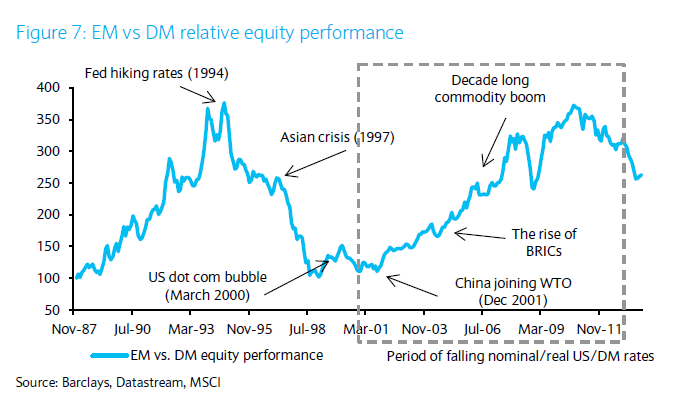
EM vs DM Stocks Performance

Source: Compass, December 2013/January 2014, Barclays

The period from 2002 to 2010 was the heyday for emerging markets due to the boom in commodity markets. The economies of resource-rich nations like Brazil, Canada, Chile, Australia, etc. boomed as the demand for all types of commodities such as copper, iron, coal, timber soared. China was one of the main factors behind this demand since the country was investing heavily in infrastructure development.

The Chinese economy has slowed and the country is rebalancing its economy. Similarly other emerging countries are also facing their own domestic challenges. Hence the fall in demand for commodities particularly from China should affect commodity exporters such as those in  Latin America.

The tightening of the US monetary policy in 1997 started a sharp and prolonged fall in emerging markets leading to the Asian financial crisis. However that scenario is unlikely to repeat now since the external debt positions and fiscal balances of emerging markets are much better now than in 1997.

Among the emerging market asset classes, Barclays prefers equities as they are bound to benefit from global growth. They are also attractive from a valuation perspective. Countries that export to the developed world such as Korea, Taiwan, Mexico and Poland are good candidates though Mexico and Poland are not cheap.

Related ETFs:

  • iShares MSCI Emerging Markets ETF (EEM
  • Vanguard Emerging Markets ETF (VWO)
  • SPDR S&P 500 ETF (SPY)
  • SPDR STOXX Europe 50 ETF (FEU)
  • SPDR DJ Euro STOXX 50 ETF (FEZ)

Disclosure: No Positions

On The Retirement Plans By Country Across Europe

Retirement plans in European countries are slowly changing in recent years. Countries are moving away from Defined Benefit (DB) plans to Defined Contribution(DC) plans.

In DB plans an employer basically defines a benefit that the employee will receive at a certain date in the future usually after retirement. This is usually a set amount based on the employees wages, tenure, etc. Once the employee retirees the employer pays the defined amount(called as pension) periodically to the employee. Here the employer is responsible for the risk associated with managing the funds of employees in order to make sure enough funds are available to pay to the retirees.

In DC plans, an employee contributes a certain percentage of his/her income to the plan.Sometimes the employer may also contribute a small percentage to that plan usually based on the employee’s salary and tenure.The funds of the plan are then invested in the market mostly in mutual funds already pre-selected by the employer. In this type of plan, the employee is responsible for the investment risk.

In the U.S. most companies got rid of the DB plans in favor of DC plans in the past few decades since it makes the employee responsible for their retirement and reduces the liability for companies.

Unlike the U.S., most of Europe still have DB plans. But that is changing with the increasing adoption of DC plans.In Europe, strict regulations and resistance from workers have prevented employers from quickly dumping DB plans and implementing DC plans. However since DC plans not only reduces employers’ liability but also affords employees the opportunity to earn more with their investments,  they will be embraced by more employers.

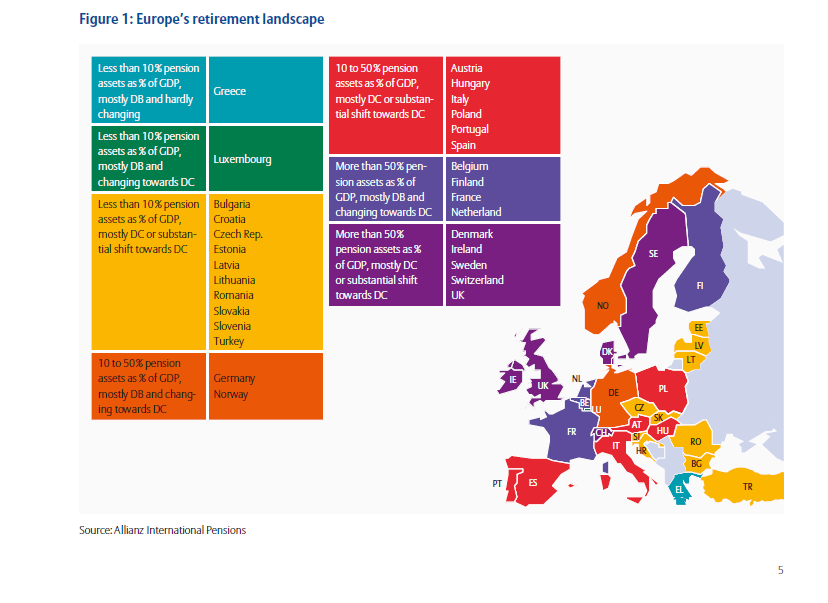
The graph below the current retirement landscape in Europe:

Click to enlarge

Europe Retirement Lansdscape

Source:  Cross-Border Defined Contribution Plans in Europe, Alliance Global Investors

The graph shows that the adoption of DC plans is not even among the countries.For example, DB plans are more prevalent in Greece and it is not changing towards DC plans. However countries such as Denmark, Ireland, UK, Sweden and Switzerland have large portion of DC plans compared to other countries.

Why The US Dollar Will Stay The Reserve Currency This Year And Beyond

The U.S. dollar will stay the reserve currency in 2014 and beyond according to a research report by Barclays. This is because there is no serious competitor despite the U.S running persistent current account deficits. poor fiscal position, loss of AAA credit rating and the ongoing QE program run by the Federal Reserve.

In addition to the above factors, three other factors that matter for the reserve currency status are: liquidity, depth of local capital markets and investor faith. In each of these categories the U.S. beats other major developed economies.

a) Liquidity

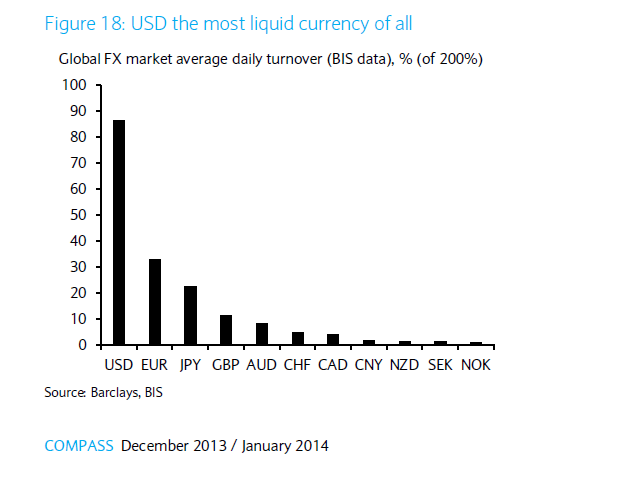
The US dollar is the most liquid currency by a wide margin. The nearest competitor Euro has a daily turnover of only about one-third  in the forex market relative to the dollar.

Click to enlarge

US Dollar Most Liquid Currency

b) Depth of local capital markets

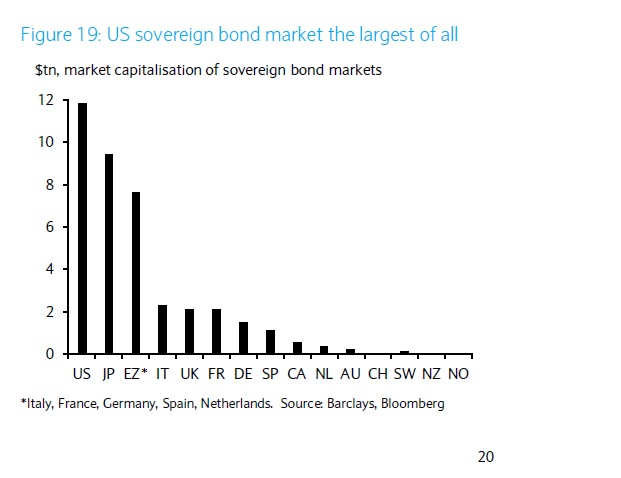
The U.S. sovereign bond market is the largest in the world. Hence it is highly liquid for investors and prices are not easily distorted when someone winds up even a smaller position.

US Sovereign bond market

c) Investor faith

The dollar and its underlying assets still retain investors’ faith even during times of great stress. For example, during the global financial crisis the dollar and treasuries benefited greatly as investors piled into them seeking safe heavens.It is ironic that investors put their faith in the same country that started the financial crisis causing the loss of billions of dollars.

Serious competition to the domination of the US dollar as the top reserve currency is non-existent. Norway has strong fiscal balances, runs a strong current account surplus and enjoys the AAA rating. However the Norwegian Kroner(NOK) cannot compete vigorously against the dollar since the local capital market is shallow, the currency is illliquid and underperforms during times of stress.

The Japanese Yen and Euro are two of the other possible substitutes for the dollar. But Japan’s fiscal position and Europe’s internal fights among member countries make it unappealing to investors.

The next contender for the reserve currency status is China’s Renminbi. However it is unlikely to attain that position anytime soon since China’s capital markets are immature and its currency is illliquid. China’s capital controls and managed nature of the currency also does not help.

In summary, the US dollar will remain the top reserve currency for the foreseeable future.

Source: Compass, December 2013/January 2014, Barclays