Why Invest In German Blue-Chip Companies

The German economy is the fifth largest in the world in terms of purchasing power parity(PPP). With a GDP of about $3.2 Trillion in 2013 based on PPP, it is also the largest economy in Europe.While the economy of the U.S. is consumption-based, Germany’s economy is export-based. Germany is a world leader in industries such as chemicals, automobiles, machinery and household equipment.

Since Germany is the economic powerhouse of Europe, investors looking invest in European companies are wise to consider German companies first. Back in October, when global equity markets turned highly volatile, Germany’s DAX index fell hard in a short period of time and reached a low of 8,354. Since then it has dramatically recovered to cross 10,000 recently and closed at 9,971 yesterday. Back in November, I wrote an article titled Keep Calm and Stay Long With German Stocks encouraging investors to not panic and dump German equities. This post follows the same theme and focuses on why investors should seriously consider investing in Germany’s DAX-listed companies.

Five reasons to invest in German blue-chip firms are listed below:

  • The 30 companies in the DAX index thrived in 2013 as they reaped business opportunities in emerging markets.
  • Turnover by DAX companies reached $1.5 Trillion in 2013, up 24% from 2008 levels according to a PriceWaterhouse Cooper study published earlier this year.
  • Revenues from foreign markets reached 855 billion Euros last year, up 33% during the same period.
  • The top firms with big rise in foreign revenues were Volkswagen followed by Daimler and BMW.
  • Overall DAX firms earned more than 90% of their total turnover in 2013 from markets outside of Germany.

Source: DAX-listed companies heavily rely on turnover abroad, Deutsche Welle

Ten DAX constituents are listed below with their current dividend yields:

1.Company: BASF SE (BASFY)
Current Dividend Yield: 4.14%
Sector:Chemicals

2.Company: Volkswagen AG (VLKAY)
Current Dividend Yield: 2.44%
Sector: Auto Manufacturing

3.Company: Siemens AG (SIEGY)
Current Dividend Yield: 3.52%
Sector:Industrial Conglomerates

4.Company: Henkel AG & Co (HENKY)
Current Dividend Yield: 1.68%
Sector: Household Products

5.Company: BMW AG (BAMXF)
Current Dividend Yield: 3.14%
Sector: Auto Manufacturing

6.Company: adidas AG (ADDYY)
Current Dividend Yield: 2.65%
Sector:Textiles, Apparel & Luxury Goods

7.Company: E.ON SE (EONGY)
Current Dividend Yield: 4.47%
Sector: Multi-Utilities

8.Company: Allianz SE (AZSEY)
Current Dividend Yield: 4.30%
Sector:Insurance

9.Company: Deutsche Telekom AG (DTEGY)
Current Dividend Yield: 4.07%
Sector:Telecom

10.Company: Linde AG (LNEGY)
Current Dividend Yield: 2.17%
Sector: Chemicals

Another simple way to invest in German blue chips is via the iShares MSCI Germany ETF(EWG). However EWG tracks the MSCI index and not the DAX index.

Note: Dividend yields noted above are as of Dec 3, 2014. Data is known to be accurate from sources used.Please use your own due diligence before making any investment decisions.

Disclosure: Long EONGY, HENKY
The Periodic Table of Commodity Returns 2004 To 2013

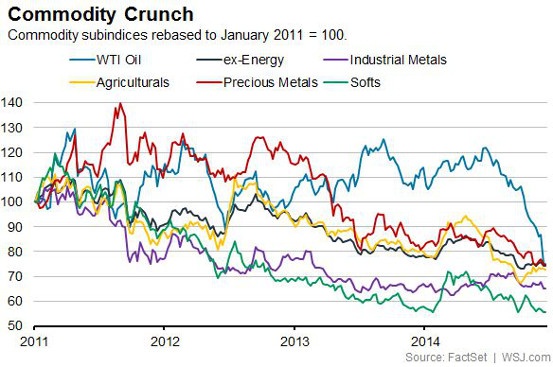
Global commodity prices have been on a steady decline mode for the past few years. More recently, Crude Oil has plunged heavily just in the past few months. Today WTI crude for January delivery rose slightly and closed at $67.97 on the NYMEX.

The following charts the decline and fall of some commodity prices:

Click to enlarge

Commodity_crunch

Source: Can The Commodities Carnage Get Worse?, Moneybeat, WSJ ; Hat Tip: The Big Picture

From the Moneybeat post:

Losses on this year’s highs are marginal compared with the drop most of these classes of commodities have suffered from their peaks, generally hit in the spring of 2011.

Oil prices are down 42% from then–and down 53% from its all-time high in 2008. Softs are down 58% from the spring of 2011. Precious metals are down 47%. Industrials have lost 40%. Agriculturals are down 35%. Overall, non-energy commodities have tumbled a third from their April 2011 highs.

Commodities are generally volatile. Investing in commodities is not suitable for most retail investors. For example, the price of wheat can go up or down for any number of reasons including drought in one country to soaring production in Russia.The dramatic collapse of crude oil recently is another example. Global crude oil prices can fall for seemingly silly reason such as a team of rebels setting fire to a pipeline somewhere in Nigeria. A few years ago many oil investors were adversely impacted by the Contango effect.So retail investors should be cautious of investing in commodity stocks, ETFs and so on.

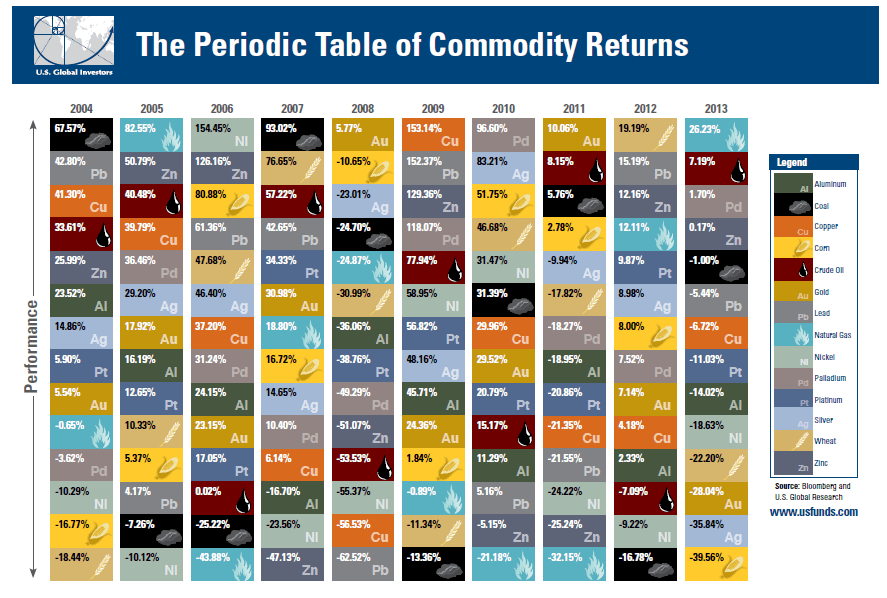
The Periodic Table of Commodity Returns 2004 To 2013:

Click to enlarge

Periodic Table of Commodities

Source:The Periodic Table of Commodity Returns For 2013, US Funds

A quick glance at the chart shows that the returns for pretty much every commodity is highly unpredictable from one year to the next.

The Periodic Table of Emerging Markets 2004 To 2013

The U.S. equity market has performed well so this year with only one more month left to go. As of November end, the S&P 500 is up by 11.9% based on price returns and the Dow is up by 7.6%.

Among the emerging markets, India is the top performer year-to-date as the benchmark BSE Sensex has shot up by over 35% in local currency terms. The Sensex closed at 28,693 an all-time high. Also on Friday the total market capitalization of all companies on the Bombay Stock Exchange(BSE) crossed over US $1.6 Trillion making it the 10th largest exchange in the world. With over 5,500 companies listed, the BSE is the largest exchange in the world based on the number of listed companies.

Following the star performance of the Sensex is the Shanghai Composite index which is up by over 26%.Brazil has been a laggard this year also. The Bovespa has increased by a mere 6.10% as investors have been disappointed with the re-election of President Dilma Rousseff. Mexico’s IPC All-Share index and Chile’s IPSA are also average performers with returns of 3.4% and 5.2% respectively.

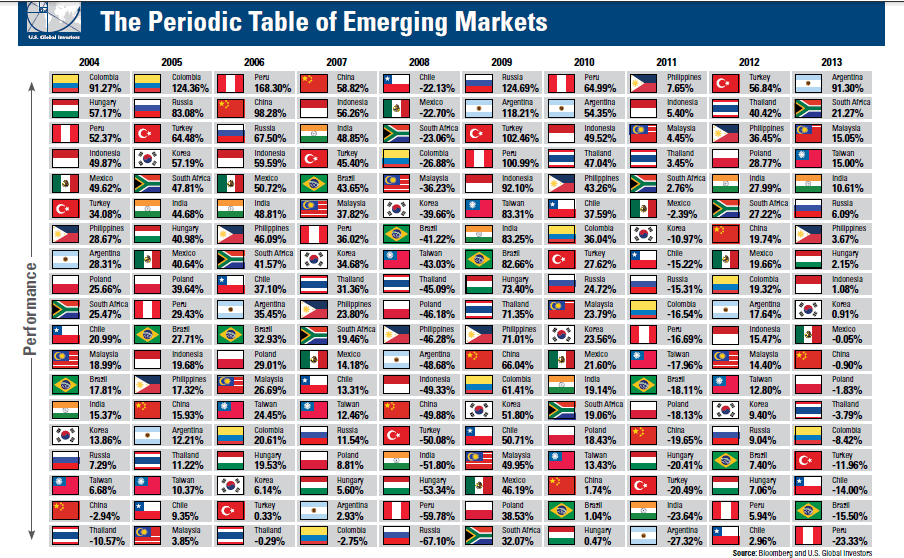
While China and India handily beat the U.S. market this year it is also important to see how they performed in the past. The following chart shows the Periodic Table of Investment Returns for Emerging Markets from 2004 to 2013:

Click to enlarge

Period Table of Emerging Markets

Source: Periodic Table of Emerging Markets 2013, U.S. Funds

A few observations from the above chart:

  • India plunged by over 51% in 2008 during the global financial crisis but boomed 83% the following year. Brazil had a similar return in the same two years.
  • With the exception of 2010, Indian stocks have yielded double digit returns every year since 2008.
  • Since 2010, Brazilian stocks were relatively average performers with a double digit negative return in 2013.
  • Though Argentina is shown as an emerging above, it is actually a frontier market. Though Argentina yielded solid returns since 2009 every year with the exception of 2011, the market is not for suitable for the faint of heart as the volatility in individual stocks can be stomach churning.
  • The Malaysian stock market deserves much attention from international investors.In 2008, Malaysia was down by only 36% and has since generated a positive annual return every year.

Some related ETFs:

  1. iShares MSCI Mexico Investable Market Index (EWW)
  2. iShares S&P India Nifty 50 (INDY)
  3. iShares MSCI South Africa Index (EZA)
  4. iShares MSCI Brazil Index (EWZ)
  5. iShares FTSE/Xinhua China 25 Index Fund (FXI)
  6. Market Vectors Russia ETF (RSX)

Disclosure: No Positions

Five Australian Stocks To Consider For Income and Growth

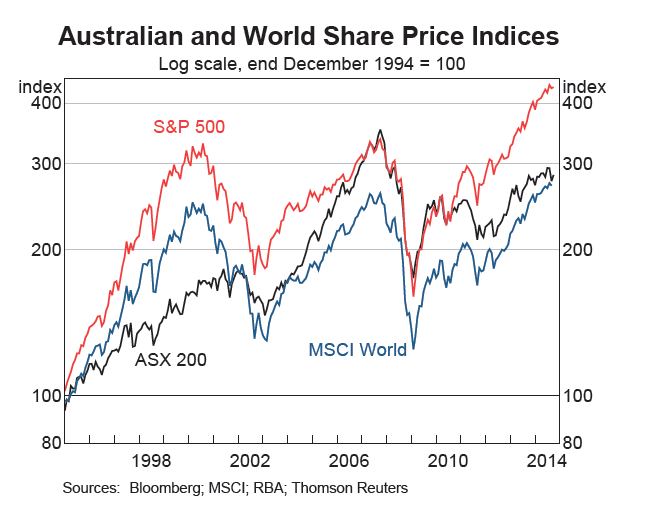
The U.S. market has performed well this year with the S&P 500 up 11.8% as of yesterday. On the other hand, many of the other developed markets including Australia.are lower than the U.S. market.Australia’s SP/ASX 200 benchmark index is basically flat at -0.30% year-to-date.

The following chart shows the long-term performance of ASX 200 against S&P 500:

Click to enlarge

Australia Share Prices

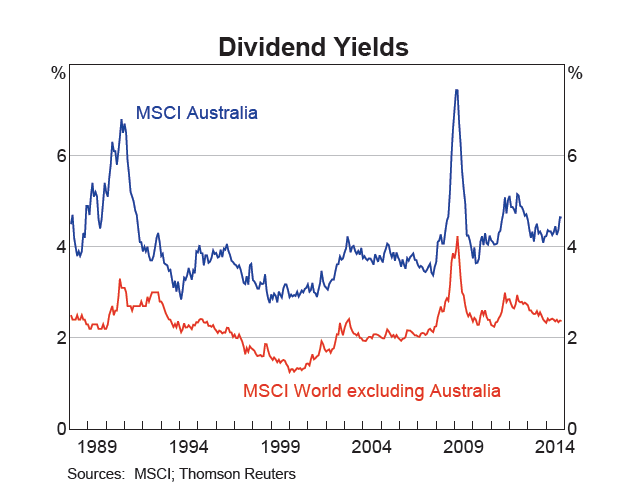
Generally dividend yields of Australian stocks are higher than the US stocks and even European stocks.The chart below shows huge difference between the dividend yields of MSCI Australia and MSCI World Excluding Australia:

MSCI Australia Dividend Yield

Source:  The Australian Economy and Financial Markets, Chart Pack November 2014, Reserve Bank of Australia

Though Australia is a resource-based economy, due to the decline in commodity prices and the continued lower demand from China it is better to stick with non-resource based companies when investing in the Australian equity market.

Five Australian stocks are listed below with their tickers and the current dividend yield for consideration:

1.Company: Westpac Banking Corp (WBK)
Current Dividend Yield: 5.90%
Sector: Banking

2.Company: Australia and New Zealand Banking Group Ltd (ANZBY)
Current Dividend Yield: 5.81%
Sector:Banking

3.Company: National Australia Bank Ltd (NABZY)
Current Dividend Yield: 6.40%
Sector:Banking

4.Company:Commonwealth Bank of Australia (CMWAY)
Current Dividend Yield: 5.18%
Sector: Banking

5.Company: Telstra Corp Ltd (TLSYY)
Current Dividend Yield: 5.44%
Sector:Telecom

Note: Dividend yields noted above are as of Nov 25, 2014. Data is known to be accurate from sources used.Please use your own due diligence before making any investment decisions.

Disclosure: Long NABZY

Goldman Sachs: 32 Best European Stocks For 2015

Every year around this time of the year Wall Street banks, pundits, financial gurus and others engage in a ritual by publishing their stock picks for the following year. These lists must be taken with a grain of salt but they are worth taking a quick look at. Having said that, listed below are  Goldman Sachs’  32 best European stock picks with their tickers on the US markets, if available.They project double and even triple digit percentage returns for some of these stocks in 2015.

  1. Innate Pharma (IPHYF)
  2. Unipol Gruppo Finanziario (UFGSY)
  3. Crest Nicholson Holdings
  4. ARM Holdings plc (ARMH)
  5. BT Group plc (BT)
  6. Credit Suisse Group (CS)
  7. SAP SE (SAP)
  8. Intesa Sanpaolo (ISNPY)
  9. E.ON AG(EONGY)
  10. Easyjet plc (ESYJY)
  11. Salvatore Ferragamo SpA (SFRGY)
  12. Iliad SA(ILIAY)
  13. Grifols SA (GIKLY)
  14. Banco Bilbao Vizcaya Argentaria, S.A. (BBVA)
  15. Burberry Group plc (BURBY)
  16. Erste Group Bank AG (EBKDY)
  17. Taylor Wimpey plc (TWODY)
  18. Eni Spa (E)
  19. Safran SA (SAFRY)
  20. Daimler AG (DDAIY)
  21. Siemens (SIEGY)
  22. L’Oreal
  23. Shire plc(SHPG)
  24. MTU Aero Engines AG(MTUAY)
  25. Bayer AG (BAYRY)
  26. SABMiller plc (SBMRY)
  27. Anheuser-Busch InBev SA/NV (BUD)
  28. Roche Holding AG (RHHBY)
  29. WPP plc (WPPGY)
  30. Tryg A/S
  31. Zurich Insurance Group AG (ZURVY)
  32. St. James’s Place plc

Source: Goldman Sachs says these are the 32 best European stocks for 2015, Financial Post

The banking sector in Europe is projected to recover next year as they are in much better shape now than int he past few years.Besides the share prices of major banks are relatively cheaper than their US peers. Two of the banking stocks in the above list include Erste Bank and Credit Suisse. Austria’s Erste has huge exposure to the Central and East European markets and those markets have fared better recently than the European core.

Another good pick in the above list is the aerospace and defense company, Safran of France. US companies in this sector have been doing well for many years now despite cuts to the US defense budget. Safran has better potential for growth than others. An interesting article on Safran can be found here.

Other high quality companies that can be held for the long-term in the Goldman’s list are beer makers SABMiller and Anheuser-Busch InBev, pharma majors Bayer and Roche and telecom provider BT group of UK.

Click to enlarge

Statute of Liberty, New York

The Statute of Liberty, Liberty Island, New York

Disclosure: Long SAFRY, EBKDY, EONGY,  BBVA