Knowledge is Power: Foreign Stocks, 2015 Predictions, US Coal Edition

Here are the Canadian stocks getting a lift from the anything-but-oil rally (Financial Post)

These ETFs Need an Exorcism (Bloomberg)

A Smart Way to Include International Stocks in Your Portfolio (WSJ)

The real story of US coal: inside the world’s biggest coalmine (The Guardian)

What facts about the United States do foreigners not believe until they come to America? (Quora)

Can businessmen make good politicians? (The Hindu Business Line)

Do Foreign Stocks Still Make Sense? (Forbes)

Jack Bogle: I Wouldn’t Risk Investing Outside the U.S. (Bloomberg)

10 outrageous predictions for 2015 (Citywire, UK)

Shareholder value maximisation: a dumb idea that we really have to dump (MoneyWeek) Also checkout: How the cult of shareholder value wrecked American business( The Washington Post)

Why Invest Internationally? (From 2012, Charles Schwab)

Lincoln Memorial

Lincoln Memorial, Washington DC

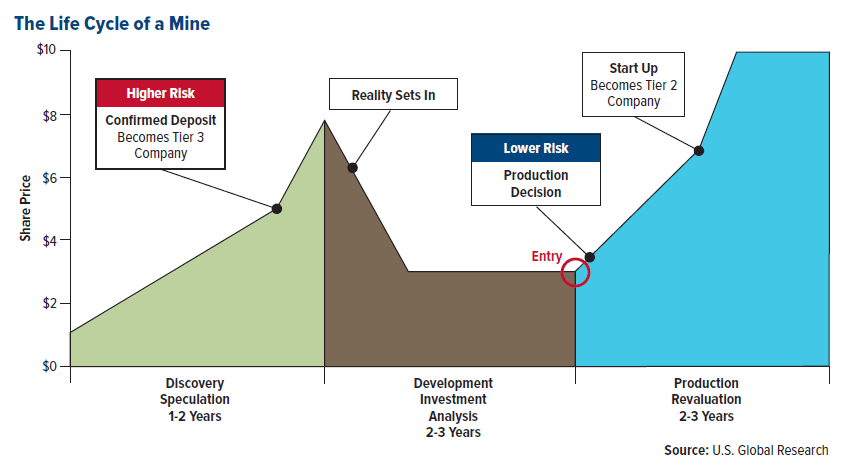
The Life Cycle of a Mine

A gold mine is a hole in the ground with a liar standing next to it.” – Mark Twain

Investing in mining companies is highly risky. It is not wise to simply invest in them based on reading some financial reports. For startup mining firms everything is based on speculation. Many years ago a Canadian gold miner called Bre-X collapsed spectacularly after all their claims of gold discovery in Indonesia turned to be a fraud. They pretty much embodied the Mark Twain’s quote above. Canada’s stocks exchanges particularly the Toronto Venture Exchange has hundreds of mining companies many of which are just small miners doing discovery somewhere in the world.

The Life Cycle of a Mine:

Click to enlarge

The Lifecycle of a Mine

From a report by U.S. Funds:

When a mine is first discovered, excitement raises the price of the stock. This is when investment is most speculative since only one in 2,000 companies finds at least a 1 million-ounce deposit. Once reality sets in and miners are faced with the notion that the metal or mineral—assuming there is any—probably won’t be exhumed for some time, prices tumble. Years later, after production finally begins, stocks see another uptick. This is when the equity is at its lowest risk factor.

Source: MANAGING EXPECTATIONS: Anticipate Before You Participate in the Market, 3Q 2014, U.S. Funds

So before investing in a mining stock one should first analyze and identify in which phase the mine is currently in.As Bre-X showed, rushing to cash in on hyped up discovery of gold or other precious metals will only cause investors to lose money.

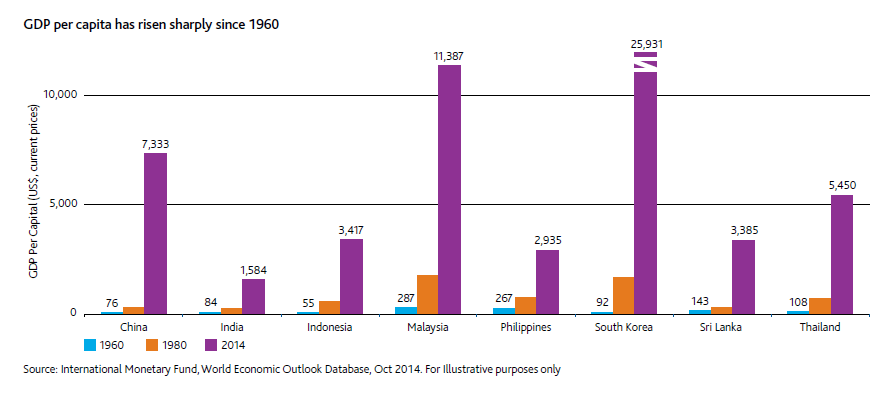
GDP Per Capita Growth Of Select Asian Countries

Some of the Asian economies have grown tremendously in the past few decades. For example, communist China used to be closed third-world country with mostly an agrarian economy. Today the country is one of the largest economies in the world and has become the factory floor for the entire world. With a fast-growing middle-class population and rising income, Chinese consumers have become the sought-after customers for global multinationals.

Other Asian countries have also seen strong economic growth since the 60s. The following chart shows the growth in GDP per capita of select Asian countries since 1960:

Click to enlarge

GDP Per Capita Asian Countries

Source:  Asia’s Crucial crossroad: Urbanization drives growth, Aberdeen Asset Management

South Korea’s GDP per capita rose from $92 in 1960 to an astonishing $25,391 this year. It should be noted that South Korea is technically a developed country today. But MSCI classifies it as an emerging country. India has lagged behind China in terms of economic growth.No wonder China attracts much more foreign investment capital than India.Another interesting factor to consider is that democracy hasn’t helped India beat China in economic growth as the chart above shows. In fact, the gap between the two countries’ GDP per capita is huge.

Related ETFs:

  • iShares S&P India Nifty 50 Fund (INDY)
  • iShares FTSE/Xinhua China 25 Index Fund (FXI)
  • iShares MSCI South Korea Index Fund(EWY)
  • iShares MSCI Indonesia Investable Market Index ETF (EIDO)

Disclosure: No Positions

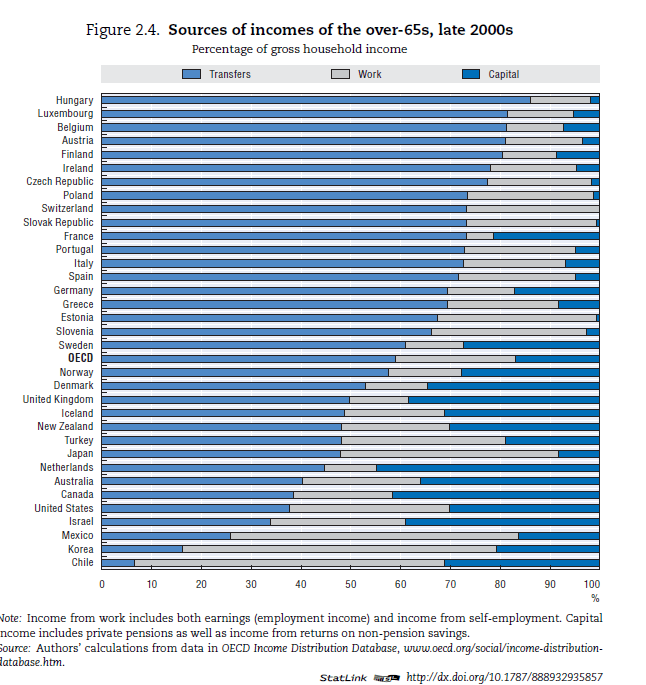
Sources of Income for Senior Citizens In OECD Countries

In the U.S., the social security check received each month is the most reliable and top source of income for senior citizens in retirement. Despite all the attacks on the social security system, majority of the retired Americans depend on Uncle Sam for their survival. Other sources of income for retired persons include pension from their employer and income from their own private investments.

In general, what are the sources of income for senior citizens in OCED countries? The following chart provides the answer:

Click to enlarge

Sources of Income for Senior Citizens in OECD Countries


Source: Pensions at a Glance 2013, OECD

“Transfer” in the chart denotes pensions provided by the state, “Work” means income derived from their former employer and “Capital” simply means an individual’s own private sources of income.

Countries such as Finland, Austria and Belgium have high public pensions.Senior citizens in the U.S. receive lower public pension (i.e. social security) than the average for OECD nations. The difference in the sources of income between Senior citizens in the U.S. and France are interesting. From the OECD report:

Alternatively, later retirement ages may be the main factor. In 2010, for example, the share of income from work was relatively high in the United States where the normal pension age is over 65. In France, by contrast, where workers who had contributed for 41 years could still retire at the age of 60 in 2010, income from work accounted for less than 10% of old people’s incomes.