Two Charts on MENA Markets

The MENA region includes countries in the Middle East and North Africa. MENA markets are classified as frontier markets and are rich in natural resources particularly oil and natural gas. As the price of oil has plunged some of these countries are better prepared to weather this downturn than others. The following chart shows that some of these countries have levels of reserves and low government debt:

Click to enlarge

High-Reserves of MENA COuntries

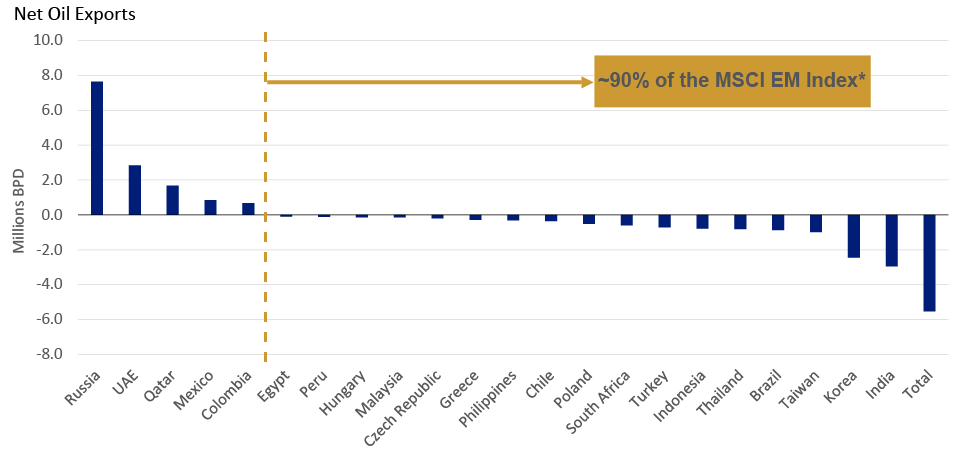
While we group MENA as one region, there are wide differences between the individual countries. Oil is a significant driver of the economy only in six of the countries. The remaining five countries in MENA are oil importers. These countries should benefit from lower oil crisis.

MENA Oil Importers and Exporters

Source: MENA Markets: More Than Just About Oil,  Franklin Templeton Investments

Related ETFs:

  • SPDR S&P Emerging Middle East & Africa ETF (GAF)
  • Market Vectors Gulf States ETF (MES)

Disclosure: No Positions

Billion Dollar Startups Founded By Immigrants

Immigrants are some of the largest successful community in the U.S. Highly educated and skilled immigrants dominate the high-tech industry in the U.S. especially in Silicon Valley. Many of the well-known startup success stories were founded by immigrants. Unlike other countries plenty of American venture capital firms are willing to bet on the next great startup.

According to a research report:

The research finds that among the billion dollar startup companies, immigrant founders have created an average of approximately 760 jobs per company in the United States. The collective value of the 44 immigrant-founded companies is $168 billion, which is close to half the value of the stock markets of Russia or Mexico.

Among the countries where immigrants came from and founded billion dollar startups, the top three countries are India, Canada and the UK.

The following table shows the startups with the high number of jobs created:

Click to enlarge

Immigrant Startups and Jobs Created

Source: Immigrants and Billion Dollar Startups by Stuart Anderson, National Foundation for American Policy, Mar 2016

Tesla’s (TSLA)founder Elon Musk is an immigrant and so is Garrett Camp, the co-founder of Uber.

The full report is worth a review as it contains many other fascinating details.

Disclosure: No Positions

Top Trade Partners of U.K.

The OECD has released a report arguing against UK’s exit from the European Union. The report states that exiting the EU would lead to a decline in British GDP in the future with economic growth stunted.

From the report:

Membership of the European Union has contributed to the economic prosperity of the United Kingdom. Uncertainty about the outcome of the referendum has already started to weaken growth in the United Kingdom. A UK exit (Brexit) would be a major negative shock to the UK economy, with economic fallout in the rest of the OECD, particularly other European countries. In some respects, Brexit would be akin to a tax on GDP, imposing a persistent and rising cost on the economy that would not be incurred if the UK remained in the EU.

By 2020, GDP would be over 3% smaller than otherwise (with continued EU membership), equivalent to a cost per household of GBP 2200 (in today’s prices). In the longer term, structural impacts would take hold through the channels of capital, immigration and lower technical progress. In particular, labour productivity would be held back by a drop in foreign direct investment and a smaller pool of skills. The extent of foregone GDP would increase over time. By 2030, in a central scenario GDP would be over 5% lower than otherwise – with the cost of Brexit  equivalent to GBP 3200 per household (in today’s prices). The effects would be even larger in a more pessimistic scenario and remain negative even in the optimistic scenario. Brexit would also hold back GDP in other European economies, particularly in the near term resulting from heightened uncertainty would create about the future of Europe. In contrast, continued UK membership in the European Union and further reforms of the Single Market would enhance living standards on both sides of the Channel.‌

Source: The Economic Consequences of Brexit: A Taxing Decision. OECD

The British economy will suffer due to a Brexit since trade relationship between the EU and the UK is high. The chart below shows the top trade partners of the UK:

Click to enlarge

UK Trade Partners

Source: Schroders Economic and Strategy Viewpoint, Schroders

The EU is the largest export market for the UK followed by the U.S. About 45% of British exports go to the EU. Britain’s export to China is just 3.3%. On the imports side, the EU is the largest source of British imports.

Chart: IKEA – Number of Stores and Top Countries for Sales

Swedish retailer IKEA is the world’s largest furniture chain. Similar to successful global retail chains such as Walmart, Tesco, Carrefour, etc. IKEA has a loyal following in the countries it operates. Here is a neat chart that shows some key facts about IKEA:

Click to enlarge

IKEA Sales and Top Countries Chart


Source: IKEA’s India Bet Runs Into Thicket of Rules, WSJ, Feb 23, 2016

Update:

Related posts:

The Number of IKEA Stores per Capita by Country: Chart

On The Current Valuation of India Stock Market

The Indian equity market is under-performing so far this year. The benchmark S&P Sensex index is down 2% year-to-date compared to S&P 500’s gain of 1.05%. Among emerging markets China is down much higher than India but Brazil is up by about 24% as Brazilian equities are recovering due to clarity on the political crisis there.

From an investment perspective, are Indian stocks cheap or expensive now?

According to an article by Sukumar Rajah at Franklin Templeton Investments, valuations of Indian equities currently are around long-term averages as the chart shows below. The previous peak of 20.9 for the S&P Sensex is unlikely to be reached again unless corporate earnings improve.

Click to enlarge

India Sensex Long-term Valuations Chart

Source: How India Is Stepping Out of China’s Shadow, Sukumar Rajah, Franklin Templeton Investments, April 28, 2016

The easiest way to invest in India is via ETFs as only a handful of companies trade on the US exchanges.

As an emerging market, Indian stocks can be very volatile. So an investor should perform a deep analysis before jumping into any individual equity. ETFs on the other hand offer a safer option since they can contain a basket of securities.

Investors looking for income opportunities should avoid India since dividend culture is yet to be adopted by many firms and Indian firms are not known for sharing their wealth with investors. The current dividend yield on the S&P Sensex is just 1.6%.  Other emerging markets in Asia such as Thailand, Indonesia, etc. offer much higher yields of 3 to 4%. As a developing country one would expect Indian firms to offer higher dividend payouts to investors to attract capital. However that is not the case.

In summary, invest in Indian stocks for mostly capital appreciation.

ETFs: The Complete List of India ETFs and ETNs Trading on the US Markets