GDP per Capita: Select Developed vs. Emerging Countries

Emerging markets have still a long way to go before they catch up with developed markets in terms of GDP per capita. This figure is calculated by taking the overall GDP of a country and dividing it up for each individual in the country.

Despite explosive growth in emerging markets in the past few decades, the GDP per capita in those countries as still low relative to developed markets. For example, Germany’s GDP per capita is over $40,000 but China’s GDP is still under $10,000. China was and is still considered one of the top fast growing emerging countries. Hence most people in China are still poor financially speaking relative to developed countries.

Click to enlarge
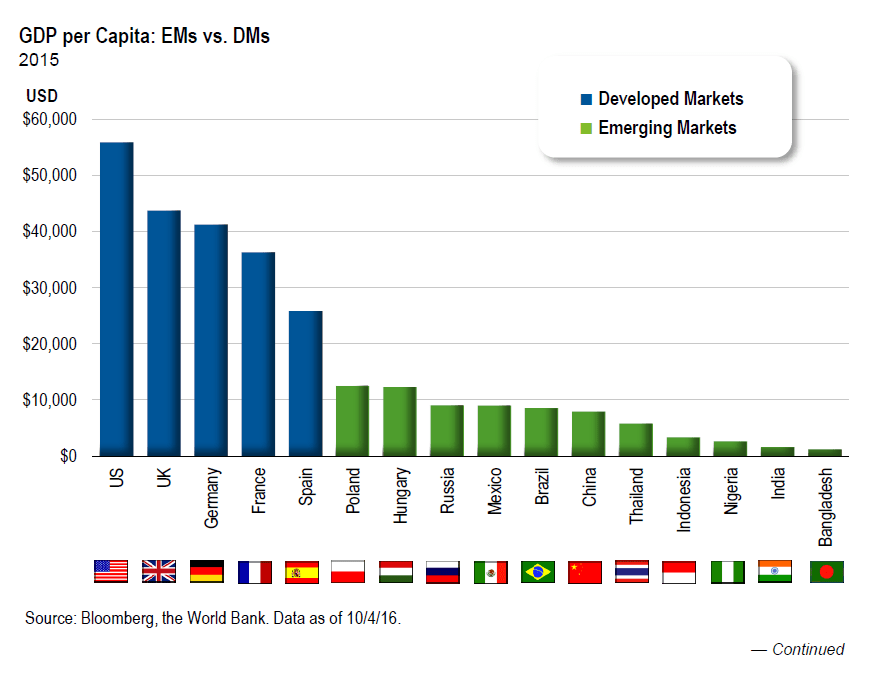
gdp-per-capita-developed-vs-emerging-countries

Takeaway for investors:

Because emerging countries have lower GDP per capita investors should not assume that people in those countries would be able to consume goods and services like those residing in developed countries. So for instance, though someone in the US may easily spend $4 or $5 for a cappucino at Starbucks(SBUX), the same may not be true in Brazil, China, India, Indonesia, etc. That does not mean nobody can afford to spend that much on a coffee in those countries. It is just the majority of the population cannot afford to spend that much on a coffee. Hence investors must consider carefully before investing in developed world companies that cater to emerging market consumers.

Source: 2017 GLOBAL INVESTMENT OUTLOOK, Franklin Templeton Investments

Disclosure: No Positions

Knowledge is Power: Successful Investor Habits, World’s Safest Banks 2016, US Stock Valuation Edition

Earlier:
Knowledge is Power: Monopsony, Coal, Anti-Globalization Edition (TFS)

train-in-wales-uk
Train in Wales, UK

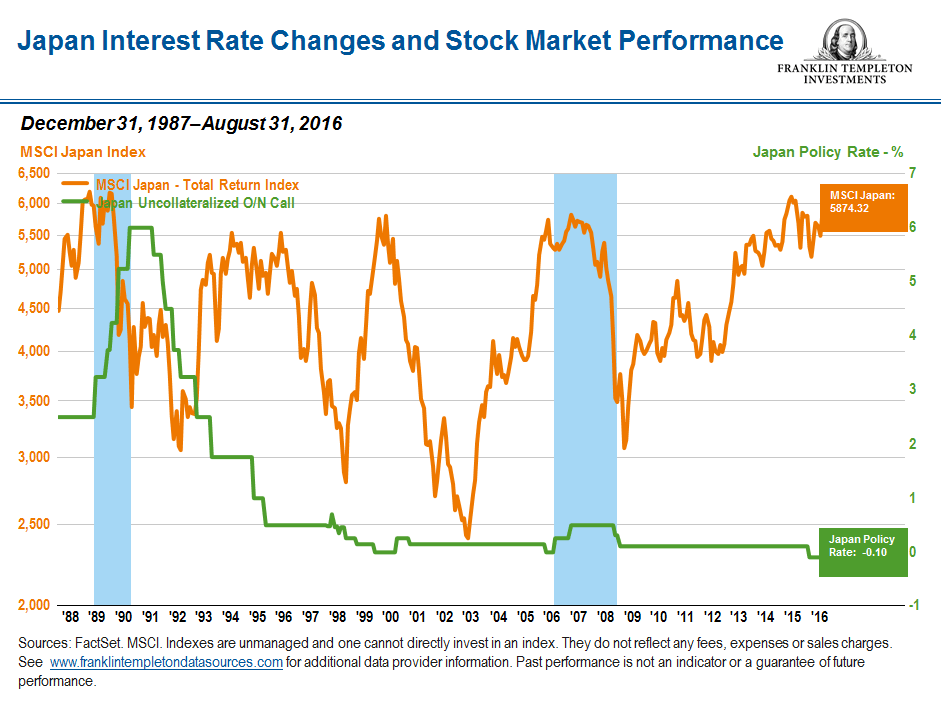
Japan: The Relationship Between Interest Rates And Stock Market Performance

The impact of falling and rising interest rates on equity markets vary by country. Stocks do not always rise when interest rates fall and vice versa. In the case of Japan, an article by Franklin Templeton Investments noted that falling interest rates did not lead to positive long-term performance of the equity markets.

The benchmark index topped out at over 37,000 in Jan, 1990. This past Friday it closed at 18.381. So after more than 25 years the Nikkei is still lower than where it was back then. Anyone who bought stocks at that peak are still sitting on a loss.

The chart below shows the changes in interest rates and the equity market performance using the MSCI Japan Total Return Index:

Click to enlarge

msci-japan-index-vs-interest-rate

From the article:

The BOJ has become a top shareholder in the one of the world’s largest equity markets and already is one of the top five owners of 81 companies listed on Japan’s Nikkei 225 Index.2 The central bank is also on its way to becoming the number one shareholder of more than 50 of those firms, according to various estimates. Market bulls are happy with the BOJ purchases, but opponents say the central bank is artificially inflating valuations and ironically discouraging companies from becoming more efficient. Interestingly, Japan’s Nikkei 225 Stock Average is actually down more than 8% year-to-date, although one might argue its fate could have been worse without central-bank buying.3

2. Ibid.

3. Source: Bloomberg, as of November 1, 2016. Indexes are unmanaged and one cannot directly invest in an index. They do not reflect any fees, expenses or sales charges.

Source: Central Banks and Stock Markets: a BOJ Case Study,  Franklin Templeton Investments, November 22, 2016

A few points to remember about the Japan equity market:

  • Foreign investors are big owners in the domestic stock market. So stocks tend to follow the whims of these investors. So in this scenario, Japan is more of an emerging or frontier market than a developed market like the UK, Canada, USA, etc.
  • Retail investor participation in Japan is very low by developed market standards. So years of stocks going nowhere does not affect the average citizen.
  • Japanese companies tend to give lower priority to shareholders than other stakeholders.
  • Dividend yields of stocks also are low relative to other major markets. The dividend for the Nikkei was just 1.83% in July, 2016.

Related ETFs:

  • iShares MSCI Japan ETF (EWJ)

Disclosure: No Positions


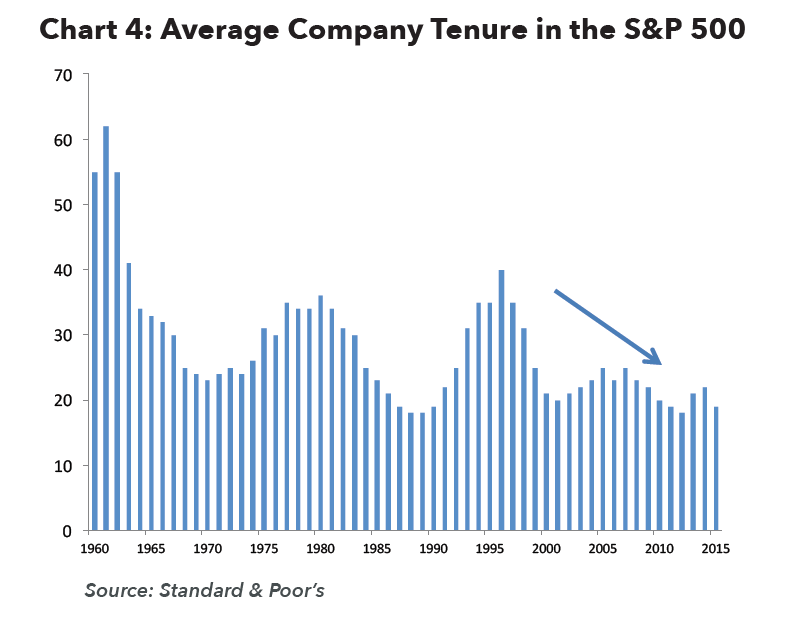
The Average Tenure of a Company in the S&P 500 Index

cThe average tenure of a company in the S&P 500 Index has declined consistently for years now. The average tenure has fallen from 40 years to less than 20 years now.

Average Tenure of a company in the S&P 500:

Click to enlarge

average-company-tenure-in-the-sp-500-chart

Source: Navigating Macro Choppiness, The Fiduciary Group

Companies get booted out of the benchmark for many reasons including going bankrupt, mergers & acquisitions, going private, technological advancements, etc. The only change in the index is constant. For example, companies tech firms like Apple(AAPL), Amazon(AMZN), Facebook(FB), are in the top 10 constituents of the S&P 500 today. However they may or may not exist in the index 20 or 30 years now as competitors can unseat them or they can be made irrelevant by newer technologies. Things like social media may be hot now but may be totally forgotten 20 years from now as consumers eventually move on to some other fad.

Related ETF:

  • SPDR S&P 500 ETF (SPY)

Disclosure: No Positions

US Unemployment Rate vs. Labor Force Participation Rate

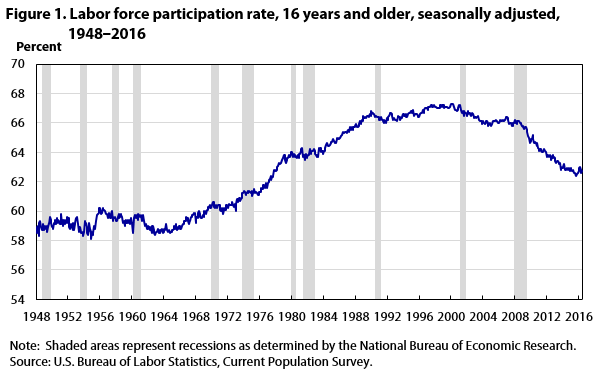
The US Unemployment Rate has been on the decline for many months now. But the Labor Force Participation Rate has also been declining. The unemployment rate stood at just 4.9% in October and the number of unemployed persons was 7.8  million according to the official data from BLS.

The labor force participation rate at 67.3% in early 2000. Since then the rate has dropped  and reached 62.7% in mid-2016. The chart below shows the slow and steady downward trend:

Click to enlarge

labor-force-participation-rate

Source: BLS

Higher labor participation rates implies more people able to work are employed. In general, the higher this rate the better for the economy.

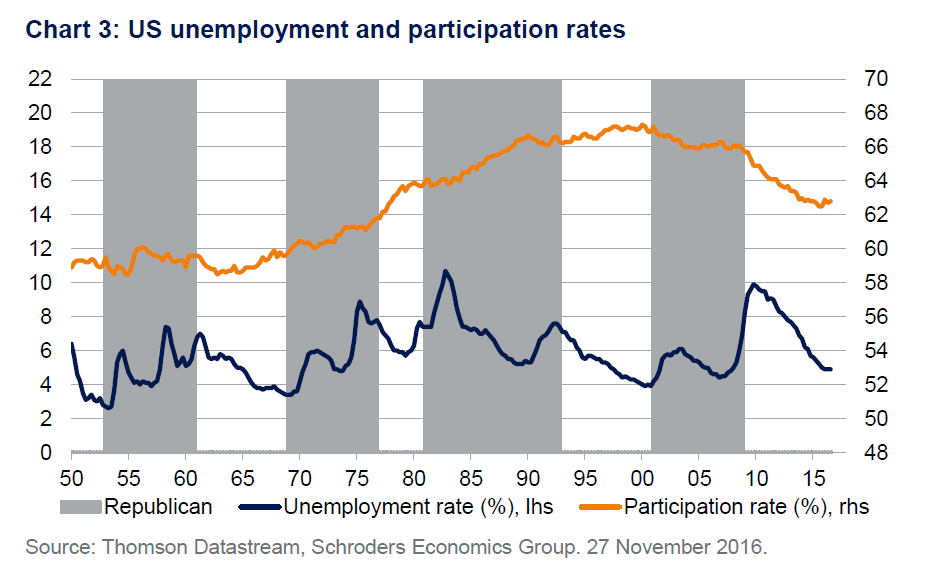
So how does a chart look like when we plot the unemployment rate against labor force participation rate?

Click to enlarge

unemployment-rate-vs-labor-force-participation-rates

Source: Schroder’s

The above chart shows that both the rates have decreased. The official unemployment is very low because of the methodology used to calculate that figure. For example, any unemployed person who has given up looking for a job are not counted. So these are the “missing” unemployed workers who fall off the radar. So the real unemployment rate is much higher.

The labor force participation rate an decrease for many reasons including lesser women wanting to be in the work force. But the chart showing the decline is stepper and repeats year after year. This should a cause for concern for policy makers.